Qatar Dyestuff For Cotton Market Size, Share & Growth Rate
The Qatar Dyestuff For Cotton Market was estimated at USD 438 Million in 2025 and is projected to reach USD 579 Million by 2032, growing at a CAGR of 4.1% from 2026 to 2032. This growth trajectory is driven primarily by the expanding textile industry, which continues to modernize and innovate in response to both domestic and international demand. The increasing focus on high-quality, vibrant cotton textiles further fuels the need for advanced dyestuffs that meet rigorous environmental and aesthetic standards.
Qatar Dyestuff For Cotton Market Year-wise Growth Rate and Key Drivers
This graph highlights how the Qatar Dyestuff For Cotton Market has steadily grown over the years, supported by major growth factors.
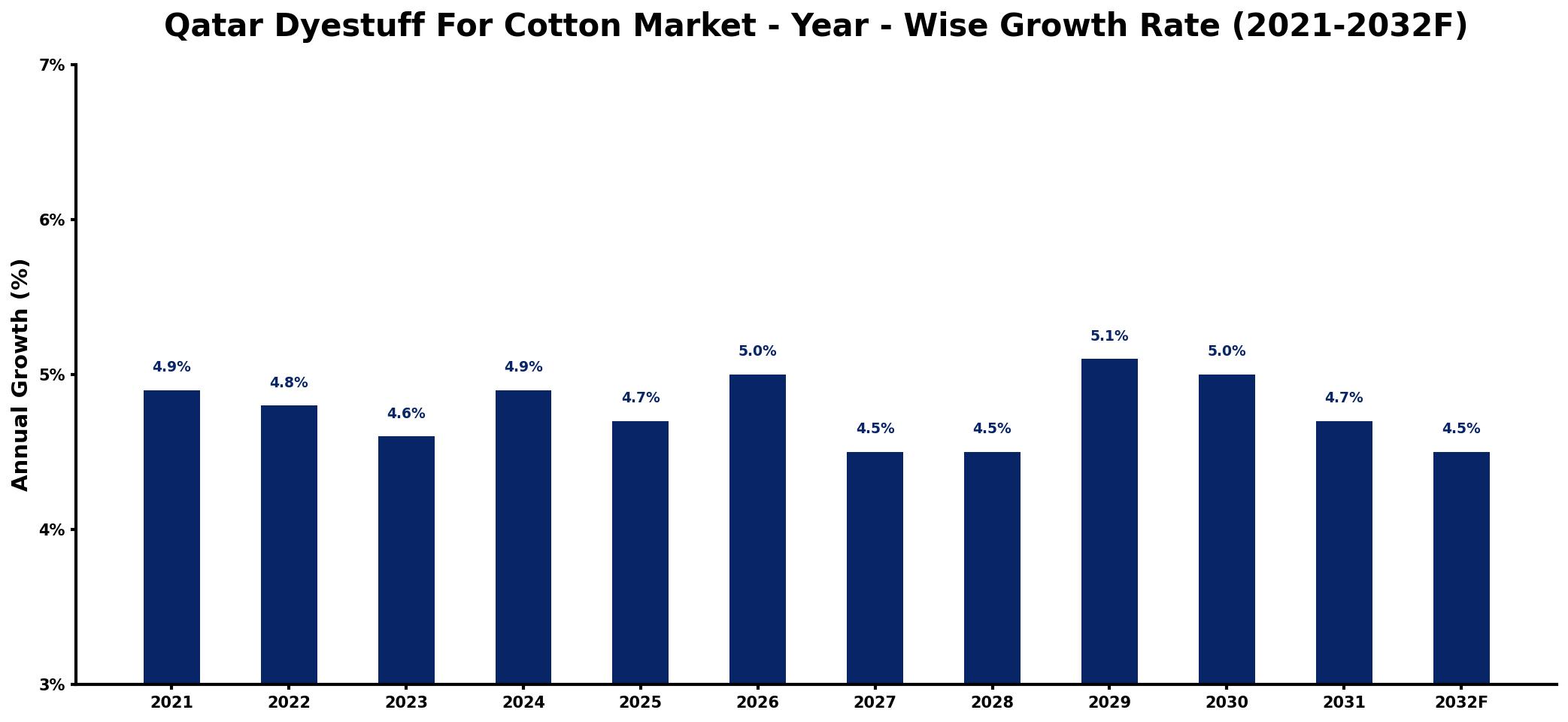
The table below presents the year‑wise growth rates along with the key drivers influencing the market
| Year | Growth Rate | Major Drivers |
| 2021 | 4.9% | Rising textile production capacity |
| 2022 | 4.8% | Increased export opportunities emerging |
| 2023 | 4.6% | Growing consumer fashion preferences |
| 2024 | 4.9% | Investment in sustainable practices |
| 2025 | 4.7% | Technological advancements in manufacturing |
| 2026 | 5.0% | Expansion of local production facilities |
| 2027 | 4.5% | Demand for eco-friendly alternatives |
| 2028 | 4.5% | Emerging markets driving consumption |
| 2029 | 5.1% | Innovations in color application techniques |
| 2030 | 5.0% | Strengthening regional trade agreements |
| 2031 | 4.7% | Enhanced supply chain efficiencies |
| 2032 | 4.5% | Collaborations with fashion designers |
Note: Market size estimations and growth projections presented in this report are based on 6Wresearch's proprietary forecasting methodology, utilizing the latest available industry data, government publications, and primary research inputs.
Qatar Dyestuff For Cotton Market Synopsis
The strongest force shaping the Qatar dyestuff for cotton market is the urgent demand for sustainable and eco-friendly dyeing solutions within the textile sector. As awareness of environmental issues grows, manufacturers are increasingly adopting practices that reduce the ecological footprint of their operations.
The expansion of the fashion and apparel industry in Qatar is another critical factor driving this market. With cotton remaining a preferred fabric choice, the need for dyestuffs that provide vibrant color while adhering to safety and environmental regulations is paramount, ensuring a robust market outlook.
Qatar Dyestuff For Cotton Market Key Takeaways
- Growth driven by modernization in the textile sector and increased demand for cotton fabrics.
- Sustainability concerns are prompting the shift towards eco-friendly dyestuffs.
- The recovery from COVID-19 is leading to a resurgence in consumer demand.
- Quality control remains essential for manufacturers to meet market expectations.
- Innovation in dyeing technologies is shaping the future of the market.
Evaluation of Restraints in Qatar Dyestuff For Cotton Market
Despite its promising outlook, the Qatar dyestuff for cotton market faces real constraints that could inhibit growth. Ensuring consistent quality and safety across all dyestuff products is imperative, as the textile industry demands high-performance dyes that yield vibrant and long-lasting colors. Compliance with both local and international regulatory standards presents additional challenges for manufacturers. Moreover, the need to develop eco-friendly solutions is becoming more pressing, compelling companies to innovate while balancing cost-effectiveness.
Qatar Dyestuff For Cotton Market Trends
Current trends in the Qatar dyestuff for cotton market include a pronounced shift towards sustainable dyeing processes that minimize environmental impact. The adoption of biodegradable and low-impact dyestuffs is gaining traction among manufacturers aiming to attract eco-conscious consumers. Additionally, there is a growing interest in digital dyeing technologies, which offer precise color application while reducing water and chemical usage. These trends not only cater to market demands but also align with the global movement towards sustainable fashion.
Qatar Dyestuff For Cotton Market Opportunities
There is significant potential for growth and investment in the Qatar dyestuff for cotton market, particularly in the area of sustainable product development. Companies that can innovate eco-friendly dyestuff solutions will find ample opportunities as consumer preferences continue to evolve. Additionally, partnerships between dyestuff manufacturers and textile producers may enhance market dynamics, facilitating a more seamless integration of sustainable practices into the production process. Export opportunities are also on the rise, as Qatar positions itself as a competitive player in the global textiles market.
Government Initiatives in the Qatar Dyestuff For Cotton Market
The Qatari government has introduced various initiatives to support the textile industry and promote sustainability within it. Policies favoring environmentally friendly practices and investments in advanced manufacturing technologies are designed to bolster local production. Additionally, public spending on research and development for sustainable materials and processes contributes to the growth of the dyestuff market. These initiatives aim to position Qatar as a leader in high-quality textile production while adhering to global environmental standards.
Future Insights of the Qatar Dyestuff For Cotton Market
Looking ahead to 2026-2032, the Qatar dyestuff for cotton market is expected to flourish as innovations in dyeing technology continue to emerge. The increasing emphasis on sustainability will drive demand for eco-friendly dyestuffs, shaping product development strategies for manufacturers. Furthermore, as the global textile industry evolves, Qatars textile sector may adapt by enhancing its export capabilities, leveraging the region's unique cultural heritage to develop niche markets for cotton textiles. The overall outlook remains optimistic, with an emphasis on resilience and adaptability in a changing market landscape.
Qatar Dyestuff For Cotton Market Latest Developments (2025 - 2026)
Recent developments within the Qatar dyestuff for cotton market highlight a shift towards more sustainable production practices. Companies are increasingly investing in research to innovate low-impact dyestuffs and improve overall dyeing efficiency. Collaborations between dyestuff producers and textile manufacturers have also increased, focusing on creating tailored solutions that meet emerging consumer demands. As market players recover from previous disruptions, a renewed focus on digitalization and process optimization is becoming evident.
Qatar Dyestuff For Cotton Market - Key Attractiveness of the Report
- 10 Years of Market Numbers
- Historical Data Starting from 2022 to 2025
- Base Year: 2025
- Forecast Data until 2032
- Key Performance Indicators Impacting the Market
- Major Upcoming Developments and Projects
Key Highlights of the Report:
- Qatar Dyestuff For Cotton Market Outlook
- Market Size of Qatar Dyestuff For Cotton Market, 2025
- Forecast of Qatar Dyestuff For Cotton Market, 2032
- Historical Data and Forecast of Qatar Dyestuff For Cotton Revenues & Volume for the Period 2022-2032F
- Qatar Dyestuff For Cotton Market Trend Evolution
- Qatar Dyestuff For Cotton Market Drivers and Challenges
- Qatar Dyestuff For Cotton Price Trends
- Qatar Dyestuff For Cotton Porter's Five Forces
- Qatar Dyestuff For Cotton Industry Life Cycle
- Historical Data and Forecast of Qatar Dyestuff For Cotton Market Revenues & Volume By Types for the Period 2022-2032F
- Historical Data and Forecast of Qatar Dyestuff For Cotton Market Revenues & Volume By Reactive Dyes for the Period 2022-2032F
- Historical Data and Forecast of Qatar Dyestuff For Cotton Market Revenues & Volume By Disperse Dyes for the Period 2022-2032F
- Historical Data and Forecast of Qatar Dyestuff For Cotton Market Revenues & Volume By Direct Dyes for the Period 2022-2032F
- Historical Data and Forecast of Qatar Dyestuff For Cotton Market Revenues & Volume By Sulfur Dyes for the Period 2022-2032F
- Historical Data and Forecast of Qatar Dyestuff For Cotton Market Revenues & Volume By Optical Brighteners for the Period 2022-2032F
- Historical Data and Forecast of Qatar Dyestuff For Cotton Market Revenues & Volume By Applications for the Period 2022-2032F
- Historical Data and Forecast of Qatar Dyestuff For Cotton Market Revenues & Volume By Non-Woven for the Period 2022-2032F
- Historical Data and Forecast of Qatar Dyestuff For Cotton Market Revenues & Volume By Health Care for the Period 2022-2032F
- Historical Data and Forecast of Qatar Dyestuff For Cotton Market Revenues & Volume By Personal Care for the Period 2022-2032F
- Historical Data and Forecast of Qatar Dyestuff For Cotton Market Revenues & Volume By Others for the Period 2022-2032F
- Qatar Dyestuff For Cotton Import Export Trade Statistics
- Market Opportunity Assessment By Types
- Market Opportunity Assessment By Applications
- Qatar Dyestuff For Cotton Top Companies Market Share
- Qatar Dyestuff For Cotton Competitive Benchmarking By Technical and Operational Parameters
- Qatar Dyestuff For Cotton Company Profiles
- Qatar Dyestuff For Cotton Key Strategic Recommendations






































