Qatar Elbow Fixators Market Size, Share & Growth Rate
The Qatar Elbow Fixators Market was estimated at USD 234 Million in 2025 and is projected to reach USD 315 Million by 2032, growing at a CAGR of 4.3% from 2026 to 2032. This growth trajectory is primarily driven by an increasing prevalence of elbow injuries due to sports and recreational activities, alongside a rapidly aging population requiring orthopedic solutions. Additionally, advancements in surgical techniques and medical technology further stimulate the demand for innovative elbow fixators within the evolving healthcare landscape of Qatar.
Qatar Elbow Fixators Market Year-wise Growth Rate and Key Drivers
This graph highlights how the Qatar Elbow Fixators Market has steadily grown over the years, supported by major growth factors.
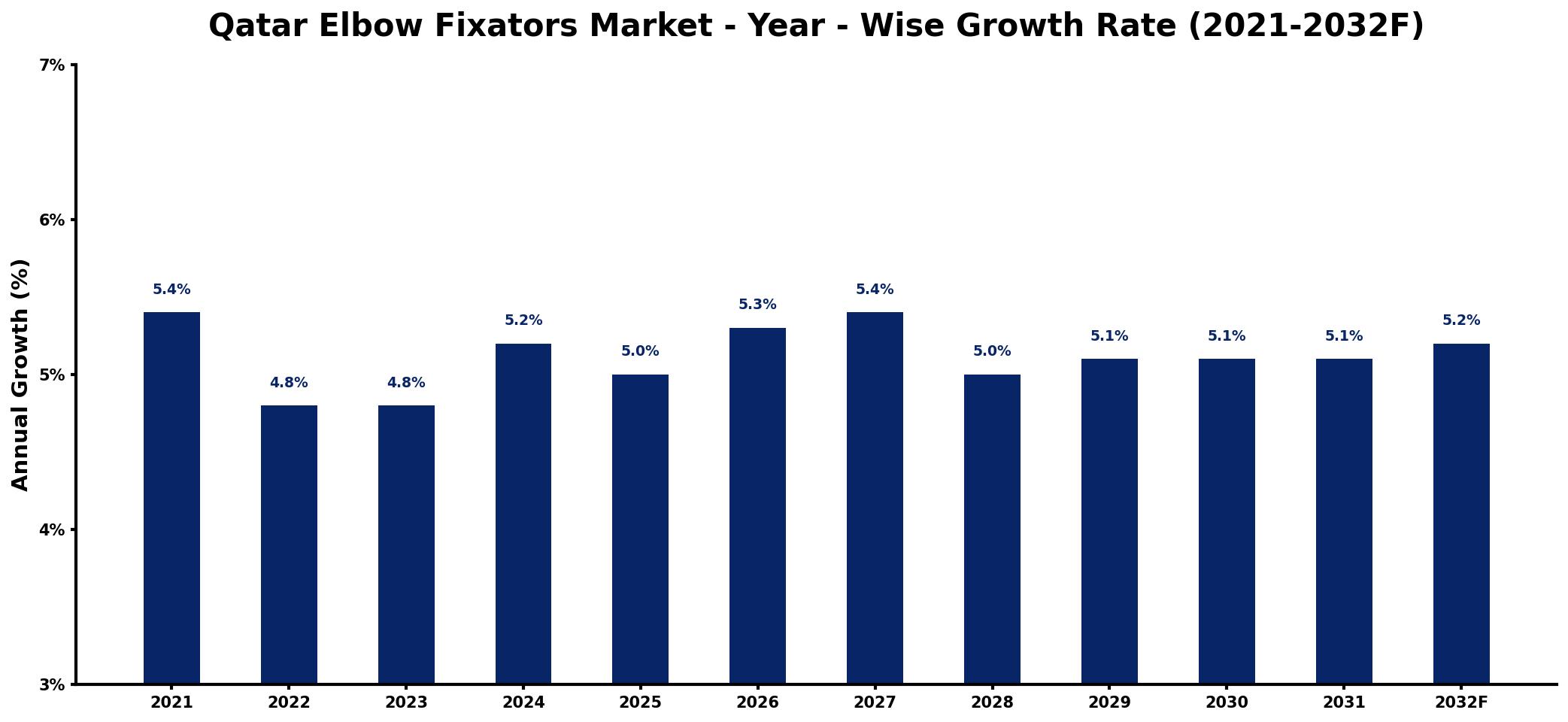
The table below presents the year‑wise growth rates along with the key drivers influencing the market
| Year | Growth Rate | Major Drivers |
| 2021 | 5.4% | Increased healthcare infrastructure investments |
| 2022 | 4.8% | Growing adoption of orthopedic technologies |
| 2023 | 4.8% | Rising prevalence of sports injuries |
| 2024 | 5.2% | Expansion of surgical procedures availability |
| 2025 | 5.0% | Increased demand for outpatient services |
| 2026 | 5.3% | Advancements in minimally invasive techniques |
| 2027 | 5.4% | Heightened focus on rehabilitation programs |
| 2028 | 5.0% | Surge in aging population demographics |
| 2029 | 5.1% | Enhanced healthcare accessibility initiatives |
| 2030 | 5.1% | Growth in medical tourism sector |
| 2031 | 5.1% | Rising awareness of orthopedic solutions |
| 2032 | 5.2% | Increased collaboration among healthcare providers |
Note: Market size estimations and growth projections presented in this report are based on 6Wresearch's proprietary forecasting methodology, utilizing the latest available industry data, government publications, and primary research inputs.
Qatar Elbow Fixators Market Synopsis
The most significant force shaping the Qatar Elbow Fixators Market today is the urgent need for effective orthopedic solutions that address rising cases of trauma and injury. With the healthcare infrastructure expanding rapidly, the market is poised for substantial growth as providers seek to enhance their offerings of high-quality fixators.
As sports participation increases among various age groups in Qatar, the incidence of elbow-related injuries is also on the rise. This creates a robust demand for specialized orthopedic devices, fostering innovation and product development within the elbow fixators segment.
Qatar Elbow Fixators Market Key Takeaways
- Significant growth is anticipated in the elbow fixators market, fueled by an aging population and increasing sports injuries.
- Technological advancements in medical devices and surgical techniques are enhancing the effectiveness of elbow fixators.
- The ongoing expansion of Qatar's healthcare sector is creating greater access to advanced orthopedic solutions.
- Regulatory complexities in the medical device sector pose challenges for market entry and development.
- COVID-19 has temporarily impacted elective procedures, but the market is on a recovery path as healthcare normalizes.
Evaluation of Restraints in Qatar Elbow Fixators Market
The Qatar Elbow Fixators Market faces several challenges that limit its potential. One primary restraint is the relatively small patient base for specialized orthopedic devices, which restricts sales volumes and market penetration for local manufacturers. Furthermore, stringent regulatory requirements complicate product development and approval processes, making it difficult for new entrants to navigate the market effectively. Additionally, international competition from established medical device manufacturers can pose significant challenges for local firms striving to gain market share.
Qatar Elbow Fixators Market Trends
Current trends in the Qatar Elbow Fixators Market include an increasing emphasis on product innovation, particularly in materials and design, to enhance the durability and functionality of elbow fixators. The shift towards minimally invasive surgical techniques is driving demand for advanced fixator systems that facilitate quicker recovery times. Furthermore, there is a growing focus on patient-centered care, leading to the development of customized solutions tailored to individual patient needs, which reflects an evolving approach to orthopedic treatment.
Qatar Elbow Fixators Market Opportunities
There exists considerable growth potential in the Qatar Elbow Fixators Market, particularly through investment in research and development for next-generation fixators that integrate smart technologies. As healthcare providers increasingly prioritize quality and efficacy, opportunities for collaboration between manufacturers and healthcare institutions can lead to improved treatment outcomes. Moreover, expanding outreach programs aimed at educating the population about elbow injuries and treatment options can further stimulate demand for elbow fixators.
Government Initiatives in the Qatar Elbow Fixators Market
The Qatari government has been actively investing in the healthcare sector, aiming to enhance the quality and accessibility of orthopedic services. Initiatives include funding for healthcare infrastructure improvements and the promotion of partnerships between public and private healthcare sectors. Additionally, government regulations are evolving to support innovative medical technologies, which could benefit local manufacturers of elbow fixators by streamlining approval processes and fostering a competitive market environment.
Future Insights of the Qatar Elbow Fixators Market
Looking ahead to the period from 2026 to 2032, the Qatar Elbow Fixators Market is expected to experience steady growth driven by continued advancements in technology and an increasing focus on patient safety and outcomes. The emphasis on preventative care and early intervention for elbow injuries will likely result in a higher demand for orthopedic devices. Moreover, as healthcare systems recover post-pandemic, elective surgeries, including elbow surgeries, will see a resurgence, contributing to the market's overall expansion.
Qatar Elbow Fixators Market Latest Developments (2025 - 2026)
In recent months, the Qatar Elbow Fixators Market has seen a surge in the introduction of innovative fixator designs that incorporate advanced materials to enhance patient comfort and surgical outcomes. Additionally, collaborations between local healthcare providers and international manufacturers have increased, facilitating knowledge transfer and technology sharing. Efforts to streamline the regulatory process for medical devices have also been initiated, promoting a more favorable environment for new entrants and existing players in the market.
Qatar Elbow Fixators Market - Key Attractiveness of the Report
- 10 Years of Market Numbers
- Historical Data Starting from 2022 to 2025
- Base Year: 2025
- Forecast Data until 2032
- Key Performance Indicators Impacting the Market
- Major Upcoming Developments and Projects
Key Highlights of the Report:
- Qatar Elbow Fixators Market Outlook
- Market Size of Qatar Elbow Fixators Market, 2025
- Forecast of Qatar Elbow Fixators Market, 2032
- Historical Data and Forecast of Qatar Elbow Fixators Revenues & Volume for the Period 2022-2032F
- Qatar Elbow Fixators Market Trend Evolution
- Qatar Elbow Fixators Market Drivers and Challenges
- Qatar Elbow Fixators Price Trends
- Qatar Elbow Fixators Porter's Five Forces
- Qatar Elbow Fixators Industry Life Cycle
- Historical Data and Forecast of Qatar Elbow Fixators Market Revenues & Volume By Product Type for the Period 2022-2032F
- Historical Data and Forecast of Qatar Elbow Fixators Market Revenues & Volume By Circular Fixators for the Period 2022-2032F
- Historical Data and Forecast of Qatar Elbow Fixators Market Revenues & Volume By Unilateral Fixators for the Period 2022-2032F
- Historical Data and Forecast of Qatar Elbow Fixators Market Revenues & Volume By Hybrid Fixators for the Period 2022-2032F
- Historical Data and Forecast of Qatar Elbow Fixators Market Revenues & Volume By Age Group for the Period 2022-2032F
- Historical Data and Forecast of Qatar Elbow Fixators Market Revenues & Volume By Adults for the Period 2022-2032F
- Historical Data and Forecast of Qatar Elbow Fixators Market Revenues & Volume By Pediatrics for the Period 2022-2032F
- Historical Data and Forecast of Qatar Elbow Fixators Market Revenues & Volume By Treatment Type for the Period 2022-2032F
- Historical Data and Forecast of Qatar Elbow Fixators Market Revenues & Volume By Surgical Fixators for the Period 2022-2032F
- Historical Data and Forecast of Qatar Elbow Fixators Market Revenues & Volume By Non-surgical Fixators for the Period 2022-2032F
- Historical Data and Forecast of Qatar Elbow Fixators Market Revenues & Volume By Fracture Type for the Period 2022-2032F
- Historical Data and Forecast of Qatar Elbow Fixators Market Revenues & Volume By Distal Humerus Fixators for the Period 2022-2032F
- Historical Data and Forecast of Qatar Elbow Fixators Market Revenues & Volume By Capitellum Fixators for the Period 2022-2032F
- Historical Data and Forecast of Qatar Elbow Fixators Market Revenues & Volume By Olecranon Fixators for the Period 2022-2032F
- Historical Data and Forecast of Qatar Elbow Fixators Market Revenues & Volume By Coronoid Fixators for the Period 2022-2032F
- Historical Data and Forecast of Qatar Elbow Fixators Market Revenues & Volume By End User for the Period 2022-2032F
- Historical Data and Forecast of Qatar Elbow Fixators Market Revenues & Volume By Hospitals for the Period 2022-2032F
- Historical Data and Forecast of Qatar Elbow Fixators Market Revenues & Volume By Ambulatory Surgical Centres for the Period 2022-2032F
- Historical Data and Forecast of Qatar Elbow Fixators Market Revenues & Volume By Specialty Clinics for the Period 2022-2032F
- Historical Data and Forecast of Qatar Elbow Fixators Market Revenues & Volume By Others for the Period 2022-2032F
- Qatar Elbow Fixators Import Export Trade Statistics
- Market Opportunity Assessment By Product Type
- Market Opportunity Assessment By Age Group
- Market Opportunity Assessment By Treatment Type
- Market Opportunity Assessment By Fracture Type
- Market Opportunity Assessment By End User
- Qatar Elbow Fixators Top Companies Market Share
- Qatar Elbow Fixators Competitive Benchmarking By Technical and Operational Parameters
- Qatar Elbow Fixators Company Profiles
- Qatar Elbow Fixators Key Strategic Recommendations






































