Qatar Fish Farming Market Size, Share & Growth Rate
The Qatar Fish Farming Market was estimated at USD 269 Million in 2025 and is projected to reach USD 379 Million by 2032, growing at a CAGR of 5.0% from 2026 to 2032. This growth is underpinned by a rising health consciousness among consumers favoring fish as a protein-rich dietary choice, along with strategic governmental support aimed at achieving self-sufficiency in seafood production. Enhanced investments in aquaculture, fueled by a diversification away from hydrocarbon reliance, further solidify the positive market trajectory.
Qatar Fish Farming Market Year-wise Growth Rate and Key Drivers
This graph highlights how the Qatar Fish Farming Market has steadily grown over the years, supported by major growth factors.
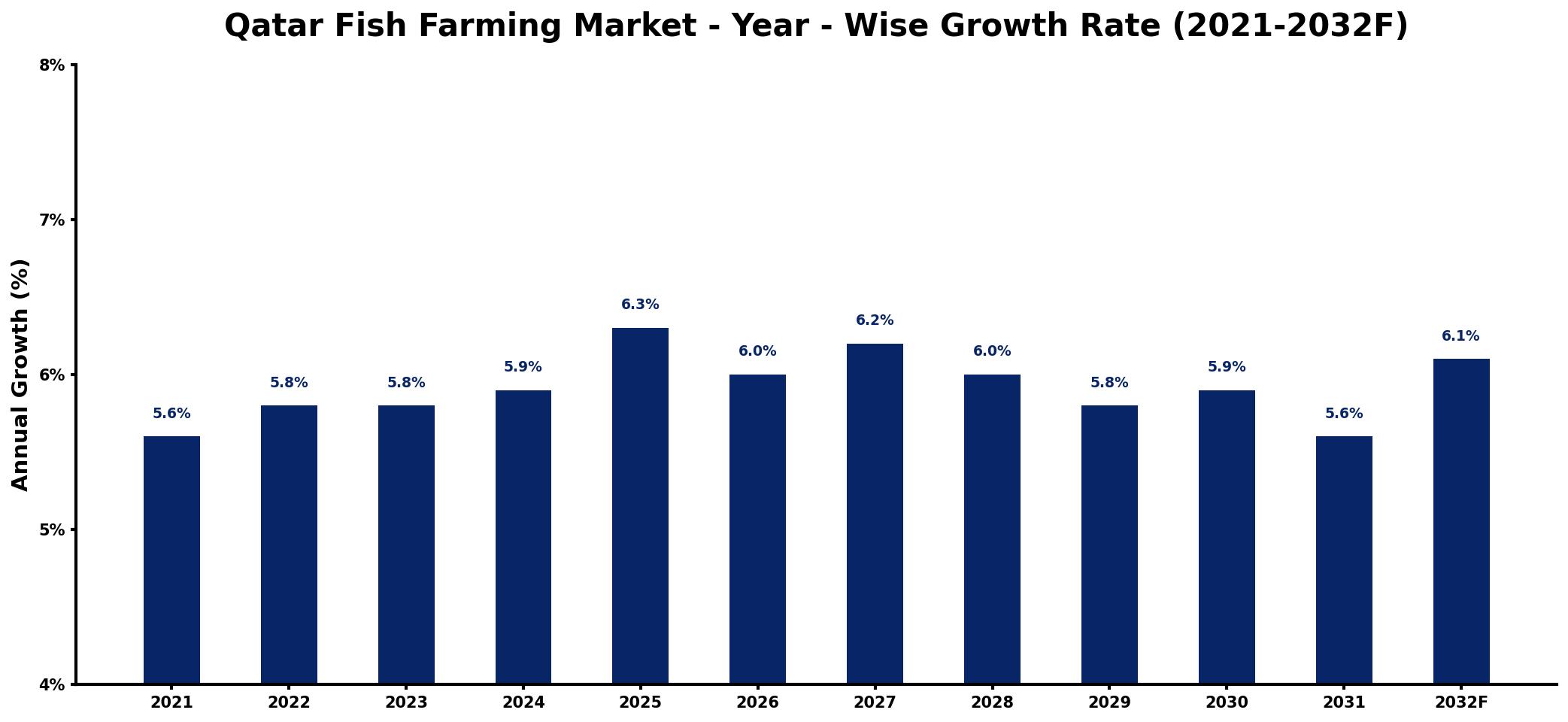
The table below presents the year‑wise growth rates along with the key drivers influencing the market
| Year | Growth Rate | Major Drivers |
| 2021 | 5.6% | Rising consumer health awareness |
| 2022 | 5.8% | Increased local production capacity |
| 2023 | 5.8% | Expansion of aquaculture technologies |
| 2024 | 5.9% | Growing export market opportunities |
| 2025 | 6.3% | Investment in sustainable practices |
| 2026 | 6.0% | Strengthening regulatory support framework |
| 2027 | 6.2% | Increased availability of feed resources |
| 2028 | 6.0% | Enhanced research and development initiatives |
| 2029 | 5.8% | Growing popularity of seafood diets |
| 2030 | 5.9% | rising end-use demand growth |
| 2031 | 5.6% | Diversification of product offerings |
| 2032 | 6.1% | Strengthened supply chain logistics |
Note: Market size estimations and growth projections presented in this report are based on 6Wresearch's proprietary forecasting methodology, utilizing the latest available industry data, government publications, and primary research inputs.
Qatar Fish Farming Market Synopsis
The strongest force shaping the Qatar fish farming market is the governments initiative to bolster local aquaculture as part of its broader economic diversification strategy. This push not only aims to enhance food security but also seeks to create a sustainable framework for the fisheries sector.
Furthermore, increasing consumer awareness regarding health benefits associated with fish consumption has significantly heightened demand for seafood products. Coupled with Qatar's geographical advantage as a distribution hub, these factors are collectively driving the expansion of the fish farming market.
Qatar Fish Farming Market Key Takeaways
- The market is projected to grow steadily, reaching USD 379 Million by 2032.
- Government initiatives are a significant driving force behind the sector's growth.
- Health trends are leading consumers towards a protein-rich fish-based diet.
- Strategic location facilitates the import and distribution of diverse fish products.
- Investment opportunities are on the rise, attracting entrepreneurs to the market.
Evaluation of Restraints in Qatar Fish Farming Market
Despite its growth potential, the Qatar fish farming market is not without challenges. One prominent restraint is the scarcity of freshwater resources, which complicates large-scale aquaculture initiatives in an arid climate. Moreover, the environmental sustainability of fish farming practices necessitates continuous investment in innovative technologies. Maintaining optimal health and quality standards for farmed fish in controlled environments remains a complex issue that demands specialized expertise. These factors collectively limit the market's scalability while necessitating strategic planning and management.
Qatar Fish Farming Market Trends
Emerging trends in the Qatar fish farming market include a growing emphasis on sustainable aquaculture practices. There is a marked shift towards adopting technology-driven solutions, such as automated feeding systems and water quality monitoring tools, enhancing productivity and fish health. Additionally, consumer preferences are evolving towards locally-sourced, organic fish products, prompting farmers to adopt more environmentally friendly practices. The market is also witnessing increased collaboration between private sectors and research institutions to foster innovation in fish farming.
Qatar Fish Farming Market Opportunities
Significant growth and investment opportunities lie in technological advancements within aquaculture. Innovations in recirculating aquaculture systems (RAS) present avenues for more efficient water use and sustainable fish farming. Additionally, the rising popularity of fish among health-conscious consumers paves the way for new product development, such as ready-to-cook fish meals and value-added seafood products. Entrepreneurs can leverage these trends by investing in vertical farming systems and integrating eco-friendly practices to attract a more discerning consumer base.
Government Initiatives in the Qatar Fish Farming Market
The Qatari government is actively implementing policies to enhance the fisheries sector. These initiatives include financial incentives for local fish farmers and support for innovative aquaculture technologies. Programs aimed at training and educating farmers in sustainable practices are also in place, encouraging self-sufficiency in seafood production. Furthermore, the government is promoting public-private partnerships to facilitate investment in the aquaculture sector, thereby ensuring a robust growth environment for the industry.
Future Insights of the Qatar Fish Farming Market
Looking ahead to 2026-2032, the Qatar fish farming market is poised for continued growth, driven by persistent demand for high-quality seafood and increased consumer advocacy for sustainable practices. The ongoing government commitment to diversify the economy will likely spur further investments in aquaculture infrastructure, enhancing overall production capacities. With a focus on technological innovation and market adaptation, the sector is well-positioned to meet evolving consumer needs while contributing to the nation's food security goals.
Qatar Fish Farming Market Latest Developments (2025 - 2026)
Recently, the Qatar fish farming sector has seen significant developments aimed at bolstering local production capacities and improving supply chain efficiencies. There has been a notable rise in partnerships between local aquaculture businesses and international technology firms, focusing on integrating advanced farming techniques. Additionally, community outreach programs have gained momentum, aimed at educating consumers about the benefits of locally-farmed fish. These efforts reflect a concerted push towards enhancing sustainability and meeting growing demand in the marketplace.
Qatar Fish Farming Market - Key Attractiveness of the Report
- 10 Years of Market Numbers
- Historical Data Starting from 2022 to 2025
- Base Year: 2025
- Forecast Data until 2032
- Key Performance Indicators Impacting the Market
- Major Upcoming Developments and Projects
Key Highlights of the Report:
- Qatar Fish Farming Market Outlook
- Market Size of Qatar Fish Farming Market, 2025
- Forecast of Qatar Fish Farming Market, 2032
- Historical Data and Forecast of Qatar Fish Farming Revenues & Volume for the Period 2022-2032F
- Qatar Fish Farming Market Trend Evolution
- Qatar Fish Farming Market Drivers and Challenges
- Qatar Fish Farming Price Trends
- Qatar Fish Farming Porter's Five Forces
- Qatar Fish Farming Industry Life Cycle
- Historical Data and Forecast of Qatar Fish Farming Market Revenues & Volume By Environment for the Period 2022-2032F
- Historical Data and Forecast of Qatar Fish Farming Market Revenues & Volume By Marine Water for the Period 2022-2032F
- Historical Data and Forecast of Qatar Fish Farming Market Revenues & Volume By Fresh Water for the Period 2022-2032F
- Historical Data and Forecast of Qatar Fish Farming Market Revenues & Volume By Brackish Water for the Period 2022-2032F
- Historical Data and Forecast of Qatar Fish Farming Market Revenues & Volume By Fish Type for the Period 2022-2032F
- Historical Data and Forecast of Qatar Fish Farming Market Revenues & Volume By Pompano for the Period 2022-2032F
- Historical Data and Forecast of Qatar Fish Farming Market Revenues & Volume By Snappers for the Period 2022-2032F
- Historical Data and Forecast of Qatar Fish Farming Market Revenues & Volume By Groupers for the Period 2022-2032F
- Historical Data and Forecast of Qatar Fish Farming Market Revenues & Volume By Salmon for the Period 2022-2032F
- Historical Data and Forecast of Qatar Fish Farming Market Revenues & Volume By Milkfish for the Period 2022-2032F
- Historical Data and Forecast of Qatar Fish Farming Market Revenues & Volume By Tuna for the Period 2022-2032F
- Historical Data and Forecast of Qatar Fish Farming Market Revenues & Volume By Tilapia for the Period 2022-2032F
- Historical Data and Forecast of Qatar Fish Farming Market Revenues & Volume By Others for the Period 2022-2032F
- Qatar Fish Farming Import Export Trade Statistics
- Market Opportunity Assessment By Environment
- Market Opportunity Assessment By Fish Type
- Qatar Fish Farming Top Companies Market Share
- Qatar Fish Farming Competitive Benchmarking By Technical and Operational Parameters
- Qatar Fish Farming Company Profiles
- Qatar Fish Farming Key Strategic Recommendations






































