Qatar Food Retail Market Summary
The qatar food retail market was estimated at USD 1226 Million in 2025 and is projected to reach USD 2136 Million by 2032, growing at a CAGR of 9.5% from 2026 to 2032.
Qatar Food Retail Market Year-wise Growth Rate and Key Drivers
This graph highlights how the Qatar Food Retail Market has steadily grown over the past five years, supported by major growth factors.
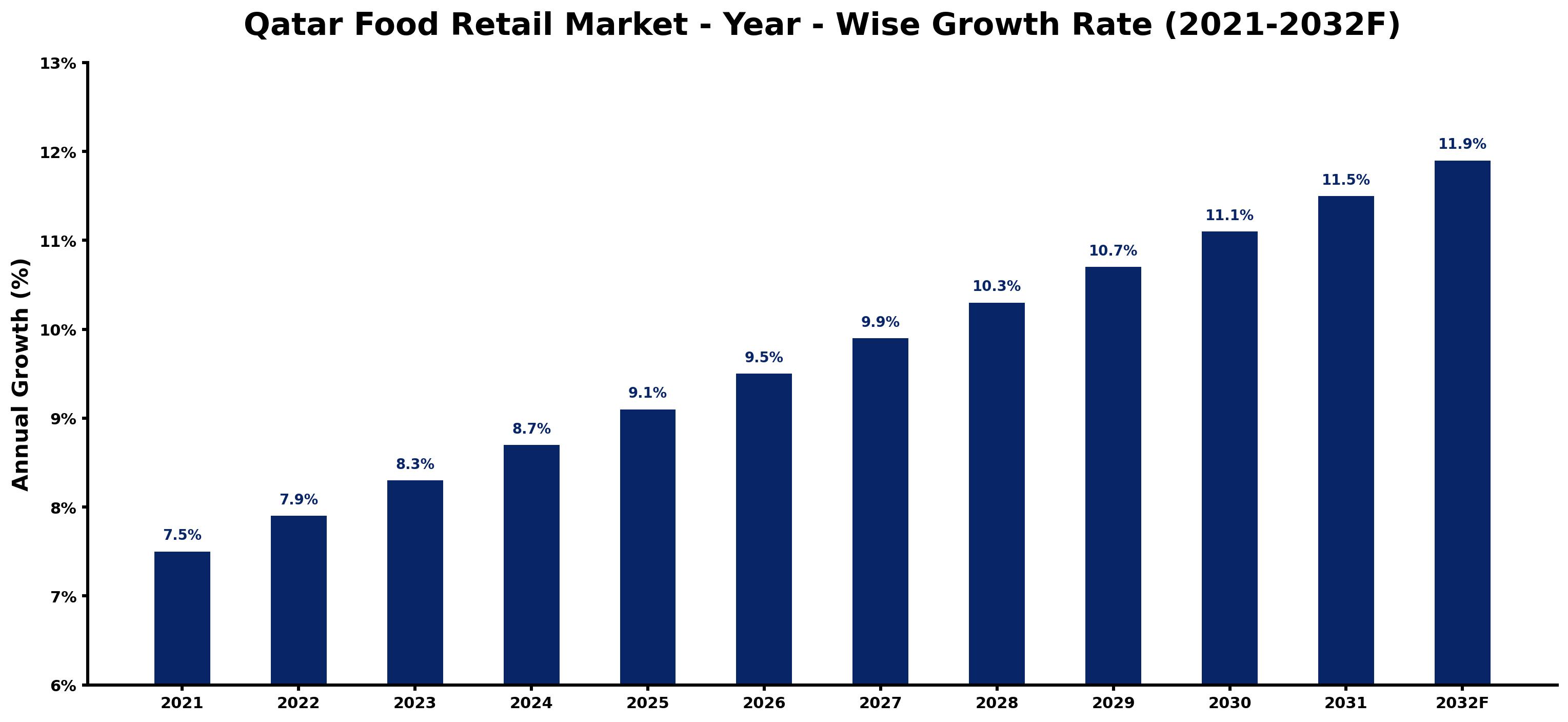
The table below presents the year wise growth rates along with the key drivers influencing the market
| Year | Growth Rate | Major Drivers |
| 2021 | 7.5% | Post-lockdown retail projects emphasize online grocery shopping and delivery services. |
| 2022 | 7.9% | Shifts in consumer preferences align with health trends, boosting organic product sales. |
| 2023 | 8.3% | E-commerce platforms expand, increasing competition among local and international retailers. |
| 2024 | 8.7% | Food security concerns prompt investments in local agricultural initiatives, enhancing supply chains. |
| 2025 | 9.1% | Emerging culinary diversity encourages specialty food stores to flourish in urban areas. |
| 2026 | 9.5% | Technological integration streamlines operations, improving inventory management and customer experience. |
| 2027 | 9.9% | Economic diversification initiatives foster a dynamic retail environment in response to oil volatility. |
| 2028 | 10.3% | Consumer awareness around sustainability leads to growth in eco-friendly packaging solutions. |
| 2029 | 10.7% | Increased expatriate population influences the demand for international food brands and products. |
| 2030 | 11.1% | Smart city projects enhance infrastructure, facilitating better food distribution networks. |
| 2031 | 11.5% | Emergence of health-conscious consumers drives innovation in ready-to-eat meal options. |
| 2032 | 11.9% | Cultural events and festivals stimulate temporary retail growth, enriching the food landscape. |
Note - Market size estimations and growth projections presented in this report are based on 6Wresearch's advanced forecasting approach, validated with industry datasets as of June 2026.
Qatar Food Retail Market Synopsis
The Qatar Food Retail Market is projected to reach 9.5% and witness significant growth during the forecast period (2026-2032). The growth trajectory of this market is largely driven by demographic shifts, urbanization, and enhancements in consumer purchasing power. The increasing number of shopping malls and hypermarkets across Qatar is fostering a convenient shopping experience, which further drives the market dynamics. With a compound annual growth rate (CAGR) expected at 4.3%, the market is poised for robust expansion as it aligns itself with evolving consumer preferences.
Qatar Food Retail Market Growth Drivers
The food retail sector in Qatar is experiencing several key growth drivers:
- Population growth in Qatar has been significant, spurred by immigration and internal migration to urban areas. This demographic shift results in increased demand for food products as households expand, creating substantial opportunities for food retailers.
- The urbanization trend is prominent, with more residents seeking diverse food options within accessible retail environments. The construction of new malls and hypermarkets is indicative of this shift, enhancing the overall shopping experience.
- Rising disposable incomes are pivotal, as they empower consumers to spend more on food items, including premium and luxury products. Enhanced financial capacity allows families to explore a broader range of food retail offerings.
- The surge in convenience-oriented shopping options caters to a fast-paced lifestyle; consumers increasingly prefer shopping venues that offer a variety of products in a single location, thereby supporting the growth of hypermarkets.
- An increase in the quality and variety of food products available in Qatar makes the food retail sector more appealing to consumers, thereby boosting sales and market expansion.
Qatar Food Retail Market Challenges and Restraints
Despite the promising outlook, the Qatar Food Retail Market faces notable challenges:
- Unorganized retailers often offer lower prices, resulting in stiff competition for organized retail businesses. This price disparity complicates customer retention efforts, posing a significant challenge for established players.
- Economic fluctuations can impact consumer spending patterns. A downturn could lead to decreased sales, particularly for non-essential and luxury food items, undermining market stability.
- Changes in consumer shopping behavior, influenced by external factors such as economic conditions and public health crises, can create uncertainty in demand for food retail products.
- Regulatory challenges associated with food safety standards and import regulations can create barriers for businesses seeking to introduce new products into the market.
- The Covid-19 pandemic introduced operational disruptions and altered consumer habits, leading to a shift toward online shopping that many traditional retailers are still adapting to.
Qatar Food Retail Market Impact of Covid-19
The Covid-19 pandemic fundamentally transformed the landscape of the food retail market in Qatar and globally. Lockdowns and health concerns significantly affected consumer access to physical retail locations. As a result, there was a pronounced shift toward online shopping platforms. Many consumers adapted to purchasing food products through digital interfaces, leading to long-term changes in shopping behaviors. The pandemic also disrupted supply chains, affecting product availability and leading to fluctuating prices. Recovery from these impacts continues to reshape the market dynamics.
Qatar Food Retail Market Government Investment and Initiatives
The Qatari government is playing a proactive role in fostering the growth of the food retail sector through various initiatives:
- Strategic development plans are aimed at boosting the overall retail landscape, including food retail, thereby enhancing the consumer shopping experience across the nation.
- Investment incentives are being offered to stimulate new business ventures in the food retail sector, encouraging both local and foreign entities to participate in market expansion.
- The government supports initiatives that promote local agricultural production, thereby reducing dependency on imports and enhancing food security, which in turn encourages retail growth.
- Public spending in infrastructure development, including transportation and logistics, is essential for improving the efficiency of supply chains and enhancing accessibility to retail locations.
- Implementation of food safety and quality regulations ensures higher standards in retail operations, boosting consumer trust and contributing to market stability.
Qatar Food Retail Market Latest Developments (May 2025 - June 2026)
Recent developments in the Qatar Food Retail Market reflect evolving consumer preferences and strategic shifts in the industry. There has been a notable increase in the establishment of hypermarkets and specialty stores, showcasing diverse food options to cater to a growing demographic. Additionally, advancements in technology have led to enhanced online shopping platforms, facilitating a seamless consumer experience. This period has seen an emphasis on sustainability, with retailers exploring eco-friendly packaging and sourcing local products more aggressively. The market is also witnessing collaborations aimed at improving supply chain logistics, thereby addressing post-pandemic challenges and enhancing operational resilience.
Qatar Food Retail Market - Key Attractiveness of the Report
- 10 Years of Market Numbers
- Historical Data Starting from 2022 to 2025
- Base Year: 2025
- Forecast Data until 2032
- Key Performance Indicators Impacting the Market
- Major Upcoming Developments and Projects
Key Highlights of the Report:
- Qatar Food Retail Market Outlook
- Market Size of Qatar Food Retail Market, 2025
- Forecast of Qatar Food Retail Market, 2032
- Historical Data and Forecast of Qatar Food Retail Revenues & Volume for the Period 2022-2032F
- Qatar Food Retail Market Trend Evolution
- Qatar Food Retail Market Drivers and Challenges
- Qatar Food Retail Price Trends
- Qatar Food Retail Porter's Five Forces
- Qatar Food Retail Industry Life Cycle
- Historical Data and Forecast of Qatar Food Retail Market Revenues & Volume By Product Types for the Period 2022-2032F
- Historical Data and Forecast of Qatar Food Retail Market Revenues & Volume By Unpackaged Food for the Period 2022-2032F
- Historical Data and Forecast of Qatar Food Retail Market Revenues & Volume By Packaged Food for the Period 2022-2032F
- Historical Data and Forecast of Qatar Food Retail Market Revenues & Volume By Drinks for the Period 2022-2032F
- Historical Data and Forecast of Qatar Food Retail Market Revenues & Volume By Household Products for the Period 2022-2032F
- Historical Data and Forecast of Qatar Food Retail Market Revenues & Volume By Packaging Types for the Period 2022-2032F
- Historical Data and Forecast of Qatar Food Retail Market Revenues & Volume By Boxes for the Period 2022-2032F
- Historical Data and Forecast of Qatar Food Retail Market Revenues & Volume By Cans for the Period 2022-2032F
- Historical Data and Forecast of Qatar Food Retail Market Revenues & Volume By Cellophane Wrapping for the Period 2022-2032F
- Historical Data and Forecast of Qatar Food Retail Market Revenues & Volume By Cylindrical Cardboard for the Period 2022-2032F
- Qatar Food Retail Import Export Trade Statistics
- Market Opportunity Assessment By Product Types
- Market Opportunity Assessment By Packaging Types
- Qatar Food Retail Top Companies Market Share
- Qatar Food Retail Competitive Benchmarking By Technical and Operational Parameters
- Qatar Food Retail Company Profiles
- Qatar Food Retail Key Strategic Recommendations






































