Qatar Greasy Wool Market Size, Share & Growth Rate
The Qatar Greasy Wool Market was estimated at USD 500 Million in 2025 and is projected to reach USD 675 Million by 2032, growing at a CAGR of 4.4% from 2026 to 2032. This growth is primarily driven by the increasing recognition of the benefits of natural fibers within the local textile industry, paired with strategic government initiatives aimed at enhancing domestic production capabilities. The confluence of rising sustainability awareness and local demand for quality raw materials is positioning greasy wool as an essential component of Qatar's evolving textile landscape.
Qatar Greasy Wool Market Year-wise Growth Rate and Key Drivers
This graph highlights how the Qatar Greasy Wool Market has steadily grown over the years, supported by major growth factors.
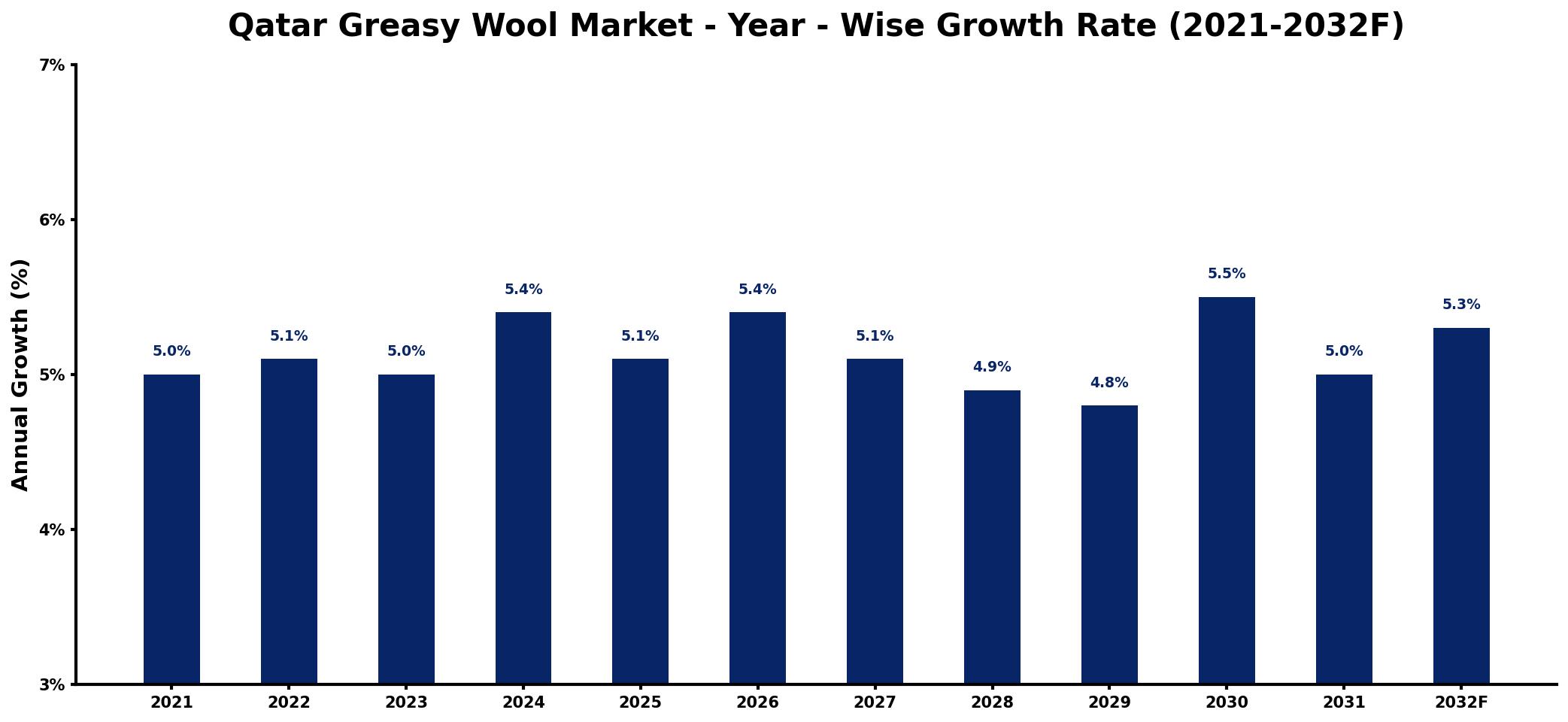
The table below presents the year‑wise growth rates along with the key drivers influencing the market
| Year | Growth Rate | Major Drivers |
| 2021 | 5.0% | Increase in textile manufacturing capacity |
| 2022 | 5.1% | Expansion of sustainable fashion trends |
| 2023 | 5.0% | Growing demand for natural fibers |
| 2024 | 5.4% | Rising investments in agriculture technology |
| 2025 | 5.1% | Enhancements in supply chain logistics |
| 2026 | 5.4% | improved raw material availability |
| 2027 | 5.1% | Development of eco-friendly production methods |
| 2028 | 4.9% | Emergence of niche market segments |
| 2029 | 4.8% | Growing consumer awareness of quality |
| 2030 | 5.5% | growing commercial sector adoption |
| 2031 | 5.0% | rising infrastructure development spending |
| 2032 | 5.3% | Rising popularity of artisanal products |
Note: Market size estimations and growth projections presented in this report are based on 6Wresearch's proprietary forecasting methodology, utilizing the latest available industry data, government publications, and primary research inputs.
Qatar Greasy Wool Market Synopsis
The current market dynamics of greasy wool in Qatar are significantly shaped by the surge in interest towards sustainable textiles. This evolving consumer preference reflects a broader global trend that is increasingly favoring natural fibers, which are perceived as environmentally friendly and durable alternatives to synthetic options. As local manufacturers ramp up production, the demand for high-quality greasy wool is anticipated to rise, reflecting the urgent need for quality raw materials.
Furthermore, Qatar's strategic plans to diversify its economy beyond hydrocarbon dependence have catalyzed investments in the textile sector. As domestic capabilities enhance, the market for greasy wool is poised to benefit, spurred by a localized manufacturing base that favors the utilization of natural and sustainable resources. However, challenges remain, particularly due to the country's climate which restricts large-scale sheep farming.
Qatar Greasy Wool Market Key Takeaways
- The market is projected to grow significantly due to increasing demand for sustainable textiles.
- Government initiatives are enhancing domestic textile manufacturing capabilities.
- Local preferences are shifting towards high-quality raw materials, positioning greasy wool as a critical component.
- Despite a challenging climate for sheep farming, investments in technology and practices are aiding market development.
- Resilience shown during the COVID-19 pandemic has set a positive outlook for recovery and growth.
Evaluation of Restraints in Qatar Greasy Wool Market
One of the primary restraints affecting the greasy wool market in Qatar is the inherent difficulty of maintaining wool quality throughout handling and storage processes. Factors such as dust and moisture can significantly compromise the value of the raw product. Furthermore, global wool price fluctuations pose economic challenges for local producers, impacting profitability. Additionally, as consumer preference shifts towards eco-friendly products, companies must invest in sustainable production practices, which could strain resources, particularly for small-scale operations.
Qatar Greasy Wool Market Trends
Currently, there is a notable trend toward adopting sustainable and eco-conscious practices within the textile industry, which is shaping demand for greasy wool. This trend is complemented by an increasing emphasis on quality over quantity, as manufacturers seek to differentiate their products in a competitive marketplace. Technological advancements in wool processing are also gaining traction, providing enhanced methods for cleaning and preparing greasy wool for production. Moreover, the growing awareness around ethical sourcing is propelling demand for locally-sourced greasy wool, thus reinforcing Qatar's textile sector.
Qatar Greasy Wool Market Opportunities
The Qatar Greasy Wool Market presents several opportunities for growth and investment. As local textile manufacturing capabilities expand, there is an increasing need for reliable sources of high-quality raw materials. Investors looking to tap into the sustainable textile trend may find promising avenues within the greasy wool segment. Additionally, developing partnerships with global players in the textile industry could facilitate knowledge transfer and boost production techniques, driving both quality and market reach.
Government Initiatives in the Qatar Greasy Wool Market
The Qatari government has been proactive in fostering an environment conducive to the growth of the textile industry, which indirectly benefits the greasy wool market. Initiatives aimed at diversifying the economy away from oil dependency include investments in local manufacturing and support for sustainable practices. Policies encouraging the establishment of textile production facilities and research into advanced agricultural methods are also noteworthy. These initiatives create a framework where the greasy wool market can thrive, reflecting the nation's broader economic goals.
Future Insights of the Qatar Greasy Wool Market
Looking ahead to 2026-2032, the Qatar Greasy Wool Market is expected to experience steady expansion driven by a combination of domestic demand and strategic industry initiatives. With a growing commitment to sustainability, local manufacturers are likely to increasingly prioritize natural fibers like greasy wool. Furthermore, as global demand for quality textiles rebounds post-pandemic, Qatars position in the luxury textile sector is expected to enhance, potentially attracting international partnerships and investments that could further solidify the market's trajectory.
Qatar Greasy Wool Market Latest Developments (2025 - 2026)
Recent developments in the Qatar greasy wool market indicate an ongoing trend toward enhancing processing technologies and production practices. Collaborations between local textile producers and global entities have emerged, focusing on improving the quality and sustainability of greasy wool. Moreover, there is a heightened focus on local sourcing, aligning with consumer preferences for ethical and sustainable materials. As market players adapt to these changes, the outlook remains optimistic for continued growth and innovation in this niche sector.
Qatar Greasy Wool Market - Key Attractiveness of the Report
- 10 Years of Market Numbers
- Historical Data Starting from 2022 to 2025
- Base Year: 2025
- Forecast Data until 2032
- Key Performance Indicators Impacting the Market
- Major Upcoming Developments and Projects
Key Highlights of the Report:
- Qatar Greasy Wool Market Outlook
- Market Size of Qatar Greasy Wool Market, 2025
- Forecast of Qatar Greasy Wool Market, 2032
- Historical Data and Forecast of Qatar Greasy Wool Revenues & Volume for the Period 2022-2032F
- Qatar Greasy Wool Market Trend Evolution
- Qatar Greasy Wool Market Drivers and Challenges
- Qatar Greasy Wool Price Trends
- Qatar Greasy Wool Porter's Five Forces
- Qatar Greasy Wool Industry Life Cycle
- Historical Data and Forecast of Qatar Greasy Wool Market Revenues & Volume By Application for the Period 2022-2032F
- Historical Data and Forecast of Qatar Greasy Wool Market Revenues & Volume By Apparel for the Period 2022-2032F
- Historical Data and Forecast of Qatar Greasy Wool Market Revenues & Volume By Sports for the Period 2022-2032F
- Historical Data and Forecast of Qatar Greasy Wool Market Revenues & Volume By Blazers for the Period 2022-2032F
- Historical Data and Forecast of Qatar Greasy Wool Market Revenues & Volume By Jacketing for the Period 2022-2032F
- Historical Data and Forecast of Qatar Greasy Wool Market Revenues & Volume By Others for the Period 2022-2032F
- Historical Data and Forecast of Qatar Greasy Wool Market Revenues & Volume By Upholstery Fabrics for the Period 2022-2032F
- Historical Data and Forecast of Qatar Greasy Wool Market Revenues & Volume By Blankets for the Period 2022-2032F
- Historical Data and Forecast of Qatar Apparel Greasy Wool Market Revenues & Volume By Flooring for the Period 2022-2032F
- Qatar Greasy Wool Import Export Trade Statistics
- Market Opportunity Assessment By Application
- Qatar Greasy Wool Top Companies Market Share
- Qatar Greasy Wool Competitive Benchmarking By Technical and Operational Parameters
- Qatar Greasy Wool Company Profiles
- Qatar Greasy Wool Key Strategic Recommendations






































