Qatar Hospital Equipment And Supplies Market Size, Share & Growth Rate
The Qatar Hospital Equipment And Supplies Market was estimated at USD 435 Million in 2025 and is projected to reach USD 578 Million by 2032, growing at a CAGR of 4.1% from 2026 to 2032. This growth trajectory is driven by the countrys strategic investments in healthcare infrastructure, which include the development of state-of-the-art hospitals and clinics. Furthermore, Qatars ambition to establish itself as a hub for medical tourism is creating an increasing demand for high-quality medical equipment and supplies, enhancing market competitiveness.
Qatar Hospital Equipment And Supplies Market Year-wise Growth Rate and Key Drivers
This graph highlights how the Qatar Hospital Equipment And Supplies Market has steadily grown over the years, supported by major growth factors.
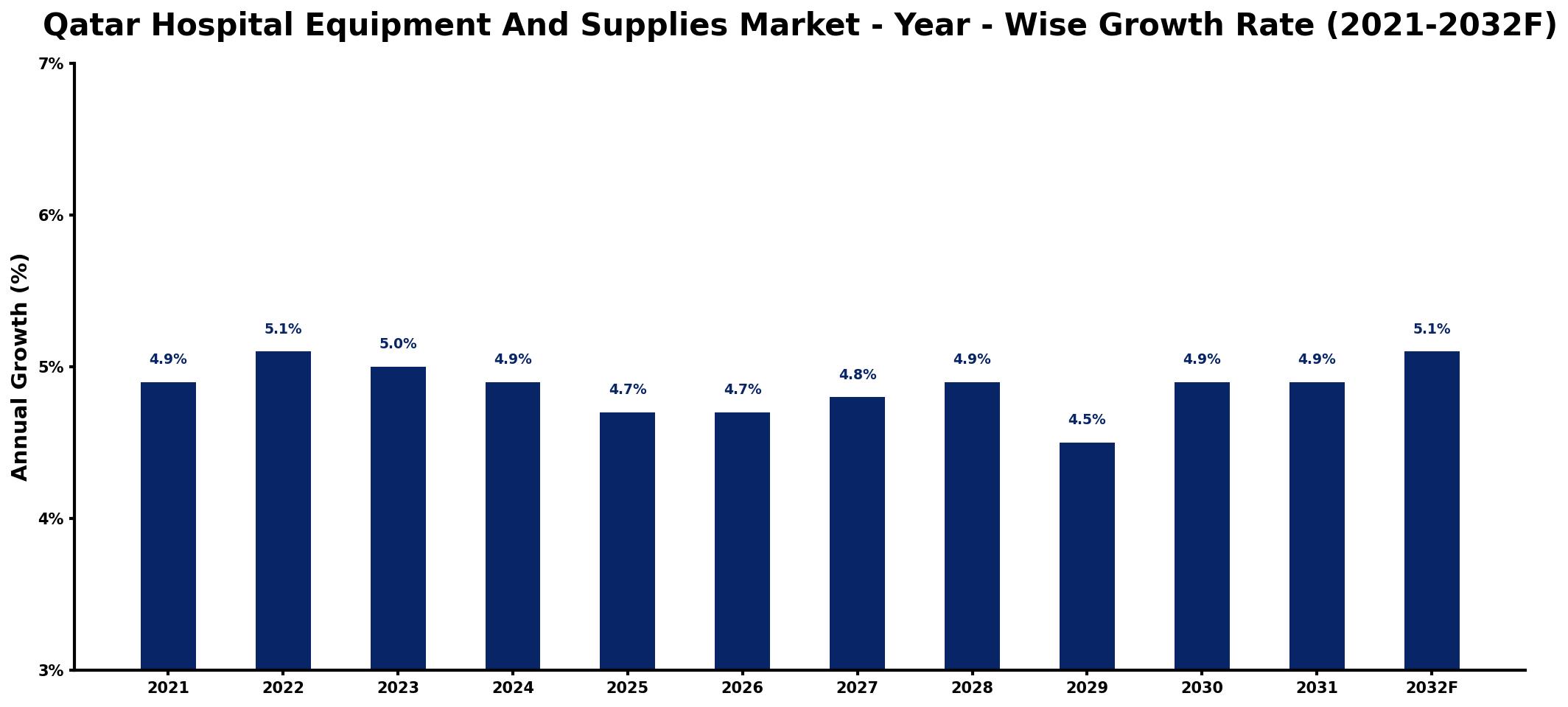
The table below presents the year‑wise growth rates along with the key drivers influencing the market
| Year | Growth Rate | Major Drivers |
| 2021 | 4.9% | Rising healthcare expenditure across sectors |
| 2022 | 5.1% | Increased focus on patient safety |
| 2023 | 5.0% | Growth in telemedicine services adoption |
| 2024 | 4.9% | Expansion of healthcare infrastructure projects |
| 2025 | 4.7% | Emergence of advanced medical technologies |
| 2026 | 4.7% | Growing aging population demands care |
| 2027 | 4.8% | Increased investment in health innovation |
| 2028 | 4.9% | Surge in preventive health initiatives |
| 2029 | 4.5% | rising export shipment volumes |
| 2030 | 4.9% | Strengthening healthcare regulatory frameworks |
| 2031 | 4.9% | Innovations in digital health solutions |
| 2032 | 5.1% | Increased collaborations in health sector |
Note: Market size estimations and growth projections presented in this report are based on 6Wresearch's proprietary forecasting methodology, utilizing the latest available industry data, government publications, and primary research inputs.
Qatar Hospital Equipment And Supplies Market Synopsis
The healthcare landscape in Qatar is transforming, with a pronounced focus on elevating the quality of patient care through advanced medical technologies. Significant investments in healthcare facilities and an increasing population are driving the demand for sophisticated hospital equipment and supplies, essential for meeting contemporary health challenges.
Moreover, the Qatar National Vision 2030 underscores the importance of a robust healthcare system, leading to enhanced procurement strategies for innovative medical devices. This commitment to excellence sets the stage for dynamic growth within the hospital equipment and supplies market.
Qatar Hospital Equipment And Supplies Market Key Takeaways
- The market is experiencing robust growth due to significant investments in healthcare infrastructure.
- Demand for advanced medical equipment is driven by the need for high-quality healthcare services.
- COVID-19 has accelerated procurement of critical equipment, reshaping market dynamics.
- Local suppliers are adapting by diversifying offerings to meet emerging healthcare needs.
- Technological advancements are fostering a competitive landscape among market players.
Evaluation of Restraints in Qatar Hospital Equipment And Supplies Market
Despite the promising outlook, the Qatar hospital equipment and supplies market faces several constraints. A significant reliance on imports exposes the market to potential disruptions in global supply chains, which can hinder timely access to crucial medical equipment. Additionally, stringent regulatory standards for medical products can delay market entry for new technologies, which could otherwise enhance healthcare delivery. Continuous training requirements for healthcare professionals to keep pace with rapid technological changes further strain budgetary allocations, affecting overall market growth. Balancing the dual demands of quality care and cost containment remains a persistent challenge.
Qatar Hospital Equipment And Supplies Market Trends
Several trends are shaping the Qatar hospital equipment and supplies market. The rise in telemedicine has prompted hospitals to invest in related technologies, pushing the demand for specialized medical devices. Additionally, an increasing focus on patient-centered care is driving innovations in equipment design and functionality. Sustainability in medical supplies is emerging as a key trend, with stakeholders looking for eco-friendly options that do not compromise on quality. Moreover, the integration of artificial intelligence in diagnostic and treatment tools is paving the way for smarter healthcare solutions.
Qatar Hospital Equipment And Supplies Market Opportunities
The evolving landscape of the Qatar hospital equipment and supplies market presents numerous opportunities for growth and investment. The governments commitment to enhancing healthcare infrastructure offers substantial prospects for suppliers and manufacturers of medical equipment. Additionally, the burgeoning medical tourism sector represents a lucrative avenue for developing specialized services and advanced healthcare technologies tailored to international patients. Innovators who can navigate the regulatory landscape while delivering cutting-edge solutions will find ample opportunities for success in this dynamic market.
Government Initiatives in the Qatar Hospital Equipment And Supplies Market
The Qatari government has undertaken various initiatives aimed at bolstering the healthcare sector, which directly impacts the hospital equipment and supplies market. Programs focused on public health improvement, substantial public funding for new healthcare projects, and initiatives that facilitate access to high-quality medical supplies are foundational to these efforts. Moreover, policies encouraging private sector participation and innovation are enhancing competition and driving advancements in medical technologies. Such strategic initiatives are pivotal in establishing Qatar as a leader in healthcare excellence in the region.
Future Insights of the Qatar Hospital Equipment And Supplies Market
Looking ahead to 2026-2032, the Qatar hospital equipment and supplies market is expected to continue its upward trajectory. The increasing adoption of advanced healthcare technologies, coupled with ongoing government support, will create a fertile environment for growth. As healthcare demands evolve, particularly with an emphasis on patient safety and experience, the market will likely see an influx of innovative medical devices and equipment. The intersection of healthcare digitalization and automation will further reshape procurement strategies, resulting in a more agile and responsive market framework.
Qatar Hospital Equipment And Supplies Market Latest Developments (2025 - 2026)
In recent months, the healthcare industry in Qatar has seen substantial shifts, particularly influenced by post-COVID recovery efforts. Facilities are enhancing their procurement of advanced medical equipment to bolster their capabilities in managing future health crises. A notable emphasis has been placed on upgrading infection control systems across hospitals, reflecting ongoing safety concerns. Suppliers are responding by diversifying their product lines to better align with these emerging needs, demonstrating the markets adaptive nature.
Qatar Hospital Equipment And Supplies Market - Key Attractiveness of the Report
- 10 Years of Market Numbers
- Historical Data Starting from 2022 to 2025
- Base Year: 2025
- Forecast Data until 2032
- Key Performance Indicators Impacting the Market
- Major Upcoming Developments and Projects
Key Highlights of the Report:
- Qatar Hospital Equipment And Supplies Market Outlook
- Market Size of Qatar Hospital Equipment And Supplies Market, 2025
- Forecast of Qatar Hospital Equipment And Supplies Market, 2032
- Historical Data and Forecast of Qatar Hospital Equipment And Supplies Revenues & Volume for the Period 2022-2032F
- Qatar Hospital Equipment And Supplies Market Trend Evolution
- Qatar Hospital Equipment And Supplies Market Drivers and Challenges
- Qatar Hospital Equipment And Supplies Price Trends
- Qatar Hospital Equipment And Supplies Porter's Five Forces
- Qatar Hospital Equipment And Supplies Industry Life Cycle
- Historical Data and Forecast of Qatar Hospital Equipment And Supplies Market Revenues & Volume By Product for the Period 2022-2032F
- Historical Data and Forecast of Qatar Hospital Equipment And Supplies Market Revenues & Volume By Sterilization And Disinfectant Equipment for the Period 2022-2032F
- Historical Data and Forecast of Qatar Hospital Equipment And Supplies Market Revenues & Volume By Disposable Hospital Supplies Patient Examination Devices for the Period 2022-2032F
- Historical Data and Forecast of Qatar Hospital Equipment And Supplies Market Revenues & Volume By Syringes And Needles for the Period 2022-2032F
- Historical Data and Forecast of Qatar Hospital Equipment And Supplies Market Revenues & Volume By Application for the Period 2022-2032F
- Historical Data and Forecast of Qatar Hospital Equipment And Supplies Market Revenues & Volume By OEMs for the Period 2022-2032F
- Historical Data and Forecast of Qatar Hospital Equipment And Supplies Market Revenues & Volume By Aftermarket for the Period 2022-2032F
- Qatar Hospital Equipment And Supplies Import Export Trade Statistics
- Market Opportunity Assessment By Product
- Market Opportunity Assessment By Application
- Qatar Hospital Equipment And Supplies Top Companies Market Share
- Qatar Hospital Equipment And Supplies Competitive Benchmarking By Technical and Operational Parameters
- Qatar Hospital Equipment And Supplies Company Profiles
- Qatar Hospital Equipment And Supplies Key Strategic Recommendations






































