Qatar Household Textile Market Summary
The qatar household textile market was estimated at USD 148 Million in 2025 and is projected to reach USD 162 Million by 2032, growing at a CAGR of 1.3% from 2026 to 2032.
Qatar Household Textile Market Year-wise Growth Rate and Key Drivers
This graph highlights how the Qatar Household Textile Market has steadily grown over the past five years, supported by major growth factors.
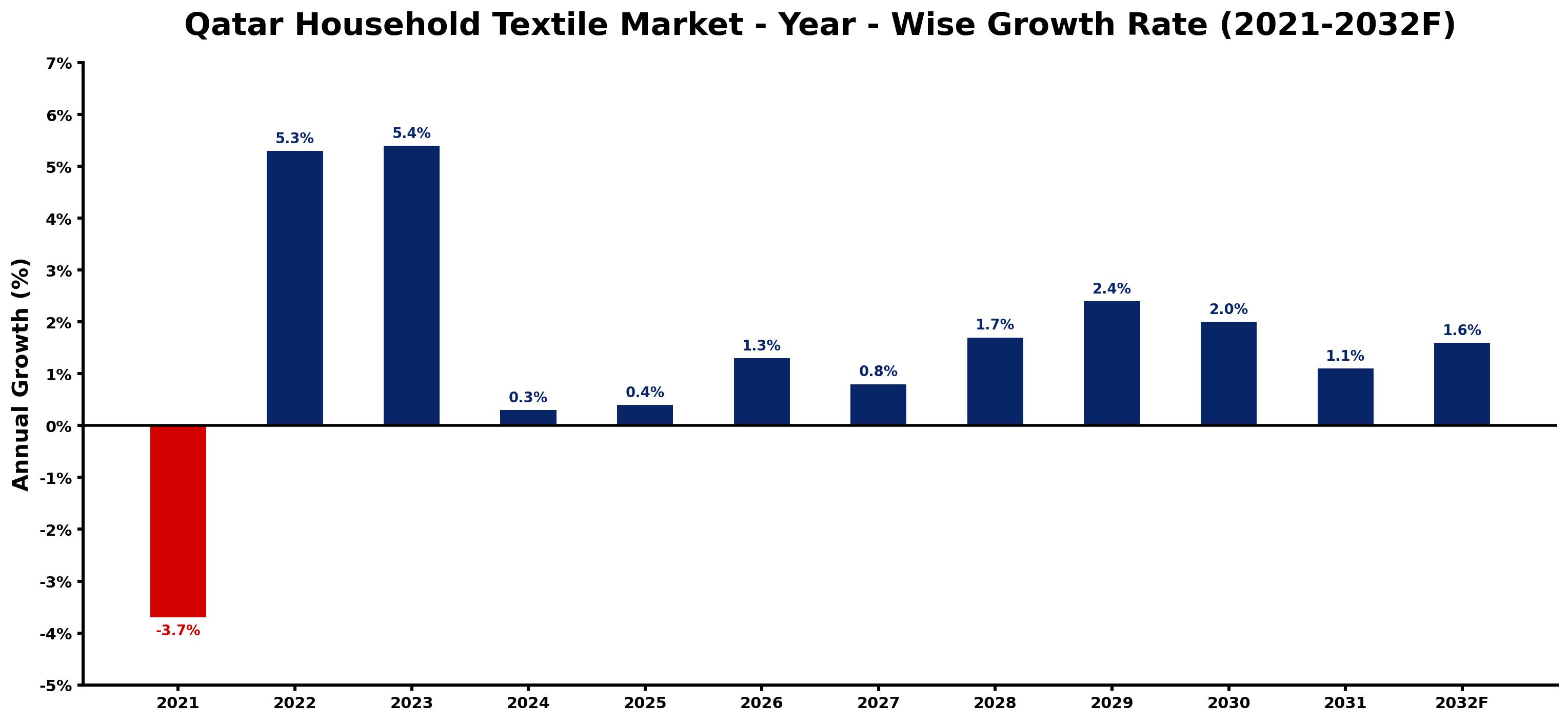
The table below presents the year wise growth rates along with the key drivers influencing the market
| Year | Growth Rate | Major Drivers |
| 2021 | -3.7% | Economic uncertainties related to the pandemic led to reduced consumer spending on nonessential household textiles. |
| 2022 | 5.3% | Qatar's hosting of major events increased demand for luxurious household textiles. |
| 2023 | 5.4% | Changing lifestyles prompted households to prioritize comfort through quality textiles. |
| 2024 | 0.3% | Luxury hotel openings stimulated the market for high-end textile products. |
| 2025 | 0.4% | Increased urbanization in Doha led to greater household spending on textiles. |
| 2026 | 1.3% | Interest in sustainable materials influenced purchasing decisions among eco-conscious consumers. |
| 2027 | 0.8% | Digital retail platforms expanded access to diverse textile products for consumers. |
| 2028 | 1.7% | Integration of smart home technologies encouraged innovative textile applications in households. |
| 2029 | 2.4% | Cultural events celebrated traditional textiles, boosting local craftsmanship and market demand. |
| 2030 | 2.0% | Shifts in consumer preferences highlighted the importance of customization in textile offerings. |
| 2031 | 1.1% | Economic diversification efforts fueled investments in local textile manufacturing capabilities. |
| 2032 | 1.6% | Expanding expatriate communities increased variety in textile preferences across households. |
Note - Market size estimations and growth projections presented in this report are based on 6Wresearch's advanced forecasting approach, validated with industry datasets as of June 2026.
Qatar Household Textile Market Synopsis
The Qatar Household Textile Market is projected to reach 1.3% and witness significant growth during the forecast period (2026-2032). This growth is primarily attributed to increasing population dynamics, an elevation in disposable income levels, and shifting consumer preferences towards enhancing home aesthetics. The market encompasses a wide array of products, including bedding, towels, curtains, and rugs, which play crucial roles in home furnishing. As households seek both comfort and style, the demand for high-quality, durable textiles continues to rise.
Qatar Household Textile Market Growth Drivers
A multitude of factors are propelling the Qatar Household Textile Market forward. Notably, the country's robust population growth is fostering increased demand for household textiles. The following elements are central to this market progression:
- Increased disposable income allows consumers to invest in quality textiles that enhance their living environments. This economic uplift drives the purchase of premium products across various textile categories.
- The rapid expansion of the real estate sector, supported by government initiatives, escalates the requirement for household textiles to furnish new residential and commercial spaces adequately.
- Heightened consumer awareness concerning environmental sustainability is steering preferences towards eco-friendly household textile options, encouraging brands to innovate with organic materials.
- The rise in urbanization leads to changes in lifestyle, wherein consumers are more inclined to prioritize home decor and comfort, thereby increasing spending on household textiles.
- Increased participation in events such as exhibitions and trade shows is allowing manufacturers and retailers to engage directly with consumers, showcasing the latest trends and reinforcing brand loyalty.
Qatar Household Textile Market Challenges and Restraints
While the Qatar Household Textile Market is witnessing growth, several challenges persist that could hinder its trajectory:
- Intense competition among local and international players results in pressure on pricing, often leading to reduced profit margins for manufacturers and retailers.
- Fluctuations in raw material prices can significantly influence product pricing, making it difficult for companies to maintain competitive pricing strategies.
- Changes in import regulations might create barriers to entry for new players, thereby restricting market expansion opportunities and product variety.
- The effects of global economic conditions, such as recessions or trade disputes, may adversely affect consumer spending patterns on household textiles.
- Shifts in consumer behavior, particularly after the COVID-19 pandemic, necessitate brands to adapt to evolving preferences, which can be resource-intensive and challenging.
Qatar Household Textile Market Government Investment and Initiatives
The Qatari government has taken significant strides towards stimulating the Household Textile Market through various investments and initiatives. Key aspects include:
- Financial incentives for the real estate sector encourage construction projects, which in turn increases demand for household textiles among new residents and commercial establishments.
- Government-led urban development plans focus on enhancing living standards, subsequently amplifying the demand for stylish and functional household textile solutions.
- Support for sustainability initiatives promotes the use of eco-friendly materials in manufacturing, aligning with global sustainability goals and consumer expectations.
- Public spending on infrastructure projects has a ripple effect across industries, including textiles, as there is a demand for high-quality furnishings in new and refurbished public spaces.
- Encouragement for local textile manufacturers through funding and training programs helps in cultivating a competitive local market, adding depth to the available offerings.
Qatar Household Textile Market Latest Developments (May 2025 - June 2026)
Recent industry trends from May 2025 to June 2026 indicate a marked shift in the Qatar Household Textile Market towards digital transformation and sustainability. Companies are increasingly adopting e-commerce platforms to reach consumers effectively, catering to a growing preference for online shopping. In tandem, there is a noticeable surge in the introduction of sustainable product lines, as manufacturers recognize changing consumer preferences. The emphasis on local sourcing and production has gained traction, supporting regional economic growth and reducing supply chain vulnerabilities.
Qatar Household Textile Market - Key Attractiveness of the Report
- 10 Years of Market Numbers
- Historical Data Starting from 2022 to 2025
- Base Year: 2025
- Forecast Data until 2032
- Key Performance Indicators Impacting the Market
- Major Upcoming Developments and Projects
Key Highlights of the Report:
- Qatar Household Textile Market Outlook
- Market Size of Qatar Household Textile Market, 2025
- Forecast of Qatar Household Textile Market, 2032
- Historical Data and Forecast of Qatar Household Textile Revenues & Volume for the Period 2022-2032F
- Qatar Household Textile Market Trend Evolution
- Qatar Household Textile Market Drivers and Challenges
- Qatar Household Textile Price Trends
- Qatar Household Textile Porter's Five Forces
- Qatar Household Textile Industry Life Cycle
- Historical Data and Forecast of Qatar Household Textile Market Revenues & Volume By Type for the Period 2022-2032F
- Historical Data and Forecast of Qatar Household Textile Market Revenues & Volume By Non-woven Textile for the Period 2022-2032F
- Historical Data and Forecast of Qatar Household Textile Market Revenues & Volume By Woven Textile for the Period 2022-2032F
- Historical Data and Forecast of Qatar Household Textile Market Revenues & Volume By Application for the Period 2022-2032F
- Historical Data and Forecast of Qatar Household Textile Market Revenues & Volume By Bed for the Period 2022-2032F
- Historical Data and Forecast of Qatar Household Textile Market Revenues & Volume By Furniture for the Period 2022-2032F
- Historical Data and Forecast of Qatar Household Textile Market Revenues & Volume By Door & Window for the Period 2022-2032F
- Historical Data and Forecast of Qatar Household Textile Market Revenues & Volume By Dining & Wash for the Period 2022-2032F
- Historical Data and Forecast of Qatar Household Textile Market Revenues & Volume By Ground for the Period 2022-2032F
- Qatar Household Textile Import Export Trade Statistics
- Market Opportunity Assessment By Type
- Market Opportunity Assessment By Application
- Qatar Household Textile Top Companies Market Share
- Qatar Household Textile Competitive Benchmarking By Technical and Operational Parameters
- Qatar Household Textile Company Profiles
- Qatar Household Textile Key Strategic Recommendations






































