Qatar Industrial Computers Market Summary
The qatar industrial computers market was estimated at USD 82 Million in 2025 and is projected to reach USD 90 Million by 2032, growing at a CAGR of 0.8% from 2026 to 2032.
Qatar Industrial Computers Market Year-wise Growth Rate and Key Drivers
This graph highlights how the Qatar Industrial Computers Market has steadily grown over the past five years, supported by major growth factors.
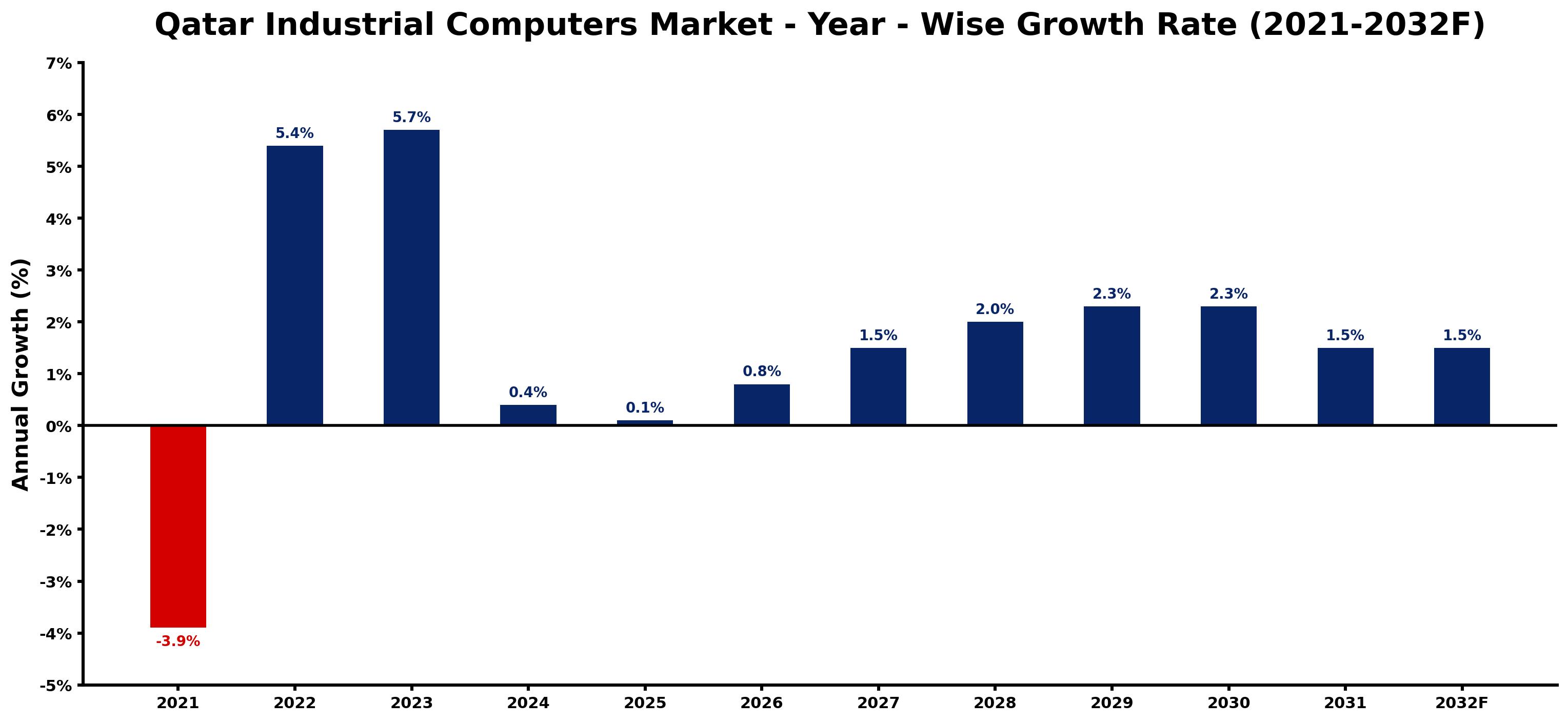
The table below presents the year wise growth rates along with the key drivers influencing the market
| Year | Growth Rate | Major Drivers |
| 2021 | -3.9% | Supply chain disruptions triggered by global logistics issues delayed projects and deterred investments in industrial computing. |
| 2022 | 5.4% | Partnerships between local firms and global tech giants enhanced market capabilities and offerings. |
| 2023 | 5.7% | Increased emphasis on cybersecurity for industrial applications created new technology demands. |
| 2024 | 0.4% | The construction boom in Qatar prompted a surge in industrial computer applications. |
| 2025 | 0.1% | Local manufacturers began adopting smart technologies to automate production processes effectively. |
| 2026 | 0.8% | Investment in renewable energy initiatives demanded robust industrial computing solutions for management. |
| 2027 | 1.5% | Logistics and supply chain optimization need drove sophisticated computing systems into industries. |
| 2028 | 2.0% | Emerging AI technologies presented unique opportunities for operational efficiency across sectors. |
| 2029 | 2.3% | Heavy machinery integration with IoT devices revolutionized traditional industrial computer functions. |
| 2030 | 2.3% | The focus on smart city projects required advanced computing solutions for infrastructure management. |
| 2031 | 1.5% | Technological upgrades in response to climate challenges influenced industrial computing requirements. |
| 2032 | 1.5% | Continued economic diversification opened new sectors, creating a broad demand for industrial computers. |
Note - Market size estimations and growth projections presented in this report are based on 6Wresearch's advanced forecasting approach, validated with industry datasets as of June 2026.
Qatar Industrial Computers Market Synopsis
The Qatar Industrial Computers Market is projected to reach 0.8% and witness significant growth during the forecast period (2026-2032). This sector is increasingly pivotal as industrial computers serve crucial functions across various applications, including automation, factory automation, process control, and data collection and analysis. The demand for these robust computing solutions is rising due to substantial investments in the oil and gas industry and advancements in the manufacturing sector.
Qatar Industrial Computers Market Growth Drivers
Several factors are driving the growth of the Qatar Industrial Computers Market. The country is undergoing a transformation aimed at developing smarter cities with improved infrastructure, necessitating the deployment of advanced IT solutions. This includes a focus on efficient transportation systems and e-governance services, which rely heavily on industrial computing capabilities.
- The Qatari government's commitment to building smarter cities fosters the demand for industrial computers, aligning with national development strategies.
- Private sector investments are amplifying the need for advanced industrial computing solutions to enhance productivity and operational efficiency.
- Organizations are increasingly shifting towards energy-efficient technologies in response to rising energy costs, propelling the adoption of industrial computers.
- Regulatory pressures related to environmental protection compel businesses to incorporate technology that aids in compliance and sustainability efforts.
- The pursuit of innovation within production processes further necessitates the integration of industrial computers to maintain competitive advantage.
Qatar Industrial Computers Market Challenges and Restraints
Despite the promising outlook for the Qatar Industrial Computers Market, several challenges persist that may hinder growth. The implementation and integration of advanced computing solutions often require significant upfront investment, particularly if additional hardware or software is necessary. This can be especially challenging for small and medium-sized enterprises seeking cost-effective solutions.
- The high deployment costs associated with sophisticated industrial computers can deter smaller businesses from adopting these technologies.
- Lack of technical expertise and skilled personnel in the region may result in slower implementation and integration processes.
- Supply chain disruptions, notably influenced by global events such as the COVID-19 pandemic, can impede the timely availability of industrial computers.
- Technological obsolescence is a concern as rapid advancements may outpace the lifecycle of existing computing solutions, leading to additional costs.
- Market volatility and economic uncertainties can impact investment decisions and delay technology adoption among organizations.
Qatar Industrial Computers Market Government Investment and Initiatives
The Qatari government has launched several initiatives aimed at escalating investments in the industrial sector, which includes substantial allocations for digital transformation strategies. As part of its vision to realize a knowledge-based economy, the government is fostering public-private partnerships, encouraging innovation, and investing in infrastructure development.
- Government frameworks are being established to facilitate the integration of IT solutions, particularly within government services and public safety sectors.
- Funding programs targeting research and development in industrial technologies are providing enterprises with resources to adopt advanced computing solutions.
- The "Qatar National Vision 2030" emphasizes the need for technological adoption, thereby creating a conducive environment for the industrial computers market.
- Regulatory reforms aimed at enhancing ease of doing business contribute to a more favorable investment environment for technology providers.
- Strategic partnerships with international entities are being pursued to leverage foreign expertise and accelerate the deployment of cutting-edge industrial solutions.
Qatar Industrial Computers Market Latest Developments (May 2025 - June 2026)
In the period leading up to mid-2026, the Qatar Industrial Computers Market has seen several notable developments that reflect a growing trend toward automation and digital solutions. The ongoing recovery from the COVID-19 pandemic has prompted organizations to revisit their technology strategies, prioritizing investments in industrial computing.
- Prioritization of automation technologies has surged, as industries aim to enhance efficiency and reduce reliance on manual processes.
- Ongoing training and capacity-building initiatives have been implemented to equip the workforce with necessary skills for operating advanced industrial computing systems.
- Discussions around regulatory frameworks to support the integration of smart technologies into industrial settings have gained momentum.
- Collaborations between government bodies and technology firms have resulted in pilot projects aimed at demonstrating the effectiveness of industrial computers in various environments.
- A rise in cybersecurity investments has become apparent as critical infrastructure sectors focus on protecting their data and systems from potential threats.
Qatar Industrial Computers Market - Key Attractiveness of the Report
- 10 Years of Market Numbers
- Historical Data Starting from 2022 to 2025
- Base Year: 2025
- Forecast Data until 2032
- Key Performance Indicators Impacting the Market
- Major Upcoming Developments and Projects
Key Highlights of the Report:
- Qatar Industrial Computers Market Outlook
- Market Size of Qatar Industrial Computers Market, 2025
- Forecast of Qatar Industrial Computers Market, 2032
- Historical Data and Forecast of Qatar Industrial Computers Revenues & Volume for the Period 2022-2032F
- Qatar Industrial Computers Market Trend Evolution
- Qatar Industrial Computers Market Drivers and Challenges
- Qatar Industrial Computers Price Trends
- Qatar Industrial Computers Porter's Five Forces
- Qatar Industrial Computers Industry Life Cycle
- Historical Data and Forecast of Qatar Industrial Computers Market Revenues & Volume By Type for the Period 2022-2032F
- Historical Data and Forecast of Qatar Industrial Computers Market Revenues & Volume By Panel for the Period 2022-2032F
- Historical Data and Forecast of Qatar Industrial Computers Market Revenues & Volume By Box for the Period 2022-2032F
- Historical Data and Forecast of Qatar Industrial Computers Market Revenues & Volume By Embedded for the Period 2022-2032F
- Historical Data and Forecast of Qatar Industrial Computers Market Revenues & Volume By Din Rail for the Period 2022-2032F
- Historical Data and Forecast of Qatar Industrial Computers Market Revenues & Volume By Rack Mount for the Period 2022-2032F
- Historical Data and Forecast of Qatar Industrial Computers Market Revenues & Volume By Thin Client for the Period 2022-2032F
- Historical Data and Forecast of Qatar Industrial Computers Market Revenues & Volume By Technology for the Period 2022-2032F
- Historical Data and Forecast of Qatar Industrial Computers Market Revenues & Volume By Resistive for the Period 2022-2032F
- Historical Data and Forecast of Qatar Industrial Computers Market Revenues & Volume By Capacitive for the Period 2022-2032F
- Historical Data and Forecast of Qatar Industrial Computers Market Revenues & Volume By Others for the Period 2022-2032F
- Historical Data and Forecast of Qatar Industrial Computers Market Revenues & Volume By ?End Use for the Period 2022-2032F
- Historical Data and Forecast of Qatar Industrial Computers Market Revenues & Volume By Automotive for the Period 2022-2032F
- Historical Data and Forecast of Qatar Industrial Computers Market Revenues & Volume By Chemicals for the Period 2022-2032F
- Historical Data and Forecast of Qatar Industrial Computers Market Revenues & Volume By Electronics for the Period 2022-2032F
- Historical Data and Forecast of Qatar Industrial Computers Market Revenues & Volume By Oil & Gas for the Period 2022-2032F
- Historical Data and Forecast of Qatar Industrial Computers Market Revenues & Volume By Food & Beverages for the Period 2022-2032F
- Historical Data and Forecast of Qatar Industrial Computers Market Revenues & Volume By Pharmaceuticals for the Period 2022-2032F
- Historical Data and Forecast of Qatar Industrial Computers Market Revenues & Volume By Others for the Period 2022-2032F
- Qatar Industrial Computers Import Export Trade Statistics
- Market Opportunity Assessment By Type
- Market Opportunity Assessment By Technology
- Market Opportunity Assessment By ?End Use
- Qatar Industrial Computers Top Companies Market Share
- Qatar Industrial Computers Competitive Benchmarking By Technical and Operational Parameters
- Qatar Industrial Computers Company Profiles
- Qatar Industrial Computers Key Strategic Recommendations






































