Qatar Kegs Market Size Growth Rate
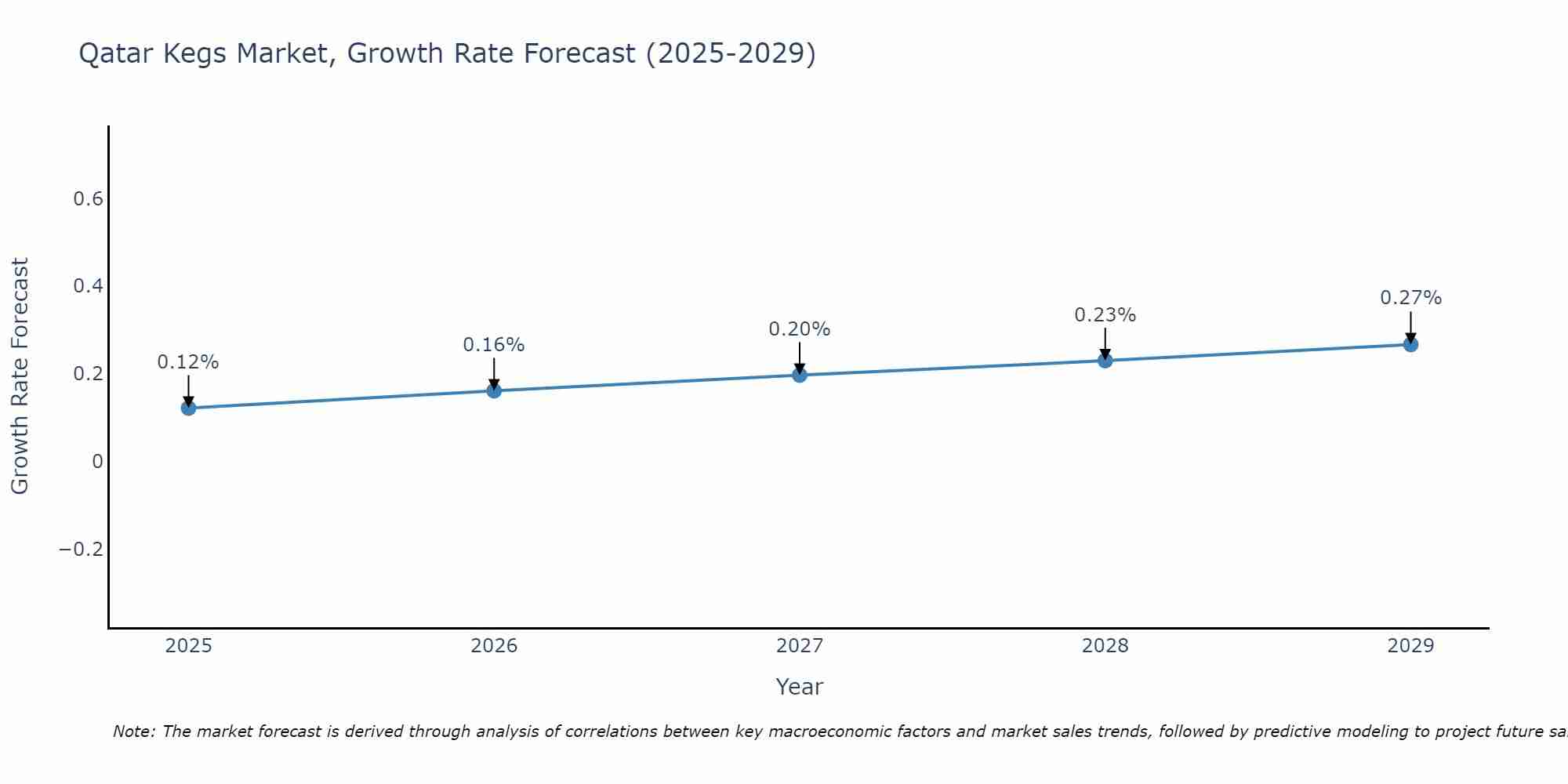
The Qatar Kegs Market is likely to experience consistent growth rate gains over the period 2025 to 2029. Commencing at 0.12% in 2025, growth builds up to 0.27% by 2029.
Qatar Kegs Market Synopsis
The Qatar kegs market has shown resilience in recent years, primarily owing to the growing popularity of craft beer and a burgeoning hospitality sector. Kegs are essential for the storage and dispensing of draft beverages, and with the rise of microbreweries and bars, the demand for kegs has surged. Qatar beverage industry, including the craft beer segment, has experienced remarkable growth, thus boosting the kegs market. Furthermore, sustainability concerns have led to a shift from single-use containers to reusable kegs, driving further market expansion.
Drivers of the Market
The kegs market in Qatar has been influenced by the country`s evolving beverage consumption patterns and preferences. With a growing population and an increasing inclination toward social gatherings and events, the demand for keg-packaged beverages, such as beer and other beverages, has risen. The hospitality sector`s expansion, coupled with changing consumer preferences for draft beverages, has driven the growth of the kegs market in Qatar. Additionally, sustainability concerns have led to a shift away from single-use containers, further boosting the demand for kegs.
Challenges of the Market
The Qatar kegs market encounters distinct challenges driven by cultural and regulatory factors. The consumption of alcoholic beverages is subject to strict regulations in Qatar due to Islamic principles, limiting the potential customer base for keg products. Additionally, cultural norms surrounding communal drinking and preferences for individual packaging can impact the adoption of kegs, requiring targeted marketing efforts to reshape perceptions. Maintaining the quality and freshness of beverages within kegs in the region`s extreme climate conditions also presents logistical and technical challenges.
COVID-19 Impact on the Market
The Qatar kegs market, catering to the beverage and hospitality sectors, felt the impact of the COVID-19 pandemic. With restrictions on public gatherings and the closure of restaurants and bars, the demand for kegs declined sharply. The beverage industry, including alcoholic beverages and non-alcoholic drinks, faced challenges as consumer preferences shifted and supply chains were disrupted. The market players had to explore alternative distribution channels and packaging solutions. As restrictions eased and social activities resumed, the market showed signs of recovery. However, the extent of recovery depended on the revival of the hospitality sector and the adaptability of businesses to changing consumer behaviors.
Key Players in the Market
In the Qatar kegs market, several companies are leading the way in providing kegs for the beverage industry. Notable players in this market include AMCOR, Franke Beverage Systems, and Petainer. These companies manufacture and supply kegs of various sizes and materials to support the storage and distribution of beverages such as beer and soft drinks.
Key Highlights of the Report:
- Qatar Kegs Market Outlook
- Market Size of Qatar Kegs Market, 2024
- Forecast of Qatar Kegs Market, 2031
- Historical Data and Forecast of Qatar Kegs Revenues & Volume for the Period 2021-2031
- Qatar Kegs Market Trend Evolution
- Qatar Kegs Market Drivers and Challenges
- Qatar Kegs Price Trends
- Qatar Kegs Porter's Five Forces
- Qatar Kegs Industry Life Cycle
- Historical Data and Forecast of Qatar Kegs Market Revenues & Volume By Material for the Period 2021-2031
- Historical Data and Forecast of Qatar Kegs Market Revenues & Volume By Plastic for the Period 2021-2031
- Historical Data and Forecast of Qatar Kegs Market Revenues & Volume By Tin for the Period 2021-2031
- Historical Data and Forecast of Qatar Kegs Market Revenues & Volume By Stainless Steel for the Period 2021-2031
- Historical Data and Forecast of Qatar Kegs Market Revenues & Volume By Capacity for the Period 2021-2031
- Historical Data and Forecast of Qatar Kegs Market Revenues & Volume By Up to 20 Liter for the Period 2021-2031
- Historical Data and Forecast of Qatar Kegs Market Revenues & Volume By 20 Liter to 40 Liter for the Period 2021-2031
- Historical Data and Forecast of Qatar Kegs Market Revenues & Volume By 40 Liter to 60 Liter for the Period 2021-2031
- Historical Data and Forecast of Qatar Kegs Market Revenues & Volume By Above 60 Liter for the Period 2021-2031
- Historical Data and Forecast of Qatar Kegs Market Revenues & Volume By End Use for the Period 2021-2031
- Historical Data and Forecast of Qatar Kegs Market Revenues & Volume By Alcoholic Beverages for the Period 2021-2031
- Historical Data and Forecast of Qatar Kegs Market Revenues & Volume By Non-Alcoholic Beverages for the Period 2021-2031
- Historical Data and Forecast of Qatar Kegs Market Revenues & Volume By Cooking Oil for the Period 2021-2031
- Historical Data and Forecast of Qatar Kegs Market Revenues & Volume By Chemicals for the Period 2021-2031
- Historical Data and Forecast of Qatar Kegs Market Revenues & Volume By Others for the Period 2021-2031
- Historical Data and Forecast of Qatar Kegs Market Revenues & Volume By Distribution Channel for the Period 2021-2031
- Historical Data and Forecast of Qatar Kegs Market Revenues & Volume By Supermarket/Hypermarket for the Period 2021-2031
- Historical Data and Forecast of Qatar Kegs Market Revenues & Volume By Commercial Liquor Store for the Period 2021-2031
- Historical Data and Forecast of Qatar Kegs Market Revenues & Volume By Others for the Period 2021-2031
- Qatar Kegs Import Export Trade Statistics
- Market Opportunity Assessment By Material
- Market Opportunity Assessment By Capacity
- Market Opportunity Assessment By End Use
- Market Opportunity Assessment By Distribution Channel
- Qatar Kegs Top Companies Market Share
- Qatar Kegs Competitive Benchmarking By Technical and Operational Parameters
- Qatar Kegs Company Profiles
- Qatar Kegs Key Strategic Recommendations






































