United States (US) Kegs Market Top 5 Importing Countries and Market Competition (HHI) Analysis
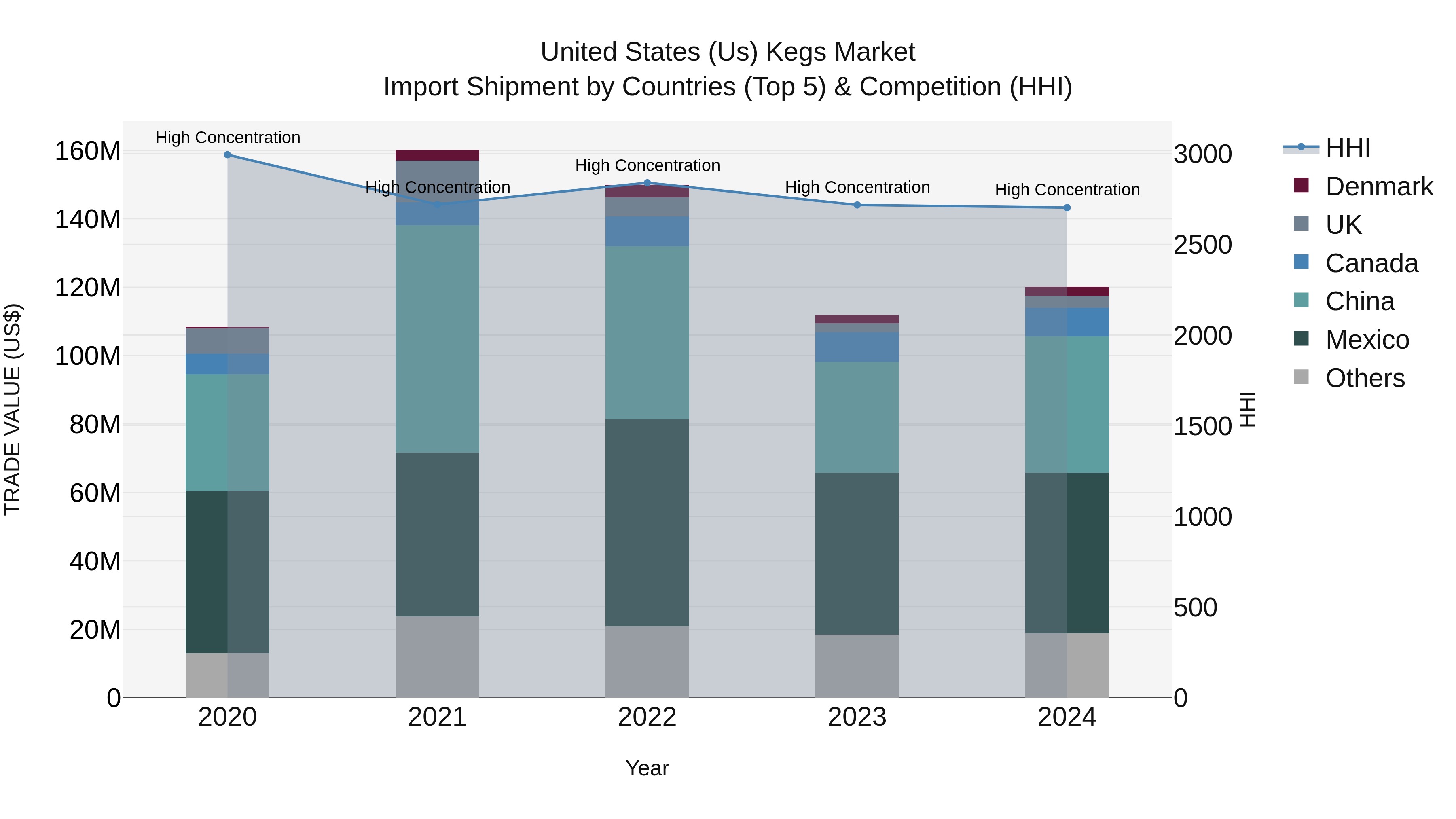
The United States kegs import market in 2024 continued to see significant contributions from key exporting countries including Mexico, China, Canada, UK, and Japan. Despite high concentration with a high Herfindahl-Hirschman Index (HHI), the market maintained a steady growth trajectory with a Compound Annual Growth Rate (CAGR) of 2.58% from 2020 to 2024. The growth momentum was particularly strong in 2024, with a notable growth rate of 7.43% compared to the previous year, indicating a robust demand for kegs imports in the US.
United States (US) Kegs Market Overview
The United States kegs market is witnessing steady growth driven by the increasing popularity of craft beer and the growing trend of draft beer consumption in various establishments. The market is characterized by a wide range of keg sizes, materials, and types, catering to the diverse needs of breweries, bars, restaurants, and event organizers. Stainless steel kegs dominate the market due to their durability, ease of cleaning, and recyclability. Key players in the US kegs market include American Keg Company, Franke Beverage Systems, and Blefa Kegs Inc., among others. The market is also witnessing a shift towards environmentally friendly kegs, with a focus on sustainability and reducing carbon footprint. Overall, the US kegs market is expected to continue its growth trajectory, driven by the increasing demand for quality draft beer experiences.
United States (US) Kegs Market Trends
The US Kegs Market is experiencing several key trends. One significant trend is the increasing popularity of craft beer and small-batch brewing, leading to a higher demand for kegs to serve these unique brews. Another trend is the growing preference for environmentally friendly packaging solutions, driving the adoption of stainless steel kegs over traditional disposable options. Additionally, the rise of home kegerators and draft systems in residential settings is fueling the demand for smaller kegs for personal use. The market is also witnessing a shift towards digital solutions such as keg tracking and monitoring systems to optimize keg management and improve operational efficiency. Overall, the US Kegs Market is evolving to meet the changing preferences and needs of consumers and businesses in the beverage industry.
United States (US) Kegs Market Challenges
The US kegs market faces several challenges, including increasing competition from alternative packaging formats such as cans and bottles, shifting consumer preferences towards craft beers and premium offerings, regulatory hurdles related to alcohol distribution and sales, and the impact of the COVID-19 pandemic on the on-premise consumption channels. Additionally, logistical challenges such as transportation costs and supply chain disruptions can also pose difficulties for keg manufacturers and distributors. Adapting to changing consumer trends, navigating complex regulations, and ensuring efficient operations in the face of external disruptions are key challenges that players in the US kegs market need to address to maintain their competitive edge and drive growth in the industry.
United States (US) Kegs Market Investment Opportunities
The United States kegs market presents various investment opportunities for both existing players and new entrants. With the increasing popularity of craft breweries and the growing trend of consumers preferring draft beer over bottled beer, there is a rising demand for kegs in the US. Investing in keg manufacturing companies that offer innovative and sustainable keg solutions can be lucrative. Additionally, there is potential for growth in the rental and leasing of kegs to breweries and bars, as well as in keg tracking and management systems to streamline operations. As the craft beer industry continues to expand and evolve, investing in the US kegs market can offer attractive returns for investors looking to capitalize on the changing preferences of consumers in the beverage industry.
United States (US) Kegs Market Government Policy
In the United States, the kegs market is subject to various government regulations and policies. The Alcohol and Tobacco Tax and Trade Bureau (TTB) oversees the production, distribution, and sale of alcoholic beverages, including kegs. Brewers and distributors must comply with TTB regulations regarding labeling, alcohol content, and taxation. Additionally, individual states have their own regulations regarding the sale and distribution of alcoholic beverages, which can impact the kegs market. Some states require specific permits or licenses for businesses that sell or serve kegs, and they may also have restrictions on where and how kegs can be sold. Overall, government policies play a significant role in shaping the kegs market in the US, impacting everything from production to distribution and sales.
United States (US) Kegs Market Future Outlook
The United States kegs market is poised for steady growth in the coming years, driven by the rising popularity of craft beer and the increasing preference for on-premise consumption at bars, restaurants, and events. The demand for kegs is expected to be fueled by the convenience they offer in serving large quantities of beer and their eco-friendly reusable nature. Additionally, technological advancements in keg design, such as smart kegs with tracking capabilities, are likely to further enhance market growth. However, challenges such as the increasing competition from alternative packaging formats like cans and bottles, as well as regulatory constraints, may impact the market dynamics. Overall, the US kegs market is forecasted to expand as the craft beer industry continues to flourish and consumer preferences evolve.
Key Highlights of the Report:
- United States (US) Kegs Market Outlook
- Market Size of United States (US) Kegs Market, 2021
- Forecast of United States (US) Kegs Market, 2031
- Historical Data and Forecast of United States (US) Kegs Revenues & Volume for the Period 2018 - 2031
- United States (US) Kegs Market Trend Evolution
- United States (US) Kegs Market Drivers and Challenges
- United States (US) Kegs Price Trends
- United States (US) Kegs Porter's Five Forces
- United States (US) Kegs Industry Life Cycle
- Historical Data and Forecast of United States (US) Kegs Market Revenues & Volume By Material for the Period 2018 - 2031
- Historical Data and Forecast of United States (US) Kegs Market Revenues & Volume By Plastic for the Period 2018 - 2031
- Historical Data and Forecast of United States (US) Kegs Market Revenues & Volume By Tin for the Period 2018 - 2031
- Historical Data and Forecast of United States (US) Kegs Market Revenues & Volume By Stainless Steel for the Period 2018 - 2031
- Historical Data and Forecast of United States (US) Kegs Market Revenues & Volume By Capacity for the Period 2018 - 2031
- Historical Data and Forecast of United States (US) Kegs Market Revenues & Volume By Up to 20 Liter for the Period 2018 - 2031
- Historical Data and Forecast of United States (US) Kegs Market Revenues & Volume By 20 Liter to 40 Liter for the Period 2018 - 2031
- Historical Data and Forecast of United States (US) Kegs Market Revenues & Volume By 40 Liter to 60 Liter for the Period 2018 - 2031
- Historical Data and Forecast of United States (US) Kegs Market Revenues & Volume By Above 60 Liter for the Period 2018 - 2031
- Historical Data and Forecast of United States (US) Kegs Market Revenues & Volume By End Use for the Period 2018 - 2031
- Historical Data and Forecast of United States (US) Kegs Market Revenues & Volume By Alcoholic Beverages for the Period 2018 - 2031
- Historical Data and Forecast of United States (US) Kegs Market Revenues & Volume By Non-Alcoholic Beverages for the Period 2018 - 2031
- Historical Data and Forecast of United States (US) Kegs Market Revenues & Volume By Cooking Oil for the Period 2018 - 2031
- Historical Data and Forecast of United States (US) Kegs Market Revenues & Volume By Chemicals for the Period 2018 - 2031
- Historical Data and Forecast of United States (US) Kegs Market Revenues & Volume By Others for the Period 2018 - 2031
- Historical Data and Forecast of United States (US) Kegs Market Revenues & Volume By Distribution Channel for the Period 2018 - 2031
- Historical Data and Forecast of United States (US) Kegs Market Revenues & Volume By Supermarket/Hypermarket for the Period 2018 - 2031
- Historical Data and Forecast of United States (US) Kegs Market Revenues & Volume By Commercial Liquor Store for the Period 2018 - 2031
- Historical Data and Forecast of United States (US) Kegs Market Revenues & Volume By Others for the Period 2018 - 2031
- United States (US) Kegs Import Export Trade Statistics
- Market Opportunity Assessment By Material
- Market Opportunity Assessment By Capacity
- Market Opportunity Assessment By End Use
- Market Opportunity Assessment By Distribution Channel
- United States (US) Kegs Top Companies Market Share
- United States (US) Kegs Competitive Benchmarking By Technical and Operational Parameters
- United States (US) Kegs Company Profiles
- United States (US) Kegs Key Strategic Recommendations






































