Qatar Leather Belts Market Summary
The qatar leather belts market was estimated at USD 354 Million in 2025 and is projected to reach USD 487 Million by 2032, growing at a CAGR of 5.8% from 2026 to 2032.
Qatar Leather Belts Market Year-wise Growth Rate and Key Drivers
This graph highlights how the Qatar Leather Belts Market has steadily grown over the past five years, supported by major growth factors.
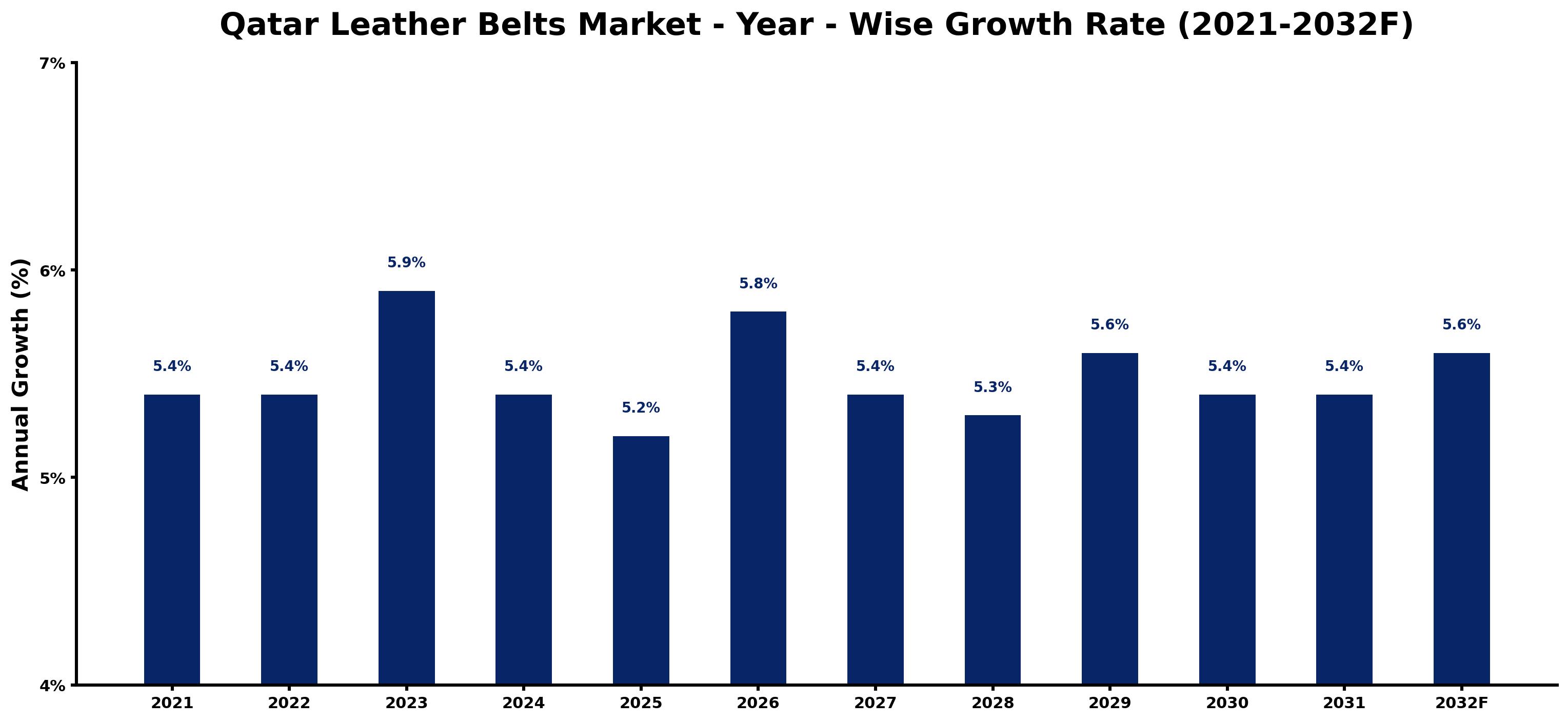
The table below presents the year wise growth rates along with the key drivers influencing the market
| Year | Growth Rate | Major Drivers |
| 2021 | 5.4% | Post-lockdown retail projects spurred renewed interest in high-quality leather accessories. |
| 2022 | 5.4% | Emerging fashion trends emphasized personalized and bespoke leather products, boosting local demand. |
| 2023 | 5.9% | Local artisans gained popularity, enhancing the appeal of handmade leather belts in Qatar. |
| 2024 | 5.4% | Increased tourism attracted international brands, expanding the leather belt retail landscape. |
| 2025 | 5.2% | Social media influencers promoted luxury leather goods, shaping consumer preferences significantly. |
| 2026 | 5.8% | Economic stability facilitated consumer spending on premium leather accessories, enhancing market growth. |
| 2027 | 5.4% | Qatar's expanding expatriate community diversified the demand for varied leather styles. |
| 2028 | 5.3% | Sustainability trends drove interest in eco-friendly leather production methods among consumers. |
| 2029 | 5.6% | Corporate culture shifts encouraged employees to adopt formal wear, boosting leather belt sales. |
| 2030 | 5.4% | Significant retail development projects created more distribution channels for leather products. |
| 2031 | 5.4% | Events like the World Cup showcased local craftsmanship, elevating brand visibility regionally. |
| 2032 | 5.6% | E-commerce platforms facilitated easier access to niche leather products, expanding market reach. |
Note - Market size estimations and growth projections presented in this report are based on 6Wresearch's advanced forecasting approach, validated with industry datasets as of June 2026.
Qatar Leather Belts Market Synopsis
The Qatar Leather Belts Market is projected to reach 5.8% and witness significant growth during the forecast period (2026-2032). This market is positioned favorably within the luxury goods sector, benefiting from the country's dynamic economy and increasing disposable incomes. The growing trend towards premium leather products, including belts, is largely driven by Qatar's burgeoning status as a luxury shopping destination. Furthermore, government initiatives aimed at enhancing infrastructure and promoting tourism are expected to bolster demand for leather accessories throughout the forecast period.
Qatar Leather Belts Market Growth Drivers
The growth of the Qatar Leather Belts Market can be attributed to several key drivers:
- Rising disposable incomes among Qatari consumers, driven by high GDP per capita, are significantly increasing the demand for luxury items, including leather belts.
- The continued advancement of manufacturing technologies has enhanced design capabilities, allowing for innovative products that cater to evolving consumer preferences.
- Government policies to promote tourism, such as visa-free entry for citizens from numerous countries, have led to an influx of international visitors, heightening the demand for premium leather goods.
- Significant investments in the fashion sector are expected to provide further impetus to the market, creating opportunities for differentiation and premium product offerings.
- Increased marketing activities and promotional campaigns by local retailers have ramped up consumer awareness and interest in luxury leather products.
Qatar Leather Belts Market Challenges and Restraints
Despite the positive growth trajectory, the Qatar Leather Belts Market faces challenges that could hinder its progress:
- Bureaucratic procedures associated with imports can lead to significant delays, causing disruptions in supply chains and increasing costs for domestic manufacturers.
- The economic ramifications of the COVID-19 pandemic have highlighted vulnerabilities in production cycles, leading to increased operational challenges.
- The fluctuation in raw material costs may result in price volatility, which could deter consumers from making purchases.
- Intense competition from both domestic and international brands can lead to pricing pressures, making it difficult for local manufacturers to maintain profitability.
- Changing fashion trends can lead to rapid shifts in consumer preferences, posing risks for manufacturers that may not be able to adapt quickly enough.
Qatar Leather Belts Market Government Investment and Initiatives
The Qatari government has been actively investing in initiatives designed to enhance the attractiveness of the country for luxury goods markets, including leather belts. Infrastructure improvements, such as the development of modern retail spaces and enhanced connectivity, play a pivotal role in establishing Qatar as a prime shopping destination. The National Vision 2030 framework emphasizes economic diversification and the promotion of tourism, leading to increased public spending on facilities that support retail growth. These initiatives not only foster foreign investment but also create a conducive environment for local manufacturers to thrive.
Qatar Leather Belts Market Latest Developments (May 2025 - June 2026)
Recent developments in the Qatar Leather Belts Market indicate a robust trajectory towards growth, with several notable trends emerging between May 2025 and June 2026. Manufacturers are increasingly focusing on sustainable practices, responding to consumer demand for eco-friendly products. Innovative designs have entered the market, reflecting a blend of traditional craftsmanship with modern aesthetics, appealing to a younger audience. Additionally, retailers are enhancing their online presence to cater to the growing trend of e-commerce. Enhanced marketing strategies are being deployed to solidify brand awareness and consumer loyalty, particularly in the luxury segment. Furthermore, collaborative ventures between designers and retailers are becoming more prevalent, leading to exclusive product lines that enrich the market offering.
Qatar Leather Belts Market - Key Attractiveness of the Report
- 10 Years of Market Numbers
- Historical Data Starting from 2022 to 2025
- Base Year: 2025
- Forecast Data until 2032
- Key Performance Indicators Impacting the Market
- Major Upcoming Developments and Projects
Key Highlights of the Report:
- Qatar Leather Belts Market Outlook
- Market Size of Qatar Leather Belts Market, 2025
- Forecast of Qatar Leather Belts Market, 2032
- Historical Data and Forecast of Qatar Leather Belts Revenues & Volume for the Period 2022-2032F
- Qatar Leather Belts Market Trend Evolution
- Qatar Leather Belts Market Drivers and Challenges
- Qatar Leather Belts Price Trends
- Qatar Leather Belts Porter's Five Forces
- Qatar Leather Belts Industry Life Cycle
- Historical Data and Forecast of Qatar Leather Belts Market Revenues & Volume By Type for the Period 2022-2032F
- Historical Data and Forecast of Qatar Leather Belts Market Revenues & Volume By Man for the Period 2022-2032F
- Historical Data and Forecast of Qatar Leather Belts Market Revenues & Volume By Woman for the Period 2022-2032F
- Historical Data and Forecast of Qatar Leather Belts Market Revenues & Volume By Application for the Period 2022-2032F
- Historical Data and Forecast of Qatar Leather Belts Market Revenues & Volume By Business for the Period 2022-2032F
- Historical Data and Forecast of Qatar Leather Belts Market Revenues & Volume By Leisure for the Period 2022-2032F
- Historical Data and Forecast of Qatar Leather Belts Market Revenues & Volume By Other for the Period 2022-2032F
- Qatar Leather Belts Import Export Trade Statistics
- Market Opportunity Assessment By Type
- Market Opportunity Assessment By Application
- Qatar Leather Belts Top Companies Market Share
- Qatar Leather Belts Competitive Benchmarking By Technical and Operational Parameters
- Qatar Leather Belts Company Profiles
- Qatar Leather Belts Key Strategic Recommendations






































