Qatar Machine tools Market Summary
The qatar machine tools market was estimated at USD 239 Million in 2025 and is projected to reach USD 323 Million by 2032, growing at a CAGR of 5.5% from 2026 to 2032.
Qatar Machine tools Market Year-wise Growth Rate and Key Drivers
This graph highlights how the Qatar Machine tools Market has steadily grown over the past five years, supported by major growth factors.
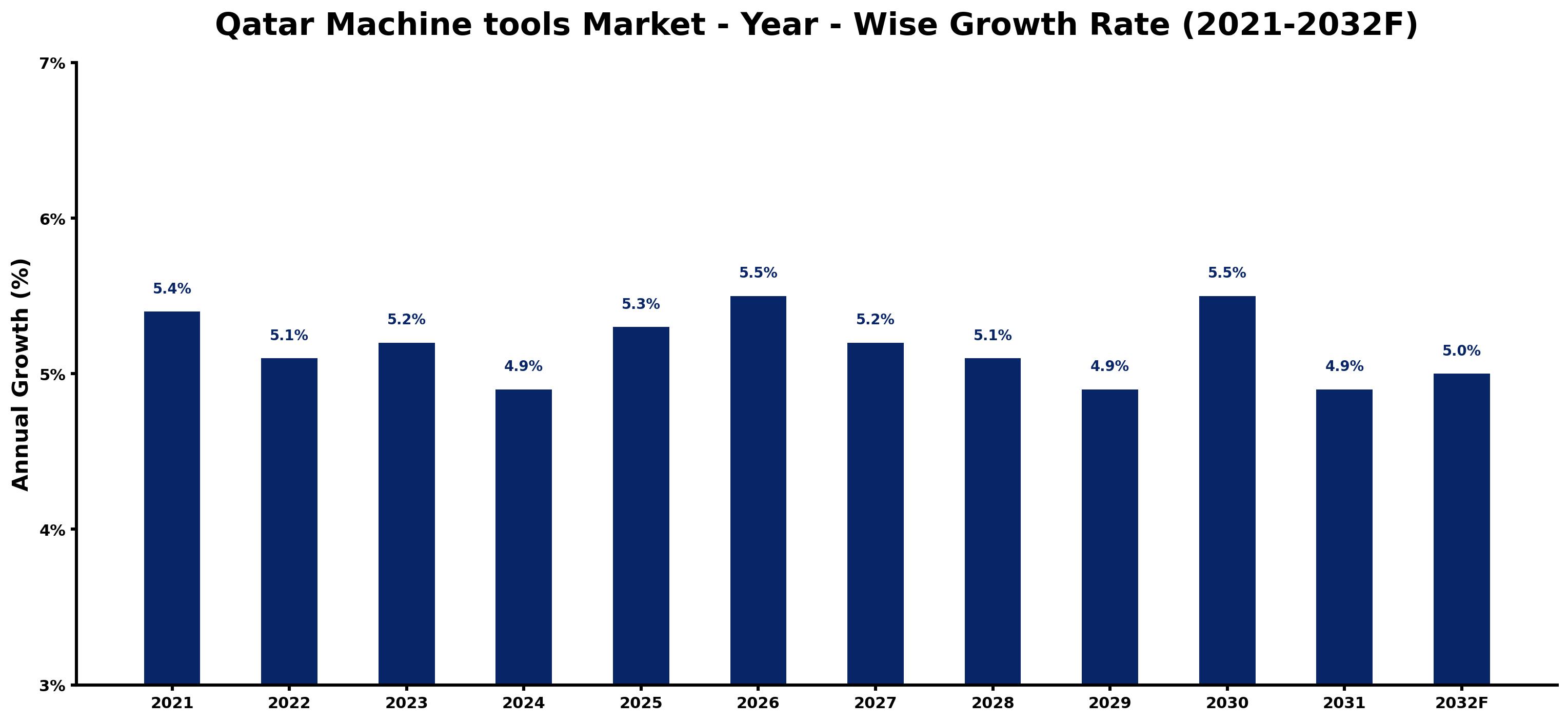
The table below presents the year wise growth rates along with the key drivers influencing the market
| Year | Growth Rate | Major Drivers |
| 2021 | 5.4% | Post-pandemic recovery led to a surge in construction and manufacturing activities. |
| 2022 | 5.1% | Local manufacturing initiatives gained traction, reducing dependence on imported machine tools. |
| 2023 | 5.2% | Qatar's infrastructure projects created substantial demand for precision engineering solutions. |
| 2024 | 4.9% | International collaborations boosted technology transfer, enhancing the local machine tools sector. |
| 2025 | 5.3% | Focus on industrial automation led to increased investment in advanced machinery. |
| 2026 | 5.5% | The oil and gas sector's expansion required specialized tools for enhanced production. |
| 2027 | 5.2% | Shifts towards sustainable practices spurred demand for energy-efficient machine tools. |
| 2028 | 5.1% | Emergence of smart factories created opportunities for IoT-enabled machine technologies. |
| 2029 | 4.9% | Regional trade agreements facilitated easier access to high-quality machinery and components. |
| 2030 | 5.5% | Rapid urbanization in Qatar necessitated advanced tools for construction and infrastructure. |
| 2031 | 4.9% | The emphasis on skilled workforce development supported machine tools market growth. |
| 2032 | 5.0% | Technological innovation in additive manufacturing reshaped traditional machine tools landscape. |
Note - Market size estimations and growth projections presented in this report are based on 6Wresearch's advanced forecasting approach, validated with industry datasets as of June 2026.
Qatar Machine tools Market Synopsis
The Qatar Machine tools Market is projected to reach 5.5% and witness significant growth during the forecast period (2026-2032). This growth trajectory is primarily driven by factors including the steady increase in demand for both consumer and industrial goods, the expansion of the automobile sector, and substantial government investments in infrastructure development projects throughout the country. Furthermore, there has been a notable surge in foreign direct investment (FDI) directed towards the manufacturing sector, spurred by favorable regulatory frameworks established by the Qatari government. Technological progress in areas such as automation and robotics is also fostering enhancements in manufacturing efficiency, cost reduction, and product quality, contributing to the heightened demand for machine tools in Qatar.
Qatar Machine tools Market Growth Drivers
The Qatar Machine tools Market is underpinned by several key growth drivers that are expected to fuel demand over the forecast period:
- Increased disposable income levels among consumers are resulting in a higher demand for diverse consumer and industrial goods, thus enhancing the prospects for machine tools in the region.
- The automotive sector is witnessing escalating investments, which are facilitating research and development activities that ultimately boost machine tool sales.
- Major infrastructure development projects aligned with the National Vision 2031 are generating a steady demand for machine tools, as significant construction and engineering projects necessitate advanced machinery.
- The government's proactive approach towards enhancing manufacturing capabilities through FDI is expected to improve the overall competitiveness of local machine tool manufacturers.
- Technological advancements providing automation solutions are not only reducing production costs but also augmenting the quality of products manufactured, leading to a robust demand for machine tools.
Qatar Machine tools Market Challenges and Restraints
Despite the optimistic growth outlook, the Qatar Machine tools Market faces several challenges that could impact profitability and operational efficiency:
- The high capital costs associated with advanced machine tools can make them unaffordable for smaller operators, which may inhibit their market penetration and profitability.
- A shortage of skilled labor capable of operating complex machinery presents a challenge for manufacturers, leading to potential operational delays and increased costs.
- Extended completion timelines for projects may lead to increased operational expenditures, diminishing the overall profitability of machine tool providers.
- Fluctuating raw material prices can affect manufacturing costs, thereby influencing pricing strategies and profit margins for machine tool manufacturers.
- Challenges related to technological adaptation and integration into existing manufacturing processes can hinder efficiency gains expected from new machinery investments.
Qatar Machine tools Market Government Investment and Initiatives
The Qatari government has adopted a range of strategic initiatives aimed at boosting the local machine tools market. Public spending on infrastructure projects has significantly increased, driven by national development plans that emphasize the importance of innovative manufacturing solutions. The government's investment in sectors aligned with its Vision 2031 has catalyzed projects emphasizing transportation, energy, and construction. These initiatives are complemented by various incentives aimed at encouraging foreign direct investment in the manufacturing sector, creating a conducive environment for machine tools market growth. Additionally, regulatory frameworks are being implemented to streamline the process for securing permits and licenses, which further facilitates market entry for new players and enhances operational efficiencies for existing manufacturers.
Qatar Machine tools Market Latest Developments (May 2025 - June 2026)
The timeframe from May 2025 to June 2026 has marked a period of significant developments within the Qatar Machine tools Market. Industry stakeholders have focused on refining their operational strategies to align with the evolving market landscape, including the adoption of more sophisticated manufacturing technologies. There has been a noticeable increase in collaborations between local enterprises and foreign manufacturers, fostering knowledge transfer and elevating technological capabilities. Additionally, the emphasis on sustainability is reshaping investment strategies, with more resources directed towards eco-friendly manufacturing practices. This period has also seen an uptick in government-sponsored programs aimed at enhancing workforce skills, which is essential for maximizing the potential of advanced machine tools in the market.
Qatar Machine tools Market - Key Attractiveness of the Report
- 10 Years of Market Numbers
- Historical Data Starting from 2022 to 2025
- Base Year: 2025
- Forecast Data until 2032
- Key Performance Indicators Impacting the Market
- Major Upcoming Developments and Projects
Key Highlights of the Report:
- Qatar Machine tools Market Outlook
- Market Size of Qatar Machine tools Market, 2025
- Forecast of Qatar Machine tools Market, 2032
- Historical Data and Forecast of Qatar Machine tools Revenues & Volume for the Period 2022-2032F
- Qatar Machine tools Market Trend Evolution
- Qatar Machine tools Market Drivers and Challenges
- Qatar Machine tools Price Trends
- Qatar Machine tools Porter's Five Forces
- Qatar Machine tools Industry Life Cycle
- Historical Data and Forecast of Qatar Machine tools Market Revenues & Volume By Product Type for the Period 2022-2032F
- Historical Data and Forecast of Qatar Machine tools Market Revenues & Volume By Milling Machines for the Period 2022-2032F
- Historical Data and Forecast of Qatar Machine tools Market Revenues & Volume By Drilling Machines for the Period 2022-2032F
- Historical Data and Forecast of Qatar Machine tools Market Revenues & Volume By Turning Machines for the Period 2022-2032F
- Historical Data and Forecast of Qatar Machine tools Market Revenues & Volume By Grinding Machines for the Period 2022-2032F
- Historical Data and Forecast of Qatar Machine tools Market Revenues & Volume By Electrical Discharge Machines for the Period 2022-2032F
- Historical Data and Forecast of Qatar Machine tools Market Revenues & Volume By Automation Type? for the Period 2022-2032F
- Historical Data and Forecast of Qatar Machine tools Market Revenues & Volume By CNC Machine Tools for the Period 2022-2032F
- Historical Data and Forecast of Qatar Machine tools Market Revenues & Volume By Conventional Machine Tools for the Period 2022-2032F
- Historical Data and Forecast of Qatar Machine tools Market Revenues & Volume By Industry Segment for the Period 2022-2032F
- Historical Data and Forecast of Qatar Machine tools Market Revenues & Volume By Automotive and Transportation for the Period 2022-2032F
- Historical Data and Forecast of Qatar Machine tools Market Revenues & Volume By Sheet Metals for the Period 2022-2032F
- Historical Data and Forecast of Qatar Machine tools Market Revenues & Volume By Capital Goods for the Period 2022-2032F
- Historical Data and Forecast of Qatar Machine tools Market Revenues & Volume By Energy for the Period 2022-2032F
- Historical Data and Forecast of Qatar Machine tools Market Revenues & Volume By Sales Channel for the Period 2022-2032F
- Historical Data and Forecast of Qatar Machine tools Market Revenues & Volume By Events and Exhibitions for the Period 2022-2032F
- Historical Data and Forecast of Qatar Machine tools Market Revenues & Volume By Dealers and Distributors for the Period 2022-2032F
- Qatar Machine tools Import Export Trade Statistics
- Market Opportunity Assessment By Product Type
- Market Opportunity Assessment By Automation Type?
- Market Opportunity Assessment By Industry Segment
- Market Opportunity Assessment By Sales Channel
- Qatar Machine tools Top Companies Market Share
- Qatar Machine tools Competitive Benchmarking By Technical and Operational Parameters
- Qatar Machine tools Company Profiles
- Qatar Machine tools Key Strategic Recommendations






































