Qatar Metal Ores Market Summary
The qatar metal ores market was estimated at USD 470 Million in 2025 and is projected to reach USD 656 Million by 2032, growing at a CAGR of 5.5% from 2026 to 2032.
Qatar Metal Ores Market Year-wise Growth Rate and Key Drivers
This graph highlights how the Qatar Metal Ores Market has steadily grown over the past five years, supported by major growth factors.
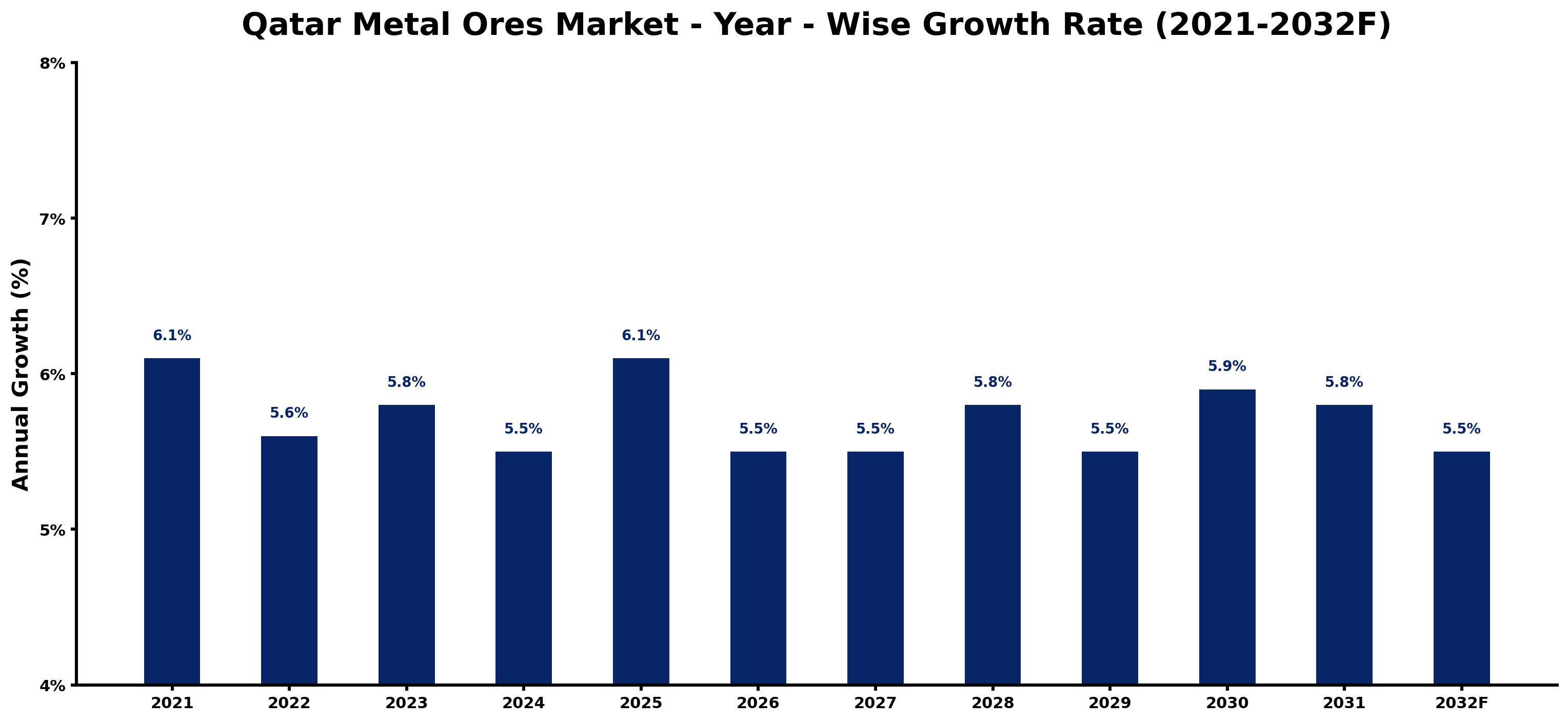
The table below presents the year wise growth rates along with the key drivers influencing the market
| Year | Growth Rate | Major Drivers |
| 2021 | 6.1% | Post-lockdown demand for construction materials supports a more robust mining sector in Qatar. |
| 2022 | 5.6% | Investment in infrastructure projects increases the need for high-grade metal ores locally. |
| 2023 | 5.8% | Qatar's hosting of global events boosts the demand for sustainable construction materials. |
| 2024 | 5.5% | Emerging tech in mining enhances extraction efficiency and reduces operational costs. |
| 2025 | 6.1% | Local manufacturers seek quality raw materials to meet growing industrial production needs. |
| 2026 | 5.5% | Strengthening trade relationships within the GCC enhances metal ore import/export activities. |
| 2027 | 5.5% | Continued urbanization prompts significant increases in metal usage across construction projects. |
| 2028 | 5.8% | Innovative recycling initiatives create opportunities for sourcing secondary metal ore materials. |
| 2029 | 5.5% | Developments in renewable energy sectors increase demand for specific metal ores like copper. |
| 2030 | 5.9% | Sustainability trends push companies to invest in eco-friendly mining and processing techniques. |
| 2031 | 5.8% | Technological advancements in mineral processing yield higher purity ores for local industry. |
| 2032 | 5.5% | Increased global competition encourages local firms to optimize and diversify ore production. |
Note - Market size estimations and growth projections presented in this report are based on 6Wresearch's advanced forecasting approach, validated with industry datasets as of June 2026.
Qatar Metal Ores Market Synopsis
The Qatar Metal Ores Market is projected to reach 5.5% and witness significant growth during the forecast period (2026-2032). Qatar's metal ore sector is a vital component of its overall economy, deriving strength from its rich mineral resources, which include metallic ores like iron ore, aluminum oxide, and titanium dioxide, as well as non-metallic ores such as silica sand and gypsum. The government's proactive stance in promoting foreign investment has set a foundation for sustained growth and development in this industry.
Qatar Metal Ores Market Growth Drivers
The growth trajectory of the Qatar Metal Ores Market can be attributed to several key factors:
- The ongoing economic expansion in Qatar has led to increased demand from construction projects, thus bolstering the need for metal ores essential for infrastructure development.
- Industrial activities, particularly those associated with oil & gas exploration and production, are contributing significantly to the demand for various metal ores, particularly iron ore, used extensively in steel manufacturing.
- The improvement in capital availability for project investments is fostering an environment where mining operations can flourish, leading to expansive growth within the sector.
- Qatar's ratification of numerous free trade agreements (FTAs) presents an attractive landscape for foreign investors, facilitating duty-free imports and enhancing Qatar's competitive edge in international markets.
- An evolving infrastructure network within Qatar simplifies logistical operations, making it more cost-effective to transport materials, thereby enhancing supply chain efficiency.
Qatar Metal Ores Market Challenges and Restraints
Despite promising growth prospects, the Qatar Metal Ores Market faces several challenges that may hinder its potential:
- Limited domestic mineral resources pose a significant constraint on mining operations, necessitating imports for certain essential materials.
- A general lack of technological expertise in modern extraction processes may impede the efficiency and effectiveness of mining activities in the region.
- Environmental concerns regarding large-scale mining operations can lead to stringent regulations, potentially slowing down project approvals and operational timelines.
- Complexities surrounding land ownership rights remain a substantial barrier, as many sites are governed by tribal laws, complicating legal negotiations for commercial exploitation.
- The impact of global economic fluctuations, exacerbated by events like the COVID-19 pandemic, can lead to volatility in demand and pricing for metal ores.
Qatar Metal Ores Market Government Investment and Initiatives
The Qatari government has committed to fostering the growth of its metal ores sector through various investment initiatives and supportive policies:
- Significant public spending on infrastructure development has opened avenues for increased consumption of metal ores, particularly in construction and related industries.
- The government offers long-term incentives to attract foreign investment, thereby enhancing operational capabilities and technological advancements in the mining sector.
- Strategic partnerships with international firms are encouraged to facilitate knowledge transfer and improve extraction technologies, ultimately enhancing productivity.
- Regulatory frameworks are being refined to streamline the permit acquisition process for mining operations, addressing previous inefficiencies that have hindered growth.
- Environmental sustainability is increasingly becoming a focus, with the government promoting practices that minimize ecological impact while encouraging resource extraction.
Qatar Metal Ores Market Latest Developments (May 2025 - June 2026)
The period from May 2025 to June 2026 has seen noteworthy developments in the Qatar Metal Ores Market, reflecting a response to both local and global market dynamics:
- The lifting of pandemic-related restrictions has led to a resurgence in demand for construction materials, thereby increasing activity in the metal ores sector.
- Recent government-led initiatives aimed at improving infrastructure have resulted in heightened consumption of metal ores, particularly in ongoing large-scale projects.
- Investment in technological advancements to optimize extraction processes has gained momentum, enhancing operational efficiency across the mining landscape.
- A notable shift towards environmentally sustainable mining practices has emerged, as companies begin to adopt methods that align with global sustainability standards.
- Increased collaboration with international stakeholders has facilitated knowledge sharing and enhanced capability within Qatar's metal ore industry.
Qatar Metal Ores Market - Key Attractiveness of the Report
- 10 Years of Market Numbers
- Historical Data Starting from 2022 to 2025
- Base Year: 2025
- Forecast Data until 2032
- Key Performance Indicators Impacting the Market
- Major Upcoming Developments and Projects
Key Highlights of the Report:
- Qatar Metal Ores Market Outlook
- Market Size of Qatar Metal Ores Market, 2025
- Forecast of Qatar Metal Ores Market, 2032
- Historical Data and Forecast of Qatar Metal Ores Revenues & Volume for the Period 2022-2032F
- Qatar Metal Ores Market Trend Evolution
- Qatar Metal Ores Market Drivers and Challenges
- Qatar Metal Ores Price Trends
- Qatar Metal Ores Porter's Five Forces
- Qatar Metal Ores Industry Life Cycle
- Historical Data and Forecast of Qatar Metal Ores Market Revenues & Volume By Product Type for the Period 2022-2032F
- Historical Data and Forecast of Qatar Metal Ores Market Revenues & Volume By Aluminum for the Period 2022-2032F
- Historical Data and Forecast of Qatar Metal Ores Market Revenues & Volume By Beryllium for the Period 2022-2032F
- Historical Data and Forecast of Qatar Metal Ores Market Revenues & Volume By Bismuth for the Period 2022-2032F
- Historical Data and Forecast of Qatar Metal Ores Market Revenues & Volume By Cadmium for the Period 2022-2032F
- Historical Data and Forecast of Qatar Metal Ores Market Revenues & Volume By Cerium for the Period 2022-2032F
- Historical Data and Forecast of Qatar Metal Ores Market Revenues & Volume By Chromium for the Period 2022-2032F
- Historical Data and Forecast of Qatar Metal Ores Market Revenues & Volume By Cobalt for the Period 2022-2032F
- Historical Data and Forecast of Qatar Aluminum Metal Ores Market Revenues & Volume By Others for the Period 2022-2032F
- Historical Data and Forecast of Qatar Metal Ores Market Revenues & Volume By Applications for the Period 2022-2032F
- Historical Data and Forecast of Qatar Metal Ores Market Revenues & Volume By Aerospace for the Period 2022-2032F
- Historical Data and Forecast of Qatar Metal Ores Market Revenues & Volume By Automotive for the Period 2022-2032F
- Historical Data and Forecast of Qatar Metal Ores Market Revenues & Volume By Electricity & energy for the Period 2022-2032F
- Historical Data and Forecast of Qatar Metal Ores Market Revenues & Volume By Construction for the Period 2022-2032F
- Historical Data and Forecast of Qatar Metal Ores Market Revenues & Volume By Packaging Fuels for the Period 2022-2032F
- Qatar Metal Ores Import Export Trade Statistics
- Market Opportunity Assessment By Product Type
- Market Opportunity Assessment By Applications
- Qatar Metal Ores Top Companies Market Share
- Qatar Metal Ores Competitive Benchmarking By Technical and Operational Parameters
- Qatar Metal Ores Company Profiles
- Qatar Metal Ores Key Strategic Recommendations






































