Qatar Mimosa Extract Market Size, Share & Growth Rate
The Qatar Mimosa Extract Market was estimated at USD 432 Million in 2025 and is projected to reach USD 588 Million by 2032, growing at a CAGR of 4.5% from 2026 to 2032. This growth is primarily fueled by an increasing consumer shift towards natural and plant-based products, a trend that resonates deeply within Qatar's wellness-conscious society. Furthermore, the extract's diverse applications in cosmetics and health supplements play a vital role in driving market expansion.
Qatar Mimosa Extract Market Year-wise Growth Rate and Key Drivers
This graph highlights how the Qatar Mimosa Extract Market has steadily grown over the years, supported by major growth factors.
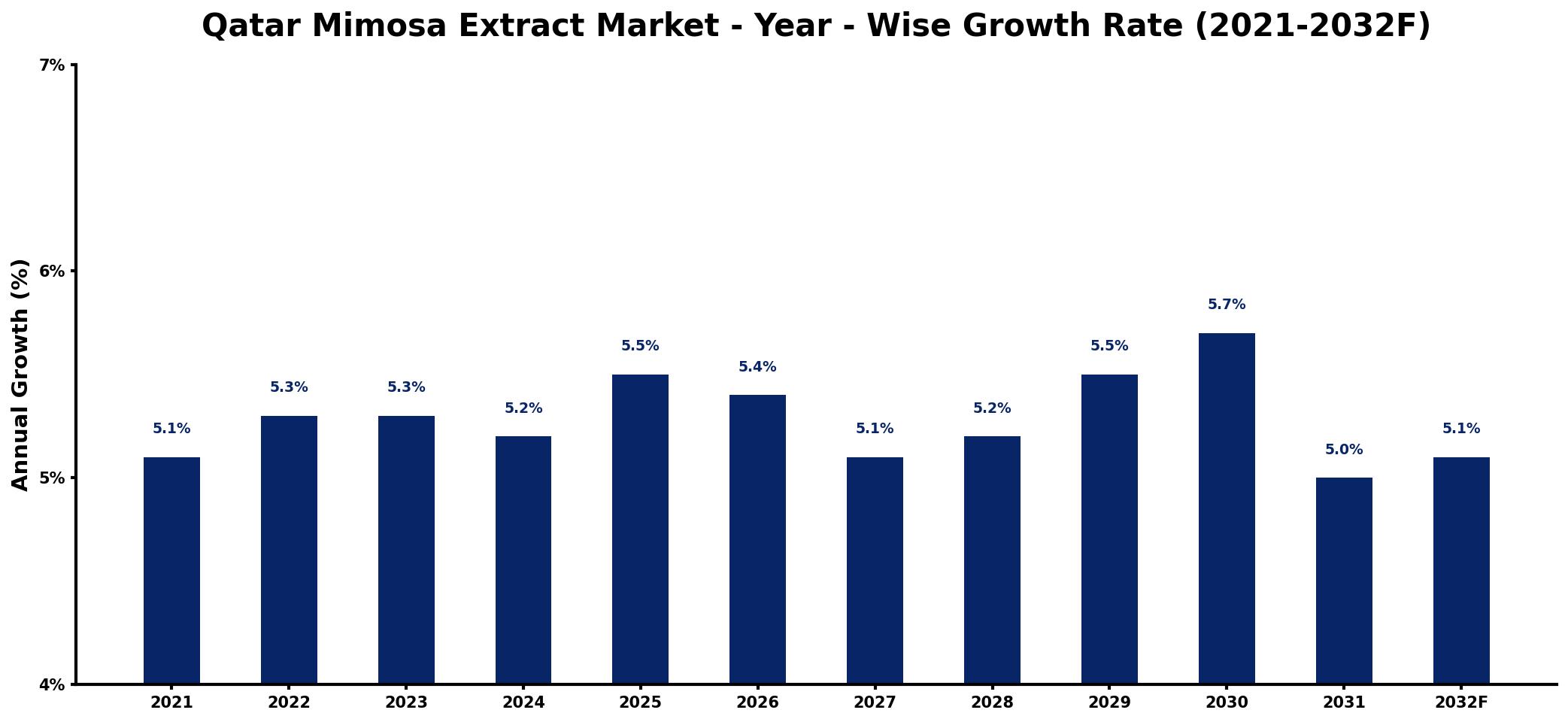
The table below presents the year‑wise growth rates along with the key drivers influencing the market
| Year | Growth Rate | Major Drivers |
| 2021 | 5.1% | Growing demand in wellness sector |
| 2022 | 5.3% | Increased investment in natural ingredients |
| 2023 | 5.3% | Expansion of health food market |
| 2024 | 5.2% | Rising popularity of herbal remedies |
| 2025 | 5.5% | Boost in organic product consumption |
| 2026 | 5.4% | Emerging trends in beauty products |
| 2027 | 5.1% | Higher consumer preference for sustainability |
| 2028 | 5.2% | Growth in dietary supplement sales |
| 2029 | 5.5% | Increased awareness of holistic health |
| 2030 | 5.7% | Surge in online retail channels |
| 2031 | 5.0% | Growing interest in plant-based solutions |
| 2032 | 5.1% | enhanced product quality standards |
Note: Market size estimations and growth projections presented in this report are based on 6Wresearch's proprietary forecasting methodology, utilizing the latest available industry data, government publications, and primary research inputs.
Qatar Mimosa Extract Market Synopsis
The most significant factor shaping the Qatar Mimosa Extract Market is the growing public interest in holistic health and wellness. As consumers become more informed about the benefits of natural extracts, the demand for mimosa extract has surged, particularly in skincare and dietary supplements, where its anti-inflammatory and antioxidant properties are highly valued.
Additionally, Qatar's commitment to maintaining high regulatory standards has helped to foster a safe environment for producers and consumers alike. As the market evolves, new product innovations and applications will continue to emerge, catering to a broad spectrum of consumer needs and preferences.
Qatar Mimosa Extract Market Key Takeaways
- The market exhibits strong growth potential, driven by rising consumer interest in natural health products.
- Mimosa extract's applications in skincare and alternative medicine are expanding rapidly.
- Qatar's regulatory framework enhances product quality and safety in the market.
- Sustainable harvesting practices will be crucial for long-term market viability.
- Awareness of mimosa extract's benefits is contributing to a gradual recovery following the COVID-19 pandemic.
Evaluation of Restraints in Qatar Mimosa Extract Market
Despite its potential, the Qatar Mimosa Extract Market faces several restraints. Sustainable sourcing practices are paramount to prevent the depletion of mimosa trees, which are essential to both the ecosystem and the industry. Additionally, maintaining high-quality standards amidst varying production techniques can be challenging, often requiring stringent quality control measures. Lastly, competition with other global markets for natural extracts can affect pricing and market entry, necessitating strategic approaches to foster growth.
Qatar Mimosa Extract Market Trends
The market is currently experiencing a pronounced trend towards clean beauty, where consumers are increasingly seeking products free from synthetic ingredients. Mimosa extract, recognized for its natural benefits, fits perfectly within this paradigm. Moreover, the rising popularity of wellness and self-care practices is prompting greater exploration of traditional remedies, further integrating mimosa extract into various health and beauty applications.
Qatar Mimosa Extract Market Opportunities
There exists a considerable opportunity for innovation within the Qatar Mimosa Extract Market. Companies can explore new formulations that combine mimosa extract with other natural ingredients to create unique products tailored to specific consumer needs. Additionally, as e-commerce continues to grow, establishing a strong online presence could unlock new customer segments, enhancing accessibility and driving sales.
Government Initiatives in the Qatar Mimosa Extract Market
The Qatari government is actively promoting the use of natural resources and sustainable practices across various sectors, including healthcare and cosmetics. Initiatives aimed at preserving biodiversity and enforcing sustainable harvesting methods are pivotal. Additionally, public spending on health and wellness campaigns supports consumer awareness and encourages the utilization of natural extracts like mimosa.
Future Insights of the Qatar Mimosa Extract Market
Looking ahead to 2026-2032, the Qatar Mimosa Extract Market is expected to continue its upward trajectory. With a deepening cultural emphasis on wellness and natural remedies, the extract's significance in both traditional and modern applications will likely expand. As consumers increasingly gravitate towards sustainability, companies that prioritize eco-friendly practices and product transparency will likely lead the market in the coming years.
Qatar Mimosa Extract Market Latest Developments (2025 - 2026)
Recent developments in the Qatar Mimosa Extract Market indicate a growing interest from local manufacturers to develop innovative product lines that highlight the benefits of mimosa extract. Collaborations between health brands and traditional herbalists have emerged, aiming to blend modern science with ancestral knowledge. These partnerships are driving not only product development but also raising consumer awareness about the health benefits associated with mimosa extract.
Qatar Mimosa Extract Market - Key Attractiveness of the Report
- 10 Years of Market Numbers
- Historical Data Starting from 2022 to 2025
- Base Year: 2025
- Forecast Data until 2032
- Key Performance Indicators Impacting the Market
- Major Upcoming Developments and Projects
Key Highlights of the Report:
- Qatar Mimosa Extract Market Outlook
- Market Size of Qatar Mimosa Extract Market, 2025
- Forecast of Qatar Mimosa Extract Market, 2032
- Historical Data and Forecast of Qatar Mimosa Extract Revenues & Volume for the Period 2022-2032F
- Qatar Mimosa Extract Market Trend Evolution
- Qatar Mimosa Extract Market Drivers and Challenges
- Qatar Mimosa Extract Price Trends
- Qatar Mimosa Extract Porter's Five Forces
- Qatar Mimosa Extract Industry Life Cycle
- Historical Data and Forecast of Qatar Mimosa Extract Market Revenues & Volume By End User for the Period 2022-2032F
- Historical Data and Forecast of Qatar Mimosa Extract Market Revenues & Volume By Forestry for the Period 2022-2032F
- Historical Data and Forecast of Qatar Mimosa Extract Market Revenues & Volume By Paper & Wood Products for the Period 2022-2032F
- Qatar Mimosa Extract Import Export Trade Statistics
- Market Opportunity Assessment By End User
- Qatar Mimosa Extract Top Companies Market Share
- Qatar Mimosa Extract Competitive Benchmarking By Technical and Operational Parameters
- Qatar Mimosa Extract Company Profiles
- Qatar Mimosa Extract Key Strategic Recommendations






































