Qatar Perchloroethylene Market Size, Share & Growth Rate
The Qatar Perchloroethylene Market was estimated at USD 919 Million in 2025 and is projected to reach USD 1310 Million by 2032, growing at a CAGR of 5.2% from 2026 to 2032. This robust growth trajectory is primarily driven by the expansion of the dry cleaning and textile industries within Qatar, where perchloroethylene remains the solvent of choice. Additionally, the automotive and manufacturing sectors are increasingly utilizing perchloroethylene for essential degreasing and cleaning applications, further bolstering market demand.
Qatar Perchloroethylene Market Year-wise Growth Rate and Key Drivers
This graph highlights how the Qatar Perchloroethylene Market has steadily grown over the years, supported by major growth factors.
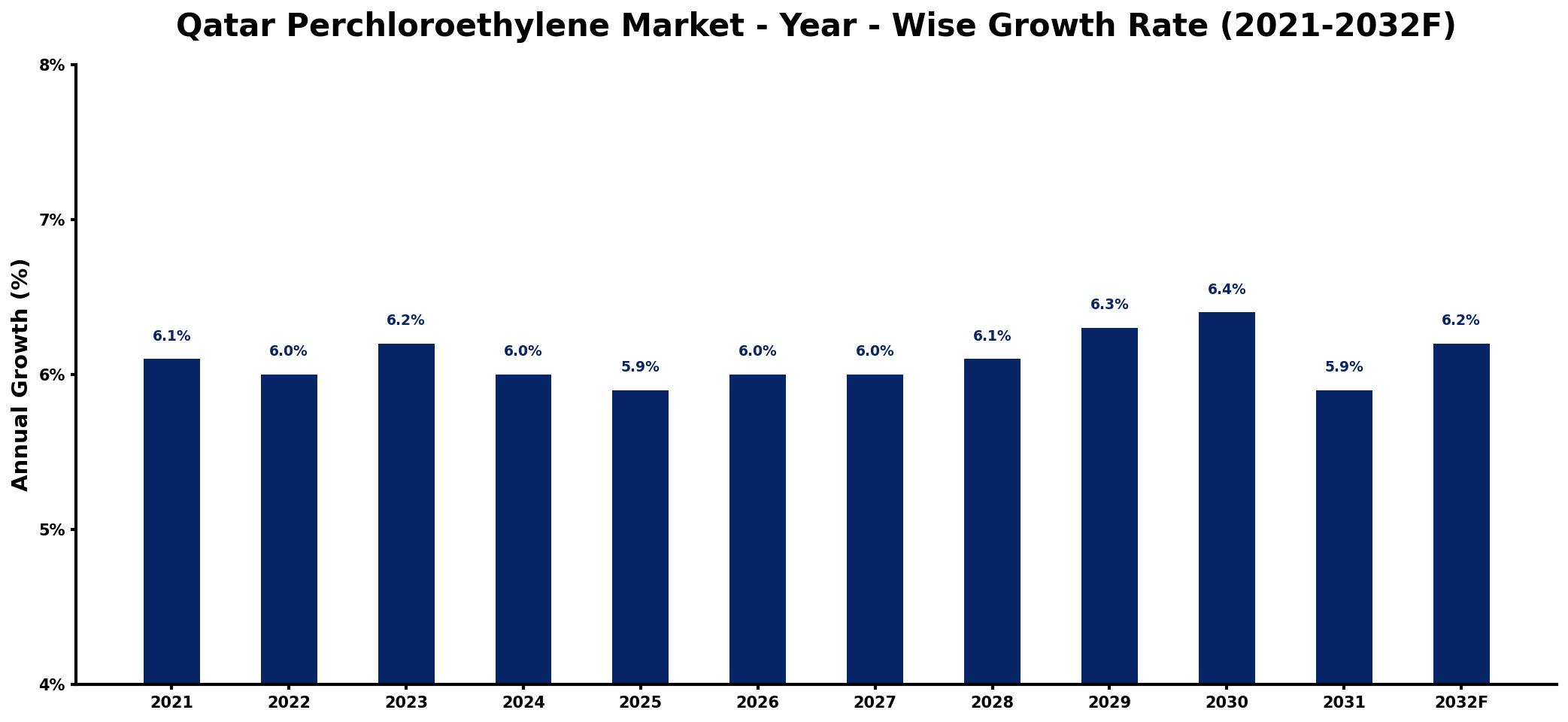
The table below presents the year‑wise growth rates along with the key drivers influencing the market
| Year | Growth Rate | Major Drivers |
| 2021 | 6.1% | increased demand from dry cleaning |
| 2022 | 6.0% | growth in industrial cleaning applications |
| 2023 | 6.2% | expansion of manufacturing facilities |
| 2024 | 6.0% | rising demand in automotive sector |
| 2025 | 5.9% | advancements in solvent technologies |
| 2026 | 6.0% | increased investment in R&D |
| 2027 | 6.0% | growing popularity in electronics sector |
| 2028 | 6.1% | higher consumption in textile industry |
| 2029 | 6.3% | increased domestic production output |
| 2030 | 6.4% | growing regional consumption patterns |
| 2031 | 5.9% | stable demand from healthcare sector |
| 2032 | 6.2% | increased usage in metal degreasing |
Note: Market size estimations and growth projections presented in this report are based on 6Wresearch's proprietary forecasting methodology, utilizing the latest available industry data, government publications, and primary research inputs.
Qatar Perchloroethylene Market Synopsis
The Qatar Perchloroethylene Market is characterized by a steady demand, particularly in the dry cleaning and textile sectors. With the country's increasing industrial activity, the reliance on perchloroethylene for various applications remains significant. Although there are growing pressures towards adopting more environmentally friendly solvents, the chemical's established usage is indicative of a resilient market.
As industries in Qatar continue to evolve, environmental regulations are becoming more stringent. This has prompted companies to not only enhance their production processes but also explore sustainable alternatives. However, the immediate future of perchloroethylene in specific industrial applications remains stable, reflecting its crucial role in current manufacturing practices.
Qatar Perchloroethylene Market Key Takeaways
- The market is anticipated to witness a compound annual growth rate (CAGR) of 5.2% from 2026 to 2032.
- Industrial growth in dry cleaning and textiles is a primary driver for demand.
- Regulatory pressures are fostering a shift towards environmentally friendly alternatives, influencing market dynamics.
- The automotive and manufacturing sectors are significant contributors to the market's stability.
- Key players are investing in sustainable practices while maintaining product quality standards.
Evaluation of Restraints in Qatar Perchloroethylene Market
While the Qatar Perchloroethylene Market shows promise, it is not without its challenges. The increasing emphasis on environmental sustainability has put pressure on traditional uses of perchloroethylene, especially in dry cleaning and industrial applications. Additionally, health concerns linked to the chemical's long-term exposure have led to heightened scrutiny from regulatory authorities. Companies operating in this space must navigate these complexities by potentially investing in alternative solvents and adhering to evolving regulations to mitigate risks and ensure compliance.
Qatar Perchloroethylene Market Trends
Recent trends in the Qatar Perchloroethylene Market include a heightened focus on eco-friendly alternatives as businesses recognize the need for sustainable solutions. The industrial sector's shift towards more advanced cleaning technologies is noteworthy, as companies seek to enhance efficiency while minimizing environmental impact. Additionally, there's a noticeable trend of integrating cutting-edge technologies in production processes, aligning with global movements towards sustainability.
Qatar Perchloroethylene Market Opportunities
The ongoing growth in the dry cleaning and textile sectors presents genuine investment opportunities for businesses focusing on perchloroethylene. Moreover, the demand for safer and greener alternatives could incentivize manufacturers to innovate, thus creating a niche market for eco-friendly solvents. As regulatory landscapes shift, the prospect for collaboration with regulatory bodies to develop safer chemical solutions is also emerging as a significant opportunity.
Government Initiatives in the Qatar Perchloroethylene Market
The Qatari government has taken significant steps to promote sustainable industrial practices, impacting the perchloroethylene market. Initiatives aimed at environmental protection and public health have led to the introduction of stricter regulations governing chemical usage. By investing in research and development for alternative solutions, the government is actively encouraging industries to transition to safer and more sustainable chemical practices.
Future Insights of the Qatar Perchloroethylene Market
Looking forward to the 2026-2032 period, the Qatar Perchloroethylene Market is expected to undergo substantial evolution. While the reliance on perchloroethylene in certain sectors is anticipated to persist, there will be increased competition from environmentally-friendly alternatives. This landscape will likely reshape how industries operate, pushing for innovation and adaptation in both cleaning methodologies and chemical production processes. As the market evolves, a collaborative approach towards sustainability will be vital.
Qatar Perchloroethylene Market Latest Developments (2025 - 2026)
Recent developments in the Qatar Perchloroethylene Market have focused on addressing sustainability concerns through new product innovations. Companies are exploring advanced formulations that reduce environmental impact while maintaining efficacy. Collaborative partnerships are also emerging, aimed at enhancing compliance with regulatory standards and promoting eco-friendly practices within the industry. This proactive approach reflects an industry on the brink of transformation, aligning more closely with global sustainability goals.
Qatar Perchloroethylene Market - Key Attractiveness of the Report
- 10 Years of Market Numbers
- Historical Data Starting from 2022 to 2025
- Base Year: 2025
- Forecast Data until 2032
- Key Performance Indicators Impacting the Market
- Major Upcoming Developments and Projects
Key Highlights of the Report:
- Qatar Perchloroethylene Market Outlook
- Market Size of Qatar Perchloroethylene Market, 2025
- Forecast of Qatar Perchloroethylene Market, 2032
- Historical Data and Forecast of Qatar Perchloroethylene Revenues & Volume for the Period 2022-2032F
- Qatar Perchloroethylene Market Trend Evolution
- Qatar Perchloroethylene Market Drivers and Challenges
- Qatar Perchloroethylene Price Trends
- Qatar Perchloroethylene Porter's Five Forces
- Qatar Perchloroethylene Industry Life Cycle
- Historical Data and Forecast of Qatar Perchloroethylene Market Revenues & Volume By Type for the Period 2022-2032F
- Historical Data and Forecast of Qatar Perchloroethylene Market Revenues & Volume By Ethylene Oxychlorination for the Period 2022-2032F
- Historical Data and Forecast of Qatar Perchloroethylene Market Revenues & Volume By Acetylene Method for the Period 2022-2032F
- Historical Data and Forecast of Qatar Perchloroethylene Market Revenues & Volume By Ethylene Direct Chlorination for the Period 2022-2032F
- Historical Data and Forecast of Qatar Perchloroethylene Market Revenues & Volume By End-use for the Period 2022-2032F
- Historical Data and Forecast of Qatar Perchloroethylene Market Revenues & Volume By Dry Cleaning Agent for the Period 2022-2032F
- Historical Data and Forecast of Qatar Perchloroethylene Market Revenues & Volume By Solvent for the Period 2022-2032F
- Historical Data and Forecast of Qatar Perchloroethylene Market Revenues & Volume By Others for the Period 2022-2032F
- Qatar Perchloroethylene Import Export Trade Statistics
- Market Opportunity Assessment By Type
- Market Opportunity Assessment By End-use
- Qatar Perchloroethylene Top Companies Market Share
- Qatar Perchloroethylene Competitive Benchmarking By Technical and Operational Parameters
- Qatar Perchloroethylene Company Profiles
- Qatar Perchloroethylene Key Strategic Recommendations






































