Qatar Point Of Sale Terminals Market Size, Share & Growth Rate
The Qatar Point Of Sale Terminals Market was estimated at USD 224 Million in 2025 and is projected to reach USD 313 Million by 2032, growing at a CAGR of 4.9% from 2026 to 2032. This growth trajectory is primarily driven by the rapid digitalization of the retail and hospitality sectors, alongside increasing consumer preferences for cashless transactions. Moreover, governmental initiatives promoting electronic payment systems are enhancing market dynamics, propelling businesses towards advanced POS solutions.
Qatar Point Of Sale Terminals Market Year-wise Growth Rate and Key Drivers
This graph highlights how the Qatar Point Of Sale Terminals Market has steadily grown over the years, supported by major growth factors.
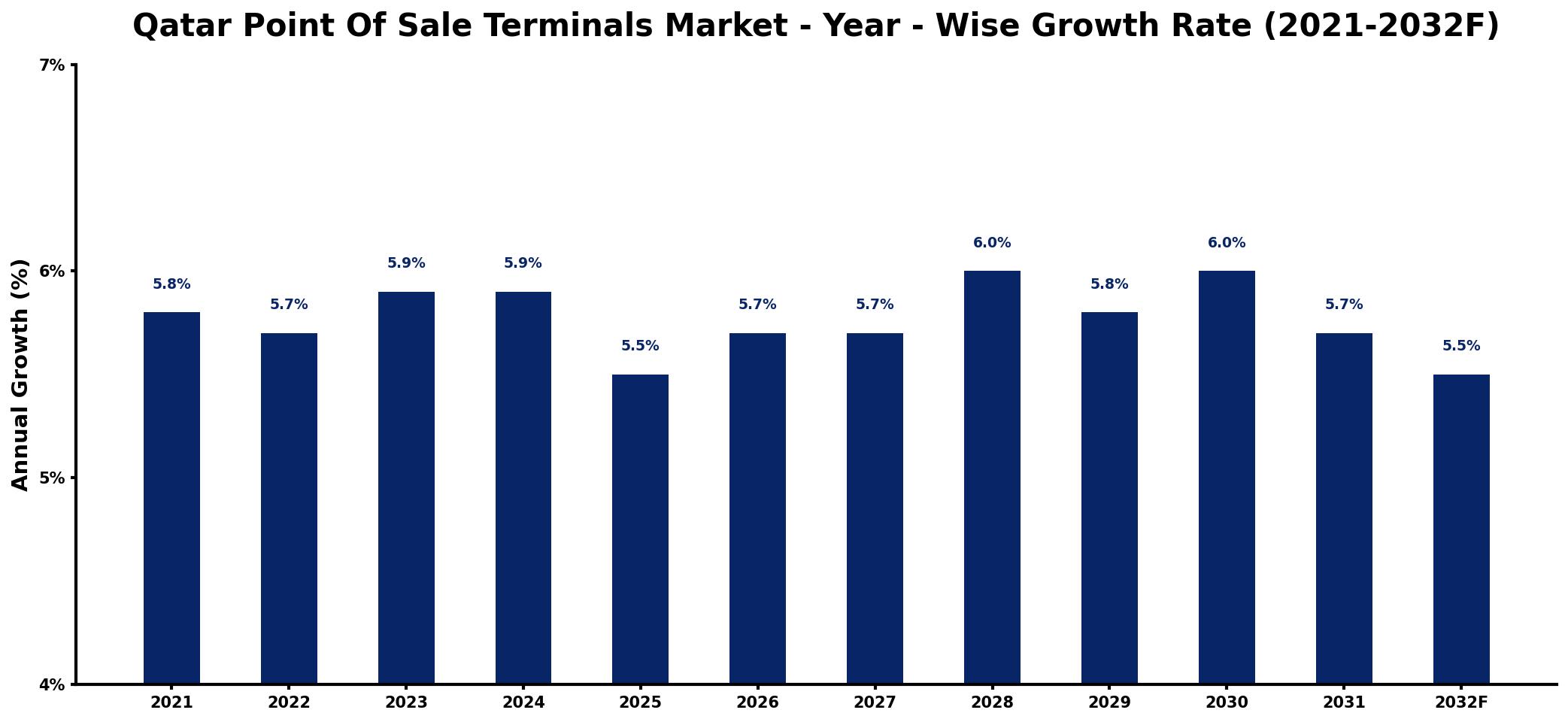
The table below presents the year‑wise growth rates along with the key drivers influencing the market
| Year | Growth Rate | Major Drivers |
| 2021 | 5.8% | Rise in cashless payment adoption |
| 2022 | 5.7% | Expansion of e-commerce platforms |
| 2023 | 5.9% | Growth in digital wallet usage |
| 2024 | 5.9% | Increased investment in fintech solutions |
| 2025 | 5.5% | Surge in retail sector modernization |
| 2026 | 5.7% | Higher demand for contactless payments |
| 2027 | 5.7% | Boost in mobile payment integrations |
| 2028 | 6.0% | growing regional consumption patterns |
| 2029 | 5.8% | increased production capacity utilization |
| 2030 | 6.0% | Increase in government digital initiatives |
| 2031 | 5.7% | growing commercial sector adoption |
| 2032 | 5.5% | stronger distribution network expansion |
Note: Market size estimations and growth projections presented in this report are based on 6Wresearch's proprietary forecasting methodology, utilizing the latest available industry data, government publications, and primary research inputs.
Qatar Point Of Sale Terminals Market Synopsis
The adoption of Point of Sale (POS) terminals in Qatar has gained significant momentum, reflecting a broader trend towards technological advancement in retail and service industries. With the rise in e-commerce and digital payments, businesses are increasingly integrating sophisticated POS systems to enhance operational efficiency and customer experience.
As Qatar continues to diversify its economy, the emphasis on modernizing payment systems aligns with the nation's strategic initiatives for financial inclusion and innovation. POS terminals are not only transforming payment processing but also facilitating better inventory management and sales tracking, critical for the evolving market landscape.
Qatar Point Of Sale Terminals Market Key Takeaways
- The market is experiencing consistent growth due to increased digital transactions and payment solutions.
- Technological advancements in POS software and hardware are shaping the competitive landscape.
- Government policies favoring cashless economies are a significant market driver.
- Retail and hospitality sectors are the primary adopters of modern POS systems, enhancing customer engagement.
- Emerging trends such as mobile payments and contactless transactions are reshaping user preferences.
Evaluation of Restraints in Qatar Point Of Sale Terminals Market
Despite the promising growth, the Qatar Point Of Sale Terminals Market faces certain constraints. One key issue is the varying levels of technological adoption across different business sectors, which can create disparities in market penetration. Furthermore, the initial investment required for advanced POS systems may deter smaller businesses from upgrading, thus slowing overall market expansion. Additionally, the evolving cyber security landscape poses risks that could affect consumer confidence in digital payment solutions.
Qatar Point Of Sale Terminals Market Trends
Recent trends in the Qatar Point Of Sale Terminals Market indicate a significant shift towards mobile and cloud-based solutions. As businesses seek more flexible and scalable options, cloud-integrated POS systems are gaining traction for their ability to provide real-time data analytics and remote management capabilities. Moreover, the integration of AI and machine learning into POS systems is enhancing predictive analytics and personalized marketing, thereby improving customer interaction.
Qatar Point Of Sale Terminals Market Opportunities
The market is ripe with opportunities, particularly in the hospitality and retail sectors, where there is a pressing need for enhanced customer engagement tools. Additionally, the ongoing push towards smart city initiatives in Qatar could provide avenues for integrating POS systems with other technologies, like IoT and data analytics, to improve operational efficiencies. As consumers continue to embrace contactless payments, businesses can capitalize on this trend by investing in modern, secure payment solutions.
Government Initiatives in the Qatar Point Of Sale Terminals Market
The Qatari government has implemented various initiatives to foster a cashless economy, notably through regulatory support for electronic payment systems. Programs aimed at promoting financial literacy and encouraging the adoption of technology in commerce are essential components of this strategy. Additionally, public spending on infrastructure to support digital transactions highlights the government's commitment to advancing the POS terminal market.
Future Insights of the Qatar Point Of Sale Terminals Market
Looking ahead to 2026-2032, the Qatar Point Of Sale Terminals Market is poised for substantial transformation. The ongoing expansion of e-commerce and shifts in consumer behavior towards digital payments are expected to fuel further growth. Additionally, as businesses increasingly prioritize operational efficiency and customer satisfaction, advanced POS technologies that integrate seamlessly with existing systems will become essential. This evolution will likely support the broader economic diversification goals of the nation.
Qatar Point Of Sale Terminals Market Latest Developments (2025 - 2026)
In recent months, the market has witnessed a surge in innovations focusing on user-friendly interfaces and enhanced security features in POS terminals. Businesses are increasingly adopting integrated systems that combine payment processing with inventory management, aiming to streamline operations. Furthermore, the introduction of new regulations encouraging digital transactions has spurred investments in POS technologies, leading to a more competitive environment among service providers.
Qatar Point Of Sale Terminals Market - Key Attractiveness of the Report
- 10 Years of Market Numbers
- Historical Data Starting from 2022 to 2025
- Base Year: 2025
- Forecast Data until 2032
- Key Performance Indicators Impacting the Market
- Major Upcoming Developments and Projects
Key Highlights of the Report:
- Qatar Point Of Sale Terminals Market Outlook
- Market Size of Qatar Point Of Sale Terminals Market, 2025
- Forecast of Qatar Point Of Sale Terminals Market, 2032
- Historical Data and Forecast of Qatar Point Of Sale Terminals Revenues & Volume for the Period 2022-2032F
- Qatar Point Of Sale Terminals Market Trend Evolution
- Qatar Point Of Sale Terminals Market Drivers and Challenges
- Qatar Point Of Sale Terminals Price Trends
- Qatar Point Of Sale Terminals Porter's Five Forces
- Qatar Point Of Sale Terminals Industry Life Cycle
- Historical Data and Forecast of Qatar Point Of Sale Terminals Market Revenues & Volume By Product for the Period 2022-2032F
- Historical Data and Forecast of Qatar Point Of Sale Terminals Market Revenues & Volume By Fixed for the Period 2022-2032F
- Historical Data and Forecast of Qatar Point Of Sale Terminals Market Revenues & Volume By Mobile for the Period 2022-2032F
- Historical Data and Forecast of Qatar Point Of Sale Terminals Market Revenues & Volume By Component for the Period 2022-2032F
- Historical Data and Forecast of Qatar Point Of Sale Terminals Market Revenues & Volume By Hardware for the Period 2022-2032F
- Historical Data and Forecast of Qatar Point Of Sale Terminals Market Revenues & Volume By Software for the Period 2022-2032F
- Historical Data and Forecast of Qatar Point Of Sale Terminals Market Revenues & Volume By Services for the Period 2022-2032F
- Historical Data and Forecast of Qatar Point Of Sale Terminals Market Revenues & Volume By Deployment for the Period 2022-2032F
- Historical Data and Forecast of Qatar Point Of Sale Terminals Market Revenues & Volume By Cloud for the Period 2022-2032F
- Historical Data and Forecast of Qatar Point Of Sale Terminals Market Revenues & Volume By On-premise for the Period 2022-2032F
- Historical Data and Forecast of Qatar Point Of Sale Terminals Market Revenues & Volume By End Use for the Period 2022-2032F
- Historical Data and Forecast of Qatar Point Of Sale Terminals Market Revenues & Volume By Restaurants for the Period 2022-2032F
- Historical Data and Forecast of Qatar Point Of Sale Terminals Market Revenues & Volume By Retail for the Period 2022-2032F
- Historical Data and Forecast of Qatar Point Of Sale Terminals Market Revenues & Volume By Hospitality for the Period 2022-2032F
- Historical Data and Forecast of Qatar Point Of Sale Terminals Market Revenues & Volume By Healthcare for the Period 2022-2032F
- Historical Data and Forecast of Qatar Point Of Sale Terminals Market Revenues & Volume By Warehouse for the Period 2022-2032F
- Historical Data and Forecast of Qatar Point Of Sale Terminals Market Revenues & Volume By Entertainment for the Period 2022-2032F
- Historical Data and Forecast of Qatar Point Of Sale Terminals Market Revenues & Volume By Others for the Period 2022-2032F
- Qatar Point Of Sale Terminals Import Export Trade Statistics
- Market Opportunity Assessment By Product
- Market Opportunity Assessment By Component
- Market Opportunity Assessment By Deployment
- Market Opportunity Assessment By End Use
- Qatar Point Of Sale Terminals Top Companies Market Share
- Qatar Point Of Sale Terminals Competitive Benchmarking By Technical and Operational Parameters
- Qatar Point Of Sale Terminals Company Profiles
- Qatar Point Of Sale Terminals Key Strategic Recommendations






































