Brazil Point Of Sale Terminals Market Size, Share & Growth Rate
The Brazil Point Of Sale Terminals Market was estimated at USD 199 Million in 2025 and is projected to reach USD 237 Million by 2032, growing at a CAGR of 2.5% from 2026 to 2032. This growth trajectory is significantly fueled by a rapid shift towards digitization across retail sectors, with increasing e-commerce adoption further enhancing the demand for POS systems. Additionally, government policies that promote digital payment solutions and financial inclusion play a pivotal role in accelerating this growth, encouraging businesses to transition to modern payment technologies.
Brazil Point Of Sale Terminals Market Year-wise Growth Rate and Key Drivers
This graph highlights how the Brazil Point Of Sale Terminals Market has steadily grown over the years, supported by major growth factors.
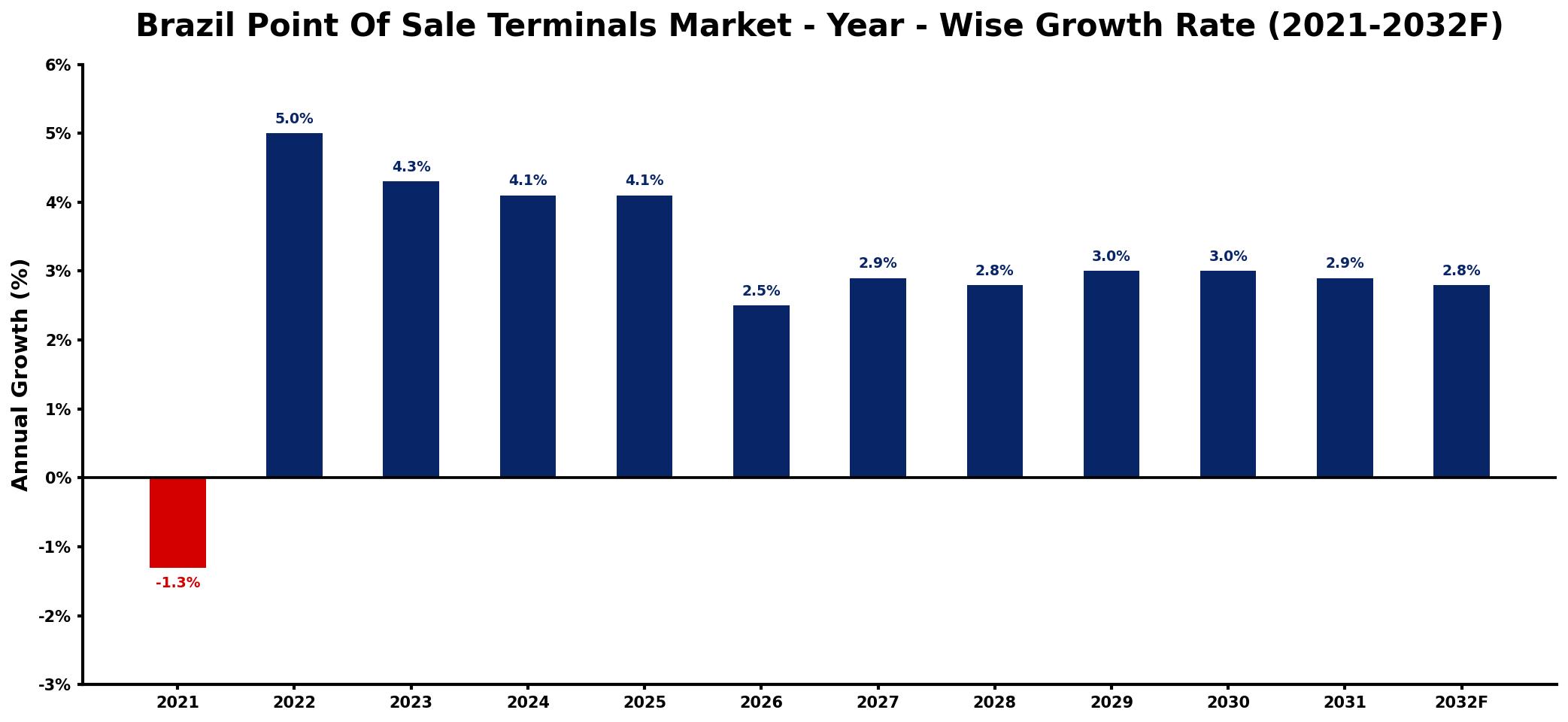
The table below presents the year‑wise growth rates along with the key drivers influencing the market
| Year | Growth Rate | Major Drivers |
| 2021 | -1.3% | E-commerce market contraction observed |
| 2022 | 5.0% | Retail sector recovery accelerates rapidly |
| 2023 | 4.3% | Mobile payment adoption increases significantly |
| 2024 | 4.1% | Investment in fintech solutions rises |
| 2025 | 4.1% | Consumer spending rebounds strongly |
| 2026 | 2.5% | Digital transformation initiatives expand nationwide |
| 2027 | 2.9% | Small businesses adopting technology solutions |
| 2028 | 2.8% | Contactless payment preferences strengthen further |
| 2029 | 3.0% | Partnerships between banks and startups |
| 2030 | 3.0% | Enhanced security features drive adoption |
| 2031 | 2.9% | Government initiatives support digital payments |
| 2032 | 2.8% | Consumer trust in technology grows |
Note: Market size estimations and growth projections presented in this report are based on 6Wresearch's proprietary forecasting methodology, utilizing the latest available industry data, government publications, and primary research inputs.
Brazil Point Of Sale Terminals Market Synopsis
Currently, the Brazil Point Of Sale Terminals Market is experiencing notable advancements as businesses increasingly recognize the necessity of adopting electronic payment systems. This shift not only facilitates smoother transactions but also aligns with consumer preferences for convenient payment methods. As the landscape evolves, businesses are seeking robust solutions that ensure both security and efficiency in their operations.
Moreover, the influence of government initiatives aimed at enhancing financial accessibility cannot be overstated. Such policies not only encourage the widespread adoption of POS terminals but also provide the framework for innovative technologies to thrive. This dynamic environment sets the stage for significant opportunities within the market, positioning Brazil as a key player in the digital payment revolution.
Brazil Point Of Sale Terminals Market Key Takeaways
- The market is driven by increasing digital payments and financial inclusion initiatives.
- POS systems are becoming essential tools for businesses amidst growing e-commerce trends.
- Government policies are playing a crucial role in shaping the market landscape.
- Security and compliance remain pivotal factors influencing POS terminal adoption.
- The shift towards contactless payments necessitates continuous innovation within the sector.
Evaluation of Restraints in Brazil Point Of Sale Terminals Market
Despite the promising growth prospects, the Brazil Point Of Sale Terminals Market faces certain restraints that could hinder its full potential. The rapid pace of technological advancements requires manufacturers to consistently innovate, often necessitating substantial investments in research and development. Additionally, security challenges, particularly concerning cyber threats, create hurdles for businesses seeking to adopt new systems. The pressure to comply with evolving regulatory standards further complicates the landscape, as organizations must ensure they meet both security and operational benchmarks. Ultimately, these factors underscore the need for a balanced approach to market expansion, integrating innovation with robust security measures.
Brazil Point Of Sale Terminals Market Trends
Current trends indicate a robust movement towards contactless payment solutions, driven by consumer preferences for convenience and speed. As the pandemic accelerated the adoption of such technologies, businesses are now prioritizing systems that facilitate seamless transactions while ensuring user security. Additionally, the integration of advanced technologies like mobile payments and digital wallets is reshaping how transactions are conducted, offering consumers greater flexibility and choice.
Furthermore, there's a growing emphasis on interoperability among payment systems, enabling a more cohesive user experience. This trend is particularly relevant in Brazil, where various payment methods coexist, and consumers expect compatibility across platforms. As businesses adapt to these trends, they will likely seek solutions that not only enhance operational efficiency but also provide an enriched customer experience.
Brazil Point Of Sale Terminals Market Opportunities
The Brazil Point Of Sale Terminals Market presents numerous growth opportunities, particularly for firms willing to invest in innovative payment solutions. As the digital economy expands, companies can capitalize on the increasing demand for sophisticated POS systems that cater to a diverse consumer base. Furthermore, the governments push for cashless transactions opens avenues for startups and established players alike to introduce cutting-edge technologies tailored to local needs.
Additionally, exploring partnerships with fintech firms can lead to enhanced product offerings that combine security with ease of use. As more retailers embrace omnichannel strategies, the potential for integrated solutions that connect in-store and online payments becomes increasingly viable, further propelling market growth.
Government Initiatives in the Brazil Point Of Sale Terminals Market
Brazil's government has implemented various initiatives to enhance the point of sale terminals market, primarily focusing on fostering financial inclusion and promoting cashless transactions. Policies that address payment security and interoperability among different systems have laid the groundwork for a more accessible digital payment landscape. Furthermore, funding programs aimed at supporting businesses transitioning to electronic payment solutions demonstrate the government's commitment to creating an inclusive financial environment that benefits both consumers and businesses.
Future Insights of the Brazil Point Of Sale Terminals Market
Looking ahead, the Brazil Point Of Sale Terminals Market is poised for continued expansion from 2026 to 2032. With an estimated market size of USD 199 Million in 2025, reaching USD 237 Million by 2032, the anticipated CAGR of 2.5% reflects strong underlying demand for digital payment solutions. As retailers increasingly prioritize consumer-centric services, the focus will likely shift towards integrating advanced technologies that improve transaction speed and security. Moreover, the collaboration between government and private sectors in enhancing infrastructure will further facilitate the widespread adoption of innovative payment solutions.
Brazil Point Of Sale Terminals Market Latest Developments (2025 - 2026)
Recent developments in the Brazil Point Of Sale Terminals Market illustrate a vibrant landscape, with numerous industry players enhancing their offerings to meet evolving consumer expectations. The focus on contactless payments continues to dominate, with many businesses investing in advanced POS systems equipped with near-field communication (NFC) capabilities. Additionally, industry stakeholders are increasingly prioritizing security enhancements to protect against emerging cyber threats, reflecting a commitment to maintaining consumer trust in digital transactions. As businesses adapt to these trends, the market is expected to witness further innovation and consolidation.
Brazil Point Of Sale Terminals Market - Key Attractiveness of the Report
- 10 Years of Market Numbers
- Historical Data Starting from 2022 to 2025
- Base Year: 2025
- Forecast Data until 2032
- Key Performance Indicators Impacting the Market
- Major Upcoming Developments and Projects
Key Highlights of the Report:
- Brazil Point Of Sale Terminals Market Outlook
- Market Size of Brazil Point Of Sale Terminals Market, 2025
- Forecast of Brazil Point Of Sale Terminals Market, 2032
- Historical Data and Forecast of Brazil Point Of Sale Terminals Revenues & Volume for the Period 2022-2032F
- Brazil Point Of Sale Terminals Market Trend Evolution
- Brazil Point Of Sale Terminals Market Drivers and Challenges
- Brazil Point Of Sale Terminals Price Trends
- Brazil Point Of Sale Terminals Porter's Five Forces
- Brazil Point Of Sale Terminals Industry Life Cycle
- Historical Data and Forecast of Brazil Point Of Sale Terminals Market Revenues & Volume By Product for the Period 2022-2032F
- Historical Data and Forecast of Brazil Point Of Sale Terminals Market Revenues & Volume By Fixed for the Period 2022-2032F
- Historical Data and Forecast of Brazil Point Of Sale Terminals Market Revenues & Volume By Mobile for the Period 2022-2032F
- Historical Data and Forecast of Brazil Point Of Sale Terminals Market Revenues & Volume By Component for the Period 2022-2032F
- Historical Data and Forecast of Brazil Point Of Sale Terminals Market Revenues & Volume By Hardware for the Period 2022-2032F
- Historical Data and Forecast of Brazil Point Of Sale Terminals Market Revenues & Volume By Software for the Period 2022-2032F
- Historical Data and Forecast of Brazil Point Of Sale Terminals Market Revenues & Volume By Services for the Period 2022-2032F
- Historical Data and Forecast of Brazil Point Of Sale Terminals Market Revenues & Volume By Deployment for the Period 2022-2032F
- Historical Data and Forecast of Brazil Point Of Sale Terminals Market Revenues & Volume By Cloud for the Period 2022-2032F
- Historical Data and Forecast of Brazil Point Of Sale Terminals Market Revenues & Volume By On-premise for the Period 2022-2032F
- Historical Data and Forecast of Brazil Point Of Sale Terminals Market Revenues & Volume By End Use for the Period 2022-2032F
- Historical Data and Forecast of Brazil Point Of Sale Terminals Market Revenues & Volume By Restaurants for the Period 2022-2032F
- Historical Data and Forecast of Brazil Point Of Sale Terminals Market Revenues & Volume By Retail for the Period 2022-2032F
- Historical Data and Forecast of Brazil Point Of Sale Terminals Market Revenues & Volume By Hospitality for the Period 2022-2032F
- Historical Data and Forecast of Brazil Point Of Sale Terminals Market Revenues & Volume By Healthcare for the Period 2022-2032F
- Historical Data and Forecast of Brazil Point Of Sale Terminals Market Revenues & Volume By Warehouse for the Period 2022-2032F
- Historical Data and Forecast of Brazil Point Of Sale Terminals Market Revenues & Volume By Entertainment for the Period 2022-2032F
- Historical Data and Forecast of Brazil Point Of Sale Terminals Market Revenues & Volume By Others for the Period 2022-2032F
- Brazil Point Of Sale Terminals Import Export Trade Statistics
- Market Opportunity Assessment By Product
- Market Opportunity Assessment By Component
- Market Opportunity Assessment By Deployment
- Market Opportunity Assessment By End Use
- Brazil Point Of Sale Terminals Top Companies Market Share
- Brazil Point Of Sale Terminals Competitive Benchmarking By Technical and Operational Parameters
- Brazil Point Of Sale Terminals Company Profiles
- Brazil Point Of Sale Terminals Key Strategic Recommendations






































