Peru Point Of Sale Terminals Market Size, Share & Growth Rate
The Peru Point Of Sale Terminals Market was estimated at USD 396 Million in 2025 and is projected to reach USD 521 Million by 2032, growing at a CAGR of 4.0% from 2026 to 2032. This growth trajectory is fueled by the escalating demand for digital payment solutions across various sectors, particularly retail and hospitality. The government's push for cashless transactions and increased awareness of advanced payment systems among businesses are pivotal in this expansion, showcasing a robust shift towards modern payment infrastructures.
Peru Point Of Sale Terminals Market Year-wise Growth Rate and Key Drivers
This graph highlights how the Peru Point Of Sale Terminals Market has steadily grown over the years, supported by major growth factors.
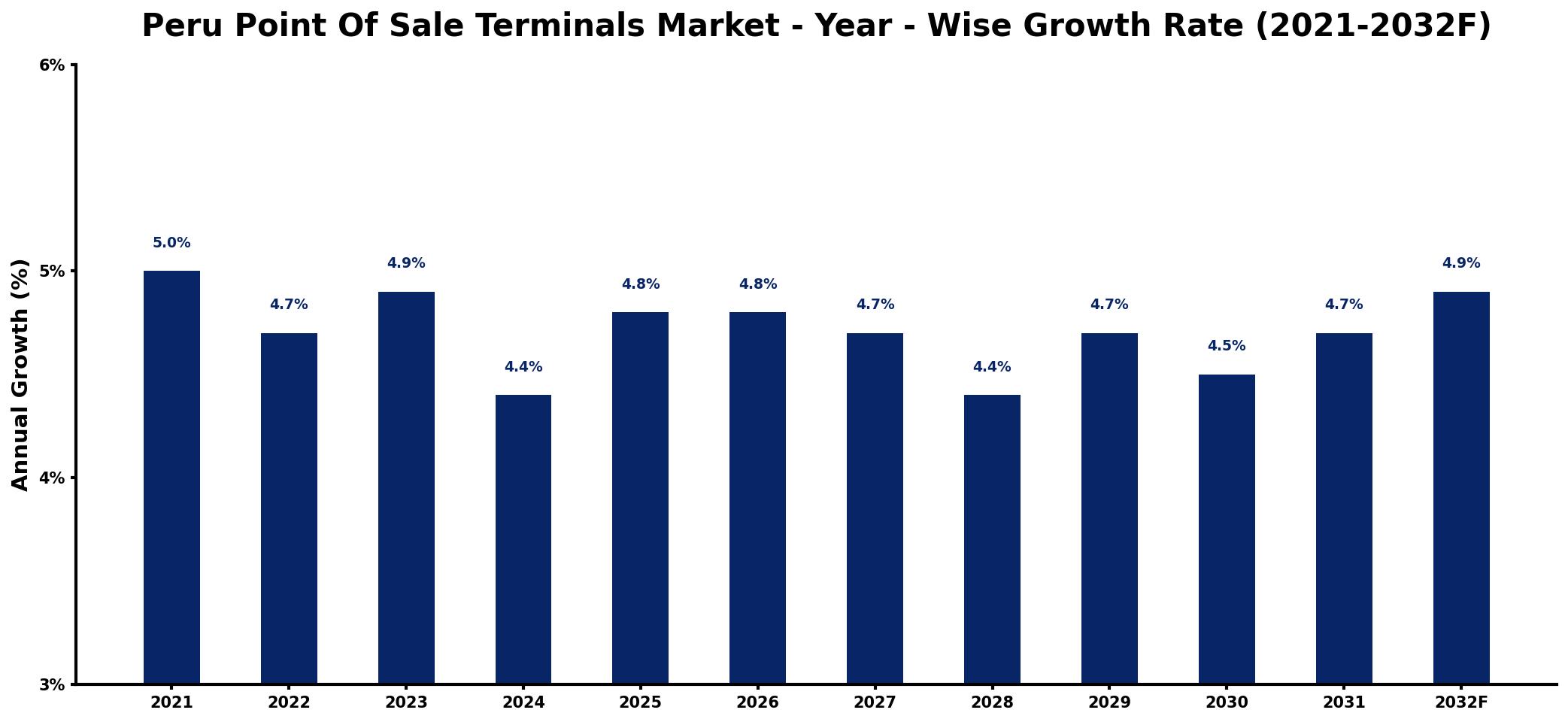
The table below presents the year‑wise growth rates along with the key drivers influencing the market
| Year | Growth Rate | Major Drivers |
| 2021 | 5.0% | Rise in digital payment adoption |
| 2022 | 4.7% | Increased retail sector investments |
| 2023 | 4.9% | Expansion of e-commerce platforms |
| 2024 | 4.4% | Growth in mobile payment solutions |
| 2025 | 4.8% | Enhanced consumer spending trends |
| 2026 | 4.8% | Wider acceptance of contactless payments |
| 2027 | 4.7% | Boost in small business transactions |
| 2028 | 4.4% | Emergence of fintech innovations |
| 2029 | 4.7% | Increase in urbanization rates |
| 2030 | 4.5% | Strengthened regulatory support frameworks |
| 2031 | 4.7% | Development of integrated payment systems |
| 2032 | 4.9% | Rising demand for online services |
Note: Market size estimations and growth projections presented in this report are based on 6Wresearch's proprietary forecasting methodology, utilizing the latest available industry data, government publications, and primary research inputs.
Peru Point Of Sale Terminals Market Synopsis
The increasing preference for mobile POS systems in Peru is reshaping the landscape of payment processing. These systems offer unparalleled flexibility, making them particularly appealing to small and medium-sized businesses seeking to improve customer engagement and streamline operations.
Furthermore, the rise of cloud-based solutions is transforming traditional POS setups by providing businesses with real-time access to critical data. This shift not only enhances security but also supports the scalability and integration needed to adapt to evolving market demands.
Peru Point Of Sale Terminals Market Key Takeaways
- The market is experiencing a robust demand for digital and mobile payment solutions.
- Cloud-based POS systems are becoming increasingly prevalent, offering advanced features and enhanced security.
- Government initiatives to promote financial inclusion are instrumental in driving market growth.
- Contactless payment methods are gaining traction as consumers seek safer transaction options.
- The competitive landscape necessitates innovation and differentiation among service providers.
Evaluation of Restraints in Peru Point Of Sale Terminals Market
Despite the positive outlook, several constraints hinder the markets potential. A notable challenge is the limited internet connectivity in rural and remote areas, which disrupts the seamless operation of POS systems. Small businesses often exhibit resistance to adopting these technologies due to initial investment concerns and apprehensions regarding data security. Additionally, the absence of standardized regulations creates inefficiencies, as businesses navigate a fragmented payment processing landscape. Therefore, addressing these limitations requires a collaborative effort among industry stakeholders to streamline operations and enhance the overall security of payment systems.
Peru Point Of Sale Terminals Market Trends
Current trends reveal a significant shift towards mobile POS solutions, appealing to businesses aiming for flexibility and efficiency. Additionally, the demand for integrated POS systems is rising, encompassing features such as inventory management and customer relationship tools. Contactless payments, increasingly favored for their hygiene and convenience, have surged post-pandemic, further encouraging merchants to update their systems. These trends underscore a broader movement towards enhancing customer experience through technology-driven solutions.
Peru Point Of Sale Terminals Market Opportunities
The market presents notable investment opportunities, particularly as more consumers shift towards digital payment methods. With a considerable segment of the population still unbanked, the demand for secure and efficient POS terminals is set to rise significantly. Investors should focus on companies delivering innovative solutions that align with local market needs, such as mobile payments and e-commerce integration. Collaborations with local financial institutions and retailers can further enhance market penetration and growth prospects.
Government Initiatives in the Peru Point Of Sale Terminals Market
The Peruvian government has introduced several initiatives aimed at fostering a more inclusive financial ecosystem. Programs such as the National Financial Inclusion Strategy and the Digital Transformation Plan actively promote the adoption of electronic payment methods. Regulatory frameworks designed to enhance the security and interoperability of POS systems are also being established to protect consumers and foster a competitive market environment. These government-backed efforts are pivotal in encouraging businesses to embrace modern payment solutions.
Future Insights of the Peru Point Of Sale Terminals Market
Looking ahead, the Peru Point of Sale Terminals Market is poised for sustained growth from 2026 to 2032, driven by the ongoing digital transformation in payment methods. As e-commerce continues to expand and the retail sector evolves, the demand for advanced POS systems will likely increase. Technological advancements, particularly in contactless and NFC payment options, will further facilitate this growth, as businesses seek to enhance transaction efficiency and security. The future landscape will be characterized by innovation and adaptability to meet changing consumer preferences.
Peru Point Of Sale Terminals Market Latest Developments (2025 - 2026)
Recent developments in the Peru Point of Sale Terminals Market indicate a concerted effort among providers to enhance features and expand service offerings. Companies are focusing on upgrading software solutions to integrate better with existing business processes, thus facilitating smoother operations for merchants. Additionally, there has been an increased emphasis on addressing cybersecurity challenges, ensuring that consumer data remains secure amidst rising digital transaction volumes.
Peru Point Of Sale Terminals Market - Key Attractiveness of the Report
- 10 Years of Market Numbers
- Historical Data Starting from 2022 to 2025
- Base Year: 2025
- Forecast Data until 2032
- Key Performance Indicators Impacting the Market
- Major Upcoming Developments and Projects
Key Highlights of the Report:
- Peru Point Of Sale Terminals Market Outlook
- Market Size of Peru Point Of Sale Terminals Market, 2025
- Forecast of Peru Point Of Sale Terminals Market, 2032
- Historical Data and Forecast of Peru Point Of Sale Terminals Revenues & Volume for the Period 2022-2032F
- Peru Point Of Sale Terminals Market Trend Evolution
- Peru Point Of Sale Terminals Market Drivers and Challenges
- Peru Point Of Sale Terminals Price Trends
- Peru Point Of Sale Terminals Porter's Five Forces
- Peru Point Of Sale Terminals Industry Life Cycle
- Historical Data and Forecast of Peru Point Of Sale Terminals Market Revenues & Volume By Product for the Period 2022-2032F
- Historical Data and Forecast of Peru Point Of Sale Terminals Market Revenues & Volume By Fixed for the Period 2022-2032F
- Historical Data and Forecast of Peru Point Of Sale Terminals Market Revenues & Volume By Mobile for the Period 2022-2032F
- Historical Data and Forecast of Peru Point Of Sale Terminals Market Revenues & Volume By Component for the Period 2022-2032F
- Historical Data and Forecast of Peru Point Of Sale Terminals Market Revenues & Volume By Hardware for the Period 2022-2032F
- Historical Data and Forecast of Peru Point Of Sale Terminals Market Revenues & Volume By Software for the Period 2022-2032F
- Historical Data and Forecast of Peru Point Of Sale Terminals Market Revenues & Volume By Services for the Period 2022-2032F
- Historical Data and Forecast of Peru Point Of Sale Terminals Market Revenues & Volume By Deployment for the Period 2022-2032F
- Historical Data and Forecast of Peru Point Of Sale Terminals Market Revenues & Volume By Cloud for the Period 2022-2032F
- Historical Data and Forecast of Peru Point Of Sale Terminals Market Revenues & Volume By On-premise for the Period 2022-2032F
- Historical Data and Forecast of Peru Point Of Sale Terminals Market Revenues & Volume By End Use for the Period 2022-2032F
- Historical Data and Forecast of Peru Point Of Sale Terminals Market Revenues & Volume By Restaurants for the Period 2022-2032F
- Historical Data and Forecast of Peru Point Of Sale Terminals Market Revenues & Volume By Retail for the Period 2022-2032F
- Historical Data and Forecast of Peru Point Of Sale Terminals Market Revenues & Volume By Hospitality for the Period 2022-2032F
- Historical Data and Forecast of Peru Point Of Sale Terminals Market Revenues & Volume By Healthcare for the Period 2022-2032F
- Historical Data and Forecast of Peru Point Of Sale Terminals Market Revenues & Volume By Warehouse for the Period 2022-2032F
- Historical Data and Forecast of Peru Point Of Sale Terminals Market Revenues & Volume By Entertainment for the Period 2022-2032F
- Historical Data and Forecast of Peru Point Of Sale Terminals Market Revenues & Volume By Others for the Period 2022-2032F
- Peru Point Of Sale Terminals Import Export Trade Statistics
- Market Opportunity Assessment By Product
- Market Opportunity Assessment By Component
- Market Opportunity Assessment By Deployment
- Market Opportunity Assessment By End Use
- Peru Point Of Sale Terminals Top Companies Market Share
- Peru Point Of Sale Terminals Competitive Benchmarking By Technical and Operational Parameters
- Peru Point Of Sale Terminals Company Profiles
- Peru Point Of Sale Terminals Key Strategic Recommendations






































