Qatar Predictive Maintenance Market Size & Growth Rate (2026-2032)
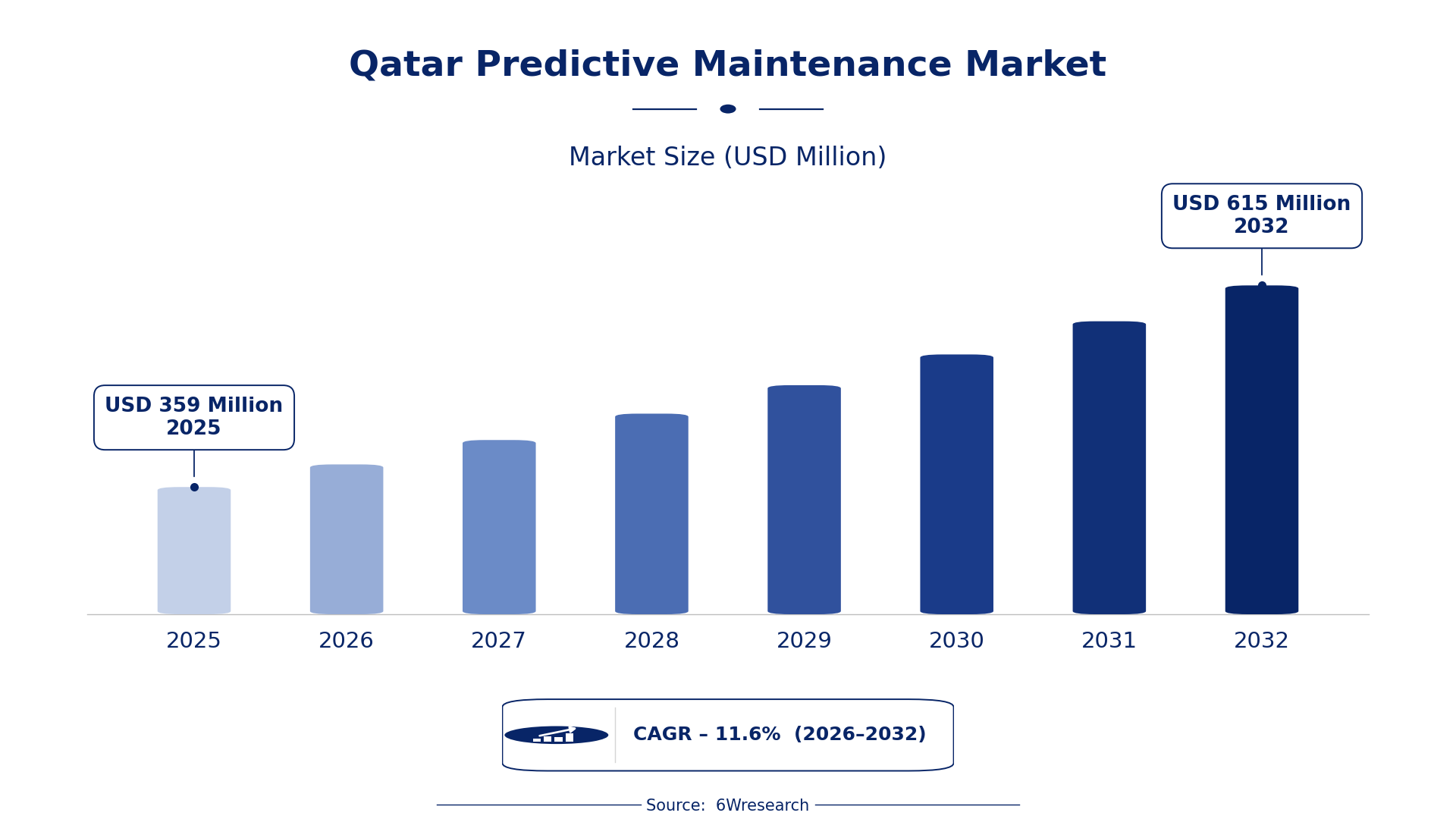
The Qatar Predictive Maintenance Market was estimated at USD 359 Million in 2025 and is projected to reach USD 615 Million by 2032, growing at a CAGR of 11.6% from 2026 to 2032.
Qatar Predictive Maintenance Market Synopsis
In Qatar, the predictive maintenance market is rapidly gaining traction as various industries strive to improve operational efficiency. Companies are increasingly adopting predictive maintenance strategies to minimize equipment failures and enhance reliability, particularly in sectors like oil and gas, manufacturing, and transportation.
The integration of advanced technologies such as IoT and machine learning has been instrumental in this shift. Businesses are now able to monitor equipment in real-time, enabling timely interventions that significantly reduce unplanned downtime and associated costs.
Qatar Predictive Maintenance Market Year-wise Growth Rate and Key Drivers
This graph illustrates the annual growth rates of the Qatar Predictive Maintenance Market from 2021 to 2032, highlighting a steady upward trajectory and projected expansion over the forecast period.
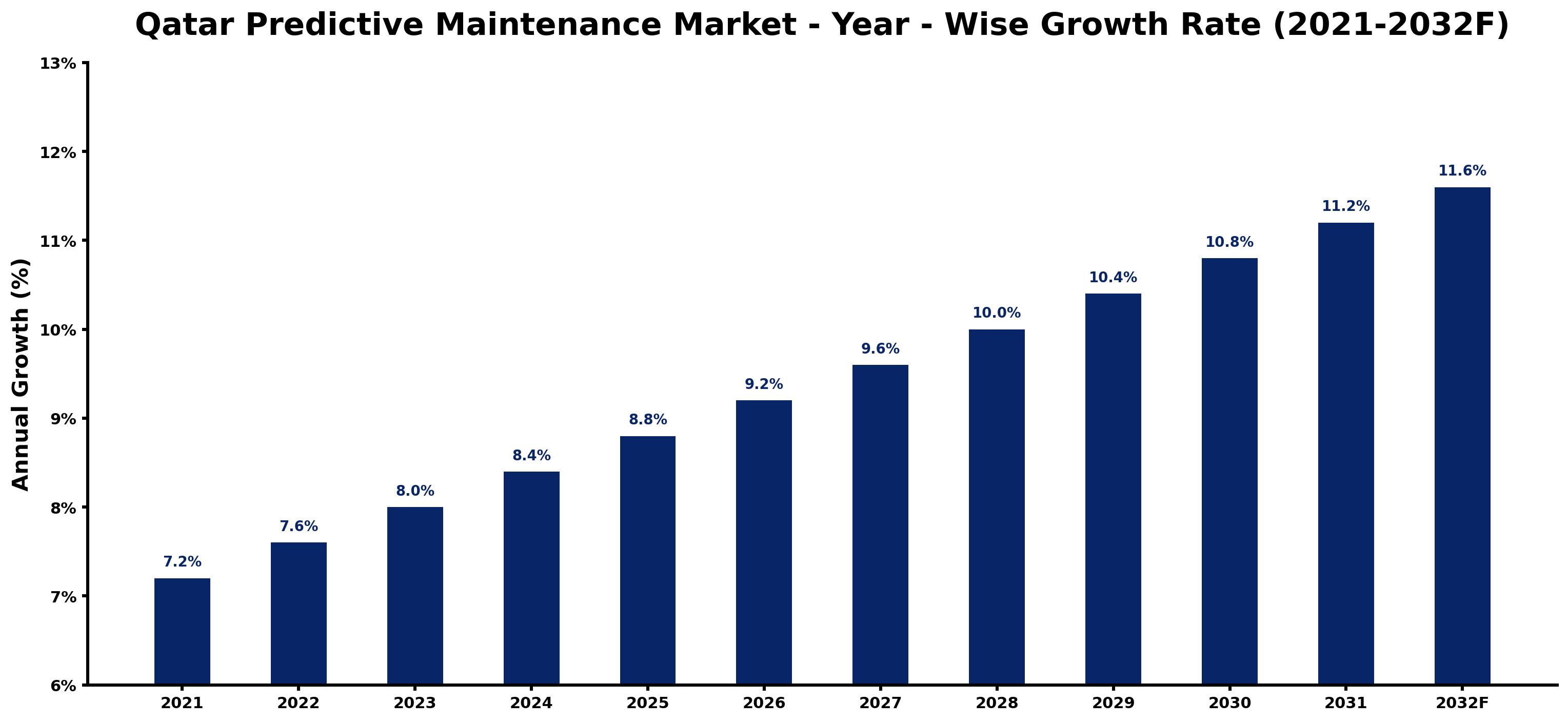
The table below presents the year‑wise growth rates along with the key drivers influencing the market
| Year | Growth Rate | Major Drivers |
| 2021 | 7.2% | Qatar National Vision 2030 promotes technology adoption. |
| 2022 | 7.6% | Investment in oil and gas increases predictive maintenance needs. |
| 2023 | 8.0% | Qatar's hosting of global events fuels infrastructure upgrades. |
| 2024 | 8.4% | Government initiatives prioritize smart monitoring in industry. |
| 2025 | 8.8% | Rise in manufacturing activities promotes data-driven maintenance. |
| 2026 | 9.2% | Qatari firms adopt IoT for operational efficiencies. |
| 2027 | 9.6% | Increased energy sector regulations drive analytics adoption. |
| 2028 | 10.0% | Remote monitoring needs surge post-pandemic in Qatar. |
| 2029 | 10.4% | Qatar's digital transformation fosters predictive technology growth. |
| 2030 | 10.8% | Growing emphasis on sustainability enhances maintenance investments. |
| 2031 | 11.2% | Local universities promote research in predictive maintenance tech. |
| 2032 | 11.6% | Partnerships with global tech firms enhance local innovations. |
Note: Market size estimations and growth projections presented in this report are based on 6Wresearch's proprietary forecasting methodology, utilizing the latest available industry data, government publications, and primary research inputs.
Qatar Predictive Maintenance Market Key Takeaways
Below are some of the specific key takeaways from the market, including:
- The market is expected to witness a surge in adoption due to increasing awareness of maintenance cost savings.
- Technological advancements are driving innovation, enabling more accurate predictions of equipment failures.
- There is a growing emphasis on training skilled professionals to manage predictive maintenance systems.
- Data security and compliance with regulations remain critical factors for market growth.
- Collaboration between solution providers and industrial sectors is key for tailored implementations.
Evaluation of Restraints in Qatar Predictive Maintenance Market
The Qatar Predictive Maintenance Market encounters several restraints that could hinder its growth trajectory. One of the most pressing issues is the high initial setup costs associated with implementing predictive maintenance technologies. Many companies, particularly smaller enterprises, may find these upfront investments challenging to manage.
Additionally, there is a notable skills gap in the workforce, with a lack of data scientists and technical experts who can effectively analyze and interpret the data produced by predictive maintenance systems. Addressing these challenges is crucial for the market to reach its full potential.
Qatar Predictive Maintenance Market Trends
Several key trends are shaping the predictive maintenance landscape in Qatar. The rise of IoT technologies is allowing for more sophisticated data collection and analysis, thus enhancing predictive capabilities. Companies are increasingly using advanced analytics to better understand equipment behavior and schedule maintenance efficiently.
Another trend is the growing focus on sustainability and operational resilience. Organizations are seeking to minimize waste and enhance the lifespan of their assets, aligning with broader environmental goals. This focus is driving investment into predictive maintenance solutions as a means to achieve these objectives.
Qatar Predictive Maintenance Market Opportunities
The market presents numerous opportunities for growth and investment. One of the most promising areas lies in the adoption of cloud-based predictive maintenance solutions, which offer scalability and flexibility for businesses of all sizes. As more companies look to transition to digital operations, the demand for these solutions is likely to increase.
on top of that, public-private partnerships aimed at enhancing industrial automation and digital transformation initiatives are expected to create additional avenues for growth. These collaborations could facilitate the development of customized predictive maintenance solutions tailored to specific industry needs.
Government Initiatives in the Qatar Predictive Maintenance Market
Government policies are playing a vital role in shaping the Qatar Predictive Maintenance Market. The Qatari government has prioritized digital transformation across various sectors, emphasizing the need for innovative solutions to boost operational efficiency. This regulatory support is crucial for fostering a conducive environment for predictive maintenance adoption.
- A national digital transformation strategy launched in early 2025 focuses on enhancing industrial efficiency through advanced technologies.
- Current initiatives include workshops and training programs aimed at developing a skilled workforce capable of implementing predictive maintenance solutions.
- Ongoing investments in IoT infrastructure are expected to bolster real-time monitoring capabilities across industries.
- Upcoming regulations are anticipated to mandate the use of predictive maintenance in critical sectors to ensure asset reliability and safety.
Future Insights of the Qatar Predictive Maintenance Market
Looking ahead to 2026-2032, the Qatar Predictive Maintenance Market is set to expand significantly as industries recognize the importance of proactive maintenance strategies. The growing integration of artificial intelligence and machine learning into predictive maintenance solutions will enhance predictive accuracy and operational efficiency.
As businesses increasingly prioritize cost reductions and operational reliability, the demand for tailored predictive maintenance solutions will only rise. Collaboration with technology providers and ongoing government support will be key to unlocking new growth avenues.
Qatar Predictive Maintenance Market Latest Developments
Over the past year, the Qatar Predictive Maintenance Market has witnessed a flurry of activity, with organizations ramping up efforts to integrate predictive maintenance into their operational frameworks. Many industries are now recognizing the critical importance of maintaining asset reliability to remain competitive.
- A major technology vendor launched a new predictive analytics platform in Q2 2025, designed to enhance real-time monitoring capabilities.
- A leading regional operator is currently implementing an IoT-based predictive maintenance system that began rollout in early 2025 and remains underway.
- Several companies have formed partnerships to develop customized predictive maintenance solutions, with initiatives expected to be completed by late 2026.
- A training program aimed at upskilling professionals in predictive maintenance technologies was introduced in Q3 2025 and is currently ongoing.
Qatar Predictive Maintenance Market - Key Attractiveness of the Report
- 10 Years of Market Numbers
- Historical Data Starting from 2022 to 2025
- Base Year: 2025
- Forecast Data until 2032
- Key Performance Indicators Impacting the Market
- Major Upcoming Developments and Projects
Key Highlights of the Report:
- Qatar Predictive Maintenance Market Outlook
- Market Size of Qatar Predictive Maintenance Market, 2025
- Forecast of Qatar Predictive Maintenance Market, 2032
- Historical Data and Forecast of Qatar Predictive Maintenance Revenues & Volume for the Period 2022-2032F
- Qatar Predictive Maintenance Market Trend Evolution
- Qatar Predictive Maintenance Market Drivers and Challenges
- Qatar Predictive Maintenance Price Trends
- Qatar Predictive Maintenance Porter's Five Forces
- Qatar Predictive Maintenance Industry Life Cycle
- Historical Data and Forecast of Qatar Predictive Maintenance Market Revenues & Volume By Component for the Period 2022-2032F
- Historical Data and Forecast of Qatar Predictive Maintenance Market Revenues & Volume By Solutions for the Period 2022-2032F
- Historical Data and Forecast of Qatar Predictive Maintenance Market Revenues & Volume By Services for the Period 2022-2032F
- Historical Data and Forecast of Qatar Predictive Maintenance Market Revenues & Volume By Organization Size for the Period 2022-2032F
- Historical Data and Forecast of Qatar Predictive Maintenance Market Revenues & Volume By Large Enterprises for the Period 2022-2032F
- Historical Data and Forecast of Qatar Predictive Maintenance Market Revenues & Volume By SME for the Period 2022-2032F
- Historical Data and Forecast of Qatar Predictive Maintenance Market Revenues & Volume By Deployment Mode for the Period 2022-2032F
- Historical Data and Forecast of Qatar Predictive Maintenance Market Revenues & Volume By On-premises for the Period 2022-2032F
- Historical Data and Forecast of Qatar Predictive Maintenance Market Revenues & Volume By Cloud for the Period 2022-2032F
- Historical Data and Forecast of Qatar Predictive Maintenance Market Revenues & Volume By Vertical for the Period 2022-2032F
- Historical Data and Forecast of Qatar Predictive Maintenance Market Revenues & Volume By Government and Defense for the Period 2022-2032F
- Historical Data and Forecast of Qatar Predictive Maintenance Market Revenues & Volume By Manufacturing for the Period 2022-2032F
- Historical Data and Forecast of Qatar Predictive Maintenance Market Revenues & Volume By Energy and Utilities for the Period 2022-2032F
- Historical Data and Forecast of Qatar Predictive Maintenance Market Revenues & Volume By Transportation and Logistics for the Period 2022-2032F
- Historical Data and Forecast of Qatar Predictive Maintenance Market Revenues & Volume By Healthcare and Life Sciences for the Period 2022-2032F
- Qatar Predictive Maintenance Import Export Trade Statistics
- Market Opportunity Assessment By Component
- Market Opportunity Assessment By Organization Size
- Market Opportunity Assessment By Deployment Mode
- Market Opportunity Assessment By Vertical
- Qatar Predictive Maintenance Top Companies Market Share
- Qatar Predictive Maintenance Competitive Benchmarking By Technical and Operational Parameters
- Qatar Predictive Maintenance Company Profiles
- Qatar Predictive Maintenance Key Strategic Recommendations






































