Qatar Refined Petroleum Products Market Size, Share & Growth Rate
The Qatar Refined Petroleum Products Market was estimated at USD 263 Million in 2025 and is projected to reach USD 366 Million by 2032, growing at a CAGR of 4.8% from 2026 to 2032. This robust growth trajectory is primarily driven by Qatars significant investments in refining capacity, which position the country to effectively meet increasing local and regional demand for high-quality petroleum products. Furthermore, the diversification of its petrochemical sector and innovative strides towards sustainable fuels are expected to strengthen market dynamics significantly.
Qatar Refined Petroleum Products Market Year-wise Growth Rate and Key Drivers
This graph highlights how the Qatar Refined Petroleum Products Market has steadily grown over the years, supported by major growth factors.
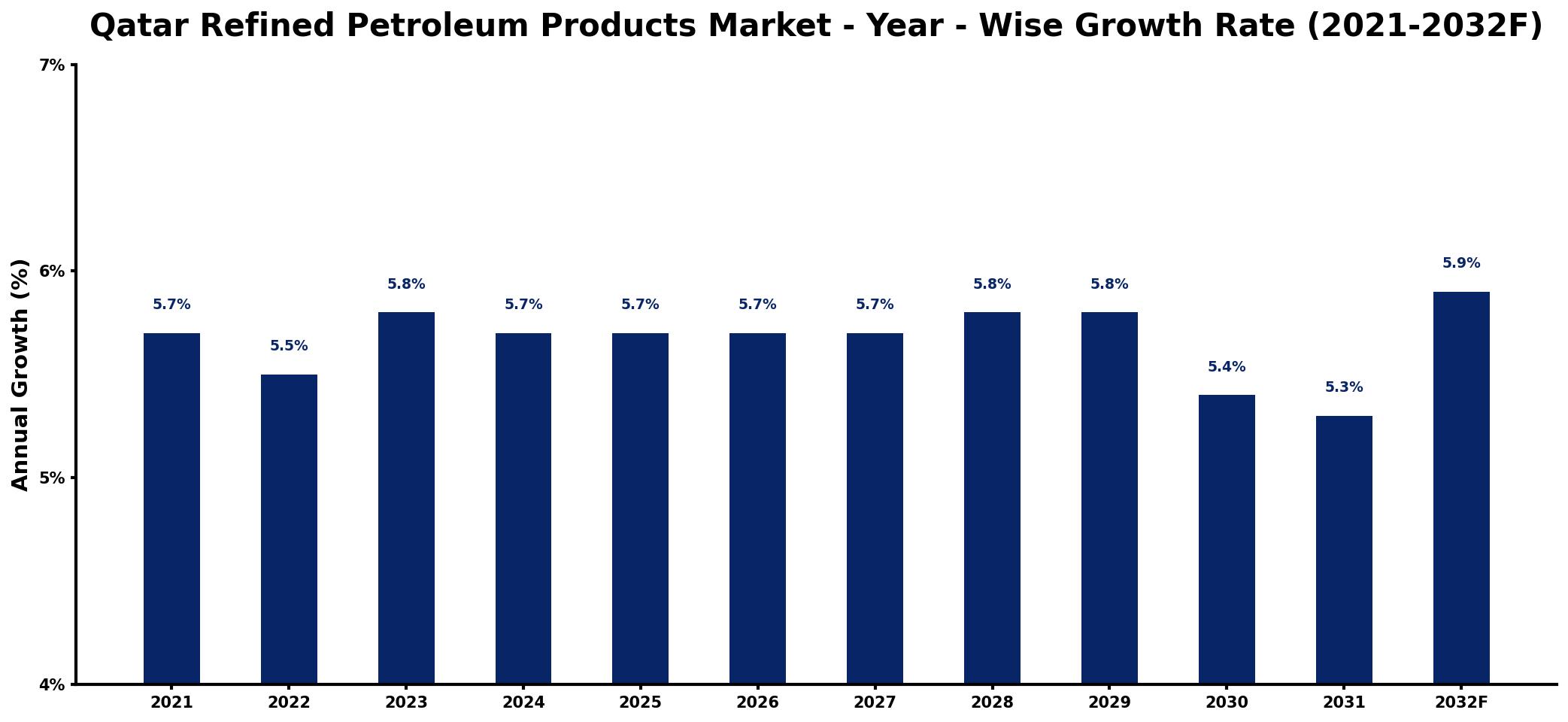
The table below presents the year‑wise growth rates along with the key drivers influencing the market
| Year | Growth Rate | Major Drivers |
| 2021 | 5.7% | Rising industrial energy demand |
| 2022 | 5.5% | Increased investment in infrastructure |
| 2023 | 5.8% | Expansion of transportation networks |
| 2024 | 5.7% | Growth in construction activities |
| 2025 | 5.7% | Surge in urban development projects |
| 2026 | 5.7% | Boost in tourism sector investments |
| 2027 | 5.7% | Strengthening regional trade agreements |
| 2028 | 5.8% | Emergence of new energy initiatives |
| 2029 | 5.8% | Advancements in logistics capabilities |
| 2030 | 5.4% | Stabilization of global supply chains |
| 2031 | 5.3% | Focus on renewable energy integration |
| 2032 | 5.9% | Rise in energy efficiency standards |
Note: Market size estimations and growth projections presented in this report are based on 6Wresearch's proprietary forecasting methodology, utilizing the latest available industry data, government publications, and primary research inputs.
Qatar Refined Petroleum Products Market Synopsis
A major force shaping the Qatar refined petroleum products market is the nations commitment to enhancing its refining infrastructure. This strategic focus allows Qatar to leverage its rich oil reserves, ensuring a consistent supply of refined products that align with global quality standards.
In addition, the burgeoning demand for refined products such as gasoline, diesel, and jet fuel, driven by local consumption and exports, further underscores the markets growth potential. As Qatar navigates its energy transition, a strong emphasis on eco-friendly fuel solutions will likely catalyze innovation and adaptation within the sector.
Qatar Refined Petroleum Products Market Key Takeaways
- Robust growth anticipated with a projected market size of USD 366 Million by 2032.
- Investment in refining infrastructure and eco-friendly innovations as key growth drivers.
- Strong domestic demand for refined products bolstered by the petrochemical sector.
- Strategic geographical position facilitating regional supply and export opportunities.
- Market adaptation crucial amidst the global energy transition towards sustainability.
Evaluation of Restraints in Qatar Refined Petroleum Products Market
Despite the promising outlook, the market faces significant restraints stemming from global energy transition trends. The move towards cleaner energy sources poses a risk of diminishing demand for traditional refined petroleum products. Qatars ability to adapt to this shift will determine its resilience; this includes potential challenges related to workforce retraining and infrastructure adjustments necessary for alternative energy systems. Furthermore, fluctuations in international oil prices can pose additional economic uncertainties that impact the revenue stability of the petroleum sector.
Qatar Refined Petroleum Products Market Trends
Emerging trends in the Qatar refined petroleum products market include a notable shift towards sustainable fuel alternatives and innovative refining technologies. The integration of advanced processing techniques aims to enhance product quality while minimizing environmental impacts. Additionally, rising consumer awareness regarding energy sustainability is prompting the industry to explore biofuels and cleaner petroleum derivatives, thereby influencing production strategies and market positioning.
Qatar Refined Petroleum Products Market Opportunities
Opportunities for growth in this market lie predominantly in the integration of cutting-edge refining technologies and the expansion of eco-friendly fuel solutions. As demand for high-quality, sustainable products continues to rise, investments in research and development can propel innovation. Furthermore, exploring potential partnerships with international firms could enhance technology transfer and elevate Qatar's presence in the global refined petroleum landscape.
Government Initiatives in the Qatar Refined Petroleum Products Market
The Qatari government is actively involved in promoting the growth of the refined petroleum products market through various initiatives aimed at enhancing energy efficiency and sustainability. These include public spending on infrastructure development, research programs focused on alternative energy, and regulatory frameworks that support the transition to greener fuel sources. Such initiatives demonstrate a commitment to not only bolstering the domestic industry but also aligning with global sustainability goals.
Future Insights of the Qatar Refined Petroleum Products Market
Looking ahead to the period from 2026 to 2032, the Qatar refined petroleum products market is anticipated to evolve significantly. Enhanced refining capabilities and a stronger emphasis on sustainable practices are expected to align with regional energy demands. As the global marketplace shifts towards renewable energy, Qatar's strategic initiatives in diversifying its petroleum output and investing in cleaner technologies will likely foster a resilient and adaptable market framework.
Qatar Refined Petroleum Products Market Latest Developments (2025 - 2026)
In recent months, the Qatar refined petroleum products sector has seen a growing focus on sustainability initiatives, with industry stakeholders collaborating on projects aimed at reducing carbon emissions. Additionally, advancements in refining technology are being explored to enhance product efficiency and quality. There is an increased dialogue within the industry regarding the integration of alternative fuels, reflecting the ongoing efforts to align with global environmental standards.
Qatar Refined Petroleum Products Market - Key Attractiveness of the Report
- 10 Years of Market Numbers
- Historical Data Starting from 2022 to 2025
- Base Year: 2025
- Forecast Data until 2032
- Key Performance Indicators Impacting the Market
- Major Upcoming Developments and Projects
Key Highlights of the Report:
- Qatar Refined Petroleum Products Market Outlook
- Market Size of Qatar Refined Petroleum Products Market, 2025
- Forecast of Qatar Refined Petroleum Products Market, 2032
- Historical Data and Forecast of Qatar Refined Petroleum Products Revenues & Volume for the Period 2022-2032F
- Qatar Refined Petroleum Products Market Trend Evolution
- Qatar Refined Petroleum Products Market Drivers and Challenges
- Qatar Refined Petroleum Products Price Trends
- Qatar Refined Petroleum Products Porter's Five Forces
- Qatar Refined Petroleum Products Industry Life Cycle
- Historical Data and Forecast of Qatar Refined Petroleum Products Market Revenues & Volume By Product Type for the Period 2022-2032F
- Historical Data and Forecast of Qatar Refined Petroleum Products Market Revenues & Volume By Diesel for the Period 2022-2032F
- Historical Data and Forecast of Qatar Refined Petroleum Products Market Revenues & Volume By Gasoline for the Period 2022-2032F
- Historical Data and Forecast of Qatar Refined Petroleum Products Market Revenues & Volume By Fuel Oils for the Period 2022-2032F
- Historical Data and Forecast of Qatar Refined Petroleum Products Market Revenues & Volume By Kerosene for the Period 2022-2032F
- Historical Data and Forecast of Qatar Refined Petroleum Products Market Revenues & Volume By Others for the Period 2022-2032F
- Historical Data and Forecast of Qatar Refined Petroleum Products Market Revenues & Volume By Application for the Period 2022-2032F
- Historical Data and Forecast of Qatar Refined Petroleum Products Market Revenues & Volume By Fuel for the Period 2022-2032F
- Historical Data and Forecast of Qatar Refined Petroleum Products Market Revenues & Volume By Chemical for the Period 2022-2032F
- Historical Data and Forecast of Qatar Refined Petroleum Products Market Revenues & Volume By Others for the Period 2022-2032F
- Historical Data and Forecast of Qatar Refined Petroleum Products Market Revenues & Volume By Fraction for the Period 2022-2032F
- Historical Data and Forecast of Qatar Refined Petroleum Products Market Revenues & Volume By Light Distillates for the Period 2022-2032F
- Historical Data and Forecast of Qatar Refined Petroleum Products Market Revenues & Volume By Middle Distillates for the Period 2022-2032F
- Historical Data and Forecast of Qatar Refined Petroleum Products Market Revenues & Volume By Heavy Oils for the Period 2022-2032F
- Qatar Refined Petroleum Products Import Export Trade Statistics
- Market Opportunity Assessment By Product Type
- Market Opportunity Assessment By Application
- Market Opportunity Assessment By Fraction
- Qatar Refined Petroleum Products Top Companies Market Share
- Qatar Refined Petroleum Products Competitive Benchmarking By Technical and Operational Parameters
- Qatar Refined Petroleum Products Company Profiles
- Qatar Refined Petroleum Products Key Strategic Recommendations






































