Qatar Reptile Leather Market Size, Share & Growth Rate
The Qatar Reptile Leather Market was estimated at USD 395 Million in 2025 and is projected to reach USD 519 Million by 2032, growing at a CAGR of 4.0% from 2026 to 2032. This promising trajectory is primarily fueled by the burgeoning luxury fashion sector, where unique and high-quality reptile leather products are increasingly in demand. Qatar's affluent consumer base and its status as a global transit hub further enhance the market's potential, as luxury brands seek to cater to a discerning clientele.
Qatar Reptile Leather Market Year-wise Growth Rate and Key Drivers
This graph highlights how the Qatar Reptile Leather Market has steadily grown over the years, supported by major growth factors.
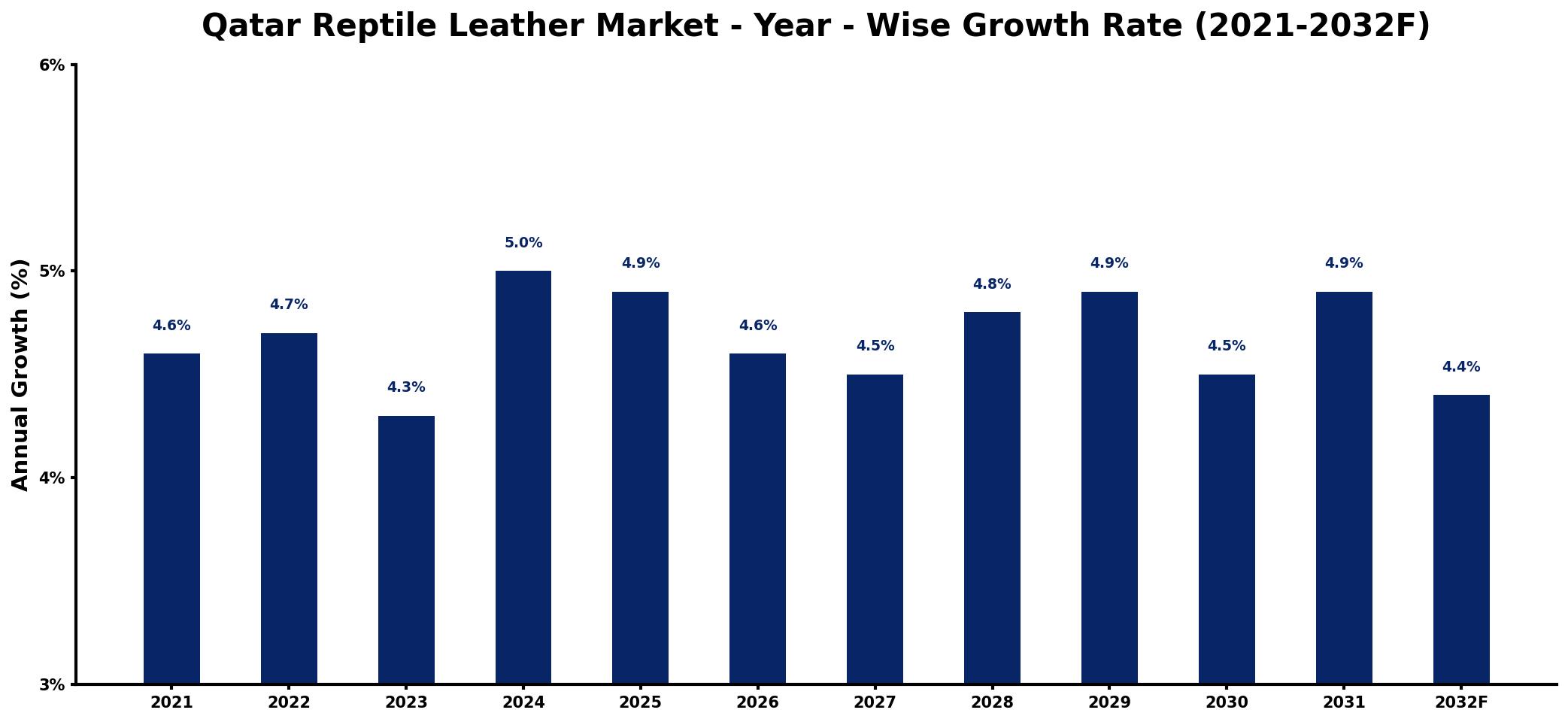
The table below presents the year‑wise growth rates along with the key drivers influencing the market
| Year | Growth Rate | Major Drivers |
| 2021 | 4.6% | Rising luxury fashion demand |
| 2022 | 4.7% | Increased investment in craftsmanship |
| 2023 | 4.3% | Growing interest in sustainable sourcing |
| 2024 | 5.0% | Expansion of international trade networks |
| 2025 | 4.9% | Emerging markets boosting consumption |
| 2026 | 4.6% | Innovative design trends gaining traction |
| 2027 | 4.5% | increased production capacity utilization |
| 2028 | 4.8% | Enhanced online retail platforms |
| 2029 | 4.9% | Collaborations with high-end brands |
| 2030 | 4.5% | Diversification of product offerings |
| 2031 | 4.9% | Growing awareness of unique materials |
| 2032 | 4.4% | Strengthening artisan community support |
Note: Market size estimations and growth projections presented in this report are based on 6Wresearch's proprietary forecasting methodology, utilizing the latest available industry data, government publications, and primary research inputs.
Qatar Reptile Leather Market Synopsis
The reptile leather market in Qatar is gaining momentum, reflecting a notable shift towards exotic and premium leather goods. Luxury brands are increasingly integrating reptile leather into their collections, appealing to consumers eager for unique fashion statements.
As the Qatar fashion industry thrives, the allure of reptile leather is amplified by a local population that values exclusivity and craftsmanship. Stringent regulations surrounding the ethical sourcing of reptile leather are also establishing a more sustainable framework for the industry, enhancing consumer trust.
Qatar Reptile Leather Market Key Takeaways
- The market is experiencing robust growth driven by luxury demand and discerning consumer preferences.
- Stringent regulations ensure responsible sourcing and processing of reptile leather.
- Qatars strategic geographical position strengthens its role as a global hub for luxury goods.
- Increased focus on sustainability is shaping consumer buying decisions.
- Government initiatives promote local craftsmanship and economic diversification.
Evaluation of Restraints in Qatar Reptile Leather Market
Despite its growth potential, the Qatar reptile leather market grapples with several restraints. Conservation and ethical concerns surrounding the sourcing of exotic leathers pose significant challenges. Regulatory compliance is essential, as the trade involves species protected under international agreements. Violating these regulations not only risks legal repercussions but can also tarnish a brand's reputation. Additionally, consumer apprehensions regarding ethical practices may lead to fluctuating demand, as shifts in consumer sentiment can rapidly alter market dynamics.
Qatar Reptile Leather Market Trends
Emerging trends in the Qatar reptile leather market indicate a growing interest in sustainability and ethically sourced products. Consumers are increasingly favoring brands that prioritize responsible practices, steering the market towards more transparent supply chains. Moreover, there is a rise in customized luxury goods, with local artisans and designers exploring innovative uses for reptile leather, thus attracting niche markets. Additionally, the integration of technology in leather processing is enhancing quality and durability, appealing to a more discerning clientele.
Qatar Reptile Leather Market Opportunities
Opportunities for growth in the Qatar reptile leather market lie in expanding the local production of luxury goods. By fostering indigenous craftsmanship, brands can offer unique products that resonate with consumers desires for exclusivity. Collaborations between fashion houses and local artisans present an avenue for innovation and creativity, further tapping into the market. Additionally, as global demand for sustainable products rises, Qatar's commitment to ethical practices can enhance its competitive edge in the international arena.
Government Initiatives in the Qatar Reptile Leather Market
The Qatari government is increasingly focusing on diversifying its economy and promoting local industries, including the reptile leather market. Initiatives aimed at supporting artisans and local craftsmanship are being implemented, enhancing the production capabilities of luxury goods. Additionally, regulatory frameworks are being established to ensure ethical sourcing and sustainability, fostering a responsible market environment. Such government support plays a pivotal role in positioning Qatar as a key player in the global reptile leather industry.
Future Insights of the Qatar Reptile Leather Market
Looking ahead to 2026-2032, the Qatar reptile leather market is poised for steady growth, underpinned by increasing demand for luxury goods and sustainable practices. As consumer awareness regarding ethical sourcing continues to rise, brands that adopt transparent supply chains will likely enjoy greater loyalty and market share. Furthermore, the local craftsmanship movement will gain momentum, creating unique offerings that appeal to both domestic and international buyers. Overall, the market is expected to benefit from a favorable economic climate and a burgeoning luxury sector.
Qatar Reptile Leather Market Latest Developments (2025 - 2026)
Recent developments in the Qatar reptile leather market indicate a continued emphasis on sustainability and ethical sourcing. Luxury brands are increasingly collaborating with local artisans to create exclusive collections that highlight Qatar's rich cultural heritage. Additionally, there has been a noticeable increase in regulatory measures designed to ensure responsible harvesting practices, reflecting a commitment to conservation efforts. Such initiatives not only boost the market's credibility but also align with the global trend towards ethical consumerism.
Qatar Reptile Leather Market - Key Attractiveness of the Report
- 10 Years of Market Numbers
- Historical Data Starting from 2022 to 2025
- Base Year: 2025
- Forecast Data until 2032
- Key Performance Indicators Impacting the Market
- Major Upcoming Developments and Projects
Key Highlights of the Report:
- Qatar Reptile Leather Market Outlook
- Market Size of Qatar Reptile Leather Market, 2025
- Forecast of Qatar Reptile Leather Market, 2032
- Historical Data and Forecast of Qatar Reptile Leather Revenues & Volume for the Period 2022-2032F
- Qatar Reptile Leather Market Trend Evolution
- Qatar Reptile Leather Market Drivers and Challenges
- Qatar Reptile Leather Price Trends
- Qatar Reptile Leather Porter's Five Forces
- Qatar Reptile Leather Industry Life Cycle
- Historical Data and Forecast of Qatar Reptile Leather Market Revenues & Volume By Distribution Channels for the Period 2022-2032F
- Historical Data and Forecast of Qatar Reptile Leather Market Revenues & Volume By Online stores for the Period 2022-2032F
- Historical Data and Forecast of Qatar Reptile Leather Market Revenues & Volume By Retail stores for the Period 2022-2032F
- Qatar Reptile Leather Import Export Trade Statistics
- Market Opportunity Assessment By Distribution Channels
- Qatar Reptile Leather Top Companies Market Share
- Qatar Reptile Leather Competitive Benchmarking By Technical and Operational Parameters
- Qatar Reptile Leather Company Profiles
- Qatar Reptile Leather Key Strategic Recommendations






































