Qatar Smokeless Tobacco Product Market Size, Share & Growth Rate
The Qatar Smokeless Tobacco Product Market was estimated at USD 449 Million in 2025 and is projected to reach USD 634 Million by 2032, growing at a CAGR of 5.1% from 2026 to 2032. This robust growth trajectory is predominantly fueled by the shifting consumer preference towards smokeless options, prompted by increasing health awareness and the desire for convenience in social settings. As traditional smoking faces heightened scrutiny, smokeless tobacco products are gaining traction, positioning themselves as viable alternatives in the evolving market landscape.
Qatar Smokeless Tobacco Product Market Year-wise Growth Rate and Key Drivers
This graph highlights how the Qatar Smokeless Tobacco Product Market has steadily grown over the years, supported by major growth factors.
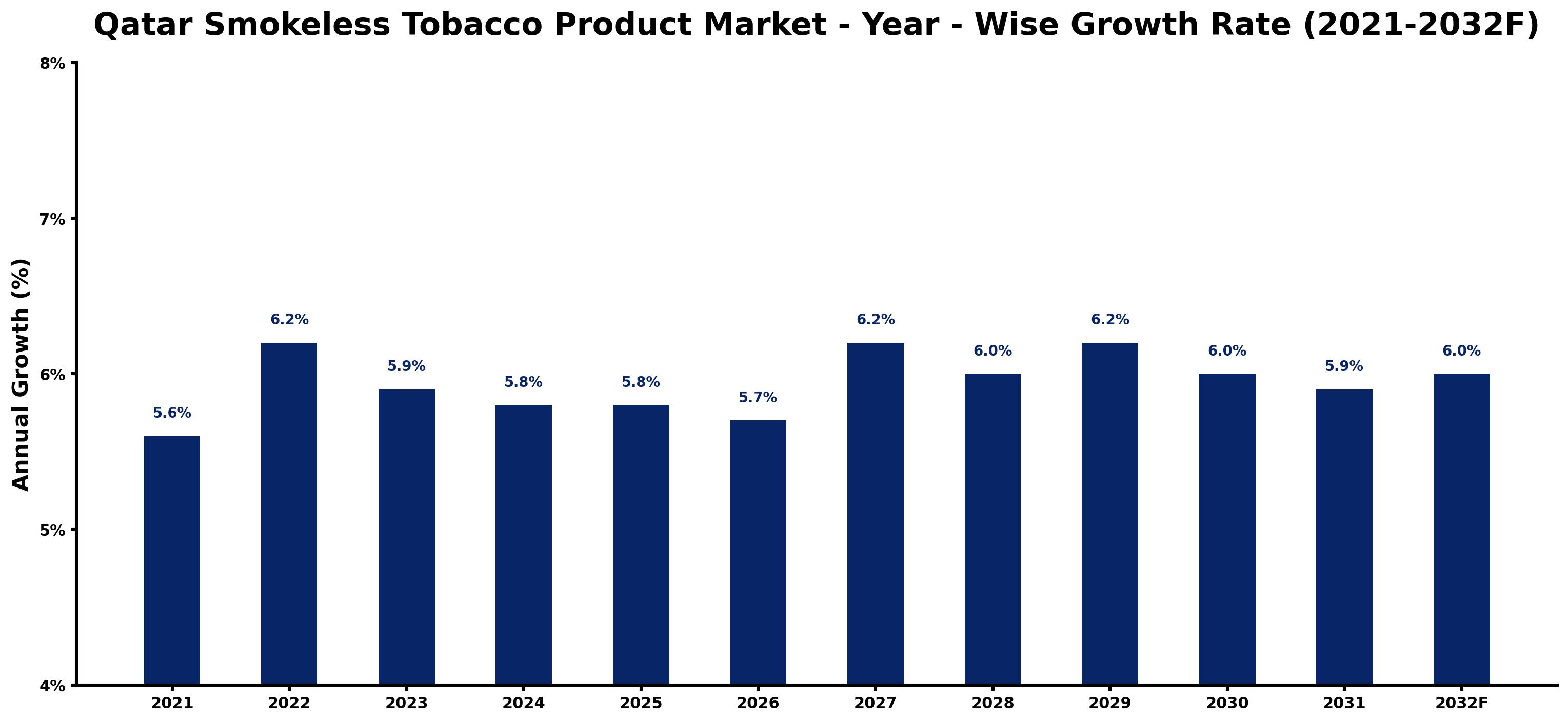
The table below presents the year‑wise growth rates along with the key drivers influencing the market
| Year | Growth Rate | Major Drivers |
| 2021 | 5.6% | Government infrastructure modernization initiatives |
| 2022 | 6.2% | Rising electricity demand across industries |
| 2023 | 5.9% | Expansion of commercial construction activities |
| 2024 | 5.8% | Expansion of commercial construction activities |
| 2025 | 5.8% | Growing renewable energy integration projects |
| 2026 | 5.7% | Increasing adoption of advanced technologies |
| 2027 | 6.2% | Expansion of commercial construction activities |
| 2028 | 6.0% | Increasing adoption of advanced technologies |
| 2029 | 6.2% | Increasing adoption of advanced technologies |
| 2030 | 6.0% | Increasing industrial automation investments |
| 2031 | 5.9% | Increasing industrial automation investments |
| 2032 | 6.0% | Growing urbanization and commercial development |
Note - Market size estimations and growth projections presented in this report are based on 6Wresearch’s advanced forecasting approach, validated with industry datasets as of June 2026.
Qatar Smokeless Tobacco Product Market Synopsis
In Qatar, the smokeless tobacco product market has seen a surge in demand, particularly among younger demographics who favor chewing tobacco and snuff. This trend is reflective of a broader societal shift towards products perceived as safer and more acceptable in public environments. Additionally, the convenience offered by these products aligns well with the fast-paced lifestyle of many consumers in the region.
Moreover, with cultural nuances influencing consumption habits, the market is witnessing an infusion of localized flavors and product offerings that resonate with the tastes of Qatari consumers. These tailored products are not only appealing to existing users but also play a pivotal role in attracting new consumers looking for alternatives to traditional smoking.
Qatar Smokeless Tobacco Product Market Key Takeaways
- The market is projected to grow significantly, reflecting a strong demand for smokeless alternatives.
- Health awareness is driving consumers away from traditional cigarettes towards smokeless options.
- Younger demographics are increasingly favoring products like chewing tobacco and snuff.
- Localized flavors and offerings are enhancing product appeal among Qatari consumers.
- Market recovery post-COVID-19 is evident, with economic activities resuming robustly.
Evaluation of Restraints in Qatar Smokeless Tobacco Product Market
Despite the positive market growth outlook, the smokeless tobacco sector in Qatar grapples with significant restraints. Public health campaigns increasingly highlight the potential dangers associated with smokeless products, creating a challenging environment for market expansion. Regulatory measures aimed at curbing tobacco use may also impact sales and marketing strategies, as the government seeks to prioritize public health. These factors necessitate a careful approach by industry stakeholders to align with evolving regulations while still meeting consumer demand.
Qatar Smokeless Tobacco Product Market Trends
The smokeless tobacco market in Qatar is currently witnessing several prominent trends. One notable trend is the rise of innovative product formats, such as dissolvable tobacco, which caters to consumers seeking discreet options. Additionally, digital marketing strategies are becoming increasingly sophisticated, leveraging social media platforms to engage a younger audience. The focus on sustainability is also emerging, with brands exploring eco-friendly packaging to align with global consumer demands for environmentally responsible practices.
Qatar Smokeless Tobacco Product Market Opportunities
The outlook for the smokeless tobacco product market in Qatar presents several compelling opportunities for growth. With an increasing number of consumers seeking alternatives to smoking, there is potential for market players to diversify their product lines to include organic and herbal options. Furthermore, strategic partnerships with local distributors can enhance market penetration and improve supply chain efficiencies. Investment in research and development will also be crucial to innovate new flavors and product formats that resonate with the evolving preferences of Qatari consumers.
Government Initiatives in the Qatar Smokeless Tobacco Product Market
The Qatari government has been proactive in addressing tobacco consumption through various public health initiatives. These programs aim to educate consumers about the risks associated with all forms of tobacco, including smokeless products. Additionally, there are ongoing regulatory efforts to implement stricter advertising guidelines and packaging requirements for tobacco products. These initiatives underline the government's commitment to promoting healthier lifestyle choices among its citizens.
Future Insights of the Qatar Smokeless Tobacco Product Market
Looking ahead to the period from 2026 to 2032, the Qatar smokeless tobacco product market is anticipated to continue its upward trajectory. The growing preference for health-conscious alternatives and the shift towards discreet consumption will likely spur further market growth. As brands innovate and adapt to consumer preferences, they will need to navigate regulatory landscapes carefully. Overall, the combination of cultural acceptance and evolving consumer behaviors will shape the future of this market, positioning it for sustained expansion.
Qatar Smokeless Tobacco Product Market Latest Developments (May 2025 - June 2026)
In recent months, the Qatar smokeless tobacco product market has seen a shift towards digital channels for product promotion and consumer engagement. Companies are increasingly investing in e-commerce platforms to reach a broader audience, particularly among younger consumers. Additionally, various brands have introduced new product lines featuring unique flavor profiles designed to cater to local tastes, enhancing their market presence in Qatar.
Qatar Smokeless Tobacco Product Market - Key Attractiveness of the Report
- 10 Years of Market Numbers
- Historical Data Starting from 2022 to 2025
- Base Year: 2025
- Forecast Data until 2032
- Key Performance Indicators Impacting the Market
- Major Upcoming Developments and Projects
Key Highlights of the Report:
- Qatar Smokeless Tobacco Product Market Outlook
- Market Size of Qatar Smokeless Tobacco Product Market, 2025
- Forecast of Qatar Smokeless Tobacco Product Market, 2032
- Historical Data and Forecast of Qatar Smokeless Tobacco Product Revenues & Volume for the Period 2022-2032F
- Qatar Smokeless Tobacco Product Market Trend Evolution
- Qatar Smokeless Tobacco Product Market Drivers and Challenges
- Qatar Smokeless Tobacco Product Price Trends
- Qatar Smokeless Tobacco Product Porter's Five Forces
- Qatar Smokeless Tobacco Product Industry Life Cycle
- Historical Data and Forecast of Qatar Smokeless Tobacco Product Market Revenues & Volume By Product Type for the Period 2022-2032F
- Historical Data and Forecast of Qatar Smokeless Tobacco Product Market Revenues & Volume By Chewing Tobacco for the Period 2022-2032F
- Historical Data and Forecast of Qatar Smokeless Tobacco Product Market Revenues & Volume By Snuff for the Period 2022-2032F
- Historical Data and Forecast of Qatar Smokeless Tobacco Product Market Revenues & Volume By Others for the Period 2022-2032F
- Historical Data and Forecast of Qatar Smokeless Tobacco Product Market Revenues & Volume By Distribution Channel for the Period 2022-2032F
- Historical Data and Forecast of Qatar Smokeless Tobacco Product Market Revenues & Volume By Online for the Period 2022-2032F
- Historical Data and Forecast of Qatar Smokeless Tobacco Product Market Revenues & Volume By Offline for the Period 2022-2032F
- Qatar Smokeless Tobacco Product Import Export Trade Statistics
- Market Opportunity Assessment By Product Type
- Market Opportunity Assessment By Distribution Channel
- Qatar Smokeless Tobacco Product Top Companies Market Share
- Qatar Smokeless Tobacco Product Competitive Benchmarking By Technical and Operational Parameters
- Qatar Smokeless Tobacco Product Company Profiles
- Qatar Smokeless Tobacco Product Key Strategic Recommendations






































