Qatar Stainless Steel Round Bar Market Size, Share & Growth Rate
The Qatar Stainless Steel Round Bar Market was estimated at USD 1212 Million in 2025 and is projected to reach USD 2021 Million by 2032, growing at a CAGR of 7.6% from 2026 to 2032. This robust growth trajectory is largely attributed to the increasing demand from the construction and aerospace sectors, where stainless steel is valued for its strength and resistance to corrosion. Additionally, ongoing infrastructure development and rapid urbanization within Qatar are expected to further bolster market dynamics.
Qatar Stainless Steel Round Bar Market Year-wise Growth Rate and Key Drivers
This graph highlights how the Qatar Stainless Steel Round Bar Market has steadily grown over the years, supported by major growth factors.
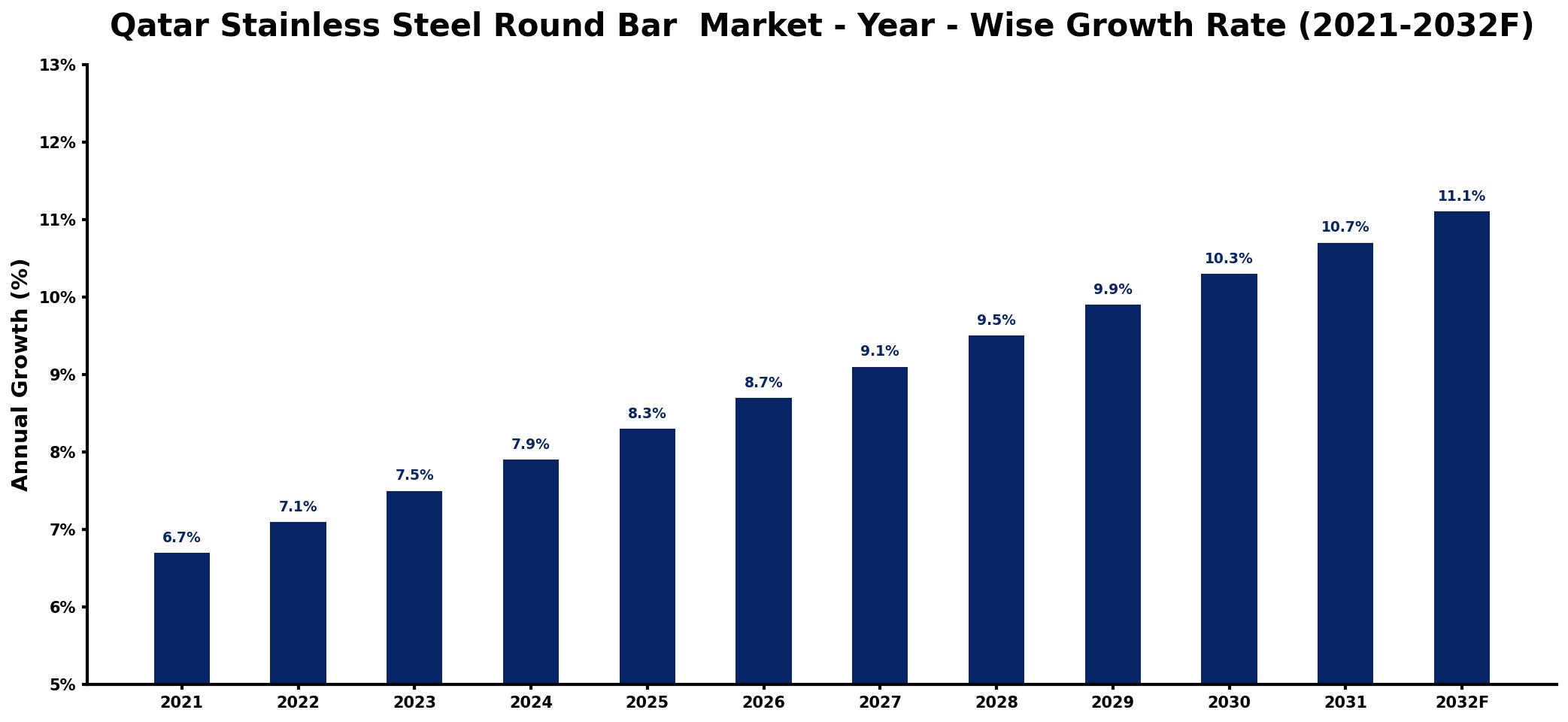
The table below presents the year‑wise growth rates along with the key drivers influencing the market
| Year | Growth Rate | Major Drivers |
| 2021 | 6.7% | Construction sector recovery initiatives |
| 2022 | 7.1% | Increased infrastructure development projects |
| 2023 | 7.5% | Growing automotive manufacturing demand |
| 2024 | 7.9% | Rise in renewable energy investments |
| 2025 | 8.3% | Expansion of industrial applications |
| 2026 | 8.7% | Boost in real estate activities |
| 2027 | 9.1% | Technological advancements in manufacturing |
| 2028 | 9.5% | Increased exports to neighboring markets |
| 2029 | 9.9% | Surge in consumer goods production |
| 2030 | 10.3% | Heightened demand for transportation solutions |
| 2031 | 10.7% | Growth in heavy machinery sector |
| 2032 | 11.1% | Investment in urban development initiatives |
Note: Market size estimations and growth projections presented in this report are based on 6Wresearch's proprietary forecasting methodology, utilizing the latest available industry data, government publications, and primary research inputs.
Qatar Stainless Steel Round Bar Market Synopsis
The Qatar stainless steel round bar market is witnessing significant momentum, driven primarily by the countrys ambitious construction projects. As Qatar continues to expand its urban landscape and enhance its industrial capabilities, the demand for high-quality stainless steel products is steadily increasing.
Moreover, the ongoing shift towards sustainable materials across various sectors reinforces the appeal of stainless steel round bars. Their intrinsic properties, such as durability and low maintenance needs, are crucial for industries looking to adopt environmentally responsible practices.
Qatar Stainless Steel Round Bar Market Key Takeaways
- Rapid urbanization and extensive infrastructure initiatives are driving demand in the market.
- Stainless steel round bars are increasingly favored for their durability and resistance to environmental factors.
- The aerospace sector's expansion presents new opportunities for stainless steel applications.
- Technological advancements in production processes are crucial for maintaining competitive edge.
- Market growth is supported by a national push towards sustainability and long-lasting materials.
Evaluation of Restraints in Qatar Stainless Steel Round Bar Market
The Qatar stainless steel round bar market faces challenges stemming from the global steel market dynamics. Fluctuations in international steel prices can impact local manufacturers' competitiveness and profit margins. Additionally, the necessity for continuous investment in research and development to keep pace with technological advancements places a strain on resources. These factors can constrain growth potential and market adaptability in an increasingly competitive landscape.
Qatar Stainless Steel Round Bar Market Trends
The current trend towards sustainability is reshaping material choices in various industries, with stainless steel round bars at the forefront. Not only do these materials offer longevity, but they also align with green building standards. Additionally, there is a noticeable increase in automation and smart manufacturing processes, which enhances production efficiency while reducing waste.
Furthermore, the increasing number of commercial and residential projects in Qatar fuels demand, particularly in structural applications where strength and reliability are paramount. Emerging technologies for material processing are also leading to enhanced product characteristics, making stainless steel more appealing across various sectors.
Qatar Stainless Steel Round Bar Market Opportunities
The market offers significant growth opportunities, particularly with the ongoing infrastructure initiatives set forth by the government. Investment in new construction projects, alongside the growing aerospace sector, provides fertile ground for increased consumption of stainless steel round bars. Additionally, partnerships with technology firms to innovate production techniques present avenues for expanding market reach and improving product quality.
Government Initiatives in the Qatar Stainless Steel Round Bar Market
The Qatari government is actively promoting initiatives aimed at enhancing the construction and manufacturing sectors through substantial public spending. Incentives for using sustainable materials and technologies in projects are being implemented, encouraging industries to adopt stainless steel for its environmentally friendly attributes. These government programs not only support local manufacturing but also align with national goals for sustainable development.
Future Insights of the Qatar Stainless Steel Round Bar Market
Looking ahead to 2026-2032, the Qatar stainless steel round bar market is poised for robust expansion. Continued infrastructure development, combined with the increasing adoption of stainless steel in high-demand sectors such as construction and aerospace, will drive significant market growth. As global trends shift toward sustainable practices, local manufacturers will have to innovate continuously to meet evolving demands and maintain their competitive edge.
Qatar Stainless Steel Round Bar Market Latest Developments (2025 - 2026)
Recent developments within the Qatar stainless steel round bar market indicate a shift towards integrating advanced production technologies. Manufacturers are increasingly focusing on automating processes to enhance efficiency and product quality. Additionally, there are signs of collaboration between local companies and international firms, aimed at leveraging expertise in sustainable manufacturing practices to meet growing demands in the market.
Qatar Stainless Steel Round Bar Market - Key Attractiveness of the Report
- 10 Years of Market Numbers
- Historical Data Starting from 2022 to 2025
- Base Year: 2025
- Forecast Data until 2032
- Key Performance Indicators Impacting the Market
- Major Upcoming Developments and Projects
Key Highlights of the Report:
- Qatar Stainless Steel Round Bar Market Outlook
- Market Size of Qatar Stainless Steel Round Bar Market, 2025
- Forecast of Qatar Stainless Steel Round Bar Market, 2032
- Historical Data and Forecast of Qatar Stainless Steel Round Bar Revenues & Volume for the Period 2022-2032F
- Qatar Stainless Steel Round Bar Market Trend Evolution
- Qatar Stainless Steel Round Bar Market Drivers and Challenges
- Qatar Stainless Steel Round Bar Price Trends
- Qatar Stainless Steel Round Bar Porter's Five Forces
- Qatar Stainless Steel Round Bar Industry Life Cycle
- Historical Data and Forecast of Qatar Stainless Steel Round Bar Market Revenues & Volume By Product for the Period 2022-2032F
- Historical Data and Forecast of Qatar Stainless Steel Round Bar Market Revenues & Volume By Cr-Ni for the Period 2022-2032F
- Historical Data and Forecast of Qatar Stainless Steel Round Bar Market Revenues & Volume By Duplex & Super Duplex for the Period 2022-2032F
- Historical Data and Forecast of Qatar Stainless Steel Round Bar Market Revenues & Volume By High Nickel Alloys for the Period 2022-2032F
- Qatar Stainless Steel Round Bar Import Export Trade Statistics
- Market Opportunity Assessment By Product
- Qatar Stainless Steel Round Bar Top Companies Market Share
- Qatar Stainless Steel Round Bar Competitive Benchmarking By Technical and Operational Parameters
- Qatar Stainless Steel Round Bar Company Profiles
- Qatar Stainless Steel Round Bar Key Strategic Recommendations






































