Qatar Thermostats Market Summary
The qatar thermostats market was estimated at USD 457 Million in 2025 and is projected to reach USD 622 Million by 2032, growing at a CAGR of 5.6% from 2026 to 2032.
Qatar Thermostats Market Year-wise Growth Rate and Key Drivers
This graph highlights how the Qatar Thermostats Market has steadily grown over the past five years, supported by major growth factors.
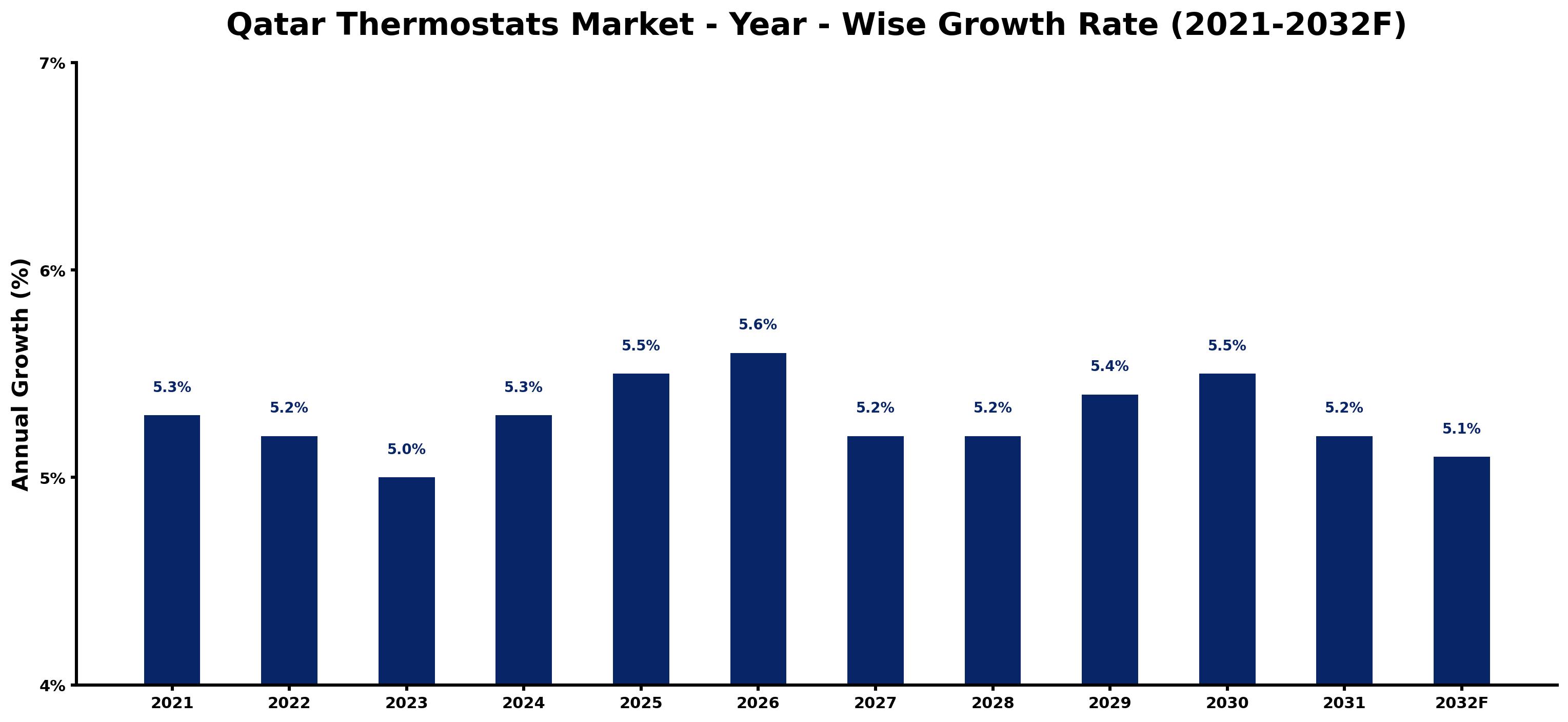
The table below presents the year wise growth rates along with the key drivers influencing the market
| Year | Growth Rate | Major Drivers |
| 2021 | 5.3% | Post-lockdown retail projects invigorated the construction sector, boosting thermostat installations. |
| 2022 | 5.2% | Investment in smart building technologies gained momentum, enhancing energy management systems. |
| 2023 | 5.0% | Emerging eco-conscious consumer trends influenced manufacturers to innovate energy-efficient thermostats. |
| 2024 | 5.3% | Expanding luxury developments in Doha increased demand for advanced climate control solutions. |
| 2025 | 5.5% | Corporate sustainability strategies prompted businesses to integrate intelligent temperature management systems. |
| 2026 | 5.6% | Increased awareness of energy savings led homeowners to upgrade to smart thermostatic solutions. |
| 2027 | 5.2% | Localization efforts in the GCC region encouraged manufacturers to tailor products for local climates. |
| 2028 | 5.2% | The construction pipeline for mega projects like Neom emphasized the need for resilient HVAC systems. |
| 2029 | 5.4% | Investor interest surged in green technology, fueling innovations in thermostat functionalities. |
| 2030 | 5.5% | Legacy copper grid failures highlighted the importance of reliable, smart energy management systems. |
| 2031 | 5.2% | Emergence of new residential clusters in Qatar drove demand for integrated smart home technologies. |
| 2032 | 5.1% | Economic diversification efforts in Qatar created new opportunities for advanced thermostat manufacturers. |
Note - Market size estimations and growth projections presented in this report are based on 6Wresearch's advanced forecasting approach, validated with industry datasets as of June 2026.
Qatar Thermostats Market Synopsis
The Qatar Thermostats Market is projected to reach 5.6% and witness significant growth during the forecast period (2026-2032). The market is anticipated to grow at a compound annual growth rate (CAGR) of 8.6%, driven by several key factors including rising energy costs, increasing construction activities, and a growing demand for smart home solutions. Furthermore, the regional emphasis on energy efficiency in neighboring Saudi Arabia is expected to further propel the growth of the Qatar thermostat market in the upcoming years.
Qatar Thermostats Market Growth Drivers
Several factors are contributing to the robust expansion of the Qatar thermostats market. The primary drivers include:
- Rising energy costs have prompted households in Qatar to seek more efficient heating and cooling systems. This shift has led to a greater adoption of thermostats, which optimize indoor climate control and help to reduce electricity bills through improved HVAC operation management.
- Increased construction activities across both residential and commercial sectors have directly correlated with the installation of air conditioning units and their associated HVAC controllers, including thermostats. This trend is expected to escalate as Qatar continues to develop its infrastructure.
- The growing awareness of smart home solutions has catalyzed the market, with consumers actively seeking advanced technologies that enhance convenience, comfort, and energy management within their living spaces.
- Government initiatives aimed at promoting energy efficiency and sustainable living in Qatar are likely to incentivize the widespread adoption of thermostat technology as part of broader environmental policies.
- The influx of foreign investments in Qatar's real estate sector has further solidified the demand for modern heating and cooling solutions, thereby driving the growth of the thermostats market.
Qatar Thermostats Market Challenges and Restraints
Despite the optimistic growth outlook, the Qatar thermostats market faces several challenges that could impede its progress:
- Smart home automation systems often require advanced technical expertise for installation and maintenance. Many users lack the necessary skills, leading to integration difficulties with other smart devices and resulting in operational issues that can negatively affect customer experiences.
- The initial cost of acquiring and installing smart thermostats can be a deterrent for some consumers, particularly in a market where budget constraints are common among certain demographics.
- The variability in power supply and potential fluctuations in electricity costs may create uncertainty for consumers considering the investment in thermostat technology as part of their energy management strategies.
- Consumer education around the benefits and functionalities of smart thermostats remains a hurdle; many potential users are unaware of how these devices can improve energy efficiency and reduce costs over time.
- Market competition from alternative energy management systems could also pose a challenge to the adoption of thermostats, as consumers may gravitate toward other solutions that promise similar outcomes.
Qatar Thermostats Market Government Investment and Initiatives
The Qatari government has been proactive in investing in energy efficiency initiatives that directly impact the thermostats market. Policies aimed at reducing overall energy consumption, enhancing building standards, and promoting the use of smart technologies are underway. Such initiatives are part of Qatar's strategic vision for sustainable development, which encompasses significant public spending on infrastructure and energy-efficient technologies. These efforts include collaboration with local and international stakeholders to foster the adoption of advanced HVAC systems equipped with smart thermostats, thereby driving market growth.
Qatar Thermostats Market Latest Developments (May 2025 - June 2026)
The period from May 2025 to June 2026 has seen notable developments in the Qatar thermostats market. A gradual resumption of manufacturing activities post-COVID-19 lockdowns has allowed key manufacturers to return to production, albeit at reduced capacity levels. Innovations in smart technology have sparked interest among consumers, with a focus on integrating IoT capabilities into thermostats. As market players adapt to changing consumer preferences, the emphasis has shifted toward developing user-friendly interfaces and enhanced functionalities in new product offerings. Additionally, the government has articulated plans to further incentivize energy-efficient home upgrades, which are expected to bolster the adoption of thermostat technologies.
Qatar Thermostats Market - Key Attractiveness of the Report
- 10 Years of Market Numbers
- Historical Data Starting from 2022 to 2025
- Base Year: 2025
- Forecast Data until 2032
- Key Performance Indicators Impacting the Market
- Major Upcoming Developments and Projects
Key Highlights of the Report:
- Qatar Thermostats Market Outlook
- Market Size of Qatar Thermostats Market, 2025
- Forecast of Qatar Thermostats Market, 2032
- Historical Data and Forecast of Qatar Thermostats Revenues & Volume for the Period 2022-2032F
- Qatar Thermostats Market Trend Evolution
- Qatar Thermostats Market Drivers and Challenges
- Qatar Thermostats Price Trends
- Qatar Thermostats Porter's Five Forces
- Qatar Thermostats Industry Life Cycle
- Historical Data and Forecast of Qatar Thermostats Market Revenues & Volume By Products for the Period 2022-2032F
- Historical Data and Forecast of Qatar Thermostats Market Revenues & Volume By Smart Thermostat for the Period 2022-2032F
- Historical Data and Forecast of Qatar Thermostats Market Revenues & Volume By Mechanical Thermostat for the Period 2022-2032F
- Historical Data and Forecast of Qatar Thermostats Market Revenues & Volume By Programmable Thermostat for the Period 2022-2032F
- Historical Data and Forecast of Qatar Thermostats Market Revenues & Volume By Distribution Channel for the Period 2022-2032F
- Historical Data and Forecast of Qatar Thermostats Market Revenues & Volume By Utility for the Period 2022-2032F
- Historical Data and Forecast of Qatar Thermostats Market Revenues & Volume By Retail for the Period 2022-2032F
- Historical Data and Forecast of Qatar Thermostats Market Revenues & Volume By Security for the Period 2022-2032F
- Historical Data and Forecast of Qatar Thermostats Market Revenues & Volume By HVAC for the Period 2022-2032F
- Historical Data and Forecast of Qatar Thermostats Market Revenues & Volume By Mode of Operations for the Period 2022-2032F
- Historical Data and Forecast of Qatar Thermostats Market Revenues & Volume By Line Voltage for the Period 2022-2032F
- Historical Data and Forecast of Qatar Thermostats Market Revenues & Volume By Low Voltage for the Period 2022-2032F
- Historical Data and Forecast of Qatar Thermostats Market Revenues & Volume By Millivolt for the Period 2022-2032F
- Historical Data and Forecast of Qatar Thermostats Market Revenues & Volume By Applications for the Period 2022-2032F
- Historical Data and Forecast of Qatar Thermostats Market Revenues & Volume By Residential for the Period 2022-2032F
- Historical Data and Forecast of Qatar Thermostats Market Revenues & Volume By Commercial for the Period 2022-2032F
- Qatar Thermostats Import Export Trade Statistics
- Market Opportunity Assessment By Products
- Market Opportunity Assessment By Distribution Channel
- Market Opportunity Assessment By Mode of Operations
- Market Opportunity Assessment By Applications
- Qatar Thermostats Top Companies Market Share
- Qatar Thermostats Competitive Benchmarking By Technical and Operational Parameters
- Qatar Thermostats Company Profiles
- Qatar Thermostats Key Strategic Recommendations






































