Qatar Wall Lamps Market Summary
The qatar wall lamps market was estimated at USD 413 Million in 2025 and is projected to reach USD 551 Million by 2032, growing at a CAGR of 5.1% from 2026 to 2032.
Qatar Wall Lamps Market Year-wise Growth Rate and Key Drivers
This graph highlights how the Qatar Wall Lamps Market has steadily grown over the past five years, supported by major growth factors.
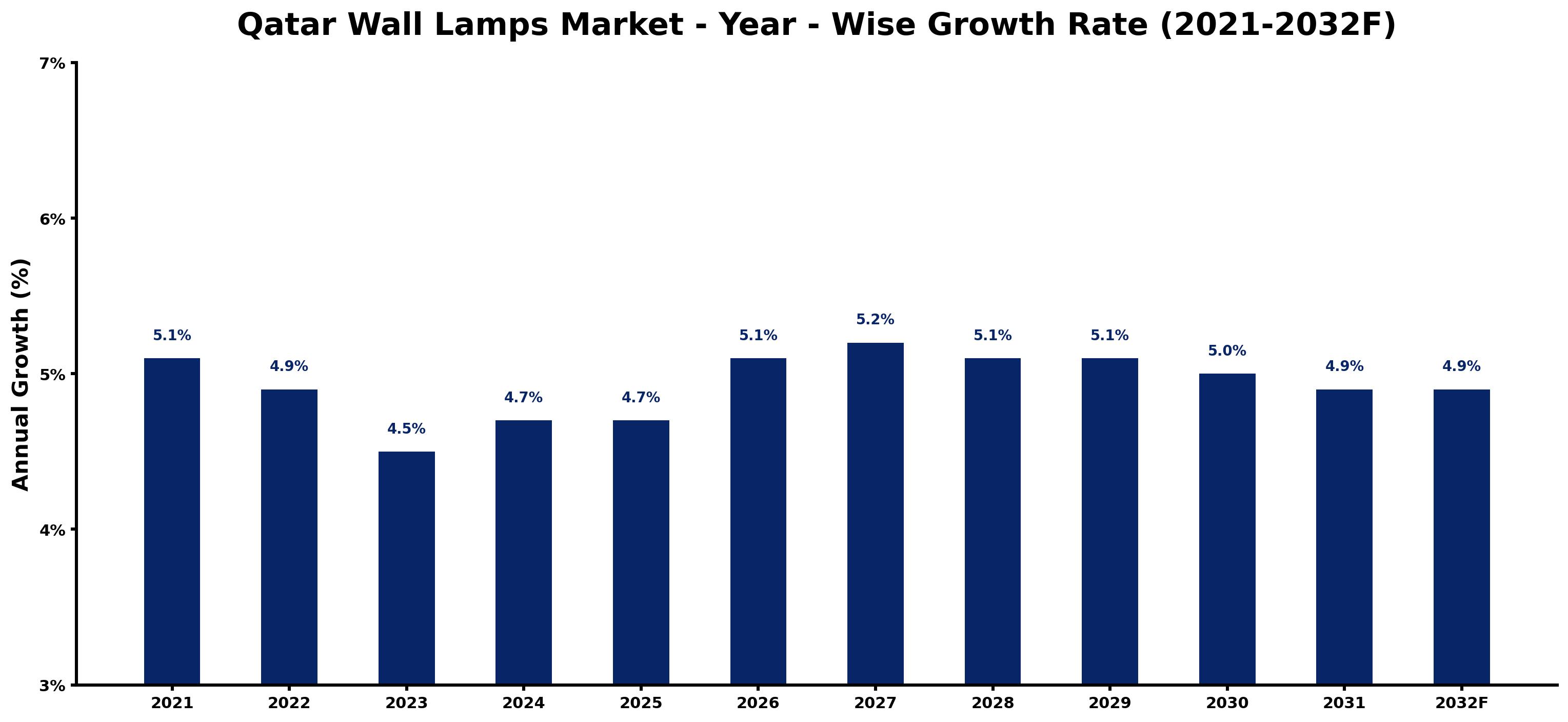
The table below presents the year wise growth rates along with the key drivers influencing the market
| Year | Growth Rate | Major Drivers |
| 2021 | 5.1% | Luxury residential developments entered the market, enhancing demand for decorative lighting solutions. |
| 2022 | 4.9% | High-end hospitality venues began emphasizing unique lighting designs to attract clientele. |
| 2023 | 4.5% | Local manufacturers expanded product lines, offering innovative wall lamps tailored to regional aesthetics. |
| 2024 | 4.7% | Emerging architectural trends highlighted integrated lighting, appealing to contemporary design enthusiasts. |
| 2025 | 4.7% | Increasing urbanization in Doha drove interest in versatile lighting for smaller living spaces. |
| 2026 | 5.1% | Participation in international design fairs positioned Qatari products in a global marketplace. |
| 2027 | 5.2% | Sustainability initiatives gained traction, prompting interest in energy-efficient wall lamp technologies. |
| 2028 | 5.1% | Online retail platforms facilitated easier consumer access to diverse wall lamp collections. |
| 2029 | 5.1% | Collaborations between local artisans and designers resulted in unique, culturally inspired lighting pieces. |
| 2030 | 5.0% | Economic diversification efforts fueled investments in luxury home decor, boosting wall lamp sales. |
| 2031 | 4.9% | Smart home technology integration in residences increased demand for advanced lighting solutions. |
| 2032 | 4.9% | Eco-conscious consumers prioritized purchases from brands committed to sustainable manufacturing practices. |
Note - Market size estimations and growth projections presented in this report are based on 6Wresearch's advanced forecasting approach, validated with industry datasets as of June 2026.
Qatar Wall Lamps Market Synopsis
The Qatar Wall Lamps Market is projected to reach 5.1% and witness significant growth during the forecast period (2026-2032). The surge in demand for energy-efficient and visually appealing lighting solutions is driving this trend. Furthermore, advancements in technology have spurred the creation of innovative wall lamps that feature wireless charging, voice assistant integration, and motion sensors, enhancing the market's appeal and functionality within the country.
Qatar Wall Lamps Market Growth Drivers
Several key factors are propelling the Qatar Wall Lamps Market towards robust growth. Primarily, the rise in disposable income among the population has enabled consumers to invest in higher-quality lighting products. The ongoing expansion in residential construction activities across Qatar is also noteworthy, as new homes typically incorporate modern lighting solutions, including wall lamps.
- One significant driver is the government's push for energy-efficient technologies. Initiatives aimed at promoting LED-based wall lamps have gained momentum, enhancing the market landscape.
- Increased environmental consciousness is prompting consumers to adopt eco-friendly lighting options. Solar-powered wall lamps are becoming increasingly popular, offering not just sustainability but also cost savings on electricity bills.
- The aesthetic appeal of wall lamps is a crucial factor, as consumers seek lighting that harmonizes with their interior design. This has led to a surge in demand for stylish and functional wall lighting.
- The influence of e-commerce platforms cannot be overlooked, as they facilitate easier access to a variety of wall lamps, allowing consumers to compare products and prices conveniently.
- Finally, the market's growth is further stimulated by the influx of new designs and technological features that cater to modern consumer preferences, thus keeping the market competitive.
Qatar Wall Lamps Market Challenges and Restraints
Despite the positive outlook for the Qatar Wall Lamps Market, there are notable challenges that could inhibit growth. High installation costs associated with advanced wall lamp technologies may deter potential buyers, particularly in a mixed economic landscape.
- The proliferation of low-quality counterfeit products presents a significant challenge. These offerings at lower price points undermine brand value and may negatively impact customer loyalty.
- Supply chain disruptions, particularly evident during the pandemic, have highlighted vulnerabilities in the production of wall lamps, potentially leading to shortages and increased prices.
- Market fluctuations in raw material prices can also pose a challenge, influencing production costs and overall market stability.
- Consumer apprehension regarding the durability and performance of new technologies in wall lamps can limit acceptance, further slowing down market penetration.
- Uncertain economic conditions may lead to decreased consumer spending, making it essential for manufacturers to strategize to maintain sales volumes in competitive environments.
Qatar Wall Lamps Market Government Investment and Initiatives
The government of Qatar has been proactive in investing in sustainable lighting solutions, recognizing the importance of energy efficiency in residential and commercial spaces. Initiatives aimed at improving energy consumption through the promotion of LED wall lamps are critical components of the national strategy for sustainable development.
Public spending on infrastructure improvement projects contributes to increased demand for advanced lighting fixtures, including wall lamps. Additionally, various government incentives are aimed at encouraging manufacturers to develop and promote eco-friendly lighting options, further driving market acceptance and growth.
Qatar Wall Lamps Market Latest Developments (May 2025 - June 2026)
Recent developments in the Qatar Wall Lamps Market indicate a shift towards integrating advanced features in lighting solutions. Manufacturers are increasingly focusing on smart technology, with products that incorporate IoT capabilities becoming more prevalent. The trend of customization is also gaining traction, allowing consumers to select lighting solutions that meet their specific needs and preferences.
Moreover, the impact of the COVID-19 pandemic is still visible, with manufacturers adapting their strategies to focus on online sales and digital marketing. E-commerce platforms have become essential for maintaining sales volumes, as consumers continue to prefer online shopping for convenience and safety. Market players are also exploring partnerships to enhance distribution networks, ensuring that innovative wall lamp models reach consumers effectively.
Qatar Wall Lamps Market - Key Attractiveness of the Report
- 10 Years of Market Numbers
- Historical Data Starting from 2022 to 2025
- Base Year: 2025
- Forecast Data until 2032
- Key Performance Indicators Impacting the Market
- Major Upcoming Developments and Projects
Key Highlights of the Report:
- Qatar Wall Lamps Market Outlook
- Market Size of Qatar Wall Lamps Market, 2025
- Forecast of Qatar Wall Lamps Market, 2032
- Historical Data and Forecast of Qatar Wall Lamps Revenues & Volume for the Period 2022-2032F
- Qatar Wall Lamps Market Trend Evolution
- Qatar Wall Lamps Market Drivers and Challenges
- Qatar Wall Lamps Price Trends
- Qatar Wall Lamps Porter's Five Forces
- Qatar Wall Lamps Industry Life Cycle
- Historical Data and Forecast of Qatar Wall Lamps Market Revenues & Volume By Types for the Period 2022-2032F
- Historical Data and Forecast of Qatar Wall Lamps Market Revenues & Volume By Bronze for the Period 2022-2032F
- Historical Data and Forecast of Qatar Wall Lamps Market Revenues & Volume By Plastic for the Period 2022-2032F
- Historical Data and Forecast of Qatar Wall Lamps Market Revenues & Volume By Steel for the Period 2022-2032F
- Historical Data and Forecast of Qatar Wall Lamps Market Revenues & Volume By Wood for the Period 2022-2032F
- Historical Data and Forecast of Qatar Wall Lamps Market Revenues & Volume By Other for the Period 2022-2032F
- Historical Data and Forecast of Qatar Wall Lamps Market Revenues & Volume By Applications for the Period 2022-2032F
- Historical Data and Forecast of Qatar Wall Lamps Market Revenues & Volume By Commercial for the Period 2022-2032F
- Historical Data and Forecast of Qatar Wall Lamps Market Revenues & Volume By Residential for the Period 2022-2032F
- Qatar Wall Lamps Import Export Trade Statistics
- Market Opportunity Assessment By Types
- Market Opportunity Assessment By Applications
- Qatar Wall Lamps Top Companies Market Share
- Qatar Wall Lamps Competitive Benchmarking By Technical and Operational Parameters
- Qatar Wall Lamps Company Profiles
- Qatar Wall Lamps Key Strategic Recommendations






































