Qatar Washable Markers Market Size, Share & Growth Rate
The Qatar Washable Markers Market was estimated at USD 363 Million in 2025 and is projected to reach USD 512 Million by 2032, growing at a CAGR of 5.0% from 2026 to 2032. This growth trajectory is primarily fueled by the ongoing investment in educational infrastructure and a rising focus on creative activities, both of which have created a robust demand for safe and versatile writing tools. As schools and art centers in Qatar increasingly emphasize child-friendly products, the market is expected to thrive amid a burgeoning culture of creativity.
Qatar Washable Markers Market Year-wise Growth Rate and Key Drivers
This graph highlights how the Qatar Washable Markers Market has steadily grown over the years, supported by major growth factors.
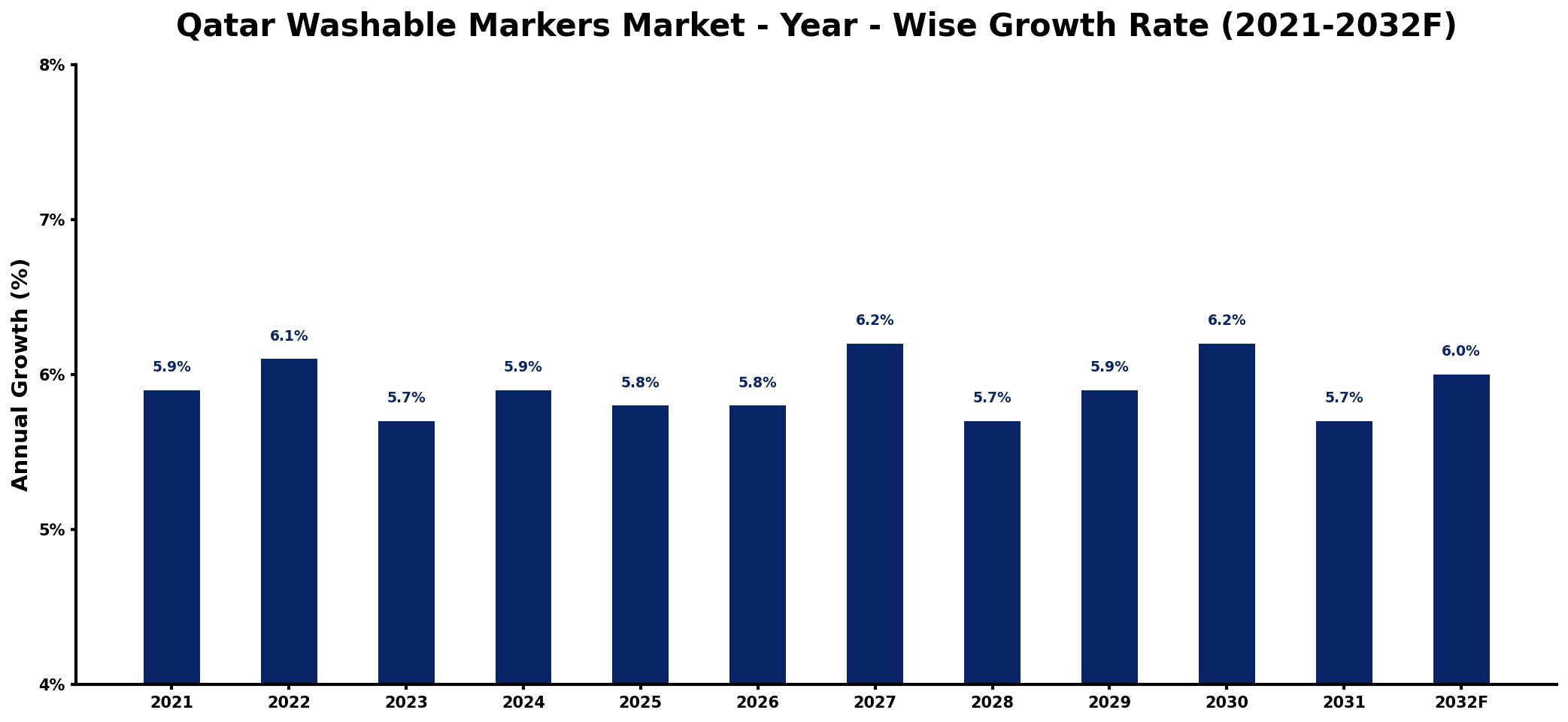
The table below presents the year‑wise growth rates along with the key drivers influencing the market
| Year | Growth Rate | Major Drivers |
| 2021 | 5.9% | Increase in educational supplies demand |
| 2022 | 6.1% | Growth in creative arts programs |
| 2023 | 5.7% | Rise in school enrollment rates |
| 2024 | 5.9% | Expansion of afterschool activities |
| 2025 | 5.8% | Increased investment in art education |
| 2026 | 5.8% | Higher demand from craft industries |
| 2027 | 6.2% | Boost in DIY project popularity |
| 2028 | 5.7% | rising end-use demand growth |
| 2029 | 5.9% | increased overall sector activity |
| 2030 | 6.2% | growing regional consumption patterns |
| 2031 | 5.7% | increased domestic production output |
| 2032 | 6.0% | expanding healthcare application demand |
Note: Market size estimations and growth projections presented in this report are based on 6Wresearch's proprietary forecasting methodology, utilizing the latest available industry data, government publications, and primary research inputs.
Qatar Washable Markers Market Synopsis
Currently, the Qatar washable markers market is experiencing a favorable shift due to heightened awareness regarding eco-friendly products and the growing preferences of consumers who value sustainability. The increasing popularity of arts and crafts among both children and adults has further escalated the demand for washable markers that are safe and easy to clean.
As educational institutions in Qatar continue to prioritize innovative and accessible resources for learning, washable markers are being recognized for their practical benefits. Their ability to easily wash off surfaces without leaving stains makes them a top choice among educators and parents alike.
Qatar Washable Markers Market Key Takeaways
- The market is driven by a focus on child safety and eco-consciousness.
- Washable markers are favored in educational settings due to their ease of use.
- Continuous growth in the arts and crafts sector supports market demand.
- The market is poised to recover and thrive post-COVID-19 due to renewed emphasis on hygiene.
- Quality assurance and compliance with safety standards remain critical for market players.
Evaluation of Restraints in Qatar Washable Markers Market
While the market presents substantial growth opportunities, several restraints may hinder its progress. One prominent challenge is the need for manufacturers to ensure the consistency and quality of washable markers, specifically confirming that products meet consumer expectations for washability. Additionally, compliance with stringent safety standards for children's products is crucial, as any lapse could impact brand reputation and sales. Moreover, concerns related to sustainability continue to emerge, necessitating manufacturers to innovate and adapt to changing consumer preferences.
Qatar Washable Markers Market Trends
As the demand for washable markers grows, several trends are shaping the Qatar market. There is a noticeable shift towards non-toxic and environmentally friendly formulations, appealing to eco-conscious consumers. Furthermore, the expansion of digital platforms for arts and crafts has led to a resurgence in traditional art tools, including washable markers, which are being promoted in schools and creative workshops. Social media's role in showcasing creative projects has also fueled interest in DIY activities, thereby increasing sales of these markers.
Qatar Washable Markers Market Opportunities
The Qatar washable markers market offers lucrative opportunities, particularly in the educational and creative sectors. Schools are likely to increase their procurement of washable markers as part of their supply lists, while parents continue to seek safe, effective art supplies for home use. The growth of e-commerce platforms also presents a significant opportunity for reaching a broader audience, with online marketing campaigns tailored to attract both educators and parents. Additionally, collaborations with local artists for limited edition products could enhance market appeal.
Government Initiatives in the Qatar Washable Markers Market
The Qatari government has prioritized educational reforms and the promotion of creativity among youth, which directly supports the washable markers market. Investments in educational infrastructure, including schools and community centers, encourage the adoption of innovative learning tools. Furthermore, various public programs aimed at enhancing artistic expression and craft activities among children align with the rising demand for washable markers.
Future Insights of the Qatar Washable Markers Market
Looking ahead to 2026-2032, the Qatar washable markers market is expected to maintain a solid growth trajectory. This positive outlook is underpinned by a sustained focus on child-friendly art supplies within the educational sector and the rising prominence of creative hobbies among adults. The growing eco-awareness among consumers is likely to push manufacturers towards developing sustainable products, potentially attracting a broader customer base that values environmental responsibility.
Qatar Washable Markers Market Latest Developments (2025 - 2026)
In recent months, the Qatar washable markers market has seen a wave of product innovation, with several brands launching new lines that emphasize eco-friendly materials and non-toxic inks. Initiatives promoting arts education in schools have gained traction, resulting in increased demand for washable markers. As the market adapts to post-pandemic dynamics, many retailers are enhancing their online presence to cater to an expanding customer base seeking convenient shopping options.
Qatar Washable Markers Market - Key Attractiveness of the Report
- 10 Years of Market Numbers
- Historical Data Starting from 2022 to 2025
- Base Year: 2025
- Forecast Data until 2032
- Key Performance Indicators Impacting the Market
- Major Upcoming Developments and Projects
Key Highlights of the Report:
- Qatar Washable Markers Market Outlook
- Market Size of Qatar Washable Markers Market, 2025
- Forecast of Qatar Washable Markers Market, 2032
- Historical Data and Forecast of Qatar Washable Markers Revenues & Volume for the Period 2022-2032F
- Qatar Washable Markers Market Trend Evolution
- Qatar Washable Markers Market Drivers and Challenges
- Qatar Washable Markers Price Trends
- Qatar Washable Markers Porter's Five Forces
- Qatar Washable Markers Industry Life Cycle
- Historical Data and Forecast of Qatar Washable Markers Market Revenues & Volume By Washability for the Period 2022-2032F
- Historical Data and Forecast of Qatar Washable Markers Market Revenues & Volume By Basic- Washable for the Period 2022-2032F
- Historical Data and Forecast of Qatar Washable Markers Market Revenues & Volume By Super-washable for the Period 2022-2032F
- Historical Data and Forecast of Qatar Washable Markers Market Revenues & Volume By End User for the Period 2022-2032F
- Historical Data and Forecast of Qatar Washable Markers Market Revenues & Volume By Children for the Period 2022-2032F
- Historical Data and Forecast of Qatar Washable Markers Market Revenues & Volume By Professionals for the Period 2022-2032F
- Qatar Washable Markers Import Export Trade Statistics
- Market Opportunity Assessment By Washability
- Market Opportunity Assessment By End User
- Qatar Washable Markers Top Companies Market Share
- Qatar Washable Markers Competitive Benchmarking By Technical and Operational Parameters
- Qatar Washable Markers Company Profiles
- Qatar Washable Markers Key Strategic Recommendations






































