Qatar Windows Market Summary
The qatar windows market was estimated at USD 430 Million in 2025 and is projected to reach USD 585 Million by 2032, growing at a CAGR of 5.2% from 2026 to 2032.
Qatar Windows Market Year-wise Growth Rate and Key Drivers
This graph highlights how the Qatar Windows Market has steadily grown over the past five years, supported by major growth factors.
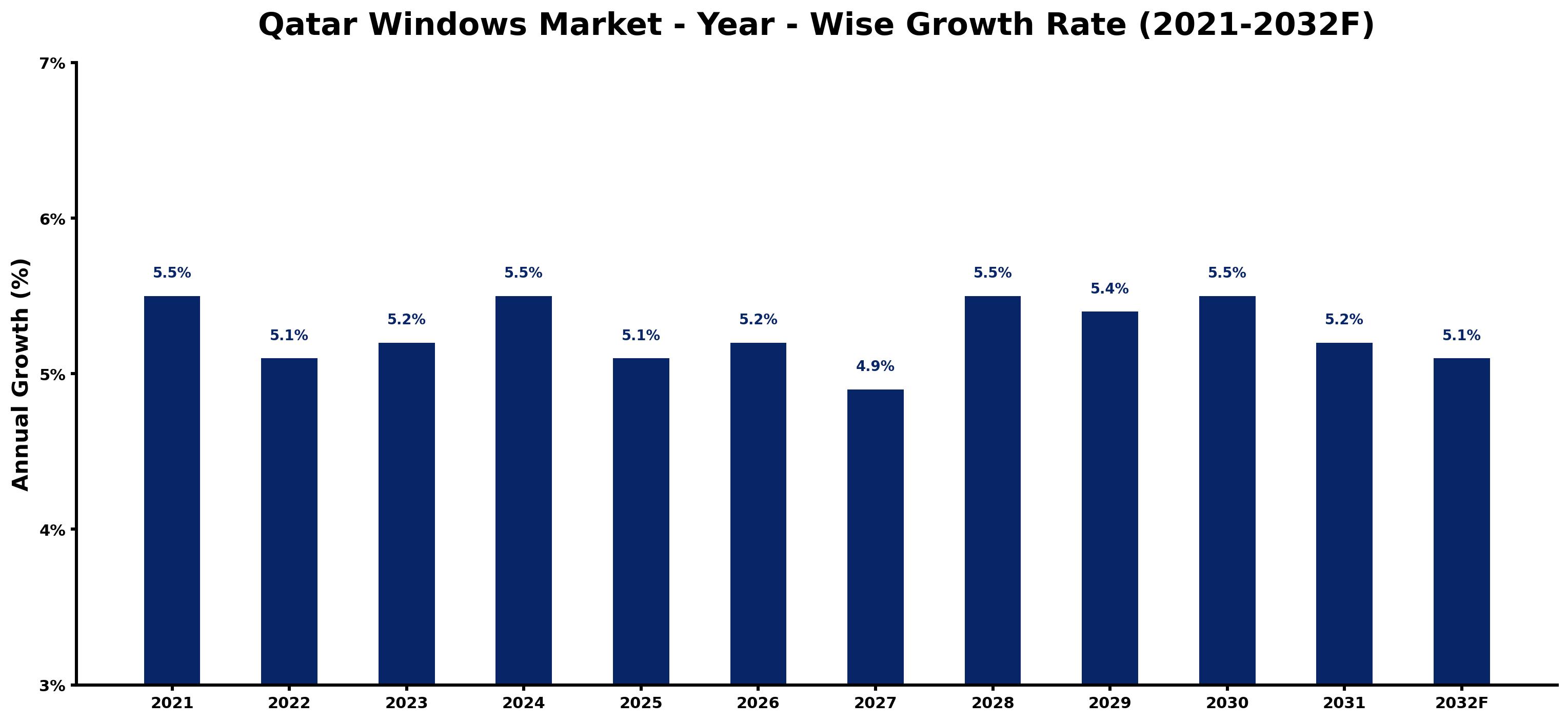
The table below presents the year wise growth rates along with the key drivers influencing the market
| Year | Growth Rate | Major Drivers |
| 2021 | 5.5% | Post-pandemic recovery sees increased investment in residential and commercial buildings. |
| 2022 | 5.1% | Construction projects resume, emphasizing energy-efficient materials for enhanced sustainability. |
| 2023 | 5.2% | Emerging luxury segments demand high-performance windows, elevating market competition significantly. |
| 2024 | 5.5% | Technological innovation allows for smart windows, catering to modern urban lifestyles. |
| 2025 | 5.1% | Regional infrastructure initiatives focus on enhancing urban living standards and aesthetics. |
| 2026 | 5.2% | Economic diversification efforts attract foreign investments, boosting local manufacturing capabilities. |
| 2027 | 4.9% | Intensified focus on climate resilience influences architectural trends and window specifications. |
| 2028 | 5.5% | Shifts towards modular construction techniques promote quicker installation of window solutions. |
| 2029 | 5.4% | Aging buildings require retrofitting, creating a demand for modern window upgrades. |
| 2030 | 5.5% | Increased tourism fosters hospitality sector growth, necessitating high-end window installations. |
| 2031 | 5.2% | Local partnerships strengthen supply chains, improving responsiveness to market fluctuations. |
| 2032 | 5.1% | Urbanization trends lead to tighter regulations on energy consumption in buildings. |
Note - Market size estimations and growth projections presented in this report are based on 6Wresearch's advanced forecasting approach, validated with industry datasets as of June 2026.
Qatar Windows Market Synopsis
The Qatar Windows Market is projected to reach 5.2% and witness significant growth during the forecast period (2026-2032). This growth is fueled by the ongoing urbanization trends and an upsurge in both commercial and residential construction activities across Qatar. Increasing investments in energy-efficient building solutions, supported by government initiatives, are also contributing to the market's expansion. Moreover, advancements in technology, particularly in the development of smart glass systems, are expected to play a pivotal role in driving further growth within the market.
Qatar Windows Market Growth Drivers
The robust growth of the Qatar Windows Market can be attributed to several key factors:
- Urban Expansion: The rapid pace of urbanization has resulted in increased demand for high-quality window solutions suitable for new construction projects.
- Government Support: Various governmental initiatives aimed at promoting energy-efficient buildings provide financial incentives to both developers and consumers, stimulating demand for efficient window products.
- Technological Advancements: The introduction of modern window solutions, such as smart glass, is gaining traction due to their energy-saving capabilities and advanced features.
- Quality Requirements: The need for superior durability and aesthetic appeal in window solutions is prompting consumers to invest in higher quality products, driving market demand.
- Increased Construction Activity: A growing number of commercial and residential projects is leading to heightened demand for window solutions tailored to diverse architectural needs.
Qatar Windows Market Challenges and Restraints
Despite the favorable growth environment, the Qatar Windows Market faces certain challenges:
- Cost Implications: The relatively high cost of modern window solutions, in comparison to traditional alternatives, may deter budget-conscious consumers from making the switch.
- Lack of Awareness: Many potential consumers are not fully informed about the benefits that advanced window technologies offer, leading to slower adoption rates.
- Market Education: Efforts to educate the market about the advantages of energy-efficient windows need to be intensified to encourage broader acceptance.
- Supply Chain Disruptions: The repercussions of global events, including the COVID-19 pandemic, have caused disruptions in the supply chain, affecting availability and pricing.
- Consumer Preferences: A significant market segment continues to prefer conventional window products due to perceived affordability, potentially limiting the growth of innovative window solutions.
Qatar Windows Market Government Investment and Initiatives
The Qatari government has launched several initiatives aimed at enhancing the construction sector, thereby positively influencing the Qatar Windows Market. Key measures include:
- Investment in Sustainable Infrastructure: The government actively supports projects focused on sustainability, which includes promoting the use of energy-efficient windows in both public and private developments.
- Financial Incentives: Various programs provide financial assistance for the installation of energy-efficient solutions, encouraging builders and homeowners to opt for modern window technologies.
- Regulatory Framework: New policies are being established to ensure that construction practices promote energy efficiency, which directly impacts the types of window products being utilized.
- Public Awareness Campaigns: The government is involved in awareness initiatives that educate the public about the long-term benefits of investment in energy-efficient windows.
- Partnerships with Industry: Collaborations between government entities and industry leaders are being fostered to drive innovation and lower costs in the energy-efficient window sector.
Qatar Windows Market Latest Developments (May 2025 - June 2026)
The period between May 2025 and June 2026 has witnessed a range of developments in the Qatar Windows Market. The focus on sustainability continues to intensify, with more construction projects integrating energy-efficient window solutions. Additionally, technological advancements in window design and materials are drawing interest from developers and consumers alike. There has been a notable shift towards smart glass technologies, which are being adopted for their energy-saving and aesthetic features. Furthermore, industry stakeholders are actively working to address supply chain challenges that arose during the pandemic, aiming to stabilize the market and normalize product availability. Overall, the trend towards more modern, efficient, and aesthetically pleasing window solutions is driving the market forward.
Qatar Windows Market - Key Attractiveness of the Report
- 10 Years of Market Numbers
- Historical Data Starting from 2022 to 2025
- Base Year: 2025
- Forecast Data until 2032
- Key Performance Indicators Impacting the Market
- Major Upcoming Developments and Projects
Key Highlights of the Report:
- Qatar Windows Market Outlook
- Market Size of Qatar Windows Market, 2025
- Forecast of Qatar Windows Market, 2032
- Historical Data and Forecast of Qatar Windows Revenues & Volume for the Period 2022-2032F
- Qatar Windows Market Trend Evolution
- Qatar Windows Market Drivers and Challenges
- Qatar Windows Price Trends
- Qatar Windows Porter's Five Forces
- Qatar Windows Industry Life Cycle
- Historical Data and Forecast of Qatar Windows Market Revenues & Volume By Material for the Period 2022-2032F
- Historical Data and Forecast of Qatar Windows Market Revenues & Volume By uPVC for the Period 2022-2032F
- Historical Data and Forecast of Qatar Windows Market Revenues & Volume By Wood for the Period 2022-2032F
- Historical Data and Forecast of Qatar Windows Market Revenues & Volume By Metal for the Period 2022-2032F
- Historical Data and Forecast of Qatar Windows Market Revenues & Volume By Others for the Period 2022-2032F
- Historical Data and Forecast of Qatar Windows Market Revenues & Volume By Application for the Period 2022-2032F
- Historical Data and Forecast of Qatar Windows Market Revenues & Volume By Residential for the Period 2022-2032F
- Historical Data and Forecast of Qatar Windows Market Revenues & Volume By Commercial for the Period 2022-2032F
- Qatar Windows Import Export Trade Statistics
- Market Opportunity Assessment By Material
- Market Opportunity Assessment By Application
- Qatar Windows Top Companies Market Share
- Qatar Windows Competitive Benchmarking By Technical and Operational Parameters
- Qatar Windows Company Profiles
- Qatar Windows Key Strategic Recommendations






































