Romania Active Space Debris Removal Market Growth Rate
According to 6Wresearch internal database and industry insights, the Romania Active Space Debris Removal Market is projected to grow at a compound annual growth rate (CAGR) of 8.4% during the forecast period (2026-2032).
Romania Active Space Debris Removal Market Year-wise Growth Rate and Key Drivers (2022-2032)
This graph illustrates the annual growth rates of the Romania Active Space Debris Removal Market from 2022 to 2032, highlighting a steady upward trajectory and projected market expansion over the forecast period.
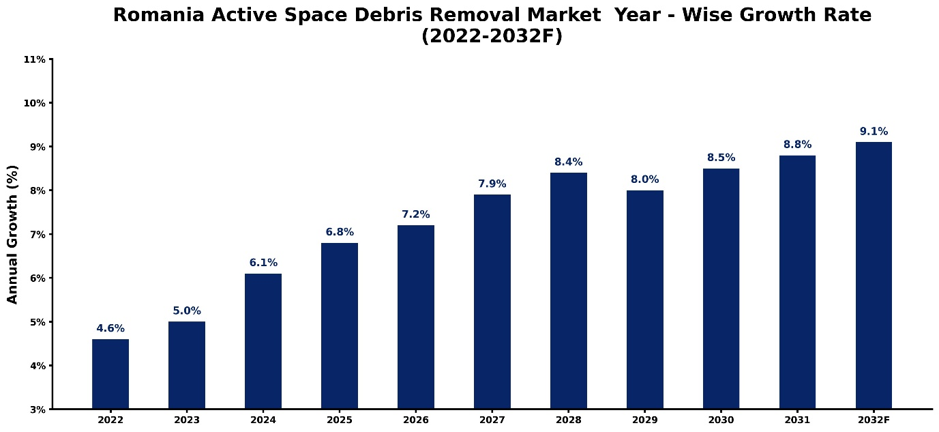
The following table summarizes the historical and forecasted growth rates of the Romania Active Space Debris Removal Market, along with the rationale behind each year’s performance.
| Year | Estimated Growth (%) | Market Rationale |
| 2022 | 4.6% | Growing satellite activity and increasing awareness of orbital congestion supported early demand for debris-monitoring and removal capabilities. |
| 2023 | 5% | Greater European focus on space sustainability and satellite end-of-life management increased interest in active debris removal technologies. |
| 2024 | 6.1% | Demonstrations of rendezvous, proximity operations, and debris inspection technologies strengthened commercial confidence in orbital servicing solutions. |
| 2025 | 6.8% | Increasing European investment in space safety and Romania’s participation in international space programmes supported market development. |
| 2026 | 7.2% | New European space-sustainability initiatives and stronger demand for responsible satellite disposal are expected to increase investment in debris removal services. |
| 2027 | 7.9% | Growing satellite constellations and higher requirements for orbital sustainability should encourage demand for inspection, capture, and controlled deorbiting services. |
| 2028 | 8.4% | Increasing commercialisation of in-orbit servicing is expected to improve technology readiness and expand opportunities for active debris removal missions. |
| 2029 | 8% | Growth may moderate slightly as early demonstration programmes transition into operational services, although demand for high-risk debris removal remains positive. |
| 2030 | 8.5% | Greater deployment of autonomous rendezvous and capture technologies should improve mission efficiency and broaden the commercial removal opportunity. |
| 2031 | 8.8% | Increasing satellite density and stricter sustainability requirements are expected to support recurring demand for orbital inspection and remediation services. |
| 2032 | 9.1% | Mature European orbital servicing capabilities and greater demand for safe, sustainable space operations are expected to sustain strong market expansion. |
Topics Covered in the Romania Active Space Debris Removal Market Report
The Romania Active Space Debris Removal Market Report provides a comprehensive analysis based on Debris Size and End-users. It offers detailed insights into key industry trends, growth drivers, emerging opportunities, competitive developments, and high-growth segments. The report presents an objective assessment of current dynamics and future prospects, enabling stakeholders to make informed business decisions and develop effective strategies aligned with the evolving requirements for orbital sustainability, satellite servicing, debris inspection, capture, and controlled removal across commercial and defence applications.
Romania Active Space Debris Removal Market Highlights
| Report Name | Romania Active Space Debris Removal Market |
| Forecast period | 2026-2032 |
| CAGR | 8.4% |
| Growing Sector | Commercial |
Romania Active Space Debris Removal Market Synopsis
Romania Active Space Debris Removal Market is anticipated to record notable growth as the number of satellites is growing, orbital congestion is increasing, and sustainable space activities become necessary in Europe. The active removal of space debris consists of using spacecraft to rendezvous with, capture, move, or de-orbit non-functional spacecraft. This technology uses navigation, sensors, robotics to capture, propulsion, and controlled deorbiting. As Romania participates in European space programs and Romanian Space Agency conduct its operations, there will be many possibilities to engage in space research and engineering through 2032.
Evaluation of Growth Drivers in the Romania Active Space Debris Removal Market (2026- 2032)
Below mentioned are some prominent drivers and their influence on the market dynamics:
| Drivers | Primary Segments Affected | Why it Matters (Evidence) |
| Increasing Orbital Congestion | More than 10 cm; Commercial | A growing population of large inactive objects increases collision risks and creates demand for targeted removal and controlled disposal services. |
| Expansion of Satellite Constellations | Between 1 cm to 10 cm; Commercial | Increasing satellite deployment raises the importance of orbital safety, tracking, end-of-life disposal, and debris mitigation capabilities. |
| European Space Sustainability Initiatives | All Debris Sizes; Commercial & Defense | European programmes are encouraging technologies that improve responsible space operations, orbital safety, and long-term sustainability. |
| Advancement of Rendezvous and Capture Technologies | More than 10 cm; Defense | Improved autonomous navigation, robotic capture, and proximity-operation technologies are making previously difficult removal missions increasingly feasible. |
| Growing Demand for In-Orbit Servicing | More than 10 cm; Commercial | Servicing platforms can combine inspection, life extension, and debris-removal capabilities, creating new commercial models for orbital sustainability. |
Romania Active Space Debris Removal Market is expected to grow at a CAGR of 8.4% during the forecast period of 2026-2032. The development profile of this market is supported by Romania’s participation in European space programmes and the increasing strategic importance of orbital sustainability. Romania’s economic environment is encouraging greater focus on high-value technology and productivity-oriented sectors. Romania’s space agency, ROSA, also established a national register for objects launched into outer space. Such institutional developments can strengthen national space governance and create opportunities for tracking, servicing, and debris-management capabilities.
Evaluation of Restraints in the Romania Active Space Debris Removal Market
Below mentioned are some major restraints and their influence on the market dynamics:
| Restraints | Primary Segments Affected | What This Means (Evidence) |
| High Mission Development Costs | More than 10 cm; Commercial | Debris-removal spacecraft require specialised propulsion, navigation, capture systems, testing, and launch services, creating substantial upfront investment requirements. |
| Complex Rendezvous Operations | All Debris Sizes; Defense | Uncooperative objects can tumble unpredictably, making proximity operations, capture, and controlled disposal technically demanding. |
| Limited Commercial Revenue Models | Commercial; More than 10 cm | The economic value of removing individual debris objects is difficult to quantify, creating uncertainty around recurring commercial demand. |
| Regulatory and Liability Requirements | Commercial & Defense; More than 10 cm | Removing another operator’s spacecraft or rocket body requires clear authorization, ownership verification, liability management, and international coordination. |
| Limited Domestic Industrial Scale | All Debris Sizes; Commercial | Romania has a developing space industry, so specialised debris-removal projects may require international partnerships and technology transfer. |
Romania Active Space Debris Removal Industry Challenges
Despite the positive outlook for the Romania Active Space Debris Removal Market Growth, the industry faces technical, financial, and regulatory challenges that can slow commercial deployment. Active debris removal requires highly accurate navigation and close-proximity operations because many legacy objects were never designed to be captured. ESA notes that a servicer must match the target’s orbit and safely capture potentially tumbling objects before changing its trajectory for disposal. ClearSpace-1, for example, targets ESA’s 95 kg PROBA-1 satellite and demonstrates the complexity involved in removing an uncooperative object. Romania’s space sector is also developing within a relatively small domestic industrial base, meaning major missions are likely to depend on European partnerships, specialised suppliers, and international programme funding.
Romania Active Space Debris Removal Market Trends
Key trends shaping the Romania Active Space Debris Removal Industry include:
- Shift Toward Active Orbital Sustainability: Space agencies and satellite operators are increasingly moving beyond debris avoidance toward active removal of existing high-risk objects from valuable orbital regions.
- Growth of Autonomous Rendezvous Technology: Autonomous navigation and proximity-operation systems are becoming increasingly important because removal spacecraft must safely approach objects without cooperative docking interfaces.
- Integration of Inspection and Removal Services: Companies are increasingly combining debris inspection, orbital servicing, life extension, and removal capabilities within common spacecraft platforms to improve mission economics.
- Stronger European Space-Sustainability Focus: European programmes are increasingly supporting technologies for debris mitigation, end-of-life disposal, active removal, and safer long-term use of orbital environments.
Investment Opportunities in the Romania Active Space Debris Removal Market
Some prominent investment opportunities in the Romania Active Space Debris Removal Market include:
- Debris Inspection and Tracking Systems: Investment in optical sensors, radar-related technologies, onboard cameras, and data-processing platforms can support identification and characterisation of high-risk orbital objects.
- Autonomous Capture Technologies: Robotic arms, docking ports, nets, magnetic technology, and many other kinds of capture mechanisms could solve the problem of effective removal of uncooperative space debris.
- Deorbiting and Propulsion Systems: Advanced propulsion, drag devices, and controlled re-entry technologies can support safe disposal while creating opportunities for suppliers serving European satellite manufacturers and servicing companies.
Top Players in Romania Active Space Debris Removal Market
Some leading players operating in the Romania Active Space Debris Removal Market include:
1. ClearSpace SA
| Company Name | ClearSpace SA |
| Established Year | 2018 |
| Headquarters | Luxembourg, Luxembourg |
| Official Website | Click Here |
ClearSpace develops in-orbit servicing and active debris removal technologies, including inspection, capture, safe disposal, and satellite life-extension solutions for institutional and commercial missions.
2. Astroscale Holdings Inc.
| Company Name | Astroscale Holdings Inc. |
| Established Year | 2018 |
| Headquarters | Tokyo, Japan |
| Official Website | Click Here |
Astroscale specialises in orbital sustainability, providing active debris removal, satellite servicing, life-extension, and space situational awareness technologies for government and commercial customers.
3. Airbus SE
| Company Name | Airbus SE |
| Established Year | 2000 |
| Headquarters | Leiden, Netherlands |
| Official Website | Click Here |
Airbus develops active debris removal, space situational awareness, controlled deorbiting, and debris-mitigation technologies supporting safer and more sustainable orbital operations.
4. D-Orbit S.p.A.
| Company Name | D-Orbit S.p.A. |
| Established Year | 2011 |
| Headquarters | Fino Mornasco, Italy |
| Official Website | Click Here |
D-Orbit develops space logistics and in-orbit transportation capabilities that support satellite deployment, orbital servicing, and responsible end-of-life management of spacecraft.
5. Northrop Grumman Corporation
| Company Name | Northrop Grumman Corporation |
| Established Year | 1994 |
| Headquarters | Falls Church, United States |
| Official Website | Click Here |
Northrop Grumman develops advanced spacecraft servicing and autonomous rendezvous capabilities supporting satellite life extension, orbital operations, and future debris-management applications.
Government Regulations Introduced in the Romania Active Space Debris Removal Market
According to Romania’s Government Data, Romania is strengthening its space governance and international cooperation framework as orbital sustainability becomes increasingly important. The Romanian Space Agency established a National Register of Objects Launched into Outer Space through Decision No. 81 of 27 May 2026 and notified the United Nations about the register. The measure requires Romanian entities whose objects are launched into outer space to submit registration information to ROSA. Romania’s space strategy is also aligned with cooperation agreements with the European Space Agency and wider European space policy. In parallel, ESA’s debris-mitigation framework requires satellites to leave valuable orbits at the end of their missions or within defined post-mission periods, supporting the broader development of responsible disposal and active-removal technologies.
Future Insights of the Romania Active Space Debris Removal Market
Romania Active Space Debris Removal Market is expected to develop from a research-oriented opportunity toward a more structured ecosystem of orbital inspection, servicing, and debris-removal activities. ESA estimates that active debris removal will require highly precise rendezvous, navigation, capture, and disposal capabilities, while its ClearSpace-1 mission is designed to demonstrate removal of a 95 kg uncooperative satellite. Romania’s creation of a national space-object register in 2026 should further strengthen accountability and space governance. Meanwhile, the country’s economic outlook suggests that high-value technology sectors and international space partnerships may become increasingly important for future investment.
Market Segmentation Analysis
This report presents a detailed analysis of the market segments along with their leading categories.
By Debris Size- More than 10 cm Debris Dominates Commercial Removal Priorities
According to Ravi Bhandari, Research Head, 6Wresearch, debris objects measuring more than 10 cm secured a dominant 62.40% of the market share in 2025, reflecting their higher collision potential and greater strategic importance for orbital sustainability. This segment is projected to advance at a CAGR of 9.10% during 2026-2032, supported by increasing attention to inactive satellites and large rocket bodies in valuable orbital regions. Debris between 1 cm and 10 cm contributed 27.80% of share, whereas those between 1 mm and 1 cm constituted 9.80%. Their removal is technically more difficult since small objects are hard to recognize, approach, and catch effectively.
By End-users- Commercial Segment Leads Market, Defense Applications Show Strong Growth
Commercial end-users held 58.70% of market share in 2025 supported by rising demand for satellites, telecommunications infrastructure, earth observation systems, and satellite sustainability. The commercial end-user segment is expected to witness a CAGR of 8.70% over 2026-2032 driven by considerations such as inspection, satellite longevity, controlled disposal, and debris removal services among others. Defense end-users represented 41.30% of share and are projected to advance at a CAGR of 8%, driven by the strategic importance of maintaining reliable access to orbital infrastructure and protecting critical space assets. International cooperation is expected to remain important for both end-user groups.
Note: Market size estimations and growth projections presented in this report are based on 6Wresearch's proprietary forecasting methodology, utilizing the latest available industry data, government publications, and primary research inputs.
Key Attractiveness of the Report
- 10 Years of Market Numbers.
- Historical Data Starting from 2022 to 2025.
- Base Year: 2025.
- Forecast Data until 2032.
- Key Performance Indicators Impacting the Market.
- Major Upcoming Developments and Projects.
Key Highlights of the Report:
- Romania Active Space Debris Removal Market Outlook
- Market Size of Romania Active Space Debris Removal Market, 2025
- Forecast of Romania Active Space Debris Removal Market, 2032
- Historical Data and Forecast of Romania Active Space Debris Removal Revenues & Volume for the Period 2022-2032
- Romania Active Space Debris Removal Market Trend Evolution
- Romania Active Space Debris Removal Market Drivers and Challenges
- Romania Active Space Debris Removal Price Trends
- Romania Active Space Debris Removal Porter's Five Forces
- Romania Active Space Debris Removal Industry Life Cycle
- Historical Data and Forecast of Romania Active Space Debris Removal Market Revenues & Volume By Debris Size for the Period 2022-2032
- Historical Data and Forecast of Romania Active Space Debris Removal Market Revenues & Volume By Between 1 mm and 1 cm for the Period 2022-2032
- Historical Data and Forecast of Romania Active Space Debris Removal Market Revenues & Volume By Between 1 cm to 10 cm for the Period 2022-2032
- Historical Data and Forecast of Romania Active Space Debris Removal Market Revenues & Volume By More than 10 cm for the Period 2022-2032
- Historical Data and Forecast of Romania Active Space Debris Removal Market Revenues & Volume By End-users for the Period 2022-2032
- Historical Data and Forecast of Romania Active Space Debris Removal Market Revenues & Volume By Commercial for the Period 2022-2032
- Historical Data and Forecast of Romania Active Space Debris Removal Market Revenues & Volume By Defense for the Period 2022-2032
- Romania Active Space Debris Removal Import Export Trade Statistics
- Market Opportunity Assessment By Debris Size
- Market Opportunity Assessment By End-users
- Romania Active Space Debris Removal Top Companies Market Share
- Romania Active Space Debris Removal Competitive Benchmarking By Technical and Operational Parameters
- Romania Active Space Debris Removal Company Profiles
- Romania Active Space Debris Removal Key Strategic Recommendations
Market Covered
The report offers a comprehensive study of the subsequent market segments:
By Debris Size
- Between 1 mm and 1 cm
- Between 1 cm to 10 cm
- More than 10 cm
By End-users
- Commercial
- Defense






































