Romania Cocoa Products Market Size (2020-2030)
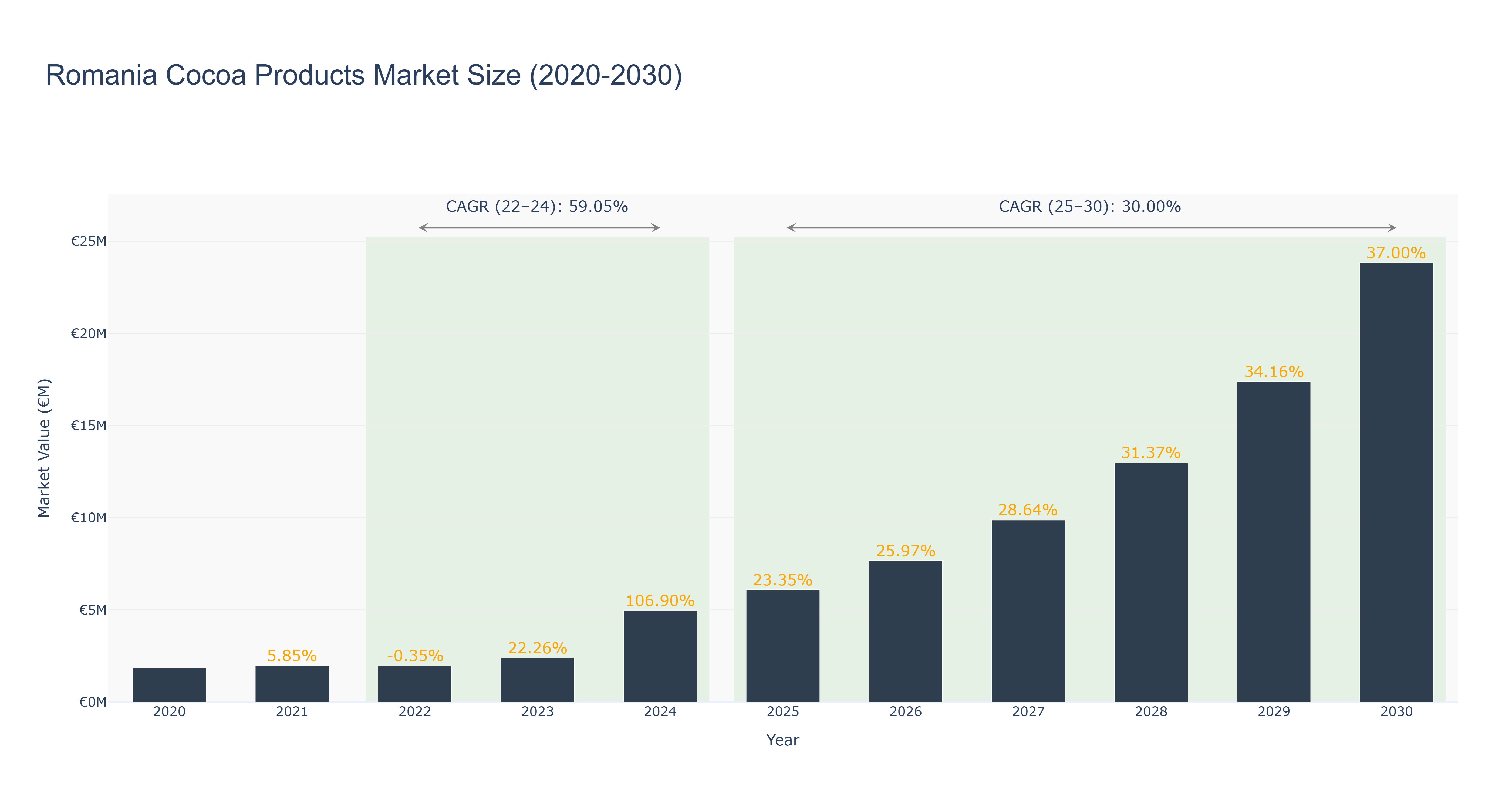
The Romania Cocoa Products Market has experienced significant fluctuations between 2020 and 2024, with a peak market size of €4.94 million in 2024, reflecting an impressive growth rate of 106.90% from the previous year. The actual market size grew from €1.85 million in 2020 to €1.96 million in 2021, followed by a slight decline to €1.95 million in 2022, before rebounding to €2.39 million in 2023. This volatility can be attributed to changing consumer preferences and increased demand for premium cocoa products. Looking ahead, the forecasted period from 2025 to 2030 shows a robust projected CAGR of 30.00%, with market sizes anticipated to reach €6.09 million in 2025 and €23.83 million by 2030. This growth will likely be driven by the rising health consciousness among consumers and the expansion of product offerings, positioning Romania as a burgeoning hub for cocoa innovation in the region.
Romania Cocoa Products Market: Production & Trade Performance (2019-2025)
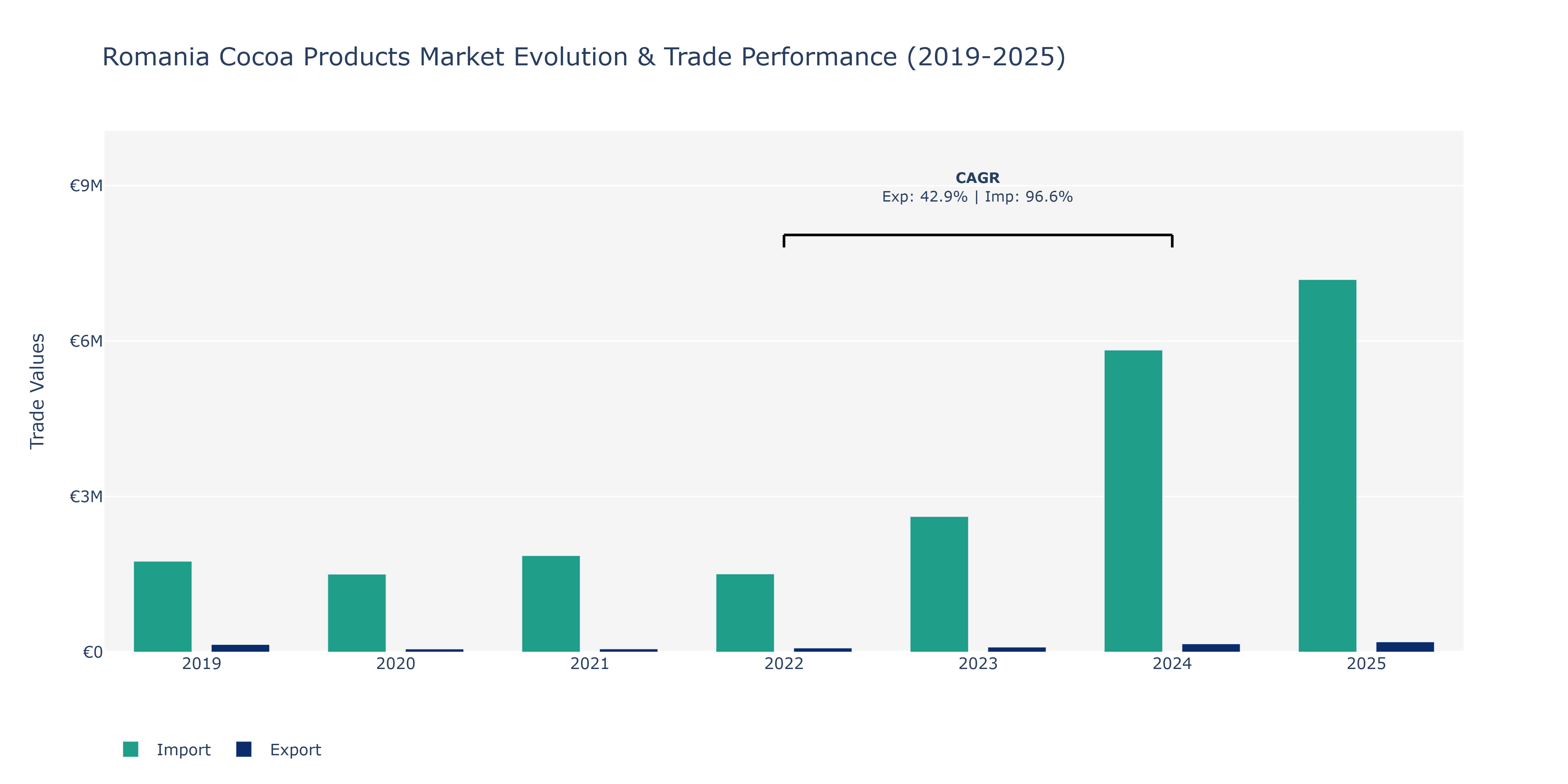
The Romania Cocoa Products Market saw fluctuating trends in exports and imports over the specified period. In 2019, imports were significantly higher than exports, indicating a reliance on foreign cocoa products. However, a notable shift occurred in 2023 and 2024, showcasing a substantial increase in both exports and imports, with imports reaching their peak in 2024 at over €5.83 million. This surge could be attributed to increased domestic demand for cocoa products or evolving consumer preferences favoring higher-quality imports. The steady growth in exports from 2019 to 2025 suggests an expanding market presence internationally, possibly driven by efforts to enhance product quality or capitalize on export opportunities. The impressive CAGR for imports from 2022 to 2024 highlights a rapid growth rate, potentially influenced by strategic partnerships with key cocoa-producing countries or increased investments in the local cocoa processing industry. Such developments align with the global cocoa market's shift towards sustainable sourcing practices and premium product offerings, indicating Romania's adaptation to industry trends for sustained market competitiveness.
Romania Cocoa Products Market Overview
The Romania cocoa products market encompasses a wide range of goods derived from cocoa, including chocolate bars, truffles, and cocoa-based beverages. Growth in this market is driven by the premiumization of chocolate products, health-conscious consumer trends, and innovative product formulations.
Drivers of the market
The market for cocoa products in Romania is driven by increasing consumption of chocolate and cocoa-based products. Consumer preferences for premium and organic offerings, coupled with the influence of global food trends, are key factors supporting market growth in this segment.
Challenges of the market
The Romania cocoa products market faces challenges such as shifting consumer preferences towards premium and organic products, requiring manufacturers to adapt their product offerings accordingly. Economic downturns and changing dietary trends also impact consumer spending on chocolate and other cocoa-based products.
Government Policy of the market
In the cocoa products market, Romania implements policies to regulate the import, production, and distribution of cocoa-based goods. These policies include quality control measures, labeling requirements for nutritional information, and consumer protection regulations to ensure product safety and transparency.
Key Highlights of the Report:
- Romania Cocoa Products Market Outlook
- Market Size of Romania Cocoa Products Market, 2024
- Forecast of Romania Cocoa Products Market, 2031
- Historical Data and Forecast of Romania Cocoa Products Revenues & Volume for the Period 2018 - 2031
- Romania Cocoa Products Market Trend Evolution
- Romania Cocoa Products Market Drivers and Challenges
- Romania Cocoa Products Price Trends
- Romania Cocoa Products Porter's Five Forces
- Romania Cocoa Products Industry Life Cycle
- Historical Data and Forecast of Romania Cocoa Products Market Revenues & Volume By Type for the Period 2018 - 2031
- Historical Data and Forecast of Romania Cocoa Products Market Revenues & Volume By Cocoa Beans for the Period 2018 - 2031
- Historical Data and Forecast of Romania Cocoa Products Market Revenues & Volume By Cocoa Butter for the Period 2018 - 2031
- Historical Data and Forecast of Romania Cocoa Products Market Revenues & Volume By Cocoa Powder & Cake for the Period 2018 - 2031
- Historical Data and Forecast of Romania Cocoa Products Market Revenues & Volume By Cocoa Paste & Liquor for the Period 2018 - 2031
- Historical Data and Forecast of Romania Cocoa Products Market Revenues & Volume By Chocolate for the Period 2018 - 2031
- Historical Data and Forecast of Romania Cocoa Products Market Revenues & Volume By Application for the Period 2018 - 2031
- Historical Data and Forecast of Romania Cocoa Products Market Revenues & Volume By Confectionery for the Period 2018 - 2031
- Historical Data and Forecast of Romania Cocoa Products Market Revenues & Volume By Food & Beverages for the Period 2018 - 2031
- Historical Data and Forecast of Romania Cocoa Products Market Revenues & Volume By Cosmetics for the Period 2018 - 2031
- Historical Data and Forecast of Romania Cocoa Products Market Revenues & Volume By Pharmaceutical for the Period 2018 - 2031
- Romania Cocoa Products Import Export Trade Statistics
- Market Opportunity Assessment By Type
- Market Opportunity Assessment By Application
- Romania Cocoa Products Top Companies Market Share
- Romania Cocoa Products Competitive Benchmarking By Technical and Operational Parameters
- Romania Cocoa Products Company Profiles
- Romania Cocoa Products Key Strategic Recommendations






































