Russia API Management Market Size & Growth Rate (2026-2032)
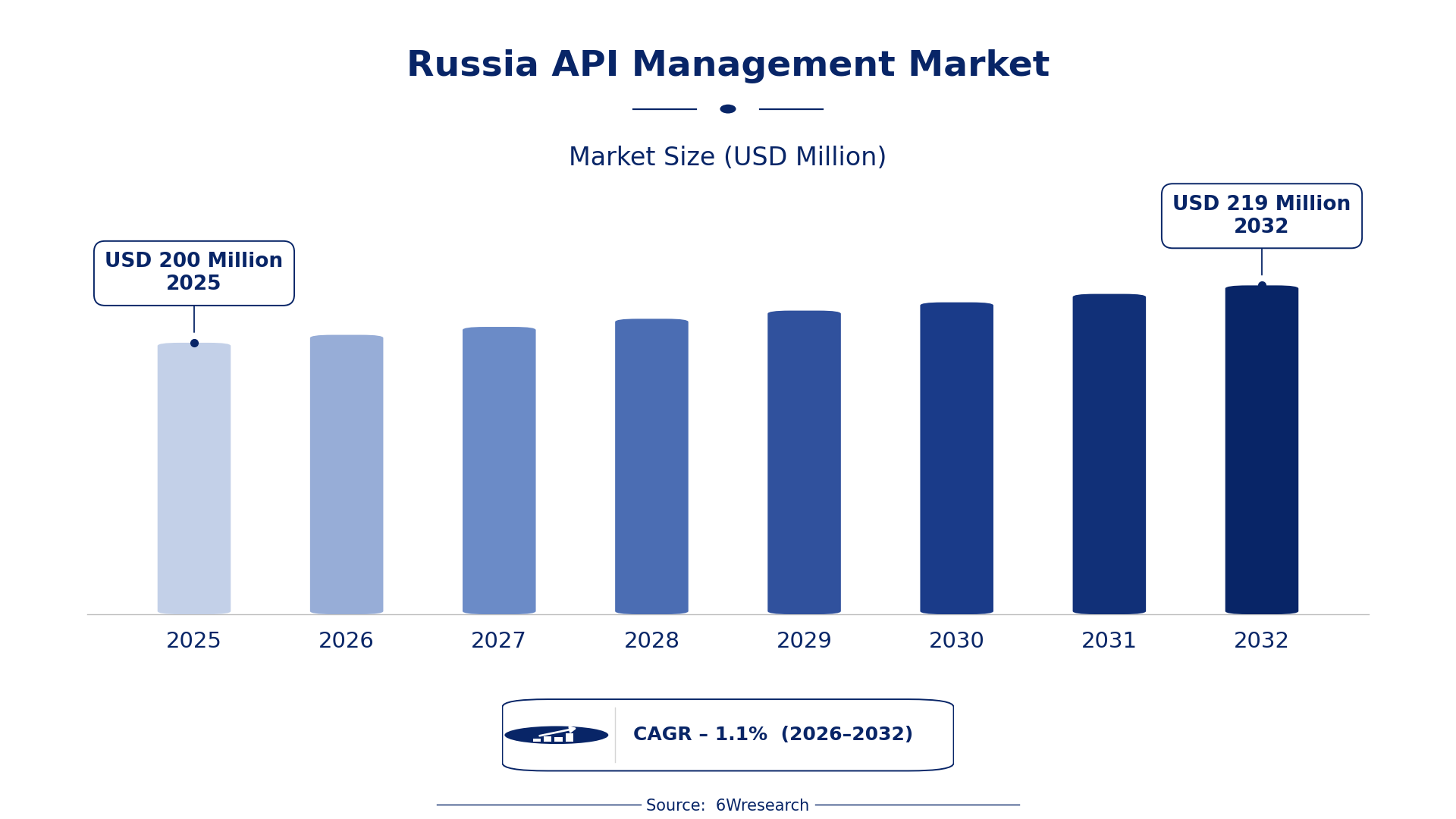
The Russia API Management Market was estimated at USD 200 Million in 2025 and is projected to reach USD 219 Million by 2032, growing at a CAGR of 1.1% from 2026 to 2032.
Russia API Management Market Synopsis
The primary force shaping the Russia API Management Market is the rapid digital transformation being adopted across various sectors. Organizations are increasingly recognizing the necessity of efficient API management solutions to enhance operational efficiency and improve customer engagement.
In this context, businesses are leaning towards cloud-based platforms, driven by the need for flexibility and scalability. The growing emphasis on data security and compliance with local regulations further underscores the importance of sophisticated API management solutions tailored to the Russian market.
Russia API Management Market Year-wise Growth Rate and Key Drivers
This graph illustrates the annual growth rates of the Russia API Management Market from 2021 to 2032, highlighting a steady upward trajectory and projected expansion over the forecast period.
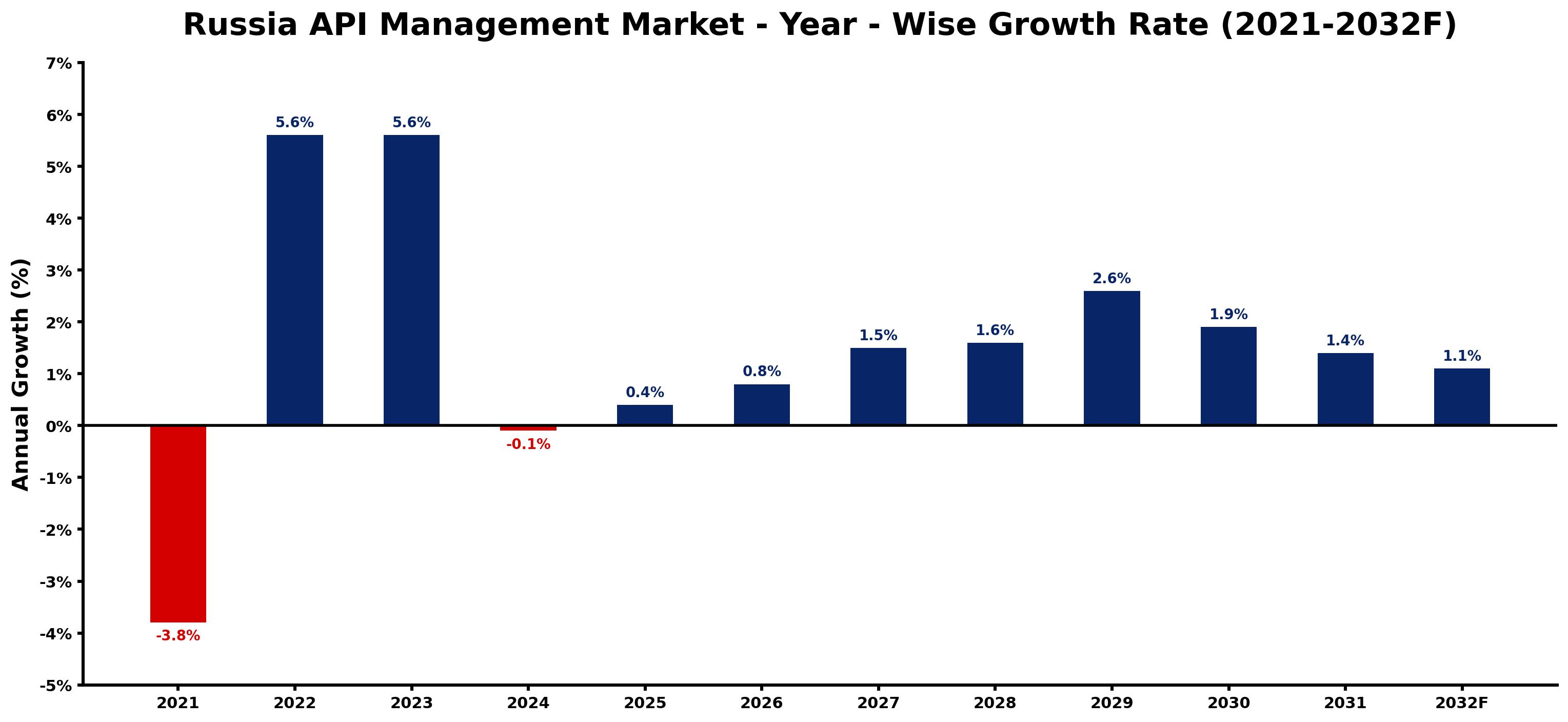
The table below presents the year‑wise growth rates along with the key drivers influencing the market
| Year | Growth Rate | Major Drivers |
| 2021 | -3.8% | Sanctions limiting foreign API technology investments in Russia |
| 2022 | 5.6% | Increased investment in digital government services integration |
| 2023 | 5.6% | Popularity of local e-commerce platforms boosting API usage |
| 2024 | -0.1% | Decline in oil prices affecting tech budget allocations |
| 2025 | 0.4% | Adoption of microservices architecture by tech startups |
| 2026 | 0.8% | Localized API solutions addressing regional market needs |
| 2027 | 1.5% | Demand for healthcare data interoperability among providers |
| 2028 | 1.6% | Rise in mobile app development requiring API facilitation |
| 2029 | 2.6% | Growth of IoT devices necessitating API connectivity |
| 2030 | 1.9% | Support for Russian cybersecurity initiatives promoting API security |
| 2031 | 1.4% | Emergence of smart city projects utilizing integrated APIs |
| 2032 | 1.1% | Increased collaboration between tech ecosystems for API optimization |
Note: Market size estimations and growth projections presented in this report are based on 6Wresearch's proprietary forecasting methodology, utilizing the latest available industry data, government publications, and primary research inputs.
Russia API Management Market Key Takeaways
Below are some of the specific key takeaways from the market, including:
- The increasing demand for cloud-based API management solutions is reshaping business operations.
- Regulatory compliance, particularly regarding data localization, is a critical consideration for market players.
- API security features are becoming essential as organizations seek to protect sensitive data.
- Integration of AI and machine learning is enhancing analytics and operational automation.
- There is a notable trend towards API monetization as businesses look to generate additional revenue streams.
Evaluation of Restraints in Russia API Management Market
Several factors are limiting the potential of the Russia API Management Market. Chief among these are stringent regulatory requirements that mandate local data storage and processing, which complicates API management for many organizations. Additionally, the market remains relatively nascent compared to global benchmarks, leading to a general lack of awareness and understanding of API management solutions among businesses. The geopolitical climate and associated cybersecurity risks further complicate adoption efforts, necessitating tailored approaches to navigate these complexities.
Russia API Management Market Trends
Several trends are currently influencing the Russia API Management Market. Notably, the demand for enhanced security features has surged, driven by the necessity to protect sensitive data handled through APIs. Companies are increasingly integrating AI and machine learning capabilities into their API management strategies to enable advanced analytics and streamline operations.
on top of that, a growing preference for cloud-based solutions is observed, providing organizations with greater scalability and flexibility. Many companies are also exploring API monetization strategies, aiming to leverage their digital assets for revenue generation and improved customer engagement.
Russia API Management Market Opportunities
Investment opportunities in the Russia API Management Market are primarily focused on the development of solutions that align with local regulatory requirements. There is a significant demand for API management platforms that accommodate data privacy regulations while supporting the Russian language. Additionally, businesses are seeking security solutions to combat the growing threat landscape in cybersecurity.
Consulting services are also in demand, as organizations require expertise to navigate the complexities associated with API integration and management. As the digital landscape evolves, these opportunities present a promising avenue for growth and profitability.
Government Initiatives in the Russia API Management Market
Government policy significantly impacts the Russia API Management Market, particularly concerning data security and privacy regulations. The government has enacted strict data localization laws that mandate the storage of Russian citizens' personal data within national borders. These regulations create a complex environment for businesses operating in the API management sector, necessitating compliance and secure data handling practices.
- A regulatory framework introduced in 2025 mandates companies to ensure data localization for personal information.
- A national cybersecurity enhancement initiative is currently underway, aimed at bolstering the security of digital infrastructures.
- The government is planning a public-private partnership initiative expected to improve access to digital infrastructure by 2028.
- A recently completed data protection law aims to further tighten regulations around the collection and processing of personal data.
Future Insights of the Russia API Management Market
Looking ahead to 2026-2032, the Russia API Management Market is expected to continue its upward trajectory, driven by the ongoing digital transformation across various industries. Organizations will increasingly recognize the necessity of robust API management solutions to facilitate application integration and enhance customer experiences.
The demand for API management is expected to be propelled by a heightened focus on cybersecurity and data privacy compliance. With the growing proliferation of IoT devices and cloud-based services, the critical role of API management in enabling efficient connectivity and data exchange will become even more apparent.
Russia API Management Market Latest Developments
Recent activity in the Russia API Management Market reflects a dynamic push towards enhanced digital solutions. Over the past year, organizations have actively sought to adopt and implement advanced API management technologies to stay competitive.
- A leading regional technology vendor launched a new API management platform in early 2025, focusing on compliance with local data regulations.
- An initiative to integrate AI-driven analytics into existing API frameworks began in Q2 2025 and remains underway.
- A collaboration between local firms to develop a comprehensive API security solution was announced in late 2025, targeting enhanced protection against cyber threats.
- A planned rollout for an API management training program is set to begin in early 2026, aimed at increasing awareness and expertise among local businesses.
Russia API Management Market - Key Attractiveness of the Report
- 10 Years of Market Numbers
- Historical Data Starting from 2022 to 2025
- Base Year: 2025
- Forecast Data until 2032
- Key Performance Indicators Impacting the Market
- Major Upcoming Developments and Projects
Key Highlights of the Report:
- Russia API Management Market Outlook
- Market Size of Russia API Management Market, 2025
- Forecast of Russia API Management Market, 2032
- Historical Data and Forecast of Russia API Management Revenues & Volume for the Period 2022-2032F
- Russia API Management Market Trend Evolution
- Russia API Management Market Drivers and Challenges
- Russia API Management Price Trends
- Russia API Management Porter's Five Forces
- Russia API Management Industry Life Cycle
- Historical Data and Forecast of Russia API Management Market Revenues & Volume By Component for the Period 2022-2032F
- Historical Data and Forecast of Russia API Management Market Revenues & Volume By Solutions for the Period 2022-2032F
- Historical Data and Forecast of Russia API Management Market Revenues & Volume By Services for the Period 2022-2032F
- Historical Data and Forecast of Russia API Management Market Revenues & Volume By Organization Size for the Period 2022-2032F
- Historical Data and Forecast of Russia API Management Market Revenues & Volume By Large Enterprise for the Period 2022-2032F
- Historical Data and Forecast of Russia API Management Market Revenues & Volume By Small & Medium Enterprise for the Period 2022-2032F
- Historical Data and Forecast of Russia API Management Market Revenues & Volume By Deployment Type for the Period 2022-2032F
- Historical Data and Forecast of Russia API Management Market Revenues & Volume By On-premises for the Period 2022-2032F
- Historical Data and Forecast of Russia API Management Market Revenues & Volume By Cloud for the Period 2022-2032F
- Historical Data and Forecast of Russia API Management Market Revenues & Volume By Vertical for the Period 2022-2032F
- Historical Data and Forecast of Russia API Management Market Revenues & Volume By BFSI for the Period 2022-2032F
- Historical Data and Forecast of Russia API Management Market Revenues & Volume By Healthcare for the Period 2022-2032F
- Historical Data and Forecast of Russia API Management Market Revenues & Volume By Government for the Period 2022-2032F
- Historical Data and Forecast of Russia API Management Market Revenues & Volume By Energy & Utilities for the Period 2022-2032F
- Historical Data and Forecast of Russia API Management Market Revenues & Volume By Manufacturing for the Period 2022-2032F
- Historical Data and Forecast of Russia API Management Market Revenues & Volume By Retail & Consumer Goods for the Period 2022-2032F
- Historical Data and Forecast of Russia API Management Market Revenues & Volume By Telecom & IT for the Period 2022-2032F
- Historical Data and Forecast of Russia API Management Market Revenues & Volume By Others for the Period 2022-2032F
- Russia API Management Import Export Trade Statistics
- Market Opportunity Assessment By Component
- Market Opportunity Assessment By Organization Size
- Market Opportunity Assessment By Deployment Type
- Market Opportunity Assessment By Vertical
- Russia API Management Top Companies Market Share
- Russia API Management Competitive Benchmarking By Technical and Operational Parameters
- Russia API Management Company Profiles
- Russia API Management Key Strategic Recommendations






































