Russia Autonomous Trucks Market Size, Share & Growth Rate
The Russia Autonomous Trucks Market was estimated at USD 194 Million in 2025 and is projected to reach USD 213 Million by 2032, growing at a CAGR of 1.3% from 2026 to 2032. This growth trajectory is driven by the increasing demand for more efficient transportation solutions, coupled with substantial advancements in autonomous vehicle technology. As stakeholders in the logistics sector seek to optimize operations and reduce costs, the adoption of autonomous trucks is becoming a vital component of strategic planning within the industry.
Russia Autonomous Trucks Market Year-wise Growth Rate and Key Drivers
This graph highlights how the Russia Autonomous Trucks Market has steadily grown over the years, supported by major growth factors.
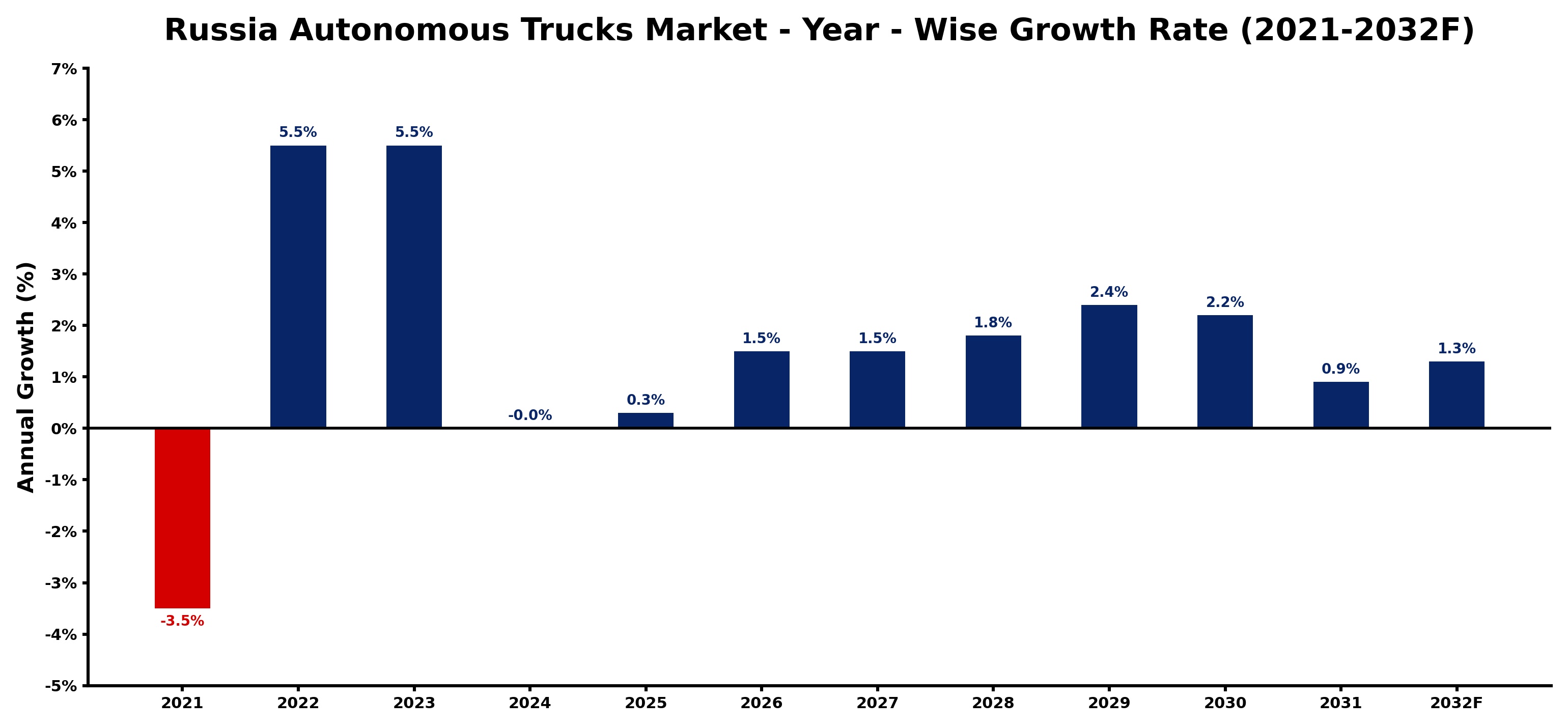
The table below presents the year‑wise growth rates along with the key drivers influencing the market
| Year | Growth Rate | Major Drivers |
| 2021 | -3.5% | Economic sanctions limited investments |
| 2022 | 5.5% | Technological advancements enhanced efficiency |
| 2023 | 5.5% | Regulatory support encouraged innovation |
| 2024 | -0.0% | Infrastructure improvements facilitated deployment |
| 2025 | 0.3% | Market demand for automation increased |
| 2026 | 1.5% | Partnerships with logistics firms expanded |
| 2027 | 1.5% | Consumer acceptance of automation grew |
| 2028 | 1.8% | Investment in R&D accelerated progress |
| 2029 | 2.4% | Sustainability initiatives drove adoption |
| 2030 | 2.2% | Cost savings attracted new entrants |
| 2031 | 0.9% | Fleet modernization initiatives gained traction |
| 2032 | 1.3% | Collaborative projects enhanced market growth |
Note - Market size estimations and growth projections presented in this report are based on 6Wresearch's advanced forecasting approach, validated with industry datasets as of June 2026.
Russia Autonomous Trucks Market Synopsis
The most significant force shaping the Russia Autonomous Trucks Market today is the rapid technological advancement being integrated into vehicle systems. With innovations in artificial intelligence and machine learning, autonomous trucks are becoming increasingly capable of safe and efficient operation on diverse road conditions across Russia.
Additionally, government policies aimed at promoting the deployment of autonomous vehicles are reinforcing the market's potential. This supportive regulatory environment is crucial as it fosters innovation while addressing safety and infrastructure challenges that must be navigated for successful adoption.
Russia Autonomous Trucks Market Key Takeaways
- The market is set to expand with a projected growth from USD 194 Million in 2025 to USD 213 Million by 2032.
- Key technological advancements include AI-driven decision-making and enhanced sensor technology.
- Government initiatives are creating a favorable regulatory landscape for the deployment of autonomous trucks.
- Stakeholders face challenges related to infrastructure and public acceptance that must be addressed for widespread adoption.
- Collaboration between tech companies and traditional manufacturers is accelerating the development of autonomous solutions.
Evaluation of Restraints in Russia Autonomous Trucks Market
While the Russia Autonomous Trucks Market shows promising growth potential, several substantial restraints are impeding its acceleration. Regulatory hurdles pose a significant challenge, as the legal framework for autonomous vehicles remains in development, leading to uncertainties regarding the certification processes required for manufacturers. Additionally, many regions in Russia lack the necessary infrastructure to support the advanced technologies that autonomous trucks rely upon, such as high-definition mapping systems and reliable communication networks. These limitations create a complex environment that requires concerted efforts among stakeholders, regulators, and infrastructure developers to ensure a smooth path to widespread adoption.
Russia Autonomous Trucks Market Trends
Current trends in the Russia Autonomous Trucks Market are heavily influenced by the integration of cutting-edge technologies. Companies are exploring advanced artificial intelligence and machine learning algorithms that enable trucks to make better, real-time decisions, effectively enhancing operational safety and efficiency. Furthermore, the development of platooning systems is gaining traction, optimizing fuel consumption and mitigating road congestion. Remote monitoring and control systems are also being increasingly implemented, allowing for real-time tracking of fleets and ensuring operational oversight. These innovations are not only attracting investment but are also cultivating a robust ecosystem poised for continued advancement.
Russia Autonomous Trucks Market Opportunities
The market presents lucrative opportunities for investment, driven by the strong demand for efficient transportation solutions and the government's emphasis on infrastructure enhancement. Investors should consider engaging with companies focused on autonomous driving technology development, manufacturing autonomous vehicles, or providing complementary services such as fleet management software. Partnerships with local logistics providers can further capitalize on market insights and drive successful deployments in the region. This convergence of innovation and strategic collaboration offers substantial prospects for long-term growth in the Russian transportation landscape.
Government Initiatives in the Russia Autonomous Trucks Market
The Russian government is actively working to establish a regulatory framework to oversee the deployment of autonomous trucks. Recent initiatives include the formulation of certification requirements for manufacturers and guidelines for testing procedures aimed at ensuring safety on the roads. Furthermore, the government has expressed its commitment to supporting research and development in this domain, which underscores its recognition of the importance of autonomous technology in the future of transportation. By fostering a collaborative environment with industry stakeholders, these policies aim to facilitate the safe and efficient integration of autonomous trucks into Russia's transportation network.
Future Insights of the Russia Autonomous Trucks Market
Looking ahead, the Russia Autonomous Trucks Market is expected to experience steady growth, bolstered by advancements in technology and a favorable regulatory climate. The increasing recognition of the benefits of autonomous technology—such as enhanced safety, reduced operating costs, and improved logistics efficiency—will likely lead to greater adoption rates among businesses and fleet operators. With continuous innovations in areas like AI, sensor technologies, and infrastructural upgrades, the market is well-positioned to capitalize on these developments and realize its full potential over the next several years.
Russia Autonomous Trucks Market Latest Developments (May 2025 - June 2026)
In the most recent months, significant activity has been observed within the Russia Autonomous Trucks Market as companies ramp up their testing programs for autonomous vehicles on public roads. Collaborative efforts between tech firms and traditional trucking companies are becoming increasingly evident, focusing on integrating software solutions that enhance vehicle capabilities. Furthermore, the government is intensifying its dialogue with industry stakeholders to refine regulatory frameworks, ensuring that the market can adapt to rapid technological advancements while maintaining safety standards. These movements suggest a growing commitment to establishing a robust environment for the deployment of autonomous trucks across the country.
Russia Autonomous Trucks Market - Key Attractiveness of the Report
- 10 Years of Market Numbers
- Historical Data Starting from 2022 to 2025
- Base Year: 2025
- Forecast Data until 2032
- Key Performance Indicators Impacting the Market
- Major Upcoming Developments and Projects
Key Highlights of the Report:
- Russia Autonomous Trucks Market Outlook
- Market Size of Russia Autonomous Trucks Market, 2025
- Forecast of Russia Autonomous Trucks Market, 2032
- Historical Data and Forecast of Russia Autonomous Trucks Revenues & Volume for the Period 2022-2032F
- Russia Autonomous Trucks Market Trend Evolution
- Russia Autonomous Trucks Market Drivers and Challenges
- Russia Autonomous Trucks Price Trends
- Russia Autonomous Trucks Porter's Five Forces
- Russia Autonomous Trucks Industry Life Cycle
- Historical Data and Forecast of Russia Autonomous Trucks Market Revenues & Volume By Level of Autonomy for the Period 2022-2032F
- Historical Data and Forecast of Russia Autonomous Trucks Market Revenues & Volume By Level 1 for the Period 2022-2032F
- Historical Data and Forecast of Russia Autonomous Trucks Market Revenues & Volume By Level 2 for the Period 2022-2032F
- Historical Data and Forecast of Russia Autonomous Trucks Market Revenues & Volume By Level 3 for the Period 2022-2032F
- Historical Data and Forecast of Russia Autonomous Trucks Market Revenues & Volume By Level 4 for the Period 2022-2032F
- Historical Data and Forecast of Russia Autonomous Trucks Market Revenues & Volume By Sensor Type for the Period 2022-2032F
- Historical Data and Forecast of Russia Autonomous Trucks Market Revenues & Volume By Ultrasonic for the Period 2022-2032F
- Historical Data and Forecast of Russia Autonomous Trucks Market Revenues & Volume By Radar for the Period 2022-2032F
- Historical Data and Forecast of Russia Autonomous Trucks Market Revenues & Volume By Camera for the Period 2022-2032F
- Historical Data and Forecast of Russia Autonomous Trucks Market Revenues & Volume By LiDAR for the Period 2022-2032F
- Historical Data and Forecast of Russia Autonomous Trucks Market Revenues & Volume By Propulsion for the Period 2022-2032F
- Historical Data and Forecast of Russia Autonomous Trucks Market Revenues & Volume By Diesel for the Period 2022-2032F
- Historical Data and Forecast of Russia Autonomous Trucks Market Revenues & Volume By Electric for the Period 2022-2032F
- Historical Data and Forecast of Russia Autonomous Trucks Market Revenues & Volume By Others for the Period 2022-2032F
- Historical Data and Forecast of Russia Autonomous Trucks Market Revenues & Volume By Truck Type for the Period 2022-2032F
- Historical Data and Forecast of Russia Autonomous Trucks Market Revenues & Volume By Light Duty Truck for the Period 2022-2032F
- Historical Data and Forecast of Russia Autonomous Trucks Market Revenues & Volume By Medium Duty Truck for the Period 2022-2032F
- Historical Data and Forecast of Russia Autonomous Trucks Market Revenues & Volume By Heavy Duty Truck for the Period 2022-2032F
- Russia Autonomous Trucks Import Export Trade Statistics
- Market Opportunity Assessment By Level of Autonomy
- Market Opportunity Assessment By Sensor Type
- Market Opportunity Assessment By Propulsion
- Market Opportunity Assessment By Truck Type
- Russia Autonomous Trucks Top Companies Market Share
- Russia Autonomous Trucks Competitive Benchmarking By Technical and Operational Parameters
- Russia Autonomous Trucks Company Profiles
- Russia Autonomous Trucks Key Strategic Recommendations






































