Russia Biscuits and Crackers Market Summary
The russia biscuits and crackers market was estimated at USD 147 Million in 2025 and is projected to reach USD 160 Million by 2032, growing at a CAGR of 1.0% from 2026 to 2032.
Russia Biscuits and Crackers Market Year-wise Growth Rate and Key Drivers
This graph highlights how the Russia Biscuits and Crackers Market has steadily grown over the past five years, supported by major growth factors.
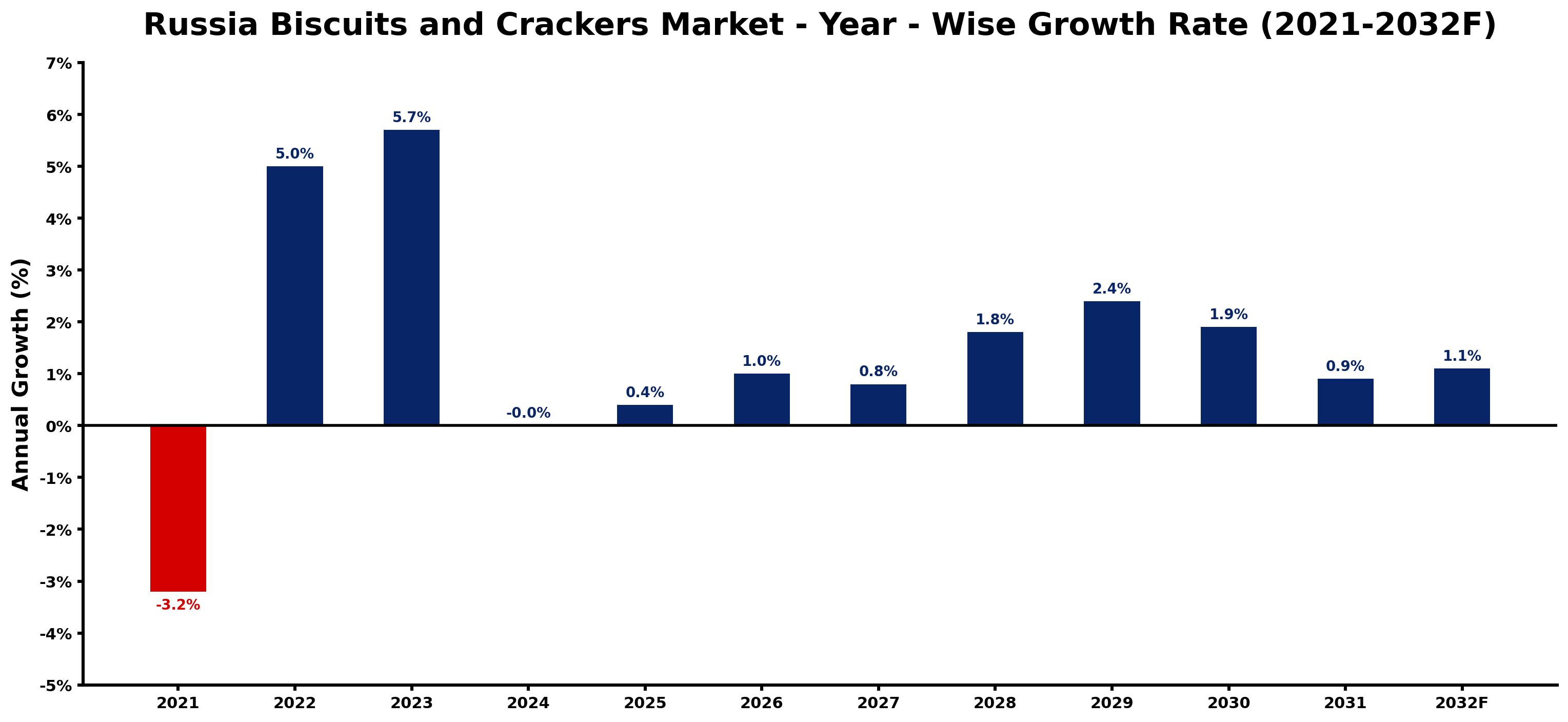
The table below presents the year wise growth rates along with the key drivers influencing the market
| Year | Growth Rate | Major Drivers |
| 2021 | -3.2% | Geopolitical tensions and economic sanctions severely impacted consumer purchasing power and market stability. |
| 2022 | 5.0% | Local manufacturers focus on healthier ingredients, appealing to health-conscious buyers. |
| 2023 | 5.7% | Competition intensifies as international brands enter the market with innovative products. |
| 2024 | -0.0% | E-commerce platforms gain traction, reshaping traditional retail approaches for snack purchases. |
| 2025 | 0.4% | Urbanization leads to busier lifestyles, boosting demand for on-the-go snack options. |
| 2026 | 1.0% | Sustainability trends emerge, with brands exploring eco-friendly packaging solutions and practices. |
| 2027 | 0.8% | Social media influences consumer preferences, driving interest in trending snack flavors. |
| 2028 | 1.8% | Increased disposable income allows families to explore premium biscuit and cracker varieties. |
| 2029 | 2.4% | A shift towards plant-based diets creates niche markets for vegan biscuit offerings. |
| 2030 | 1.9% | Health regulations prompt manufacturers to reformulate products, enhancing nutritional profiles. |
| 2031 | 0.9% | Cultural events and holidays spur seasonal marketing campaigns, increasing sales volumes. |
| 2032 | 1.1% | Technological innovations streamline production processes, reducing costs and improving quality. |
Note - Market size estimations and growth projections presented in this report are based on 6Wresearch's advanced forecasting approach, validated with industry datasets as of June 2026.
Russia Biscuits and Crackers Market Synopsis
The Russia Biscuits and Crackers Market is projected to reach 1.0% and witness significant growth during the forecast period (2026-2032). This market is notable for being one of the largest snack segments in Europe, with an impressive sale of over 11 billion packs annually. Since 2012, the sector has experienced a remarkable compound annual growth rate (CAGR) of 8%, driven by changing consumer preferences toward convenient snack options. The evolving landscape indicates a robust growth trajectory fueled by factors such as health consciousness and the increasing demand for diverse snack varieties.
Russia Biscuits and Crackers Market Growth Drivers
Several key drivers are propelling the expansion of the Russia Biscuits and Crackers Market. First, rising urbanization levels contribute significantly as more individuals seek quick, on-the-go snack solutions. Second, changing dietary patterns have led consumers to prefer healthier options such as whole grain and organic products. Third, the development of innovative flavors and textures enhances the appeal of biscuits and crackers, attracting a wider customer base. Fourth, increasing disposable income allows consumers to experiment with premium and gourmet snack options. Lastly, the growing prevalence of e-commerce facilitates easier access to a broader range of products, fostering market growth.
Russia Biscuits and Crackers Market Trends and Opportunities
The Russia Biscuits and Crackers Market is witnessing several notable trends that present significant opportunities. A shift towards healthier snacks is evident, with consumers actively seeking products that align with dietary requirements, including gluten-free and low-calorie options. Moreover, the trend of snacking as an integral part of daily meals is solidifying the position of biscuits and crackers in the diet. Furthermore, the introduction of modern packaging solutions not only enhances product freshness but also appeals to environmentally conscious consumers. Another trend is the integration of functional ingredients into biscuits and crackers, such as fortified vitamins and minerals, which cater to the health-focused demographic.
Russia Biscuits and Crackers Market Challenges and Restraints
While the Russia Biscuits and Crackers Market shows promising growth potential, it faces several challenges. The increasing awareness of health risks associated with excessive consumption of processed snacks poses a threat to demand. Additionally, fluctuating raw material prices may impact production costs and retail prices. Furthermore, regulatory standards concerning food safety and labeling require manufacturers to adapt swiftly, which can strain resources. Another constraint is the saturated market landscape, which compels brands to engage in intense competition to maintain market share. Finally, supply chain disruptions, particularly those arising from geopolitical tensions, can impact distribution efficiency.
Russia Biscuits and Crackers Market Government Investment and Initiatives
The Russian government plays an instrumental role in shaping the biscuits and crackers industry through various investments and initiatives. Public spending on food safety regulations and quality assurance is prioritized to ensure consumer trust and safety in food products. Moreover, the government is keen on promoting local agricultural production, which benefits the supply chain of raw materials necessary for biscuit and cracker manufacturing. Initiatives aimed at enhancing export capabilities also exist, allowing manufacturers to tap into international markets. Furthermore, investing in infrastructure improvements supports better logistics and distribution channels, thereby facilitating market access for producers.
Russia Biscuits and Crackers Market Latest Developments (May 2025 - June 2026)
During the period from May 2025 to June 2026, the Russia Biscuits and Crackers Market has seen several pivotal developments that indicate its dynamic nature. There has been an increase in the launch of health-focused products, with many players emphasizing organic and natural ingredients in their offerings. Additionally, sustainability initiatives have come to the forefront as brands strive to reduce their ecological footprint through eco-friendly packaging. The rise of innovative flavors has garnered consumer attention, with several manufacturers experimenting with unique combinations to entice younger demographics. Further, the overall digitization trend has accelerated, with brands investing in e-commerce platforms to enhance their reach amid shifting consumer purchasing behaviors.
Russia Biscuits and Crackers Market - Key Attractiveness of the Report
- 10 Years of Market Numbers
- Historical Data Starting from 2022 to 2025
- Base Year: 2025
- Forecast Data until 2032
- Key Performance Indicators Impacting the Market
- Major Upcoming Developments and Projects
Key Highlights of the Report:
- Russia Biscuits and Crackers Market Outlook
- Market Size of Russia Biscuits and Crackers Market, 2025
- Forecast of Russia Biscuits and Crackers Market, 2032F
- Historical Data and Forecast of Russia Biscuits and Crackers Revenues & Volume for the Period 2022-2032F
- Russia Biscuits and Crackers Market Trend Evolution
- Russia Biscuits and Crackers Market Drivers and Challenges
- Russia Biscuits and Crackers Price Trends
- Russia Biscuits and Crackers Porter's Five Forces
- Russia Biscuits and Crackers Industry Life Cycle
- Historical Data and Forecast of Russia Biscuits and Crackers Market Revenues & Volume By Product for the Period 2022-2032F
- Historical Data and Forecast of Russia Biscuits and Crackers Market Revenues & Volume By Biscuits for the Period 2022-2032F
- Historical Data and Forecast of Russia Biscuits and Crackers Market Revenues & Volume By Crackers for the Period 2022-2032F
- Historical Data and Forecast of Russia Biscuits and Crackers Market Revenues & Volume By Applications for the Period 2022-2032F
- Historical Data and Forecast of Russia Biscuits and Crackers Market Revenues & Volume By Online for the Period 2022-2032F
- Historical Data and Forecast of Russia Biscuits and Crackers Market Revenues & Volume By Supermarket for the Period 2022-2032F
- Historical Data and Forecast of Russia Biscuits and Crackers Market Revenues & Volume By Food Store for the Period 2022-2032F
- Russia Biscuits and Crackers Import Export Trade Statistics
- Market Opportunity Assessment By Product
- Market Opportunity Assessment By Applications
- Russia Biscuits and Crackers Top Companies Market Share
- Russia Biscuits and Crackers Competitive Benchmarking By Technical and Operational Parameters
- Russia Biscuits and Crackers Company Profiles
- Russia Biscuits and Crackers Key Strategic Recommendations






































