Russia Edge Computing Market Size & Growth Rate (2026-2032)
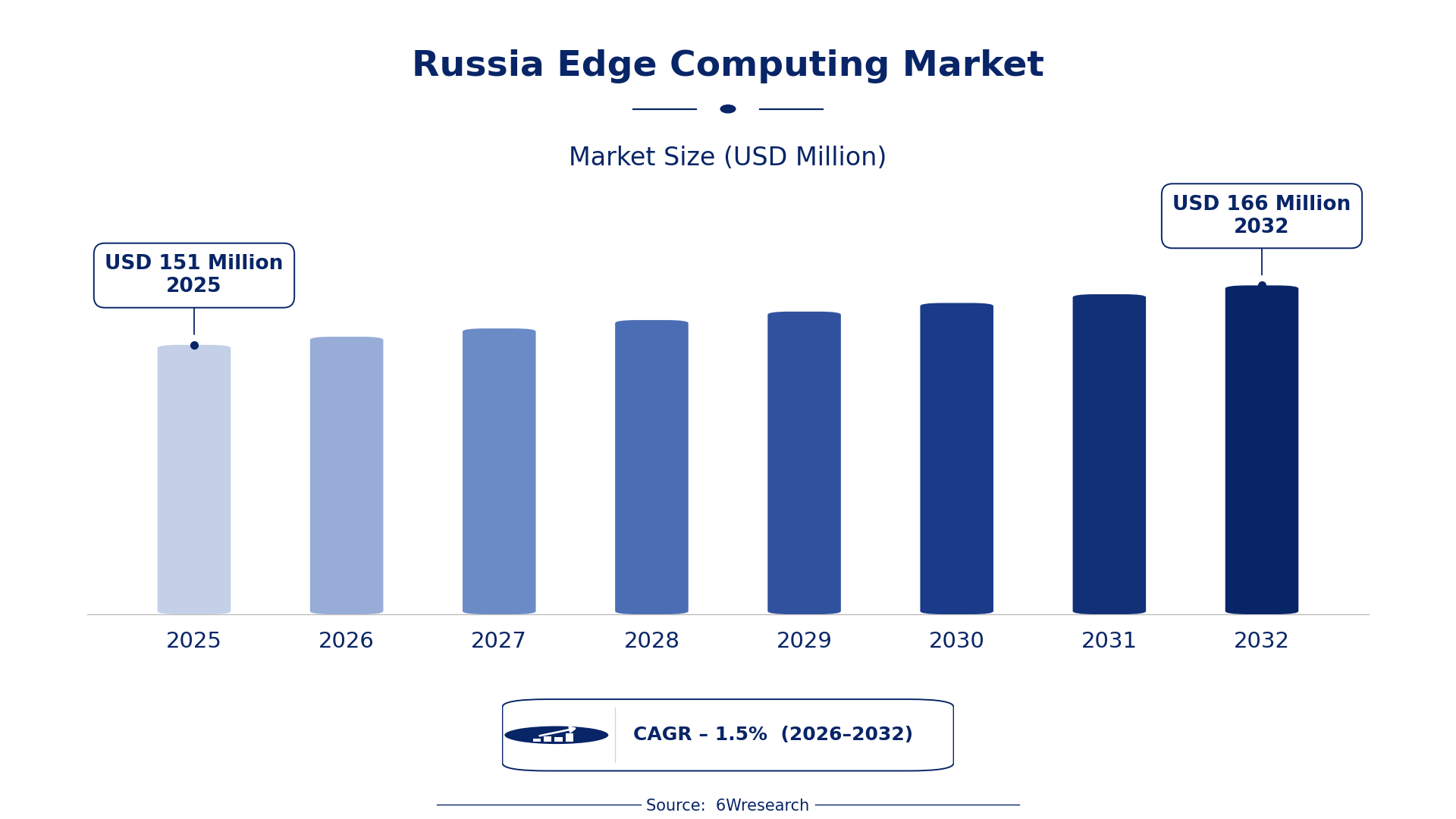
The Russia Edge Computing Market was estimated at USD 151 Million in 2025 and is projected to reach USD 166 Million by 2032, growing at a CAGR of 1.5% from 2026 to 2032.
Russia Edge Computing Market Synopsis
The rapid expansion of 5G networks is the most powerful force currently shaping the Russia Edge Computing Market. This technology not only enables faster data transmission but also creates an environment where edge computing can flourish. As organizations begin to harness the speed and capacity of 5G, the demand for real-time data processing at the edge intensifies.
In various sectors, including manufacturing and healthcare, companies are increasingly looking to edge solutions to enhance operational efficiency. The integration of IoT devices further amplifies this trend, allowing businesses to process data closer to where it is generated, leading to better decision-making and improved customer experiences.
Russia Edge Computing Market Year-wise Growth Rate and Key Drivers
This graph illustrates the annual growth rates of the Russia Edge Computing Market from 2021 to 2032, highlighting a steady upward trajectory and projected expansion over the forecast period.
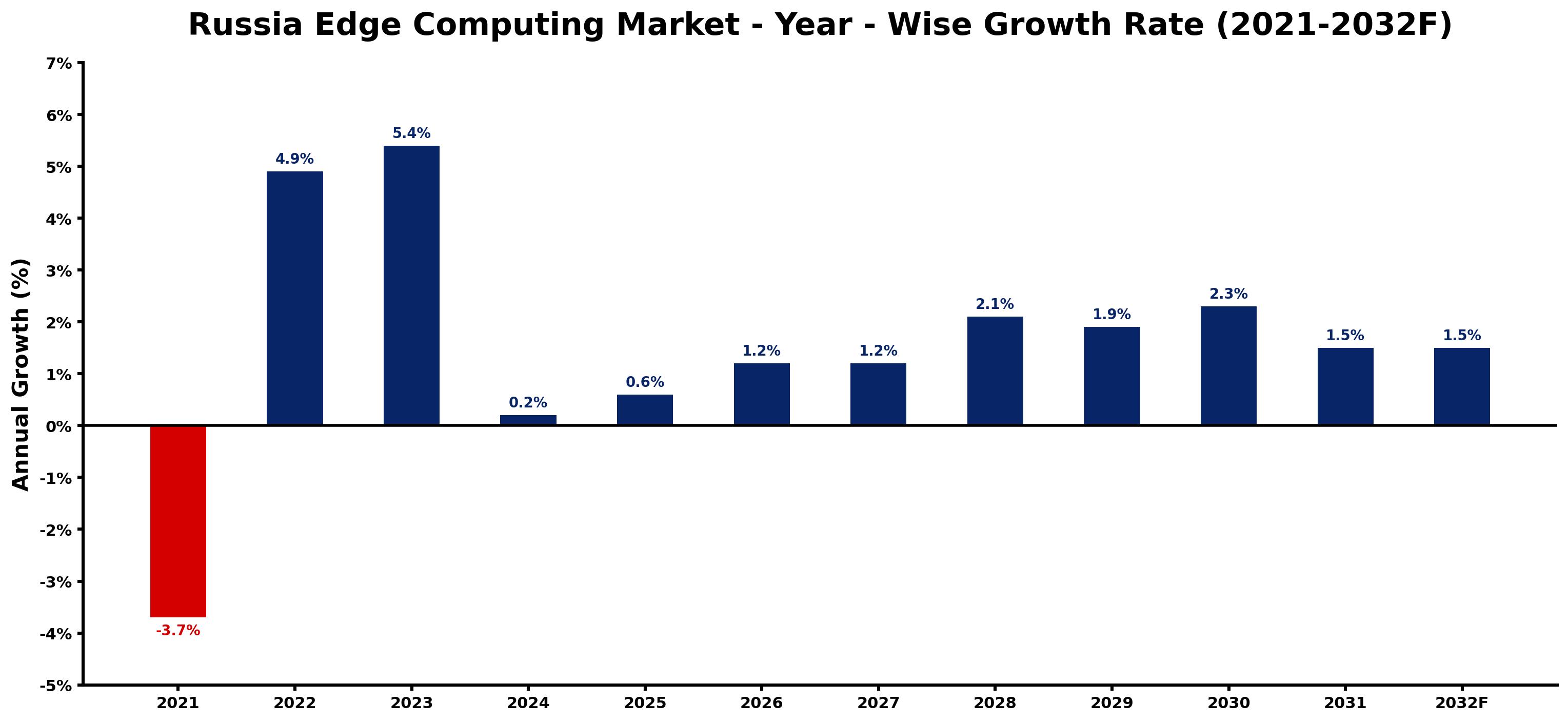
The table below presents the year‑wise growth rates along with the key drivers influencing the market
| Year | Growth Rate | Major Drivers |
| 2021 | -3.7% | Western sanctions hinder technology imports and partnerships. |
| 2022 | 4.9% | Increased demand for low-latency applications in cities |
| 2023 | 5.4% | Government support for IT infrastructure modernization initiatives |
| 2024 | 0.2% | Growing investments in local data centers and edge nodes |
| 2025 | 0.6% | Surge in IoT devices requiring localized processing power |
| 2026 | 1.2% | Rise in digital services due to remote work trends |
| 2027 | 1.2% | Enhanced cybersecurity regulations driving edge solutions adoption |
| 2028 | 2.1% | Local tech startups advancing edge computing innovations |
| 2029 | 1.9% | Increased mobile data consumption boosting infrastructure needs |
| 2030 | 2.3% | More businesses adopting AI solutions needing quick processing |
| 2031 | 1.5% | E-commerce growth necessitating fast data handling capabilities |
| 2032 | 1.5% | Telecommunication advancements supporting edge service expansion |
Note: Market size estimations and growth projections presented in this report are based on 6Wresearch's proprietary forecasting methodology, utilizing the latest available industry data, government publications, and primary research inputs.
Russia Edge Computing Market Key Takeaways
Below are some of the specific key takeaways from the market, including:
- The Russian government is actively promoting digital transformation initiatives that directly impact edge computing adoption.
- Investment in edge computing infrastructure is on the rise, driven by the need for low-latency data processing.
- Companies are increasingly integrating AI capabilities at the edge to enhance data analytics and security.
- Edge-as-a-service models are becoming more popular as businesses look to reduce infrastructure costs.
- Cybersecurity remains a top priority as organizations seek to protect sensitive data processed at the edge.
Evaluation of Restraints in Russia Edge Computing Market
Regulatory challenges loom large over the Russia Edge Computing Market. Stringent data localization laws complicate the deployment of edge solutions, as companies must navigate a complex web of compliance requirements. Additionally, data privacy concerns further hinder widespread adoption. The lack of standardized frameworks and interoperability among edge devices poses technical barriers that limit scalability. Until these hurdles are addressed through collaboration between stakeholders and regulatory bodies, the market may struggle to reach its full potential.
Russia Edge Computing Market Trends
As businesses recognize the necessity for real-time data processing, several key trends are emerging in the Russia Edge Computing Market. The integration of AI and machine learning at the edge is transforming how data is analyzed, allowing for quicker insights. Companies are also increasingly adopting edge-as-a-service models to manage costs and simplify infrastructure. Cybersecurity enhancements, especially concerning data protection, are becoming a focal point as organizations handle more sensitive information at the edge.
Russia Edge Computing Market Opportunities
The market offers numerous investment opportunities, particularly in edge computing infrastructure and software solutions tailored for analytics and security. Given the Russian government's emphasis on digital transformation, businesses that provide innovative edge computing technologies are likely to thrive. Key sectors such as manufacturing, healthcare, and transportation present ripe opportunities for growth, driven by their increasing reliance on IoT devices and real-time data processing.
Government Initiatives in the Russia Edge Computing Market
The Russian government is actively shaping the edge computing landscape through a series of strategic initiatives aimed at fostering innovation and infrastructure development. These efforts focus on enhancing digital capabilities across various sectors, highlighting the importance of a supportive regulatory environment for edge computing solutions.
- A national digital infrastructure upgrade programme launched in 2025 aims to bolster the country's edge computing capabilities.
- Ongoing initiatives include partnerships between technology providers and academic institutions to drive R&D in edge technologies.
- Current efforts also focus on creating a regulatory framework addressing data privacy and security concerns in edge computing.
- Plans for a public-private partnership expected to enhance telecom infrastructure access by 2027 are currently in development.
Future Insights of the Russia Edge Computing Market
Looking ahead, the Russia Edge Computing Market is set for considerable growth from 2026 to 2032. As sectors such as manufacturing and healthcare continue to digitize operations, the demand for edge solutions will surge. The rollout of 5G networks will undoubtedly play a crucial role in supporting this growth, enabling high-speed data processing and fostering innovative applications. Organizations will increasingly seek to optimize their data resources, ultimately driving the market forward.
Russia Edge Computing Market Latest Developments
Recent developments in the Russia Edge Computing Market indicate a robust momentum, with various initiatives aimed at enhancing infrastructure and capabilities. The past year has seen increased investment and collaboration among key stakeholders, signaling a commitment to advancing edge technologies.
- A major technology vendor launched a new edge computing platform in Q2 2025, enhancing data processing capabilities for various industries.
- In early 2025, a leading regional operator began rolling out an edge computing service aimed at the healthcare sector, improving patient data analytics.
- An initiative that started in late 2024 and remains ongoing focuses on building partnerships to address cybersecurity challenges at the edge.
- Plans for a comprehensive training program for businesses on edge computing adoption are expected to kick off in mid-2026.
Russia Edge Computing Market - Key Attractiveness of the Report
- 10 Years of Market Numbers
- Historical Data Starting from 2022 to 2025
- Base Year: 2025
- Forecast Data until 2032
- Key Performance Indicators Impacting the Market
- Major Upcoming Developments and Projects
Key Highlights of the Report:
- Russia Edge Computing Market Outlook
- Market Size of Russia Edge Computing Market, 2025
- Forecast of Russia Edge Computing Market, 2032
- Historical Data and Forecast of Russia Edge Computing Revenues & Volume for the Period 2022-2032F
- Russia Edge Computing Market Trend Evolution
- Russia Edge Computing Market Drivers and Challenges
- Russia Edge Computing Price Trends
- Russia Edge Computing Porter's Five Forces
- Russia Edge Computing Industry Life Cycle
- Historical Data and Forecast of Russia Edge Computing Market Revenues & Volume By Component for the Period 2022-2032F
- Historical Data and Forecast of Russia Edge Computing Market Revenues & Volume By Hardware for the Period 2022-2032F
- Historical Data and Forecast of Russia Edge Computing Market Revenues & Volume By Software for the Period 2022-2032F
- Historical Data and Forecast of Russia Edge Computing Market Revenues & Volume By Services for the Period 2022-2032F
- Historical Data and Forecast of Russia Edge Computing Market Revenues & Volume By Organization Size for the Period 2022-2032F
- Historical Data and Forecast of Russia Edge Computing Market Revenues & Volume By Large Enterprises for the Period 2022-2032F
- Historical Data and Forecast of Russia Edge Computing Market Revenues & Volume By SMEs for the Period 2022-2032F
- Historical Data and Forecast of Russia Edge Computing Market Revenues & Volume By Application for the Period 2022-2032F
- Historical Data and Forecast of Russia Edge Computing Market Revenues & Volume By Smart Cities for the Period 2022-2032F
- Historical Data and Forecast of Russia Edge Computing Market Revenues & Volume By Industrial Internet of Things (IIoT) for the Period 2022-2032F
- Historical Data and Forecast of Russia Edge Computing Market Revenues & Volume By Remote Monitoring for the Period 2022-2032F
- Historical Data and Forecast of Russia Edge Computing Market Revenues & Volume By Content Delivery for the Period 2022-2032F
- Historical Data and Forecast of Russia Edge Computing Market Revenues & Volume By Augmented Reality (AR) and Virtual Reality (VR) for the Period 2022-2032F
- Historical Data and Forecast of Russia Edge Computing Market Revenues & Volume By Others (Autonomous Vehicles, Drones, And Gaming) for the Period 2022-2032F
- Historical Data and Forecast of Russia Edge Computing Market Revenues & Volume By Vertical for the Period 2022-2032F
- Historical Data and Forecast of Russia Edge Computing Market Revenues & Volume By Manufacturing for the Period 2022-2032F
- Historical Data and Forecast of Russia Edge Computing Market Revenues & Volume By Energy and Utilities for the Period 2022-2032F
- Historical Data and Forecast of Russia Edge Computing Market Revenues & Volume By Government and Defense for the Period 2022-2032F
- Historical Data and Forecast of Russia Edge Computing Market Revenues & Volume By Telecommunications for the Period 2022-2032F
- Historical Data and Forecast of Russia Edge Computing Market Revenues & Volume By Media and Entertainment for the Period 2022-2032F
- Historical Data and Forecast of Russia Edge Computing Market Revenues & Volume By Retail and Consumer Goods for the Period 2022-2032F
- Historical Data and Forecast of Russia Edge Computing Market Revenues & Volume By Transportation and Logistics for the Period 2022-2032F
- Historical Data and Forecast of Russia Edge Computing Market Revenues & Volume By Healthcare and Life Sciences for the Period 2022-2032F
- Russia Edge Computing Import Export Trade Statistics
- Market Opportunity Assessment By Component
- Market Opportunity Assessment By Organization Size
- Market Opportunity Assessment By Application
- Market Opportunity Assessment By Vertical
- Russia Edge Computing Top Companies Market Share
- Russia Edge Computing Competitive Benchmarking By Technical and Operational Parameters
- Russia Edge Computing Company Profiles
- Russia Edge Computing Key Strategic Recommendations






































