Russia Energy Security Market Size & Growth Rate (2026-2032)
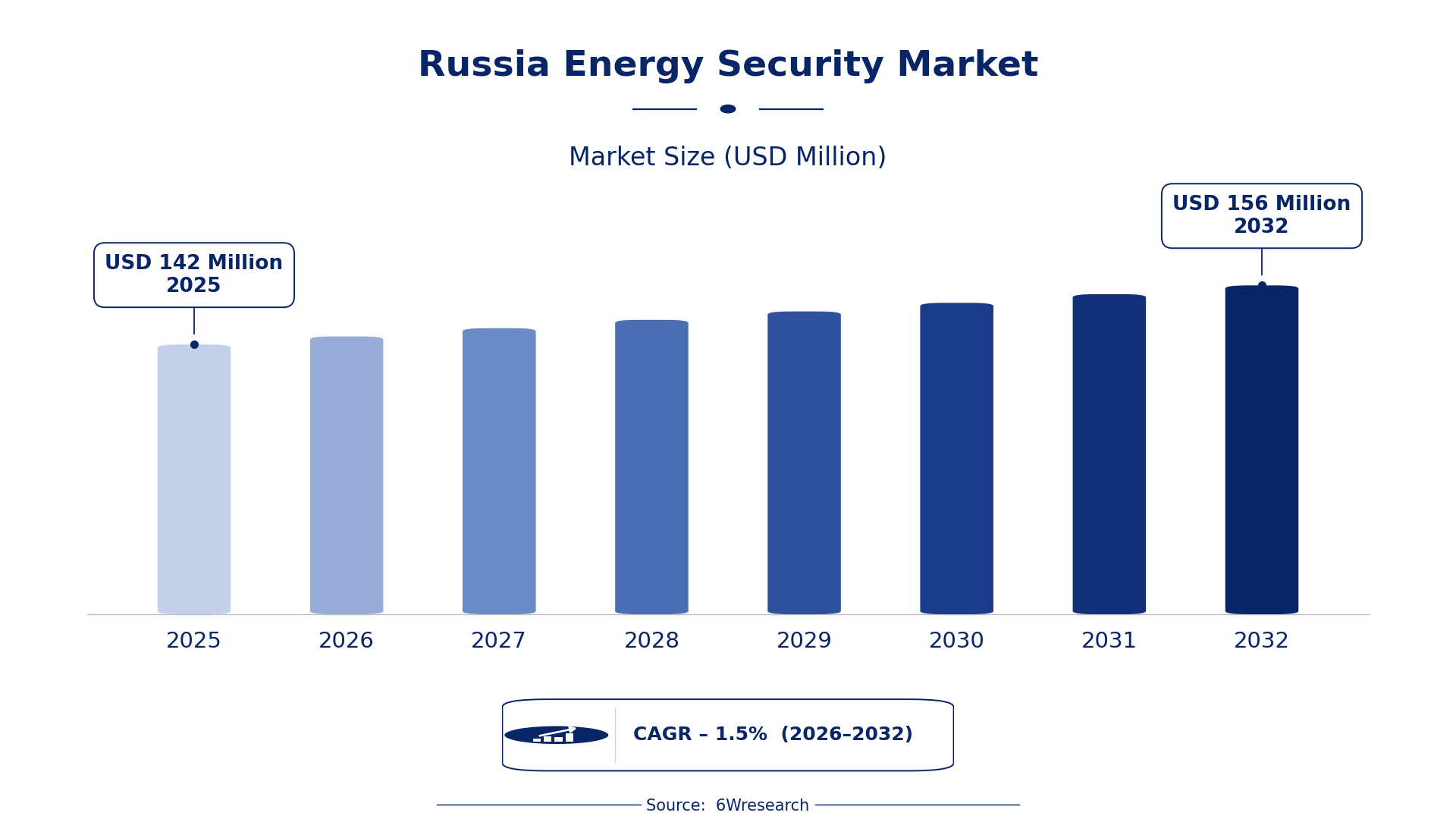
The Russia Energy Security Market was estimated at USD 142 Million in 2025 and is projected to reach USD 156 Million by 2032, growing at a CAGR of 1.5% from 2026 to 2032.
Russia Energy Security Market Synopsis
The principal factor driving the Russia Energy Security Market is its state-owned energy enterprises, particularly Gazprom and Rosneft. These giants not only dominate production but also strategize the country’s energy independence and security through comprehensive resource management.
Amidst fluctuating geopolitical climates, Russia is intensifying its efforts to diversify energy sources, including a notable shift towards renewables. This evolution is critical, as it aligns with global energy trends while bolstering national security against external pressures.
Russia Energy Security Market Year-wise Growth Rate and Key Drivers
This graph illustrates the annual growth rates of the Russia Energy Security Market from 2021 to 2032, highlighting a steady upward trajectory and projected expansion over the forecast period.
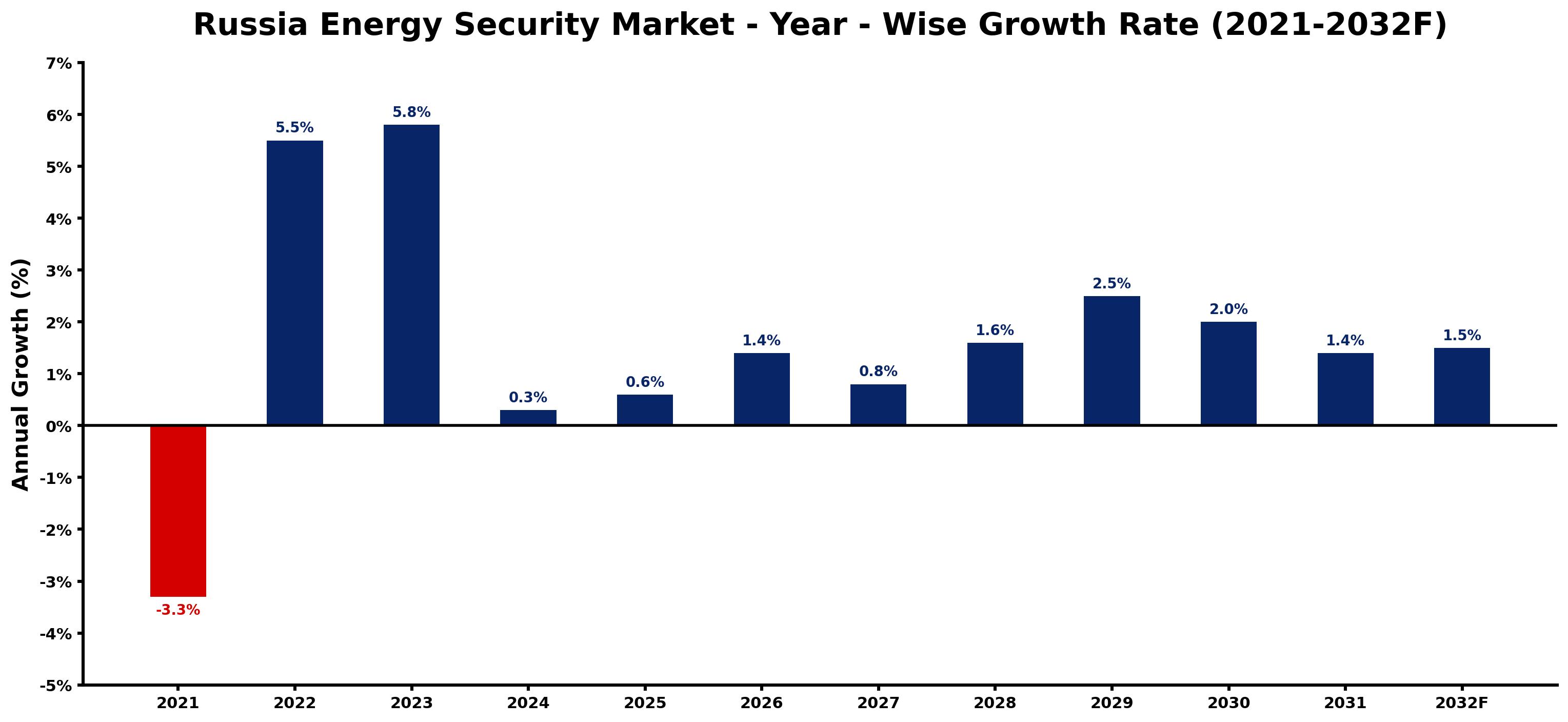
The table below presents the year‑wise growth rates along with the key drivers influencing the market
| Year | Growth Rate | Major Drivers |
| 2021 | -3.3% | Decreased fossil fuel exports due to sanctions. |
| 2022 | 5.5% | Increased investment in domestic renewable energy projects |
| 2023 | 5.8% | Strengthened regulatory framework for energy efficiency initiatives |
| 2024 | 0.3% | Emergence of local energy technology startups enhancing security |
| 2025 | 0.6% | Government incentives for regional energy diversification programs |
| 2026 | 1.4% | Boost in public-private partnerships for energy innovations |
| 2027 | 0.8% | Rise in energy storage technologies adoption across sectors |
| 2028 | 1.6% | Public awareness campaigns promoting energy conservation practices |
| 2029 | 2.5% | Growing emphasis on self-sufficient energy supply strategies |
| 2030 | 2.0% | Improvements in energy management systems for industry |
| 2031 | 1.4% | Increased focus on cybersecurity in energy infrastructure |
| 2032 | 1.5% | Enhanced collaboration with regional energy cooperatives |
Note: Market size estimations and growth projections presented in this report are based on 6Wresearch's proprietary forecasting methodology, utilizing the latest available industry data, government publications, and primary research inputs.
Russia Energy Security Market Key Takeaways
Below are some of the specific key takeaways from the market, including:
- State-owned companies are the backbone of Russia's energy security, managing vast fossil fuel reserves.
- The market is increasingly integrating renewable energy sources to meet domestic and global demands.
- Infrastructure modernization initiatives are crucial to maintaining efficiency and reliability in energy distribution.
- Regulatory frameworks are evolving, aiming to enhance energy independence and security through diversified supply chains.
- Investment opportunities are expanding in renewable projects and infrastructure upgrades as the market seeks sustainability.
Evaluation of Restraints in Russia Energy Security Market
The Russia Energy Security Market faces substantial challenges. Geopolitical tensions often disrupt established energy supply routes, which can lead to economic instability. Heavy reliance on oil and gas exports for government revenue places the economy at risk, particularly when global prices fluctuate. on top of that, an aging energy infrastructure demands immediate modernization, yet financial and political barriers inhibit timely upgrades. These restraints highlight the complexity of ensuring a stable energy future in Russia.
Russia Energy Security Market Trends
Current trends in the Russia Energy Security Market reveal a pronounced shift towards renewable energy investments, driven by both environmental considerations and the need to reduce dependency on fossil fuels. Additionally, modernization efforts across energy infrastructure are aimed at improving efficiency and adapting to technological advancements. The government is also enforcing stricter regulations to safeguard critical energy infrastructures, indicating a prioritization of national security in energy policy.
Russia Energy Security Market Opportunities
Opportunities for investment in the Russia Energy Security Market are diverse and expansive. The country’s significant oil and gas production presents a solid foundation for investment in established companies. However, the burgeoning renewable energy sector, particularly in solar and wind, offers attractive prospects for forward-thinking investors. Infrastructure development, including the construction of pipelines and storage facilities, is a promising avenue for capitalizing on market needs as Russia enhances its energy export capabilities.
Government Initiatives in the Russia Energy Security Market
Government policy plays a crucial role in shaping the Russia Energy Security Market. Emphasizing energy independence and domestic resource development, current regulations aim to strengthen energy security through a variety of initiatives. This regulatory posture is critical, particularly as the country navigates complex geopolitical challenges that affect its energy supply and market stability.
- A national energy strategy implemented in 2025 emphasizes the development of domestic energy resources while promoting renewable investments.
- Current initiatives include upgrading existing energy infrastructure to enhance efficiency and reliability, ongoing since early 2025.
- A planned diversification program aims to expand export routes and reduce reliance on singular transit countries, set to commence by late 2026.
- Recent regulations introduced focus on tightening cybersecurity measures across critical energy installations to protect against potential threats.
- An upcoming public-private partnership initiative aims to foster collaboration in renewable energy projects, expected to be launched in 2027.
Future Insights of the Russia Energy Security Market
Looking ahead to the 2026-2032 period, the Russia Energy Security Market is anticipated to evolve significantly. Continuous geopolitical uncertainties will compel the nation to reinforce its energy independence through diversified sources and innovative infrastructure investments. The interplay of economic imperatives and environmental commitments will drive modernization efforts, pushing the market toward a more sustainable future.
Russia Energy Security Market Latest Developments
Recent developments in the Russia Energy Security Market highlight a proactive approach to addressing emerging challenges. In the past year, significant strides have been made in infrastructure upgrades, alongside increasing investments in renewable energy projects aimed at enhancing energy security.
- A major infrastructure upgrade initiative started in Q3 2025, focusing on enhancing the efficiency of gas distribution networks across Siberia.
- Currently, a renewable energy project is underway that aims to develop wind farms along the northern coast, enhancing energy diversification.
- A strategic partnership agreement was signed in early 2025 between government bodies and private firms, aiming to advance technology in energy efficiency.
- Plans for a new regulatory framework mandating the adoption of clean energy solutions are slated for introduction by mid-2026.
- A technology pilot program focusing on cybersecurity measures for energy infrastructures is currently in implementation, expected to complete by late 2025.
Russia Energy Security Market - Key Attractiveness of the Report
- 10 Years of Market Numbers
- Historical Data Starting from 2022 to 2025
- Base Year: 2025
- Forecast Data until 2032
- Key Performance Indicators Impacting the Market
- Major Upcoming Developments and Projects
Key Highlights of the Report:
- Russia Energy Security Market Outlook
- Market Size of Russia Energy Security Market, 2025
- Forecast of Russia Energy Security Market, 2032
- Historical Data and Forecast of Russia Energy Security Revenues & Volume for the Period 2022-2032F
- Russia Energy Security Market Trend Evolution
- Russia Energy Security Market Drivers and Challenges
- Russia Energy Security Price Trends
- Russia Energy Security Porter's Five Forces
- Russia Energy Security Industry Life Cycle
- Historical Data and Forecast of Russia Energy Security Market Revenues & Volume By Power Plants for the Period 2022-2032F
- Historical Data and Forecast of Russia Energy Security Market Revenues & Volume By Nuclear for the Period 2022-2032F
- Historical Data and Forecast of Russia Energy Security Market Revenues & Volume By Thermal for the Period 2022-2032F
- Historical Data and Forecast of Russia Energy Security Market Revenues & Volume By Hydro for the Period 2022-2032F
- Historical Data and Forecast of Russia Energy Security Market Revenues & Volume By Oil for the Period 2022-2032F
- Historical Data and Forecast of Russia Energy Security Market Revenues & Volume By Gas for the Period 2022-2032F
- Historical Data and Forecast of Russia Energy Security Market Revenues & Volume By Renewable Energy for the Period 2022-2032F
- Historical Data and Forecast of Russia Energy Security Market Revenues & Volume By Technologies for the Period 2022-2032F
- Historical Data and Forecast of Russia Energy Security Market Revenues & Volume By Physical for the Period 2022-2032F
- Historical Data and Forecast of Russia Energy Security Market Revenues & Volume By Network Security for the Period 2022-2032F
- Russia Energy Security Import Export Trade Statistics
- Market Opportunity Assessment By Power Plants
- Market Opportunity Assessment By Technologies
- Russia Energy Security Top Companies Market Share
- Russia Energy Security Competitive Benchmarking By Technical and Operational Parameters
- Russia Energy Security Company Profiles
- Russia Energy Security Key Strategic Recommendations






































