Russia Home Appliances Market Summary
The russia home appliances market was estimated at USD 148 Million in 2025 and is projected to reach USD 162 Million by 2032, growing at a CAGR of 0.7% from 2026 to 2032.
Russia Home Appliances Market Year-wise Growth Rate and Key Drivers
This graph highlights how the Russia Home Appliances Market has steadily grown over the past five years, supported by major growth factors.
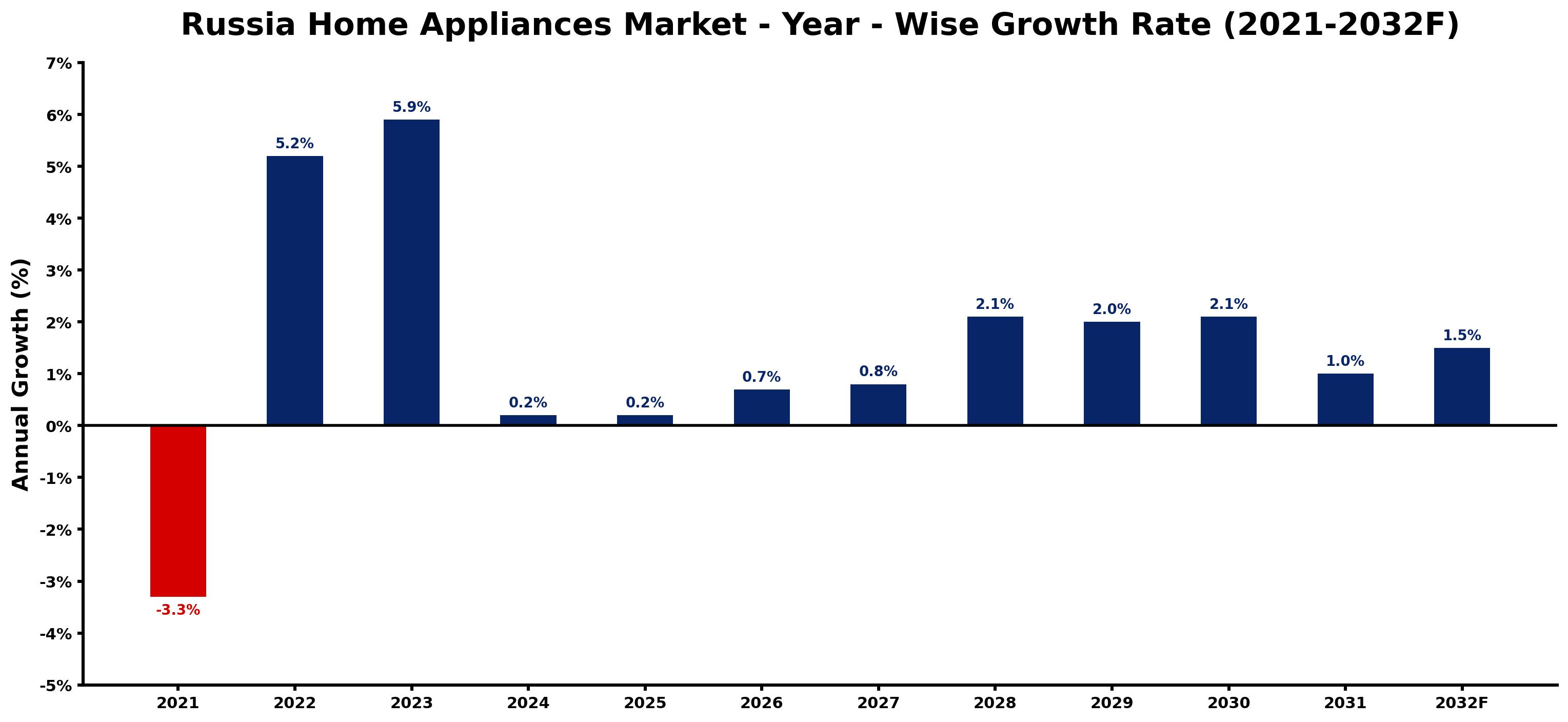
The table below presents the year wise growth rates along with the key drivers influencing the market
| Year | Growth Rate | Major Drivers |
| 2021 | -3.3% | Economic sanctions significantly restricted consumer purchasing power, leading to decreased demand for home appliances. |
| 2022 | 5.2% | Rising urbanization trends shifted preferences towards energy-efficient appliance solutions. |
| 2023 | 5.9% | Sustainability awareness led to increased demand for eco-friendly home appliances. |
| 2024 | 0.2% | Technological innovations in smart appliances attracted tech-savvy buyers and urban families. |
| 2025 | 0.2% | Competitive pricing strategies from local manufacturers improved market accessibility significantly. |
| 2026 | 0.7% | E-commerce expansion provided convenient shopping options for remote and urban customers. |
| 2027 | 0.8% | Investment in home renovation projects by consumers fueled appliance replacement cycles. |
| 2028 | 2.1% | Emerging middle-class demographics emphasized quality and performance in appliance choices. |
| 2029 | 2.0% | Rising disposable incomes motivated purchases of premium and luxury appliance brands. |
| 2030 | 2.1% | Consumer interest shifted towards multifunctional appliances amid space constraints in homes. |
| 2031 | 1.0% | Health and hygiene trends demanded appliances with sanitizing features and capabilities. |
| 2032 | 1.5% | Continued innovation in energy efficiency standards shaped consumer purchasing decisions. |
Note - Market size estimations and growth projections presented in this report are based on 6Wresearch's advanced forecasting approach, validated with industry datasets as of June 2026.
Russia Home Appliances Market Synopsis
The Russia Home Appliances Market is projected to reach 0.7% and witness significant growth during the forecast period (2026-2032). This growth is attributed to a combination of urbanization, rising disposable income, and a growing consumer preference for technologically advanced home appliances. Key product categories such as refrigerators, washing machines, air conditioners, and kitchen appliances are in high demand, reflecting changing consumer lifestyles. With a competitive landscape featuring both domestic and international brands, manufacturers are innovating actively to capture market share and meet evolving consumer expectations.
Russia Home Appliances Market Growth Drivers
Several factors are driving the growth of the Russia Home Appliances Market. Firstly, urbanization is prompting a shift towards modern living standards, necessitating the need for efficient home appliances. Secondly, the increase in disposable income allows Russian consumers to invest in higher-quality, technologically advanced products. Thirdly, there is a notable consumer shift towards energy-efficient and smart appliances, which manufacturers are increasingly focusing on to align with sustainability trends. Additionally, the rise of e-commerce as a preferred shopping channel provides consumers with convenience, a broader selection, and competitive pricing, further stimulating market growth. Finally, heightened awareness of environmental issues is pushing consumers to opt for eco-friendly appliances, enhancing demand for innovative products.
Russia Home Appliances Market Trends and Opportunities
The Russia Home Appliances Market is experiencing a significant transformation, with a marked trend towards smart and energy-efficient appliances. As consumers become more environmentally conscious, there is a growing demand for products that feature advanced connectivity capabilities, allowing for remote control through smartphones or integration with smart home systems. Additionally, consumers are favoring multifunctional appliances that serve multiple purposes and save space in smaller living environments. Manufacturers are investing in research and development to bring to market innovative solutions that appeal to these evolving preferences, presenting ample opportunities for businesses to tap into a changing consumer landscape.
Russia Home Appliances Market Challenges and Restraints
Despite the positive outlook, the Russia Home Appliances Market faces several challenges. Economic instability poses a significant risk, as fluctuations in currency values may negatively affect consumer purchasing power. Furthermore, local manufacturers may struggle to compete with international brands, especially if they rely heavily on imported components, making compliance with regulatory standards an additional hurdle. The complexity of navigating Russian regulations can be daunting for manufacturers, often requiring adherence to diverse standards and certifications. Moreover, competition in the market is intense, compelling businesses to innovate continuously and differentiate their offerings to capture consumer interest and loyalty.
Russia Home Appliances Market Investment Opportunities
Investors looking at the Russia Home Appliances Market will find ample opportunities, particularly in segments such as refrigerators, washing machines, air conditioners, and kitchen appliances, all projected to grow significantly. Modern consumers are increasingly interested in energy-efficient appliances, which underscores the potential for investment in innovative technologies. Companies can also benefit by expanding their distribution channels and utilizing e-commerce platforms to reach a broader audience. Additionally, employing competitive pricing strategies will be essential in appealing to cost-conscious consumers. However, investors must remain cognizant of the regulatory landscape and anticipate shifts in consumer demand to optimize their market approaches.
Russia Home Appliances Market Government Investment and Initiatives
The Russian government has introduced several policies to support the home appliances market. These include import tariffs designed to encourage domestic production and protect local manufacturers from foreign competition. Moreover, the government has implemented energy efficiency regulations that promote the use of environmentally friendly appliances. To further bolster this initiative, subsidies and incentives are offered to consumers purchasing energy-efficient products, aimed at reducing energy consumption in households nationwide. However, challenges remain, including bureaucratic inefficiencies and instances of corruption, which can hinder business operations and complicate the market environment for home appliance manufacturers.
Russia Home Appliances Market Latest Developments (May 2025 - June 2026)
In the recent months leading up to mid-2026, the Russia Home Appliances Market has observed notable trends. Manufacturers have increasingly focused on integrating smart technology into their product lines, aiming to meet the growing consumer demand for connected home appliances. With the rapid penetration of e-commerce channels, brands are investing in enhancing online shopping experiences to capture the digital consumer base. Additionally, sustainability has become a central theme, compelling companies to innovate with eco-friendly features in their offerings. As the market landscape evolves, firms are also exploring new marketing strategies to engage consumers effectively and differentiate their brands in a competitive environment.
Russia Home Appliances Market - Key Attractiveness of the Report
- 10 Years of Market Numbers
- Historical Data Starting from 2022 to 2025
- Base Year: 2025
- Forecast Data until 2032
- Key Performance Indicators Impacting the Market
- Major Upcoming Developments and Projects
Key Highlights of the Report:
- Russia Home Appliances Market Outlook
- Market Size of Russia Home Appliances Market, 2025
- Forecast of Russia Home Appliances Market, 2032F
- Historical Data and Forecast of Russia Home Appliances Revenues & Volume for the Period 2022-2032F
- Russia Home Appliances Market Trend Evolution
- Russia Home Appliances Market Drivers and Challenges
- Russia Home Appliances Price Trends
- Russia Home Appliances Porter's Five Forces
- Russia Home Appliances Industry Life Cycle
- Historical Data and Forecast of Russia Home Appliances Market Revenues & Volume By Product Types for the Period 2022-2032F
- Historical Data and Forecast of Russia Home Appliances Market Revenues & Volume By Kitchen Appliances for the Period 2022-2032F
- Historical Data and Forecast of Russia Home Appliances Market Revenues & Volume By Washing Appliances for the Period 2022-2032F
- Historical Data and Forecast of Russia Home Appliances Market Revenues & Volume By Entertainment Appliances for the Period 2022-2032F
- Historical Data and Forecast of Russia Home Appliances Market Revenues & Volume By Air Conditioner for the Period 2022-2032F
- Historical Data and Forecast of Russia Home Appliances Market Revenues & Volume By Others for the Period 2022-2032F
- Historical Data and Forecast of Russia Home Appliances Market Revenues & Volume By Technology for the Period 2022-2032F
- Historical Data and Forecast of Russia Home Appliances Market Revenues & Volume By Wi-Fi for the Period 2022-2032F
- Historical Data and Forecast of Russia Home Appliances Market Revenues & Volume By Bluetooth for the Period 2022-2032F
- Historical Data and Forecast of Russia Home Appliances Market Revenues & Volume By ZigBee for the Period 2022-2032F
- Historical Data and Forecast of Russia Home Appliances Market Revenues & Volume By Radio Frequency Identification for the Period 2022-2032F
- Historical Data and Forecast of Russia Home Appliances Market Revenues & Volume By Cellular Technology for the Period 2022-2032F
- Historical Data and Forecast of Russia Home Appliances Market Revenues & Volume By IoT for the Period 2022-2032F
- Historical Data and Forecast of Russia Home Appliances Market Revenues & Volume By Distribution Channel for the Period 2022-2032F
- Historical Data and Forecast of Russia Home Appliances Market Revenues & Volume By Retail for the Period 2022-2032F
- Historical Data and Forecast of Russia Home Appliances Market Revenues & Volume By E-commerce for the Period 2022-2032F
- Historical Data and Forecast of Russia Home Appliances Market Revenues & Volume By Others for the Period 2022-2032F
- Russia Home Appliances Import Export Trade Statistics
- Market Opportunity Assessment By Product Types
- Market Opportunity Assessment By Technology
- Market Opportunity Assessment By Distribution Channel
- Russia Home Appliances Top Companies Market Share
- Russia Home Appliances Competitive Benchmarking By Technical and Operational Parameters
- Russia Home Appliances Company Profiles
- Russia Home Appliances Key Strategic Recommendations






































