Russia IoT in Manufacturing Market Size & Growth Rate (2026-2032)
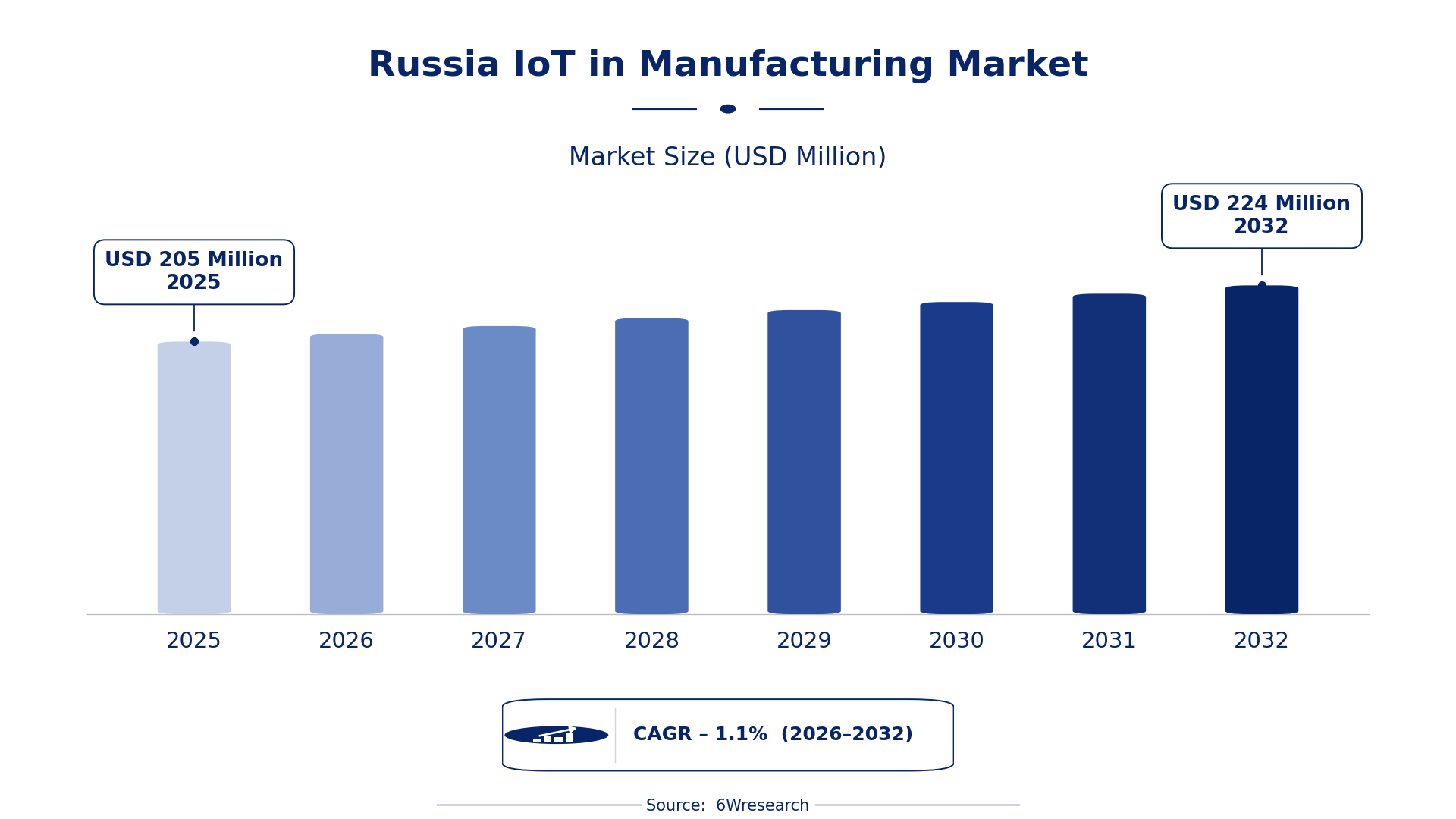
The Russia IoT in Manufacturing Market was estimated at USD 205 Million in 2025 and is projected to reach USD 224 Million by 2032, growing at a CAGR of 1.1% from 2026 to 2032.
Russia IoT in Manufacturing Market Synopsis
The Russian manufacturing sector is increasingly integrating IoT technologies, targeting efficiency and productivity across operations. A notable shift is evident in predictive maintenance and smart inventory management, which are now at the forefront of technological adoption.
As industries embrace automation, the demand for IoT solutions continues to escalate. This push is not merely about upgrading existing systems; it’s about fundamentally transforming how manufacturing is approached in Russia, leading to data-driven decision-making that enhances operational agility.
Russia IoT in Manufacturing Market Year-wise Growth Rate and Key Drivers
This graph illustrates the annual growth rates of the Russia IoT in Manufacturing Market from 2021 to 2032, highlighting a steady upward trajectory and projected expansion over the forecast period.
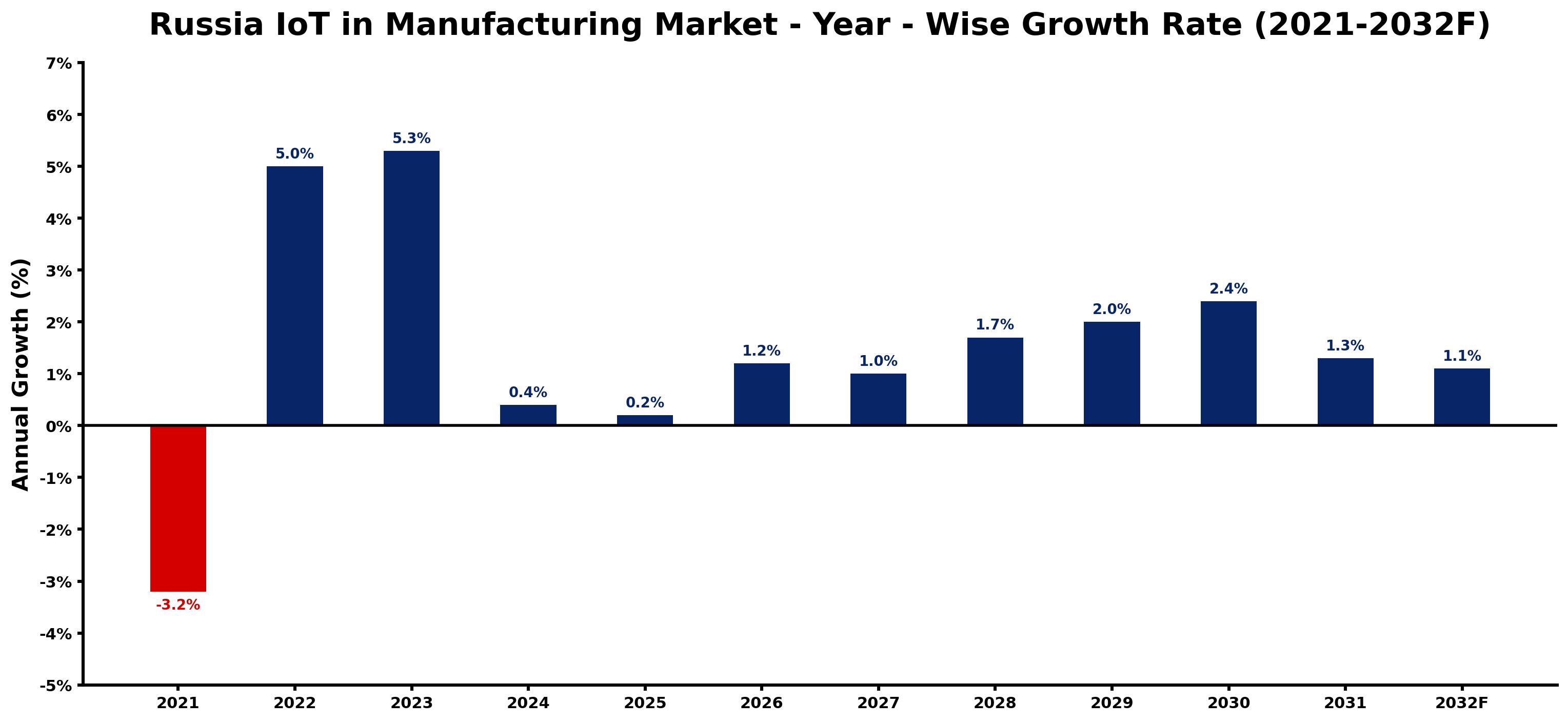
The table below presents the year‑wise growth rates along with the key drivers influencing the market
| Year | Growth Rate | Major Drivers |
| 2021 | -3.2% | Sanctions restricting foreign IoT technology imports. |
| 2022 | 5.0% | Support from Russian Ministry of Industry for IoT adoption |
| 2023 | 5.3% | Growing factory digitization initiatives driven by local enterprises |
| 2024 | 0.4% | Increased investment in security solutions for connected devices |
| 2025 | 0.2% | Rising interest in predictive maintenance to reduce downtime |
| 2026 | 1.2% | Partnerships between tech firms and manufacturers for IoT |
| 2027 | 1.0% | Implementation of local smart factory pilot projects |
| 2028 | 1.7% | Increasing focus on energy efficiency in manufacturing processes |
| 2029 | 2.0% | Local regulations promoting sustainable manufacturing technologies |
| 2030 | 2.4% | Adoption of cloud computing for industrial IoT applications |
| 2031 | 1.3% | Integration of AI analytics in manufacturing processes |
| 2032 | 1.1% | Growing collaboration between academia and industry on IoT |
Note: Market size estimations and growth projections presented in this report are based on 6Wresearch's proprietary forecasting methodology, utilizing the latest available industry data, government publications, and primary research inputs.
Russia IoT in Manufacturing Market Key Takeaways
Below are some of the specific key takeaways from the market, including:
- The integration of IoT technologies is redefining operational standards in Russia's manufacturing sector.
- Predictive maintenance and asset tracking are the primary drivers of IoT adoption.
- High implementation costs and system integration challenges are prevalent concerns.
- Government initiatives are actively promoting IoT integration in manufacturing.
- The market is expected to grow steadily as companies seek improved efficiency and reduced downtime.
Evaluation of Restraints in Russia IoT in Manufacturing Market
Despite the growth potential, the Russia IoT in Manufacturing Market faces notable constraints. High implementation costs are a primary barrier, deterring many manufacturers from fully embracing IoT solutions. Additionally, the complexity of integrating these technologies with existing systems poses a significant challenge. Security vulnerabilities also loom large, with manufacturers wary of potential production downtimes stemming from device failures. The shortage of skilled professionals in industrial automation exacerbates these issues, stalling progress across the sector.
Russia IoT in Manufacturing Market Trends
A few key trends are currently shaping the Russia IoT in Manufacturing Market. The fusion of IoT with artificial intelligence and big data analytics is enhancing predictive capabilities, allowing for smarter, more efficient manufacturing processes. on top of that, the rise of smart factories is gaining traction, where interconnected devices and systems communicate to optimize production cycles. There is also an increasing focus on sustainability, pushing manufacturers to adopt IoT solutions that not only improve efficiency but also reduce environmental impact.
Russia IoT in Manufacturing Market Opportunities
Opportunities abound in the Russia IoT in Manufacturing Market as industries look to modernize operations. The ongoing shift towards automation opens doors for companies specializing in IoT solutions, particularly those focused on predictive maintenance and real-time monitoring. Additionally, investment in cybersecurity solutions tailored for IoT devices represents a growing niche, addressing the pressing need for secure systems. Public-private partnerships for technology development and infrastructure upgrades are also expected to foster innovation and market expansion.
Government Initiatives in the Russia IoT in Manufacturing Market
The Russian government plays a crucial role in facilitating IoT integration within the manufacturing sector. With a focus on enhancing productivity and competitiveness, various initiatives have been launched to promote technological adoption. These initiatives aim to create an environment conducive to innovation, addressing both regulatory and financial barriers that manufacturers face.
- A national digital infrastructure upgrade programme was recently completed to support IoT deployment across manufacturing facilities.
- Current efforts include the rollout of funding initiatives aimed at research and development in IoT technologies.
- Upcoming regulatory frameworks are expected to establish industry standards for IoT implementation in manufacturing.
- Investment incentives for companies adopting IoT solutions are currently being promoted to stimulate market growth.
- A planned public-private initiative focuses on enhancing the cybersecurity landscape for IoT devices in manufacturing.
Future Insights of the Russia IoT in Manufacturing Market
Looking ahead to 2026-2032, the Russia IoT in Manufacturing Market is set for a steady trajectory. As manufacturers continue to prioritize operational efficiency, the demand for IoT solutions will grow. The integration of advanced technologies such as AI and analytics will further enhance decision-making processes, leading to more agile manufacturing environments. Companies that can address current challenges, particularly in terms of cost and integration, will be well-positioned to capitalize on the market's evolution.
Russia IoT in Manufacturing Market Latest Developments
In the last 12-14 months, the Russia IoT in Manufacturing Market has seen notable activity, reflecting a commitment to technological advancement. Manufacturers are increasingly recognizing the potential of IoT to drive efficiency and innovation, leading to a surge in projects aimed at IoT integration.
- A major technology vendor launched a new suite of IoT solutions tailored for predictive maintenance in early 2025.
- An ongoing initiative that began in mid-2025 focuses on deploying smart sensors across major manufacturing facilities.
- A partnership between regional manufacturers is expected to enhance IoT infrastructure access by late 2026.
- A pilot program for an IoT-enabled supply chain management system is currently underway, with implementation expected by Q3 2026.
- Planned updates to existing manufacturing systems aimed at IoT compatibility are set to begin in early 2026.
Russia IoT in Manufacturing Market - Key Attractiveness of the Report
- 10 Years of Market Numbers
- Historical Data Starting from 2022 to 2025
- Base Year: 2025
- Forecast Data until 2032
- Key Performance Indicators Impacting the Market
- Major Upcoming Developments and Projects
The Russian government is promoting IoT adoption through funding for R&D, investment incentives, and the development of industry standards aimed at enhancing technological integration.
Key Highlights of the Report:
- Russia IoT in Manufacturing Market Outlook
- Market Size of Russia IoT in Manufacturing Market, 2025
- Forecast of Russia IoT in Manufacturing Market, 2032
- Historical Data and Forecast of Russia IoT in Manufacturing Revenues & Volume for the Period 2022-2032F
- Russia IoT in Manufacturing Market Trend Evolution
- Russia IoT in Manufacturing Market Drivers and Challenges
- Russia IoT in Manufacturing Price Trends
- Russia IoT in Manufacturing Porter's Five Forces
- Russia IoT in Manufacturing Industry Life Cycle
- Historical Data and Forecast of Russia IoT in Manufacturing Market Revenues & Volume By Component for the Period 2022-2032F
- Historical Data and Forecast of Russia IoT in Manufacturing Market Revenues & Volume By Solutions Network Management for the Period 2022-2032F
- Historical Data and Forecast of Russia IoT in Manufacturing Market Revenues & Volume By Data Management for the Period 2022-2032F
- Historical Data and Forecast of Russia IoT in Manufacturing Market Revenues & Volume By Vertical for the Period 2022-2032F
- Historical Data and Forecast of Russia IoT in Manufacturing Market Revenues & Volume By Process for the Period 2022-2032F
- Historical Data and Forecast of Russia IoT in Manufacturing Market Revenues & Volume By Discrete for the Period 2022-2032F
- Historical Data and Forecast of Russia IoT in Manufacturing Market Revenues & Volume By Services for the Period 2022-2032F
- Historical Data and Forecast of Russia IoT in Manufacturing Market Revenues & Volume By Professional for the Period 2022-2032F
- Historical Data and Forecast of Russia IoT in Manufacturing Market Revenues & Volume By Managed for the Period 2022-2032F
- Historical Data and Forecast of Russia IoT in Manufacturing Market Revenues & Volume By Application for the Period 2022-2032F
- Historical Data and Forecast of Russia IoT in Manufacturing Market Revenues & Volume By Predictive maintenance for the Period 2022-2032F
- Historical Data and Forecast of Russia IoT in Manufacturing Market Revenues & Volume By Business process optimization for the Period 2022-2032F
- Historical Data and Forecast of Russia IoT in Manufacturing Market Revenues & Volume By Asset tracking and management for the Period 2022-2032F
- Historical Data and Forecast of Russia IoT in Manufacturing Market Revenues & Volume By Logistics and supply chain management for the Period 2022-2032F
- Historical Data and Forecast of Russia IoT in Manufacturing Market Revenues & Volume By Real-time workforce tracking and management for the Period 2022-2032F
- Historical Data and Forecast of Russia IoT in Manufacturing Market Revenues & Volume By Automation control and management for the Period 2022-2032F
- Historical Data and Forecast of Russia IoT in Manufacturing Market Revenues & Volume By Emergency and incident management and business communication for the Period 2022-2032F
- Historical Data and Forecast of Russia IoT in Manufacturing Market Revenues & Volume By Deployment Mode for the Period 2022-2032F
- Historical Data and Forecast of Russia IoT in Manufacturing Market Revenues & Volume By On-premises for the Period 2022-2032F
- Historical Data and Forecast of Russia IoT in Manufacturing Market Revenues & Volume By Cloud for the Period 2022-2032F
- Historical Data and Forecast of Russia IoT in Manufacturing Market Revenues & Volume By Organization Size for the Period 2022-2032F
- Historical Data and Forecast of Russia IoT in Manufacturing Market Revenues & Volume By Small and Medium Enterprises for the Period 2022-2032F
- Historical Data and Forecast of Russia IoT in Manufacturing Market Revenues & Volume By Large Enterprises for the Period 2022-2032F
- Russia IoT in Manufacturing Import Export Trade Statistics
- Market Opportunity Assessment By Component
- Market Opportunity Assessment By Vertical
- Market Opportunity Assessment By Services
- Market Opportunity Assessment By Application
- Market Opportunity Assessment By Deployment Mode
- Market Opportunity Assessment By Organization Size
- Russia IoT in Manufacturing Top Companies Market Share
- Russia IoT in Manufacturing Competitive Benchmarking By Technical and Operational Parameters
- Russia IoT in Manufacturing Company Profiles
- Russia IoT in Manufacturing Key Strategic Recommendations






































