Russia Policy Management in Telecom Market Size & Growth Rate (2026-2032)
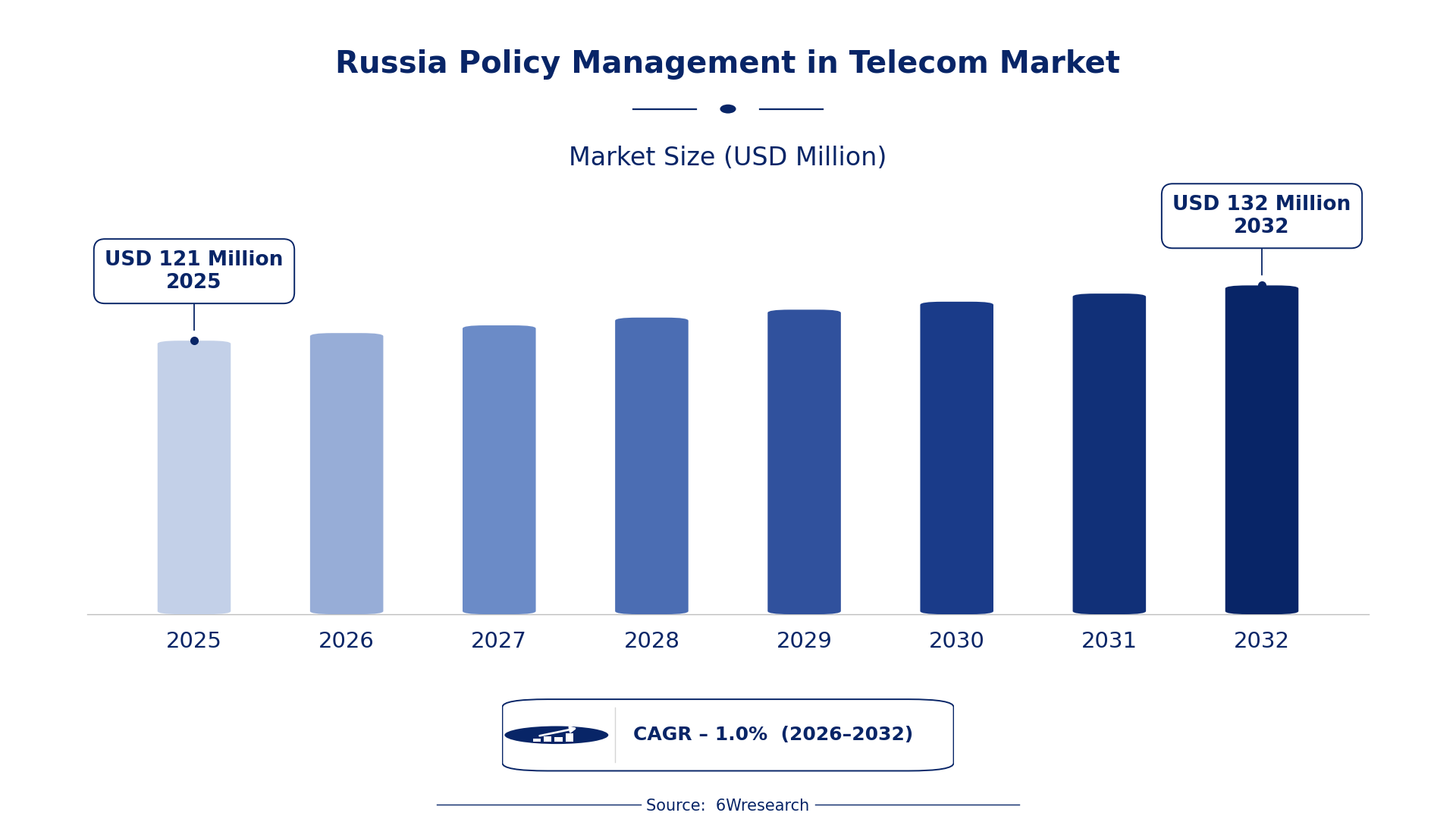
The Russia Policy Management in Telecom Market was estimated at USD 121 Million in 2025 and is projected to reach USD 132 Million by 2032, growing at a CAGR of 1.0% from 2026 to 2032.
Russia Policy Management in Telecom Market Synopsis
The Russia Policy Management in Telecom Market is currently experiencing a phase of cautious optimism, driven by recent governmental pushes for regulatory clarity. However, the road ahead remains fraught with challenges as the sector grapples with stringent data protection laws and evolving market dynamics.
As technological advancements reshape the industry, telecom operators must continuously adapt their policies. Future growth will largely depend on how effectively these companies can respond to governmental regulations while ensuring network security and customer trust amidst rising cybersecurity concerns.
Russia Policy Management in Telecom Market Year-wise Growth Rate and Key Drivers
This graph illustrates the annual growth rates of the Russia Policy Management in Telecom Market from 2021 to 2032, highlighting a steady upward trajectory and projected expansion over the forecast period.
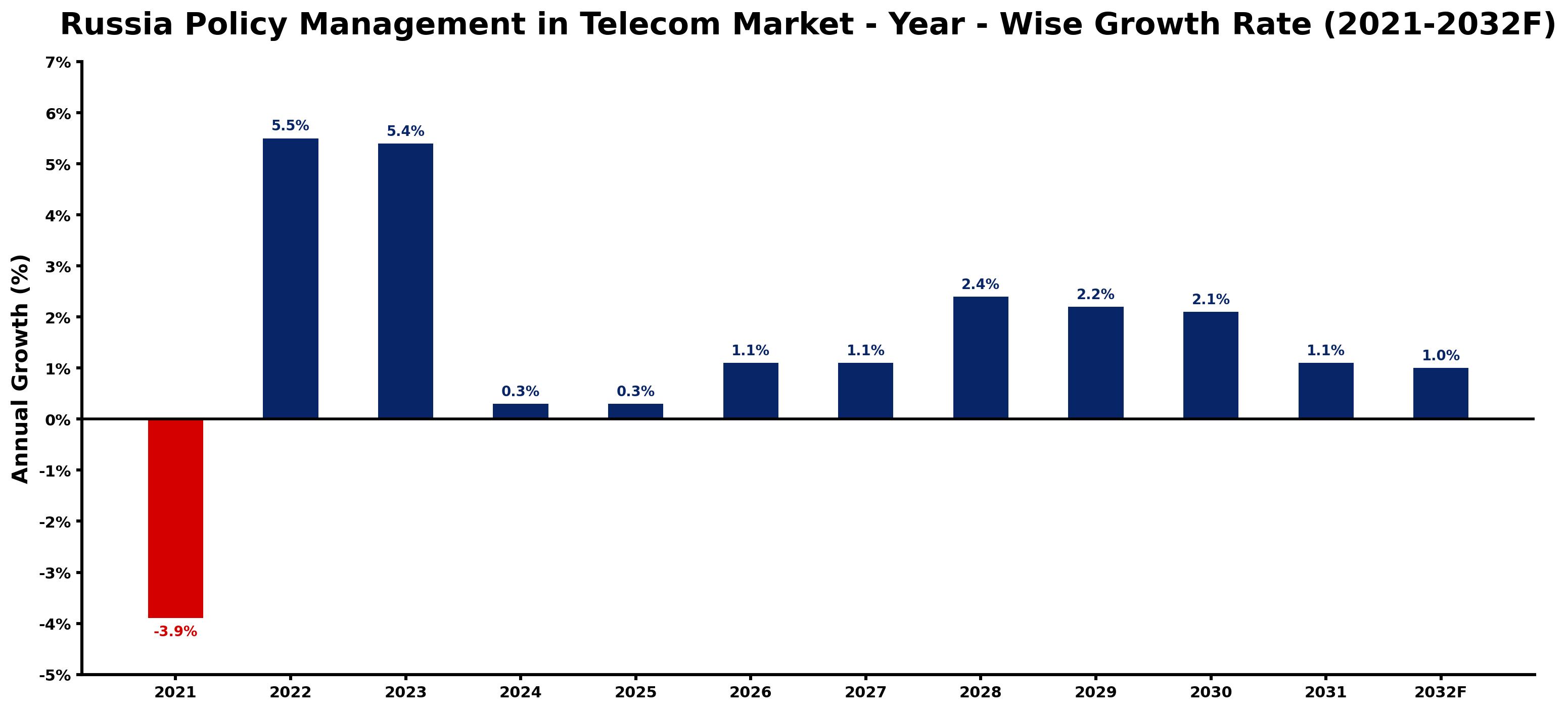
The table below presents the year‑wise growth rates along with the key drivers influencing the market
| Year | Growth Rate | Major Drivers |
| 2021 | -3.9% | Increased government regulation from Roskomnadzor on telecom services. |
| 2022 | 5.5% | New telecom regulations by the Ministry of Digital Development. |
| 2023 | 5.4% | Increased cybersecurity mandates driving telecom policy changes. |
| 2024 | 0.3% | Rising smartphone penetration enhancing telecom service policies. |
| 2025 | 0.3% | Government support for rural telecom infrastructure expansion. |
| 2026 | 1.1% | Increasing competition among regional telecom operators boosting policies. |
| 2027 | 1.1% | Adoption of digital identity initiatives by telecom providers. |
| 2028 | 2.4% | Growing focus on telecommunications privacy laws enforcement. |
| 2029 | 2.2% | Introduction of consumer protection regulations for telecom services. |
| 2030 | 2.1% | Emergence of telecom analytics improving operational policies. |
| 2031 | 1.1% | Government incentives for deploying telecom in remote areas. |
| 2032 | 1.0% | Strengthening collaboration between telecom and local governments. |
Note: Market size estimations and growth projections presented in this report are based on 6Wresearch's proprietary forecasting methodology, utilizing the latest available industry data, government publications, and primary research inputs.
Russia Policy Management in Telecom Market Key Takeaways
Below are some of the specific key takeaways from the market, including:
- Telecom operators are navigating a complex regulatory environment marked by frequent policy shifts.
- Investment in advanced policy management solutions is increasing to enhance compliance and network efficiency.
- Cybersecurity and data protection are now top priorities in policy formulation and implementation.
- The government aims to balance competition and national security through stringent regulations.
- Emerging technologies like IoT and 5G are prompting a need for innovative policy frameworks.
Evaluation of Restraints in Russia Policy Management in Telecom Market
The regulatory environment in Russia is characterized by its complexity, with frequent changes that can leave telecom operators scrambling for compliance. Government intervention can stifle competition, creating barriers to entry for new players and limiting innovation among established companies. Additionally, stringent data privacy laws impose significant operational costs, as telecom firms must invest heavily in robust data protection mechanisms. These factors collectively limit market growth and challenge the sustainability of existing business models.
Russia Policy Management in Telecom Market Trends
The focus on data protection and cybersecurity is intensifying, pushing telecom companies to adopt more stringent policies and invest in state-of-the-art technology solutions. Another trend is the demand for transparency in regulatory practices, as operators strive to build trust with consumers and authorities alike. Additionally, the increasing integration of AI and analytics into policy management systems is becoming critical for real-time monitoring and compliance.
Russia Policy Management in Telecom Market Opportunities
There exists a wealth of investment opportunities within the Russia Policy Management in Telecom Market, particularly in developing advanced policy management solutions tailored to evolving regulatory demands. Companies can capitalize on the growing need for solutions that ensure compliance with stringent data privacy regulations while enhancing the customer experience. As the digital landscape expands, there is also potential in supporting technologies that align with the rollout of 5G and IoT services, which require a nuanced approach to policy management.
Government Initiatives in the Russia Policy Management in Telecom Market
Government policies are actively shaping the Russia Policy Management in Telecom Market, focusing on enhancing competition and ensuring consumer data protection. The authorities aim to foster a regulatory environment that supports innovation while addressing national security concerns. Recent and ongoing initiatives are geared towards improving compliance frameworks and enhancing the robustness of the telecommunications infrastructure.
- A regulatory framework introduced in 2025 mandating stricter billing transparency for telecom operators.
- A national digital infrastructure upgrade programme now in its rollout phase, aimed at enhancing connectivity across rural areas.
- A planned public-private initiative expected to expand access to high-speed internet by 2028.
- Current reviews of spectrum allocation rules to promote fairness in market competition, which are currently underway.
Future Insights of the Russia Policy Management in Telecom Market
As we look towards 2026-2032, the Russia Policy Management in Telecom Market is expected to evolve significantly, influenced by both regulatory changes and technological advancements. The adoption of 5G technology will necessitate more comprehensive policy frameworks, with an emphasis on network efficiency and compliance. Additionally, operators will need to prioritize adaptability in their policy management systems to meet the growing expectations of consumers for privacy and security in their digital communications.
Russia Policy Management in Telecom Market Latest Developments
In recent months, the Russia Policy Management in Telecom Market has witnessed a series of initiatives aimed at enhancing regulatory compliance and operational efficiency. These developments highlight the sector's responsiveness to both governmental directives and market needs, reflecting a shifting paradigm in policy management.
- An initiative that began in early 2025 aimed at implementing AI-driven analytics for real-time policy management is currently ongoing.
- A leading regional operator completed a major network security upgrade focused on protecting customer data by late 2025.
- A rollout expected to begin in Q3 2025 will introduce enhanced compliance monitoring tools across major telecom networks.
- A new partnership between telecom operators and cybersecurity firms, initiated in mid-2025, is focused on bolstering network defenses against emerging threats.
Russia Policy Management in Telecom Market - Key Attractiveness of the Report
- 10 Years of Market Numbers
- Historical Data Starting from 2022 to 2025
- Base Year: 2025
- Forecast Data until 2032
- Key Performance Indicators Impacting the Market
- Major Upcoming Developments and Projects
Key Highlights of the Report:
- Russia Policy Management in Telecom Market Outlook
- Market Size of Russia Policy Management in Telecom Market, 2025
- Forecast of Russia Policy Management in Telecom Market, 2032
- Historical Data and Forecast of Russia Policy Management in Telecom Revenues & Volume for the Period 2022-2032F
- Russia Policy Management in Telecom Market Trend Evolution
- Russia Policy Management in Telecom Market Drivers and Challenges
- Russia Policy Management in Telecom Price Trends
- Russia Policy Management in Telecom Porter's Five Forces
- Russia Policy Management in Telecom Industry Life Cycle
- Historical Data and Forecast of Russia Policy Management in Telecom Market Revenues & Volume By Network for the Period 2022-2032F
- Historical Data and Forecast of Russia Policy Management in Telecom Market Revenues & Volume By Fixed for the Period 2022-2032F
- Historical Data and Forecast of Russia Policy Management in Telecom Market Revenues & Volume By Wireless for the Period 2022-2032F
- Historical Data and Forecast of Russia Policy Management in Telecom Market Revenues & Volume By Component for the Period 2022-2032F
- Historical Data and Forecast of Russia Policy Management in Telecom Market Revenues & Volume By Solutions for the Period 2022-2032F
- Historical Data and Forecast of Russia Policy Management in Telecom Market Revenues & Volume By Services for the Period 2022-2032F
- Historical Data and Forecast of Russia Policy Management in Telecom Market Revenues & Volume By Deployment for the Period 2022-2032F
- Historical Data and Forecast of Russia Policy Management in Telecom Market Revenues & Volume By Cloud for the Period 2022-2032F
- Historical Data and Forecast of Russia Policy Management in Telecom Market Revenues & Volume By On-Premises for the Period 2022-2032F
- Russia Policy Management in Telecom Import Export Trade Statistics
- Market Opportunity Assessment By Network
- Market Opportunity Assessment By Component
- Market Opportunity Assessment By Deployment
- Russia Policy Management in Telecom Top Companies Market Share
- Russia Policy Management in Telecom Competitive Benchmarking By Technical and Operational Parameters
- Russia Policy Management in Telecom Company Profiles
- Russia Policy Management in Telecom Key Strategic Recommendations






































