Tanzania Policy Management in Telecom Market Size & Growth Rate (2026-2032)
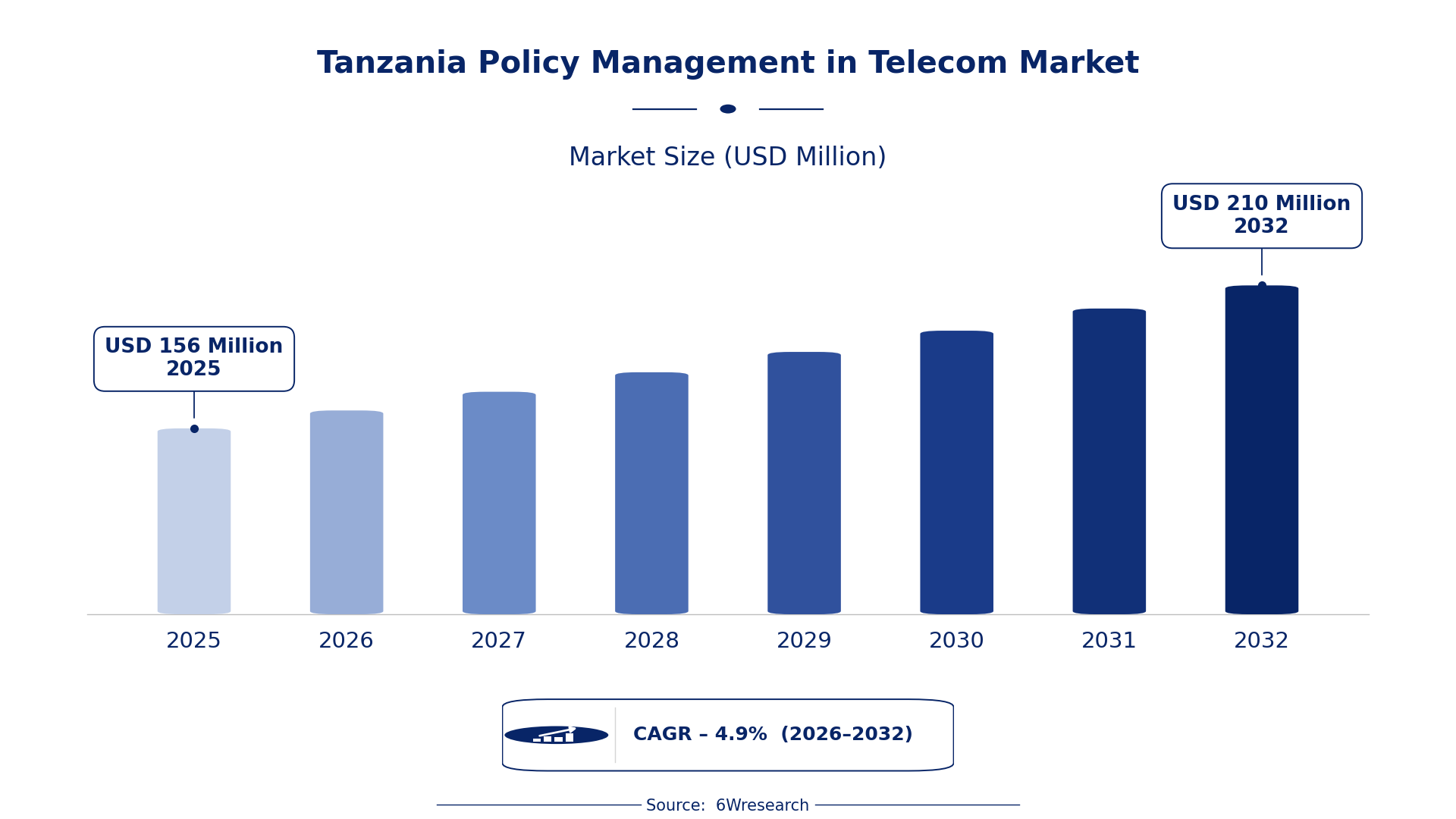
The Tanzania Policy Management in Telecom Market was estimated at USD 156 Million in 2025 and is projected to reach USD 210 Million by 2032, growing at a CAGR of 4.9% from 2026 to 2032.
Tanzania Policy Management in Telecom Market Synopsis
In recent years, Tanzania's telecom sector has showcased notable growth propelled by government initiatives aimed at enhancing competition and expanding services. However, as the market matures, it is transitioning towards a more structured regulatory environment designed to manage the complexities of a dynamic digital landscape.
This shift is not merely bureaucratic; it underscores a commitment to consumer protection, investment in infrastructure, and the fortification of data privacy policies. As these regulatory frameworks evolve, the market's trajectory indicates a balanced approach that supports both industry innovation and user security.
Tanzania Policy Management in Telecom Market Year-wise Growth Rate and Key Drivers
This graph illustrates the annual growth rates of the Tanzania Policy Management in Telecom Market from 2021 to 2032, highlighting a steady upward trajectory and projected expansion over the forecast period.
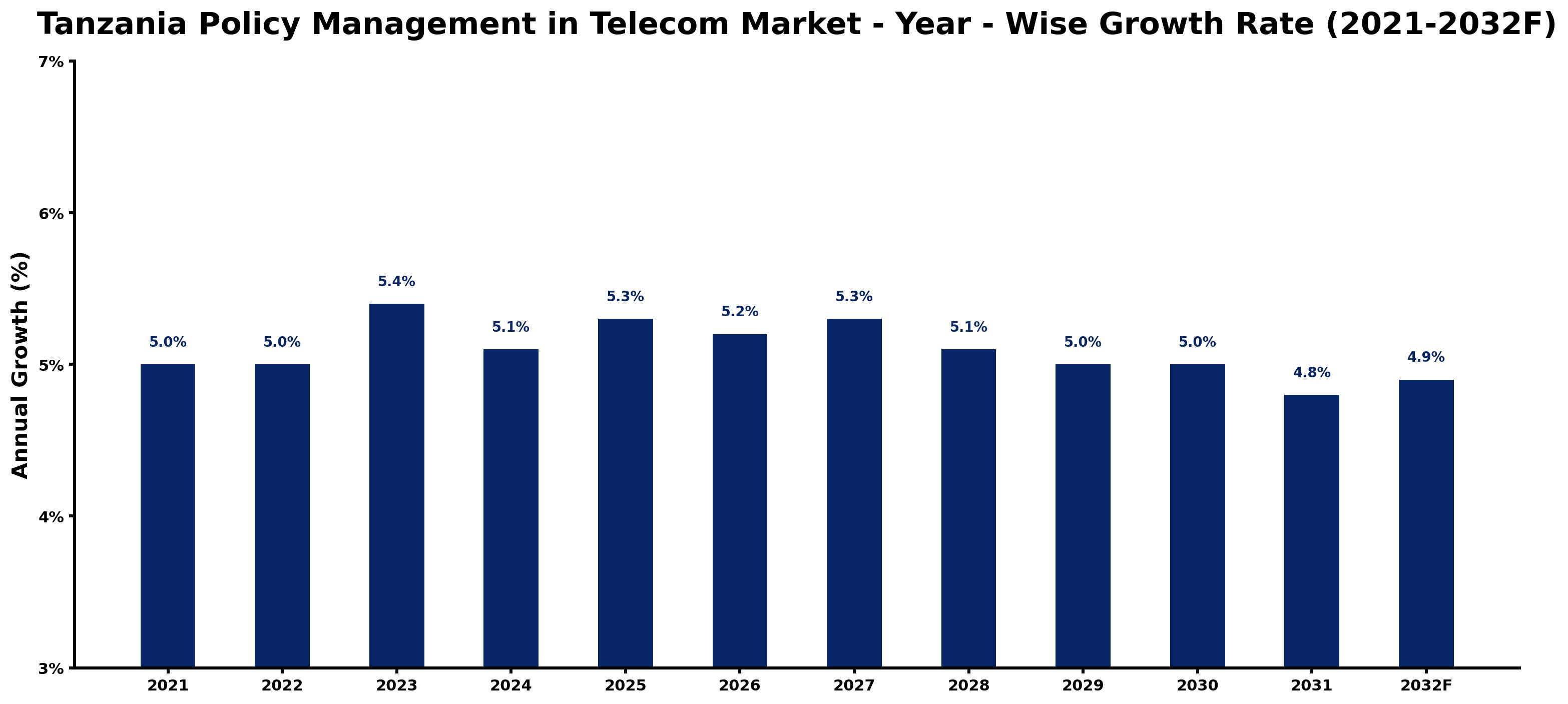
The table below presents the year‑wise growth rates along with the key drivers influencing the market
| Year | Growth Rate | Major Drivers |
| 2021 | 5.0% | Government initiatives promoting digital finance services accessibility. |
| 2022 | 5.0% | Regulatory support for mobile money interoperability expansion. |
| 2023 | 5.4% | Increased foreign investment in telecom infrastructure developments. |
| 2024 | 5.1% | TCRA's push for improved internet connectivity in rural areas. |
| 2025 | 5.3% | Adoption of 5G technology to enhance service delivery. |
| 2026 | 5.2% | Partnerships boosting telecommunications for agricultural market access. |
| 2027 | 5.3% | Growth in digital content driving telecom service subscriptions. |
| 2028 | 5.1% | Regulatory frameworks supporting telecom sector competition enhancements. |
| 2029 | 5.0% | Government focus on expanding broadband access nationwide. |
| 2030 | 5.0% | Increased demand for mobile health services post-pandemic. |
| 2031 | 4.8% | Youth engagement programs driving telecom usage among students. |
| 2032 | 4.9% | Strengthening cybersecurity laws enhancing user trust in telecom. |
Note: Market size estimations and growth projections presented in this report are based on 6Wresearch's proprietary forecasting methodology, utilizing the latest available industry data, government publications, and primary research inputs.
Tanzania Policy Management in Telecom Market Key Takeaways
Below are some of the specific key takeaways from the market, including:
- Government policies are increasingly focused on consumer protection and competition within the telecom sector.
- Data privacy and cybersecurity regulations are becoming a top priority for telecom operators.
- Investment in policy management solutions is rising to address regulatory compliance and network management.
- The market is anticipated to grow steadily, driven by rising demand for digital services.
- Emerging technologies like 5G are set to shape future policy frameworks and operational strategies.
Evaluation of Restraints in Tanzania Policy Management in Telecom Market
Despite the growth potential, the market faces significant restraints. Regulatory uncertainty continues to create apprehension among telecom operators, resulting in hesitancy towards investment and innovation. The inconsistent enforcement of policies complicates compliance efforts, while frequently changing regulations can lead to operational confusion. To foster a more predictable and conducive environment, a collaborative approach between regulators and industry stakeholders is critical.
Tanzania Policy Management in Telecom Market Trends
A marked trend in the Tanzania Policy Management in Telecom Market is the intensifying focus on data privacy and security. The government has started implementing stricter regulations aimed at ensuring compliance among telecom operators. This push for transparency and accountability is gaining momentum, particularly as the digital economy expands.
Additionally, the demand for advanced policy management solutions has surged as telecom companies strive to enhance service quality while adhering to regulatory requirements. As technology evolves, policy frameworks will need to adapt to emerging challenges, including those posed by cyber threats and the increasing complexity of digital services.
Tanzania Policy Management in Telecom Market Opportunities
Opportunities for growth in this market are substantial, driven by the increasing need for sophisticated policy management solutions. Telecom operators are actively seeking tools to optimize network performance and improve customer experience amidst regulatory requirements. Investors are encouraged to explore tailored solutions that provide real-time analytics and policy enforcement, which are critical for maintaining competitive edge.
Partnerships with local telecom companies present another avenue for growth, enabling foreign players to strengthen their market presence while enhancing the capabilities of existing operators.
Government Initiatives in the Tanzania Policy Management in Telecom Market
The Tanzanian government is actively shaping the policy framework for the telecom sector, focusing on enhancing regulatory measures to support growth. This proactive approach is essential as it aims to encourage investment, improve service delivery, and ensure consumer rights are protected. Current initiatives reflect a commitment to not only advance technology but also to maintain a competitive marketplace.
- A national digital infrastructure upgrade programme now in its rollout phase aims to enhance connectivity across underserved regions.
- The TCRA is currently overseeing new licensing regulations designed to foster fair competition among telecom providers.
- A cybersecurity strategy introduced in early 2025 is focused on strengthening data protection measures in line with global standards.
- A regulatory framework mandating billing transparency is set to be implemented in mid-2026 to enhance consumer trust.
- A planned public-private initiative is expected to expand telecom infrastructure access by 2028, targeting rural areas.
Future Insights of the Tanzania Policy Management in Telecom Market
Looking ahead to 2026-2032, the Tanzania Policy Management in Telecom Market is set for steady expansion. The demand for policy management solutions is expected to rise in tandem with increasing internet penetration and data service usage. Operators will likely invest in innovative technologies to navigate the regulatory complexities while enhancing operational efficiency.
The anticipated rollout of 5G technology will not only transform service delivery but also necessitate new regulatory considerations, further underscoring the importance of robust policy management.
Tanzania Policy Management in Telecom Market Latest Developments
Over the last year, the Tanzania Policy Management in Telecom Market has witnessed a flurry of activity indicative of a sector adapting to regulatory demands and consumer expectations. Companies are increasingly engaging in initiatives to enhance their compliance mechanisms and improve service quality amid tightening regulations.
- A major technology vendor launched an innovative real-time analytics platform in late 2025, aimed at helping telecom companies comply with new regulatory requirements.
- In Q1 2026, a leading regional operator announced an ongoing collaboration with local authorities to improve infrastructure in rural areas.
- A public-private partnership aimed at boosting cybersecurity measures is expected to commence in early 2026.
- In early 2025, an initiative focusing on enhancing billing transparency was successfully completed, improving customer trust in the telecom sector.
- Plans for an upcoming policy summit in late 2026 will focus on setting the agenda for future regulations in line with technology advancements.
Tanzania Policy Management in Telecom Market - Key Attractiveness of the Report
- 10 Years of Market Numbers
- Historical Data Starting from 2022 to 2025
- Base Year: 2025
- Forecast Data until 2032
- Key Performance Indicators Impacting the Market
- Major Upcoming Developments and Projects
Key Highlights of the Report:
- Tanzania Policy Management in Telecom Market Outlook
- Market Size of Tanzania Policy Management in Telecom Market, 2025
- Forecast of Tanzania Policy Management in Telecom Market, 2032
- Historical Data and Forecast of Tanzania Policy Management in Telecom Revenues & Volume for the Period 2022-2032F
- Tanzania Policy Management in Telecom Market Trend Evolution
- Tanzania Policy Management in Telecom Market Drivers and Challenges
- Tanzania Policy Management in Telecom Price Trends
- Tanzania Policy Management in Telecom Porter's Five Forces
- Tanzania Policy Management in Telecom Industry Life Cycle
- Historical Data and Forecast of Tanzania Policy Management in Telecom Market Revenues & Volume By Network for the Period 2022-2032F
- Historical Data and Forecast of Tanzania Policy Management in Telecom Market Revenues & Volume By Fixed for the Period 2022-2032F
- Historical Data and Forecast of Tanzania Policy Management in Telecom Market Revenues & Volume By Wireless for the Period 2022-2032F
- Historical Data and Forecast of Tanzania Policy Management in Telecom Market Revenues & Volume By Component for the Period 2022-2032F
- Historical Data and Forecast of Tanzania Policy Management in Telecom Market Revenues & Volume By Solutions for the Period 2022-2032F
- Historical Data and Forecast of Tanzania Policy Management in Telecom Market Revenues & Volume By Services for the Period 2022-2032F
- Historical Data and Forecast of Tanzania Policy Management in Telecom Market Revenues & Volume By Deployment for the Period 2022-2032F
- Historical Data and Forecast of Tanzania Policy Management in Telecom Market Revenues & Volume By Cloud for the Period 2022-2032F
- Historical Data and Forecast of Tanzania Policy Management in Telecom Market Revenues & Volume By On-Premises for the Period 2022-2032F
- Tanzania Policy Management in Telecom Import Export Trade Statistics
- Market Opportunity Assessment By Network
- Market Opportunity Assessment By Component
- Market Opportunity Assessment By Deployment
- Tanzania Policy Management in Telecom Top Companies Market Share
- Tanzania Policy Management in Telecom Competitive Benchmarking By Technical and Operational Parameters
- Tanzania Policy Management in Telecom Company Profiles
- Tanzania Policy Management in Telecom Key Strategic Recommendations






































