Argentina Policy Management in Telecom Market Size & Growth Rate (2026-2032)
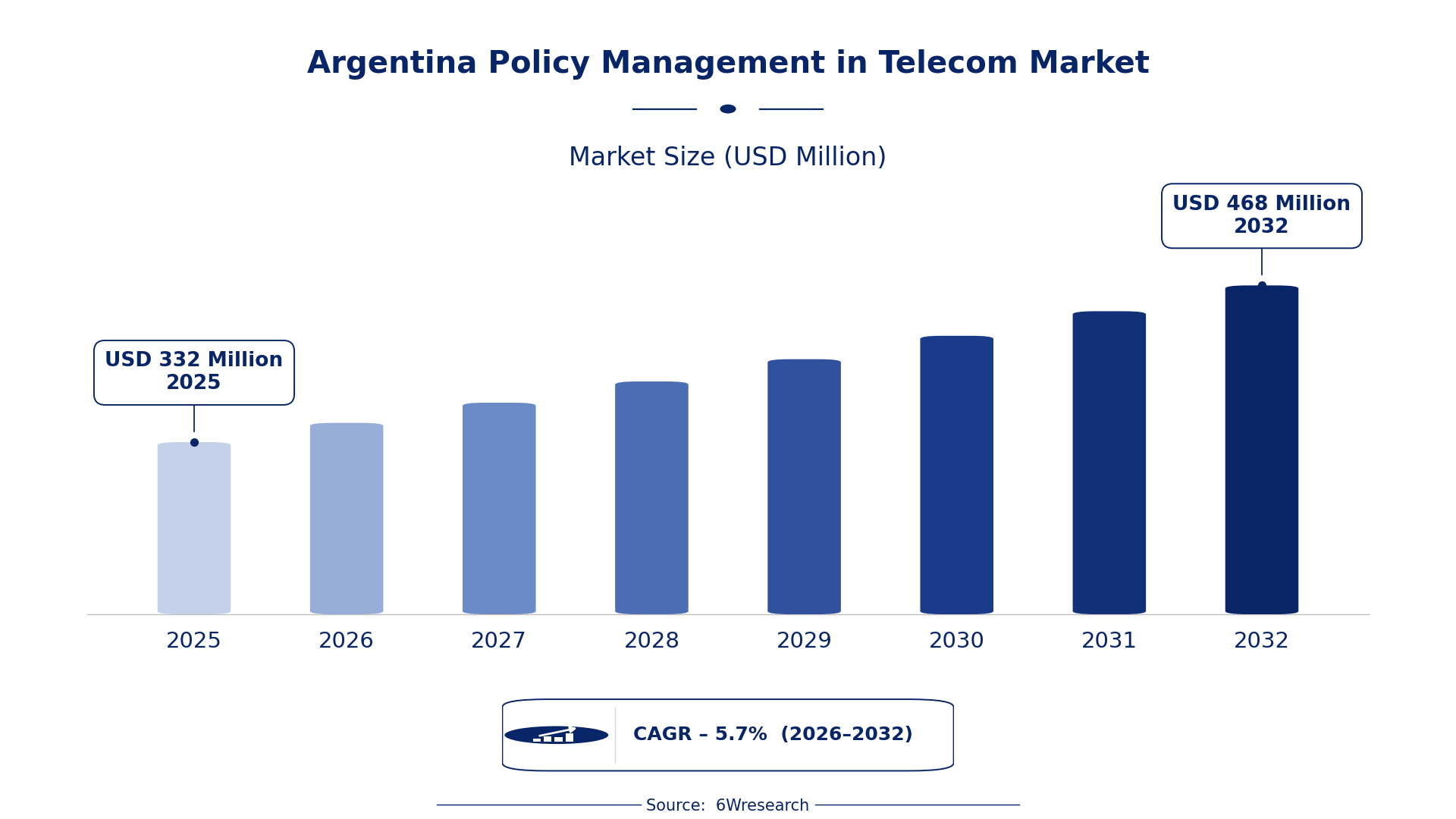
The Argentina Policy Management in Telecom Market was estimated at USD 332 Million in 2025 and is projected to reach USD 468 Million by 2032, growing at a CAGR of 5.7% from 2026 to 2032.
Argentina Policy Management in Telecom Market Synopsis
In Argentina, the demand for sophisticated policy management solutions is surging as telecom operators grapple with an increasingly complex network environment. This need is driven by the rapid expansion of mobile data services, IoT applications, and the omnipresence of over-the-top content, pushing operators to adopt systems that ensure optimal service delivery.
Policy management tools play a crucial role in helping telecom providers maintain quality of service, manage traffic, and implement effective billing strategies. With evolving regulatory frameworks shaping the telecom sector, these solutions become vital for compliance and customer satisfaction, making this market one of Argentina's critical technological frontiers.
Argentina Policy Management in Telecom Market Year-wise Growth Rate and Key Drivers
This graph illustrates the annual growth rates of the Argentina Policy Management in Telecom Market from 2021 to 2032, highlighting a steady upward trajectory and projected expansion over the forecast period.
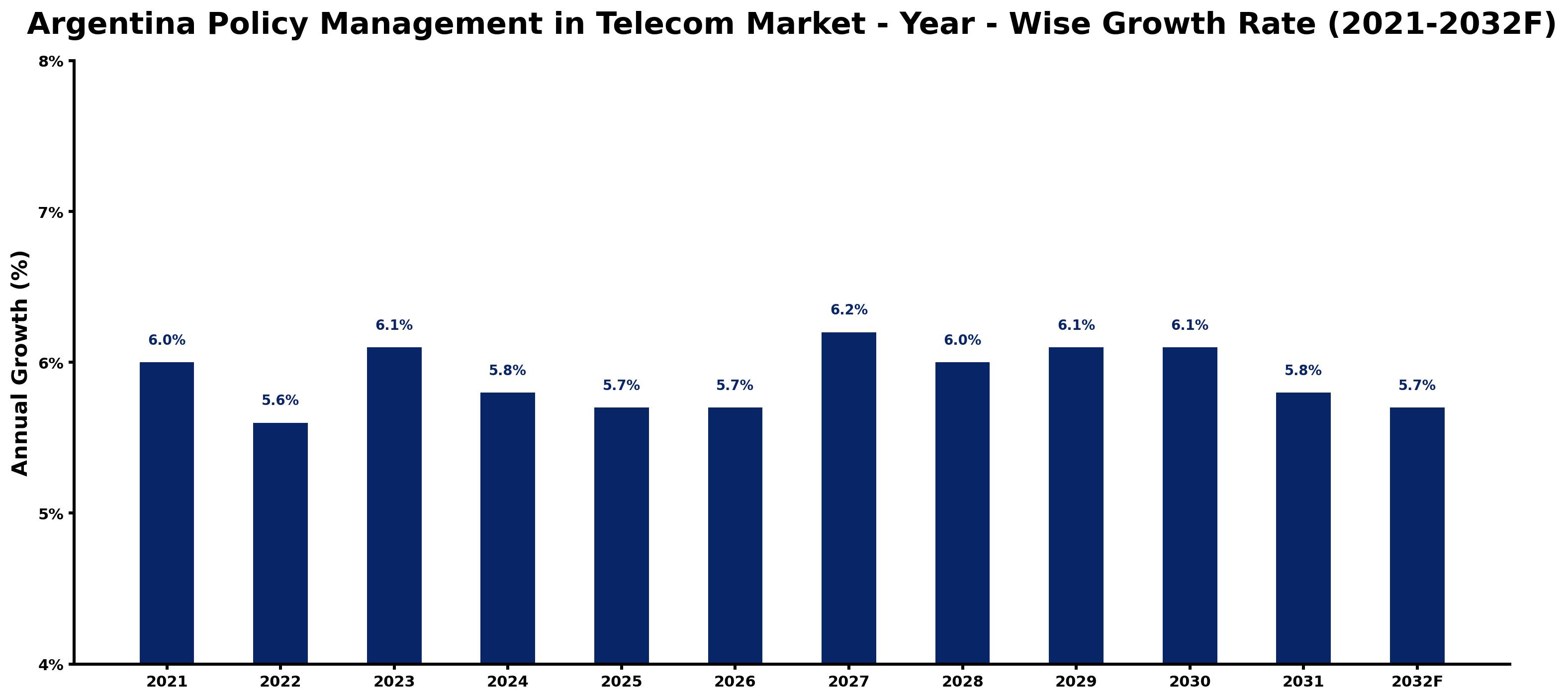
The table below presents the year‑wise growth rates along with the key drivers influencing the market
| Year | Growth Rate | Major Drivers |
| 2021 | 6.0% | ENACOM’s new telecom regulations boosting service competition |
| 2022 | 5.6% | Increased smartphone penetration enhancing broadband policy engagement |
| 2023 | 6.1% | New digital transformation policies accelerating telecom infrastructure upgrades |
| 2024 | 5.8% | Government incentives for rural telecom expansion strategies |
| 2025 | 5.7% | Investment in tech startups driving innovative telecom solutions |
| 2026 | 5.7% | Public-private partnerships improving telecom service delivery |
| 2027 | 6.2% | Rising consumer demand for faster and affordable internet |
| 2028 | 6.0% | Policy reforms facilitating entry for new telecom providers |
| 2029 | 6.1% | Increased focus on cybersecurity legislation for telecom operators |
| 2030 | 6.1% | Growing usage of mobile data spurring policy enhancements |
| 2031 | 5.8% | Consumer advocacy groups pushing for better service standards |
| 2032 | 5.7% | Collaborations between universities and telecom firms for R&D |
Note: Market size estimations and growth projections presented in this report are based on 6Wresearch's proprietary forecasting methodology, utilizing the latest available industry data, government publications, and primary research inputs.
Argentina Policy Management in Telecom Market Key Takeaways
Below are some of the specific key takeaways from the market, including:
- Dynamic policy control is essential for optimizing network performance.
- The growth of IoT and mobile data necessitates advanced policy management solutions.
- Regulatory compliance remains a critical driver of market demand.
- Technological advancements in machine learning enhance policy orchestration.
- Collaboration among stakeholders is necessary for successful implementation.
Evaluation of Restraints in Argentina Policy Management in Telecom Market
Despite the market's promising outlook, several factors restrain its growth. For one, telecom operators face significant hurdles in ensuring regulatory compliance while integrating new technologies into their existing frameworks. This interoperability issue often leads to delays and increased costs. Concerns about data privacy and the transparency of policy enforcement further complicate market acceptance, as customers grow wary of their data handling. Additionally, competition from established international vendors puts pressure on local operators to lower costs while maintaining service quality, a challenging balancing act that could hamper profitability.
Argentina Policy Management in Telecom Market Trends
Recent trends indicate a shift toward the adoption of machine learning and AI technologies in policy management solutions. These technologies allow operators to analyze data in real time and adjust service policies dynamically, enhancing the customer experience. There is also a noticeable push toward network slicing, which offers tailored services to different subscriber groups, reflecting a growing demand for personalized telecom experiences. As the regulatory environment continues to evolve, operators are increasingly prioritizing compliance-focused solutions to meet both governmental and customer expectations.
Argentina Policy Management in Telecom Market Opportunities
With a burgeoning demand for personalized services, telecom operators can capitalize on the opportunities presented by AI and machine learning to refine their policy management systems. Investment in cloud-based platforms also presents a promising avenue for growth, enabling operators to scale their services efficiently. The focus on IoT connectivity offers an attractive growth segment, as operators seek to implement effective policy management to handle the increasing volume of connected devices. Additionally, fostering partnerships between telecom operators and local government entities can lead to innovative public-private initiatives that enhance service delivery and compliance.
Government Initiatives in the Argentina Policy Management in Telecom Market
Government actions are crucial in shaping the Argentina Policy Management in Telecom Market. With a clear emphasis on regulatory compliance and the need for efficient service delivery, the Argentine government is introducing policies to streamline telecom operations and bolster infrastructure development. These initiatives aim to ensure transparency while addressing the complexities of modern telecom networks.
- A regulatory framework introduced in 2025 mandating billing transparency to improve consumer trust.
- A national digital infrastructure upgrade program now in its rollout phase, focusing on enhancing connectivity across urban and rural areas.
- A planned public-private initiative aimed at expanding telecom infrastructure access by 2028, targeting underserved regions.
- Current discussions are ongoing regarding spectrum management policies to optimize resource allocation in telecommunications.
- Recent reforms are underway to enhance data privacy regulations, ensuring telecom operators comply with best practices.
Future Insights of the Argentina Policy Management in Telecom Market
From 2026 to 2032, the Argentina Policy Management in Telecom Market is expected to evolve significantly, driven by technological advancements and regulatory changes. As operators embrace AI and machine learning, policy enforcement will become more precise, enhancing both user satisfaction and service quality. Regulatory bodies are likely to introduce stricter compliance measures, pushing operators to invest in robust policy management systems. The rising influence of IoT will further necessitate dynamic policy frameworks, making agility a key characteristic of future telecom services.
Argentina Policy Management in Telecom Market Latest Developments
Over the past 12-14 months, Argentina’s telecom sector has witnessed a flurry of activity in policy management. The competitive environment has driven operators to innovate and adapt their strategies to meet both consumer and regulatory demands. This push has led to notable developments in policy management solutions tailored to address the complexities of a rapidly changing telecommunications ecosystem.
- A major technology vendor launched a new policy orchestration platform in early 2025, designed to enhance service delivery and compliance capabilities.
- An initiative that began in mid-2025 is currently underway, focusing on integrating AI technologies into existing policy management systems for improved automation.
- A recent collaboration between telecom operators and local governments aims to address infrastructure challenges in rural areas, expected to roll out by the end of 2026.
- A program initiated in Q1 2025 is enhancing data privacy measures, aligning with upcoming regulations to foster consumer trust.
- Current partnerships are being formed to develop advanced billing solutions that comply with the new transparency mandates.
Argentina Policy Management in Telecom Market - Key Attractiveness of the Report
- 10 Years of Market Numbers
- Historical Data Starting from 2022 to 2025
- Base Year: 2025
- Forecast Data until 2032
- Key Performance Indicators Impacting the Market
- Major Upcoming Developments and Projects
Key Highlights of the Report:
- Argentina Policy Management in Telecom Market Outlook
- Market Size of Argentina Policy Management in Telecom Market, 2025
- Forecast of Argentina Policy Management in Telecom Market, 2032
- Historical Data and Forecast of Argentina Policy Management in Telecom Revenues & Volume for the Period 2022-2032F
- Argentina Policy Management in Telecom Market Trend Evolution
- Argentina Policy Management in Telecom Market Drivers and Challenges
- Argentina Policy Management in Telecom Price Trends
- Argentina Policy Management in Telecom Porter's Five Forces
- Argentina Policy Management in Telecom Industry Life Cycle
- Historical Data and Forecast of Argentina Policy Management in Telecom Market Revenues & Volume By Network for the Period 2022-2032F
- Historical Data and Forecast of Argentina Policy Management in Telecom Market Revenues & Volume By Fixed for the Period 2022-2032F
- Historical Data and Forecast of Argentina Policy Management in Telecom Market Revenues & Volume By Wireless for the Period 2022-2032F
- Historical Data and Forecast of Argentina Policy Management in Telecom Market Revenues & Volume By Component for the Period 2022-2032F
- Historical Data and Forecast of Argentina Policy Management in Telecom Market Revenues & Volume By Solutions for the Period 2022-2032F
- Historical Data and Forecast of Argentina Policy Management in Telecom Market Revenues & Volume By Services for the Period 2022-2032F
- Historical Data and Forecast of Argentina Policy Management in Telecom Market Revenues & Volume By Deployment for the Period 2022-2032F
- Historical Data and Forecast of Argentina Policy Management in Telecom Market Revenues & Volume By Cloud for the Period 2022-2032F
- Historical Data and Forecast of Argentina Policy Management in Telecom Market Revenues & Volume By On-Premises for the Period 2022-2032F
- Argentina Policy Management in Telecom Import Export Trade Statistics
- Market Opportunity Assessment By Network
- Market Opportunity Assessment By Component
- Market Opportunity Assessment By Deployment
- Argentina Policy Management in Telecom Top Companies Market Share
- Argentina Policy Management in Telecom Competitive Benchmarking By Technical and Operational Parameters
- Argentina Policy Management in Telecom Company Profiles
- Argentina Policy Management in Telecom Key Strategic Recommendations






































