Colombia Policy Management in Telecom Market Size & Growth Rate (2026-2032)
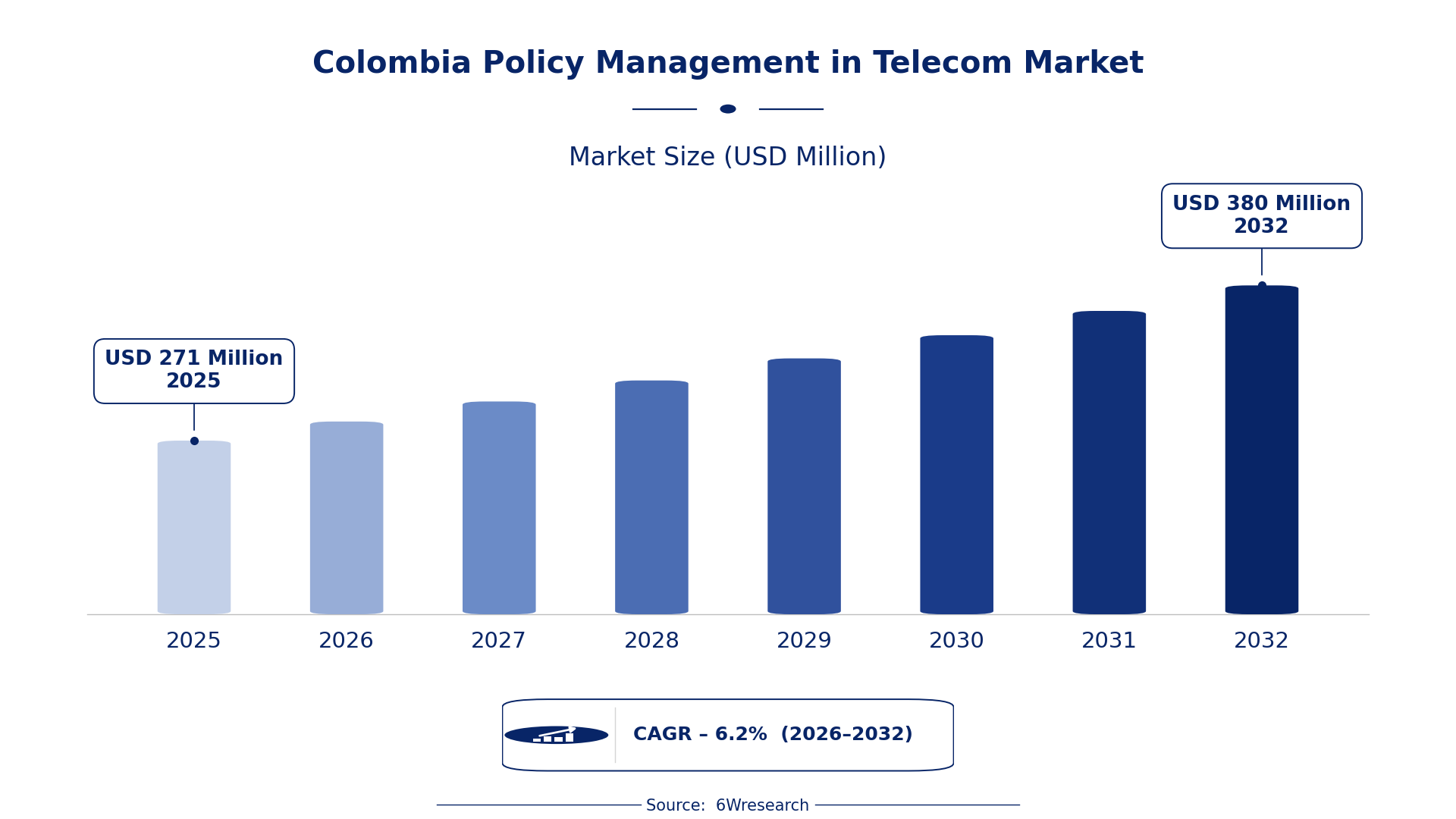
The Colombia Policy Management in Telecom Market was estimated at USD 271 Million in 2025 and is projected to reach USD 380 Million by 2032, growing at a CAGR of 6.2% from 2026 to 2032.
Colombia Policy Management in Telecom Market Synopsis
The regulatory reforms initiated by the Colombian government are the strongest driving force currently shaping the market. These reforms are designed to foster competition, consumer protection, and infrastructure development across the telecom sector, ensuring a more transparent and efficient environment.
Telecom operators in Colombia are increasingly investing in sophisticated policy management systems. This surge is primarily fueled by the pressing need to comply with ever-evolving regulatory standards while effectively managing subscriber data and enhancing overall service delivery amid heightened market competition.
Colombia Policy Management in Telecom Market Year-wise Growth Rate and Key Drivers
This graph illustrates the annual growth rates of the Colombia Policy Management in Telecom Market from 2021 to 2032, highlighting a steady upward trajectory and projected expansion over the forecast period.
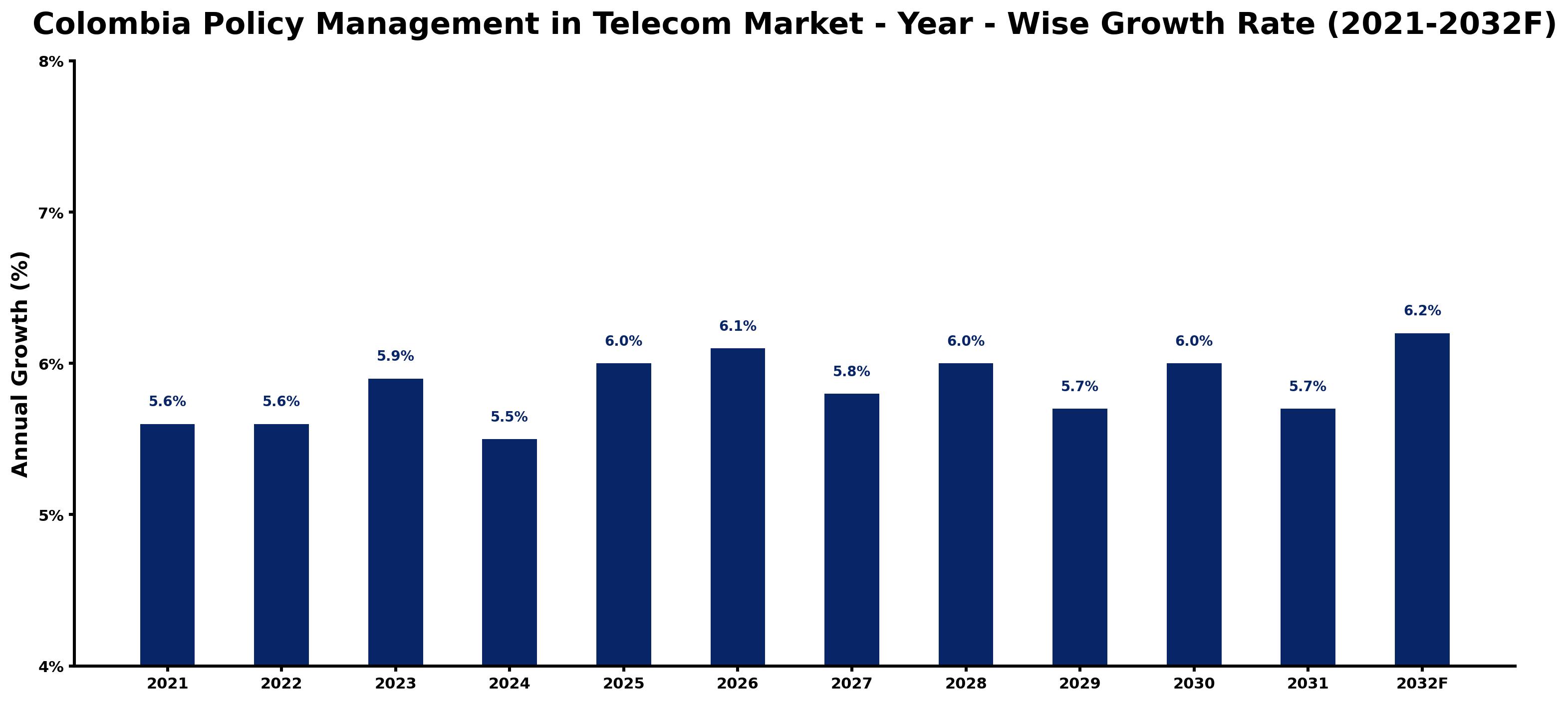
The table below presents the year‑wise growth rates along with the key drivers influencing the market
| Year | Growth Rate | Major Drivers |
| 2021 | 5.6% | Regulatory support for 5G spectrum allocation in Colombia |
| 2022 | 5.6% | Implementation of Colombia's national digital transformation policy |
| 2023 | 5.9% | Increased foreign investment in Colombian telecom infrastructure |
| 2024 | 5.5% | Rise in mobile payment services boosting telecom sector growth |
| 2025 | 6.0% | Adoption of IoT solutions driven by Colombian agriculture needs |
| 2026 | 6.1% | Government incentives for green telecom technologies in Colombia |
| 2027 | 5.8% | Strengthening cybersecurity regulations enhancing telecom service trust |
| 2028 | 6.0% | Growth of e-learning platforms increasing internet subscription rates |
| 2029 | 5.7% | Expanded telecom operator collaborations enhancing service coverage |
| 2030 | 6.0% | Local startups innovating in telecom solutions and services |
| 2031 | 5.7% | Increased urbanization stimulating demand for better connectivity |
| 2032 | 6.2% | Partnerships with international firms driving telecom service advancements |
Note: Market size estimations and growth projections presented in this report are based on 6Wresearch's proprietary forecasting methodology, utilizing the latest available industry data, government publications, and primary research inputs.
Colombia Policy Management in Telecom Market Key Takeaways
Below are some of the specific key takeaways from the market, including:
- The market is projected to grow to USD 380 Million by 2032, driven by regulatory reforms.
- Key regulatory focus areas include spectrum allocation and data privacy regulations.
- Operators are investing in compliance solutions to enhance service delivery and consumer protection.
- Market complexities arise from frequent policy changes and infrastructure challenges.
- Government initiatives are pivotal in shaping competitive dynamics and regulatory frameworks.
Evaluation of Restraints in Colombia Policy Management in Telecom Market
The Colombia Policy Management in Telecom Market is facing a series of restraints that pose challenges to its growth trajectory. Regulatory complexities are a prominent issue, with frequent changes in telecommunications policies affecting operational stability and investment planning. Moreover, the intricacies related to spectrum allocation and the deployment of network infrastructure further complicate the environment for telecom operators. These factors often lead to hesitancy in investment, thereby slowing down potential advancements within the market.
Colombia Policy Management in Telecom Market Trends
Several trends are influencing the dynamics of the policy management in telecom market. An increasing emphasis on data privacy and security regulations is pushing operators to invest in more advanced compliance solutions. Additionally, the shift toward digital services is prompting firms to adopt agile policy management frameworks that can adapt to rapid changes in technology and consumer behavior. The focus on enhancing customer experience through better service delivery mechanisms is another critical trend, driving innovation within the sector.
Colombia Policy Management in Telecom Market Opportunities
The landscape presents significant growth opportunities for investors and operators alike. As the government prioritizes infrastructure development and digital transformation, there is a clear opening for companies that can provide innovative policy management solutions. Collaborations between public and private sectors are likely to thrive, especially in initiatives aimed at expanding broadband access. Furthermore, the need for enhanced consumer protection frameworks indicates a growing demand for tailored policy management systems that address these specific regulatory requirements.
Government Initiatives in the Colombia Policy Management in Telecom Market
The Colombian government is actively shaping the telecom sector through various initiatives aimed at fostering a more competitive environment. There is a strong focus on regulatory frameworks that ensure fair practices while encouraging innovation and infrastructure development. This posture is crucial as the telecom market continues to evolve, necessitating effective policy management to align with new governmental guidelines.
- A national digital infrastructure upgrade programme launched in late 2023 aims to enhance broadband access across urban and rural areas.
- The government is currently working on a regulatory framework that mandates data privacy compliance, set to be implemented by mid-2025.
- A planned public-private initiative expected to commence in 2026 aims to bolster mobile network coverage in underserved regions.
- The recent establishment of a regulatory body for telecom competition aims to ensure fair practices among operators, launched in early 2024.
- Upcoming spectrum auctions are scheduled for Q1 2025, designed to allocate frequencies that support next-generation mobile services.
Future Insights of the Colombia Policy Management in Telecom Market
From 2026 to 2032, the Colombia Policy Management in Telecom Market is expected to evolve significantly. Continued regulatory reforms will likely shape competitive dynamics, compelling telecom operators to adopt more agile and adaptable management solutions. The focus will shift towards more advanced technologies, particularly in response to consumer demands for enhanced digital services. As operators strive to comply with stringent regulations, investing in innovative policy management systems will be essential for long-term sustainability and growth.
Colombia Policy Management in Telecom Market Latest Developments
In the last 12-14 months, the Colombia Policy Management in Telecom Market has witnessed a series of strategic advancements, aligning closely with government initiatives aimed at bolstering competition and consumer protection. These developments reflect the sector's commitment to adapting to changing regulatory requirements while enhancing service offerings.
- A leading telecom operator completed the rollout of an advanced compliance management system in early 2023, designed to streamline regulatory adherence.
- A major technology vendor announced an ongoing partnership with local operators to develop data protection solutions, initiated in mid-2023.
- Recently, a comprehensive training program for telecom staff focused on new regulatory compliance requirements was launched in Q4 2023.
- A planned upgrade of mobile networks, set to begin in late 2024, aims to improve service delivery in rural communities.
- An initiative to assess the impact of existing telecommunications regulations on market dynamics is currently underway, expected to conclude by early 2025.
Colombia Policy Management in Telecom Market - Key Attractiveness of the Report
- 10 Years of Market Numbers
- Historical Data Starting from 2022 to 2025
- Base Year: 2025
- Forecast Data until 2032
- Key Performance Indicators Impacting the Market
- Major Upcoming Developments and Projects
Key Highlights of the Report:
- Colombia Policy Management in Telecom Market Outlook
- Market Size of Colombia Policy Management in Telecom Market, 2025
- Forecast of Colombia Policy Management in Telecom Market, 2032
- Historical Data and Forecast of Colombia Policy Management in Telecom Revenues & Volume for the Period 2022-2032F
- Colombia Policy Management in Telecom Market Trend Evolution
- Colombia Policy Management in Telecom Market Drivers and Challenges
- Colombia Policy Management in Telecom Price Trends
- Colombia Policy Management in Telecom Porter's Five Forces
- Colombia Policy Management in Telecom Industry Life Cycle
- Historical Data and Forecast of Colombia Policy Management in Telecom Market Revenues & Volume By Network for the Period 2022-2032F
- Historical Data and Forecast of Colombia Policy Management in Telecom Market Revenues & Volume By Fixed for the Period 2022-2032F
- Historical Data and Forecast of Colombia Policy Management in Telecom Market Revenues & Volume By Wireless for the Period 2022-2032F
- Historical Data and Forecast of Colombia Policy Management in Telecom Market Revenues & Volume By Component for the Period 2022-2032F
- Historical Data and Forecast of Colombia Policy Management in Telecom Market Revenues & Volume By Solutions for the Period 2022-2032F
- Historical Data and Forecast of Colombia Policy Management in Telecom Market Revenues & Volume By Services for the Period 2022-2032F
- Historical Data and Forecast of Colombia Policy Management in Telecom Market Revenues & Volume By Deployment for the Period 2022-2032F
- Historical Data and Forecast of Colombia Policy Management in Telecom Market Revenues & Volume By Cloud for the Period 2022-2032F
- Historical Data and Forecast of Colombia Policy Management in Telecom Market Revenues & Volume By On-Premises for the Period 2022-2032F
- Colombia Policy Management in Telecom Import Export Trade Statistics
- Market Opportunity Assessment By Network
- Market Opportunity Assessment By Component
- Market Opportunity Assessment By Deployment
- Colombia Policy Management in Telecom Top Companies Market Share
- Colombia Policy Management in Telecom Competitive Benchmarking By Technical and Operational Parameters
- Colombia Policy Management in Telecom Company Profiles
- Colombia Policy Management in Telecom Key Strategic Recommendations






































