Peru Policy Management in Telecom Market Size & Growth Rate (2026-2032)
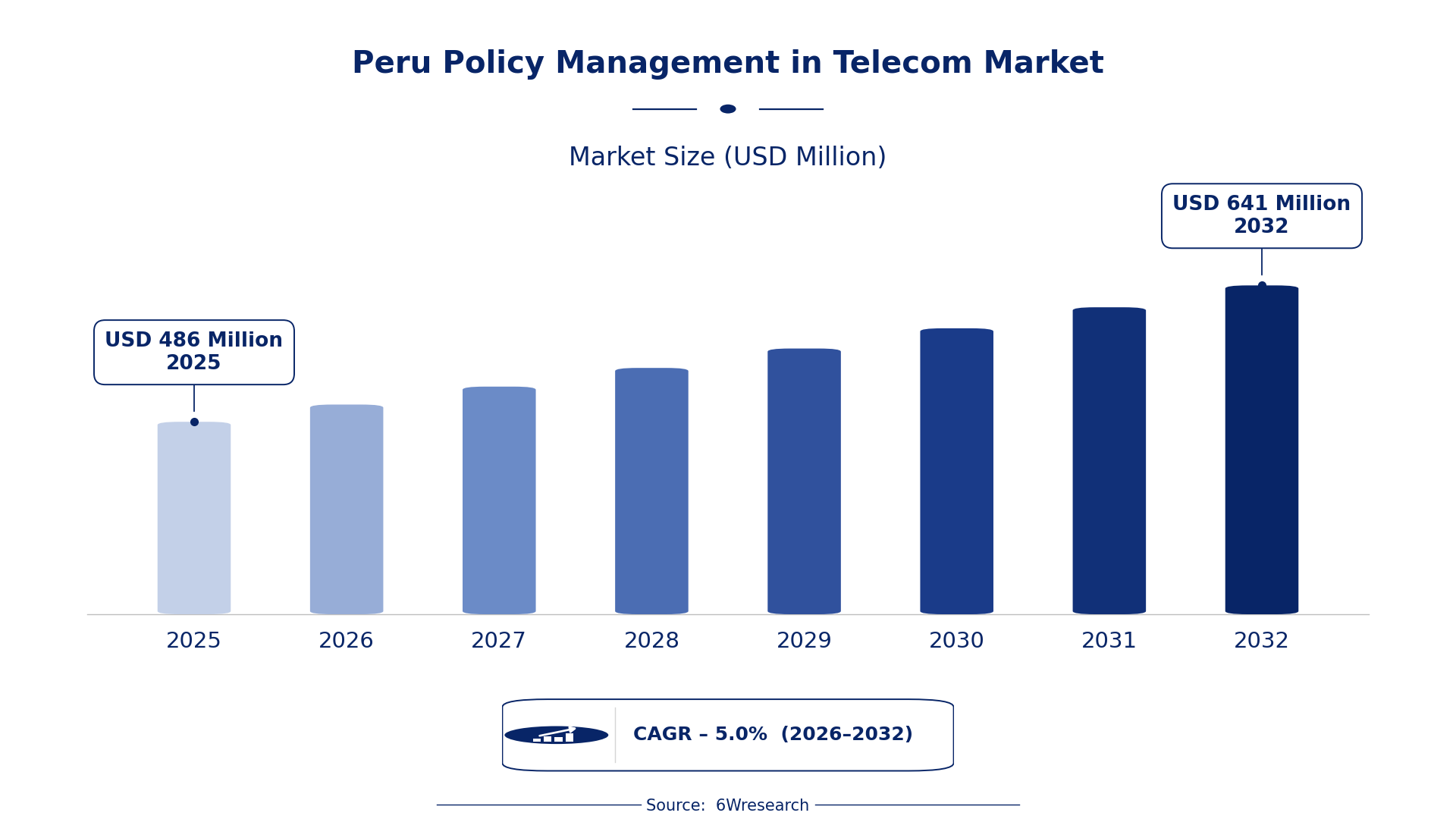
The Peru Policy Management in Telecom Market was estimated at USD 486 Million in 2025 and is projected to reach USD 641 Million by 2032, growing at a CAGR of 5.0% from 2026 to 2032.
Peru Policy Management in Telecom Market Synopsis
The Peruvian telecom sector is undergoing a transformation driven by regulatory frameworks that encourage competition and protect consumers. With an increasing number of operators entering the market, there is a pressing need for effective policy management to ensure compliance with spectrum allocation, licensing, and quality of service regulations.
As the country accelerates its digitization initiatives, the emphasis on expanding broadband services and enhancing cybersecurity measures is intensifying. The focus is shifting toward adopting emerging technologies, particularly 5G, which necessitates robust policy management to handle complex regulatory requirements.
Peru Policy Management in Telecom Market Year-wise Growth Rate and Key Drivers
This graph illustrates the annual growth rates of the Peru Policy Management in Telecom Market from 2021 to 2032, highlighting a steady upward trajectory and projected expansion over the forecast period.
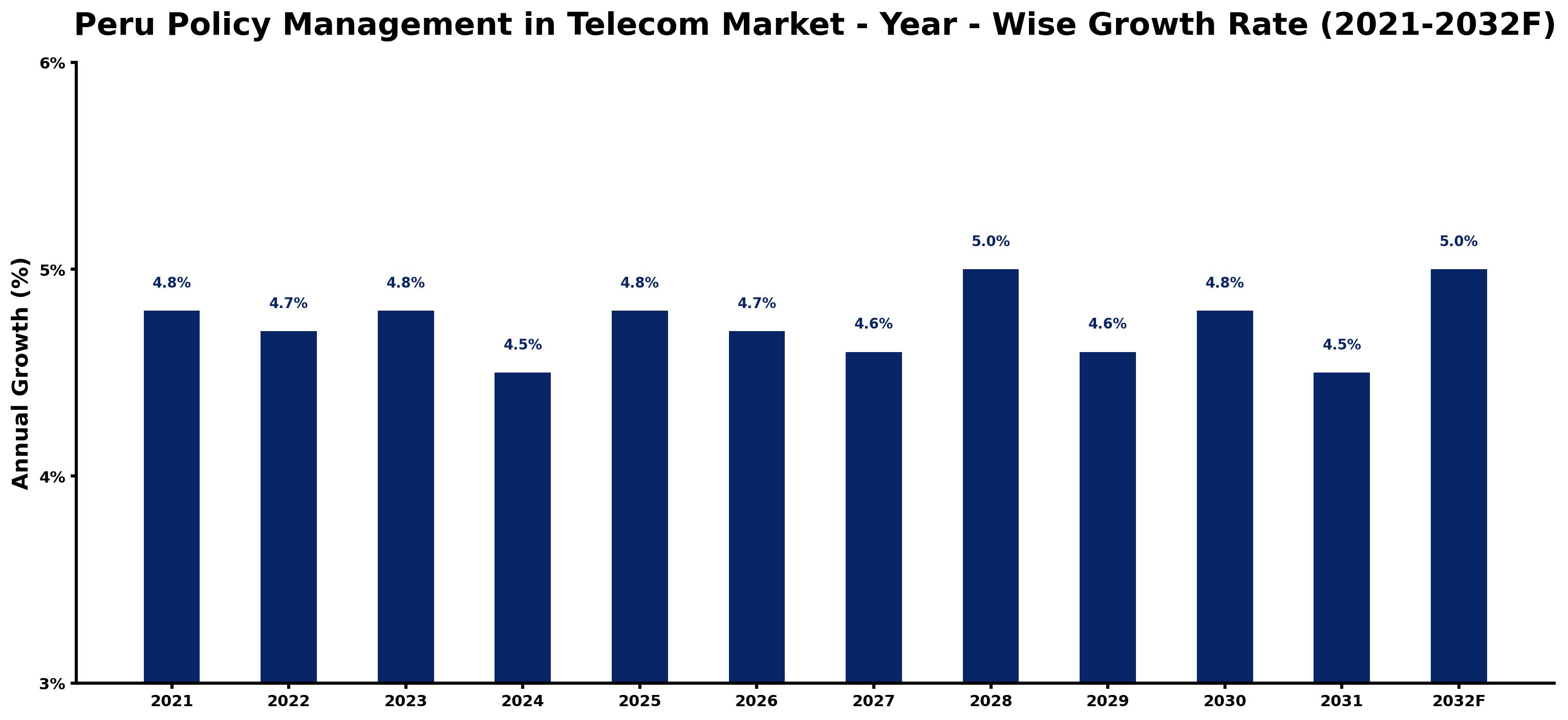
The table below presents the year‑wise growth rates along with the key drivers influencing the market
| Year | Growth Rate | Major Drivers |
| 2021 | 4.8% | Telecommunications Law 30220 promotes sector investment incentives. |
| 2022 | 4.7% | Increased demand for mobile data usage drives policy adjustments. |
| 2023 | 4.8% | Regulatory focus on expanding broadband access in rural areas. |
| 2024 | 4.5% | Government initiatives support regulatory improvements for telecom operators. |
| 2025 | 4.8% | Growing smartphone penetration boosts demand for digital services regulation. |
| 2026 | 4.7% | Regulatory reforms enhance competition among local telecom providers. |
| 2027 | 4.6% | Efforts to reduce mobile connectivity costs attract new users. |
| 2028 | 5.0% | Investments in 5G technology lead to updated telecom policies. |
| 2029 | 4.6% | Streamlined licensing processes encourage new telecom service entrants. |
| 2030 | 4.8% | Increased urbanization drives demand for enhanced telecom regulations. |
| 2031 | 4.5% | Focus on cybersecurity regulations bolsters consumer confidence in telecom. |
| 2032 | 5.0% | National plan aims for universal internet access by 2030. |
Note: Market size estimations and growth projections presented in this report are based on 6Wresearch's proprietary forecasting methodology, utilizing the latest available industry data, government publications, and primary research inputs.
Peru Policy Management in Telecom Market Key Takeaways
Below are some of the specific key takeaways from the market, including:
- The market is experiencing a shift towards enhanced regulatory compliance, driven by consumer protection and competition promotion.
- Investment opportunities are growing in policy management solutions as telecom operators seek to streamline operations.
- The regulatory landscape is complex, with frequent changes posing challenges for companies attempting to stay compliant.
- Infrastructure development remains critical, particularly in rural areas where access to services is limited.
- Government initiatives are increasingly focused on expanding broadband access and fostering innovation in the telecom sector.
Evaluation of Restraints in Peru Policy Management in Telecom Market
A tangled regulatory framework presents significant obstacles for telecom operators in Peru. With numerous regulations imposed by the government, telecom companies often find themselves grappling with compliance challenges. Frequent regulatory changes can introduce uncertainty, complicating strategic planning and operational execution. Furthermore, inadequate infrastructure development in remote areas continues to hinder service expansion, limiting the overall growth potential of the sector.
Peru Policy Management in Telecom Market Trends
The trend toward robust regulatory policies to enhance competition is becoming increasingly evident. The Peruvian government has introduced measures aimed at improving infrastructure and ensuring that underserved areas gain better access to telecom services. A growing emphasis on data privacy and security regulations also reflects the rising importance of consumer protection in the digital age. Telecom companies are responding by adopting advanced policy management systems to efficiently navigate these regulatory demands.
Peru Policy Management in Telecom Market Opportunities
The market presents a variety of investment opportunities, particularly in advanced telecommunications services and infrastructure development. Policy management software solutions designed to help companies comply with ever-changing regulations are in high demand. There are also significant prospects in collaborative projects aimed at extending network coverage and the implementation of next-generation technologies like 5G, which promise long-term returns for investors willing to engage with the local telecom landscape.
Government Initiatives in the Peru Policy Management in Telecom Market
The role of government policy in shaping the Peru Policy Management in Telecom Market cannot be overstated. Regulatory frameworks set by the Ministry of Transport and Communications (MTC) focus on enhancing competition while ensuring consumer protection. Such policies create a structured environment conducive to investment and innovation, critical for the sector's growth.
- A recently completed National Broadband Plan aims to improve internet access for underserved populations, enhancing equity in digital connectivity.
- A current initiative involves the Telecommunications Investment Promotion Plan, which incentivizes private sector investments in telecom infrastructure.
- A planned public-private partnership is set to expand infrastructure access by 2028, promoting a more extensive network coverage across rural regions.
- Ongoing regulations target fair competition, including the establishment of a Quality of Service Regulation to guarantee minimum service standards.
- The MTC is currently implementing a framework that mandates transparent billing practices to enhance consumer confidence in telecom services.
Future Insights of the Peru Policy Management in Telecom Market
Looking ahead to 2026-2032, the Peru Policy Management in Telecom Market is expected to witness steady growth fueled by increasing demand for advanced telecom services. As operators invest in policy management solutions, compliance with evolving regulations will become even more critical. The rollout of 5G and the integration of IoT technologies will further require sophisticated policy frameworks to manage network traffic and ensure robust security measures. This environment presents ample opportunities for solution providers aiming to support telecom operators in meeting their regulatory obligations while enhancing service delivery.
Peru Policy Management in Telecom Market Latest Developments
Over the past year, activity in the Peru Policy Management in Telecom Market has ramped up, highlighting the urgent need for regulatory compliance amid expanding service demands. Operators are increasingly investing in innovative solutions to enhance their policy management capabilities while addressing consumer protection regulations.
- A leading regional operator launched a new policy management software solution in early 2025, designed to streamline compliance processes and improve operational efficiency.
- An ongoing initiative aimed at enhancing broadband infrastructure began in mid-2025, targeting rural areas to provide better service access.
- A major technology vendor is expected to roll out an advanced security framework by late 2026, addressing the growing cybersecurity concerns in the telecom sector.
- A regulatory assessment program initiated in Q3 2025 is currently underway to evaluate the impact of recent telecom policies on market competition.
- A planned service upgrade, set for the second half of 2026, aims to enhance customer experience through improved quality of service delivery standards.
Peru Policy Management in Telecom Market - Key Attractiveness of the Report
- 10 Years of Market Numbers
- Historical Data Starting from 2022 to 2025
- Base Year: 2025
- Forecast Data until 2032
- Key Performance Indicators Impacting the Market
- Major Upcoming Developments and Projects
Key Highlights of the Report:
- Peru Policy Management in Telecom Market Outlook
- Market Size of Peru Policy Management in Telecom Market, 2025
- Forecast of Peru Policy Management in Telecom Market, 2032
- Historical Data and Forecast of Peru Policy Management in Telecom Revenues & Volume for the Period 2022-2032F
- Peru Policy Management in Telecom Market Trend Evolution
- Peru Policy Management in Telecom Market Drivers and Challenges
- Peru Policy Management in Telecom Price Trends
- Peru Policy Management in Telecom Porter's Five Forces
- Peru Policy Management in Telecom Industry Life Cycle
- Historical Data and Forecast of Peru Policy Management in Telecom Market Revenues & Volume By Network for the Period 2022-2032F
- Historical Data and Forecast of Peru Policy Management in Telecom Market Revenues & Volume By Fixed for the Period 2022-2032F
- Historical Data and Forecast of Peru Policy Management in Telecom Market Revenues & Volume By Wireless for the Period 2022-2032F
- Historical Data and Forecast of Peru Policy Management in Telecom Market Revenues & Volume By Component for the Period 2022-2032F
- Historical Data and Forecast of Peru Policy Management in Telecom Market Revenues & Volume By Solutions for the Period 2022-2032F
- Historical Data and Forecast of Peru Policy Management in Telecom Market Revenues & Volume By Services for the Period 2022-2032F
- Historical Data and Forecast of Peru Policy Management in Telecom Market Revenues & Volume By Deployment for the Period 2022-2032F
- Historical Data and Forecast of Peru Policy Management in Telecom Market Revenues & Volume By Cloud for the Period 2022-2032F
- Historical Data and Forecast of Peru Policy Management in Telecom Market Revenues & Volume By On-Premises for the Period 2022-2032F
- Peru Policy Management in Telecom Import Export Trade Statistics
- Market Opportunity Assessment By Network
- Market Opportunity Assessment By Component
- Market Opportunity Assessment By Deployment
- Peru Policy Management in Telecom Top Companies Market Share
- Peru Policy Management in Telecom Competitive Benchmarking By Technical and Operational Parameters
- Peru Policy Management in Telecom Company Profiles
- Peru Policy Management in Telecom Key Strategic Recommendations






































