Brazil Policy Management in Telecom Market Size & Growth Rate (2026-2032)
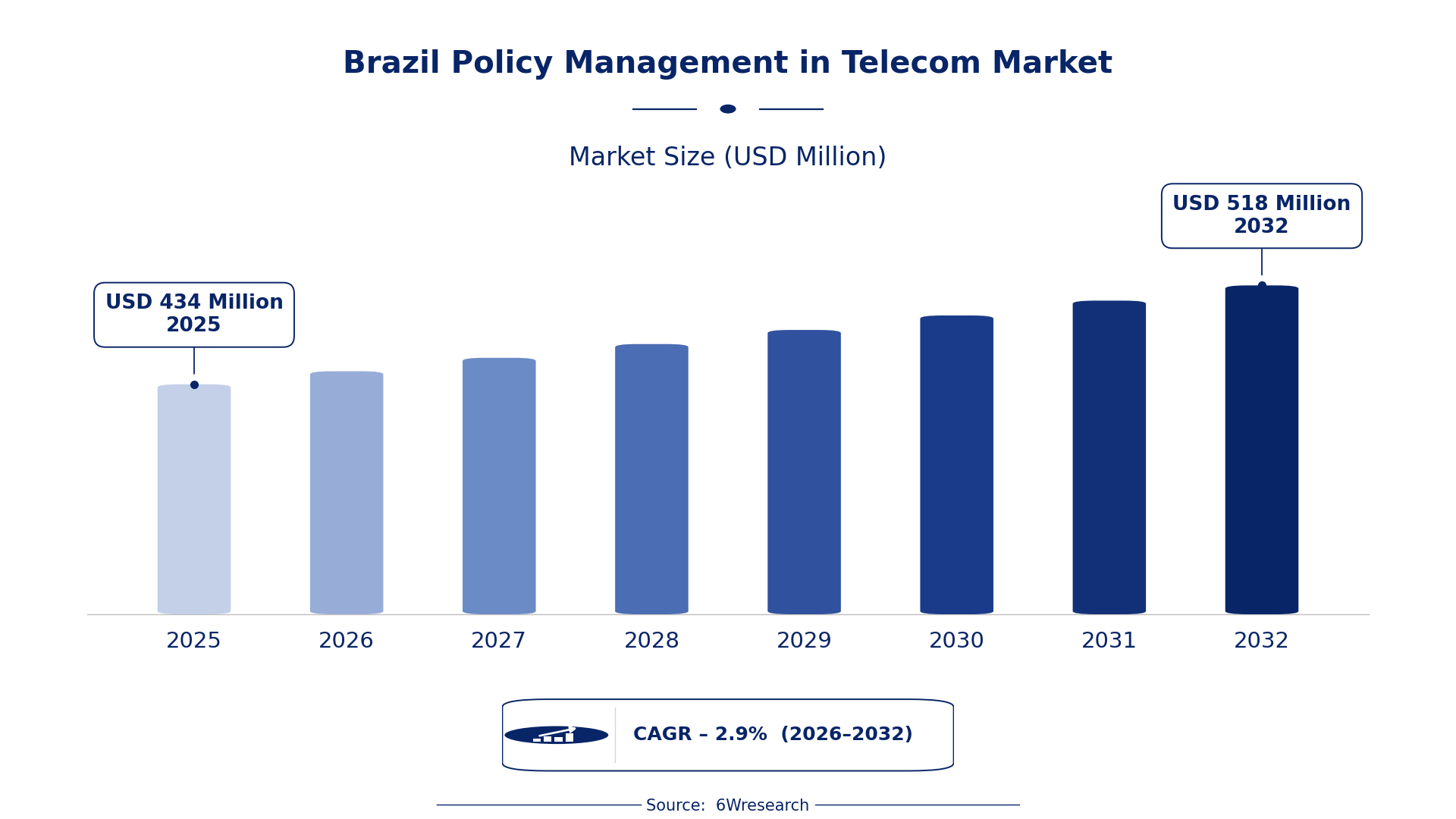
The Brazil Policy Management in Telecom Market was estimated at USD 434 Million in 2025 and is projected to reach USD 518 Million by 2032, growing at a CAGR of 2.9% from 2026 to 2032.
Brazil Policy Management in Telecom Market Synopsis
As telecom operators in Brazil grapple with increasing demands for service personalization and network efficiency, the need for adept policy management systems has never been more critical. The complexity of contemporary telecom networks mandates robust solutions that can handle dynamic policy enforcement and network optimization.
Investment in policy management technologies is surging as operators aim to enhance customer experiences while complying with stringent regulatory requirements. These developments are not only reshaping operational models but also setting the stage for future innovations in telecom management.
Brazil Policy Management in Telecom Market Year-wise Growth Rate and Key Drivers
This graph illustrates the annual growth rates of the Brazil Policy Management in Telecom Market from 2021 to 2032, highlighting a steady upward trajectory and projected expansion over the forecast period.
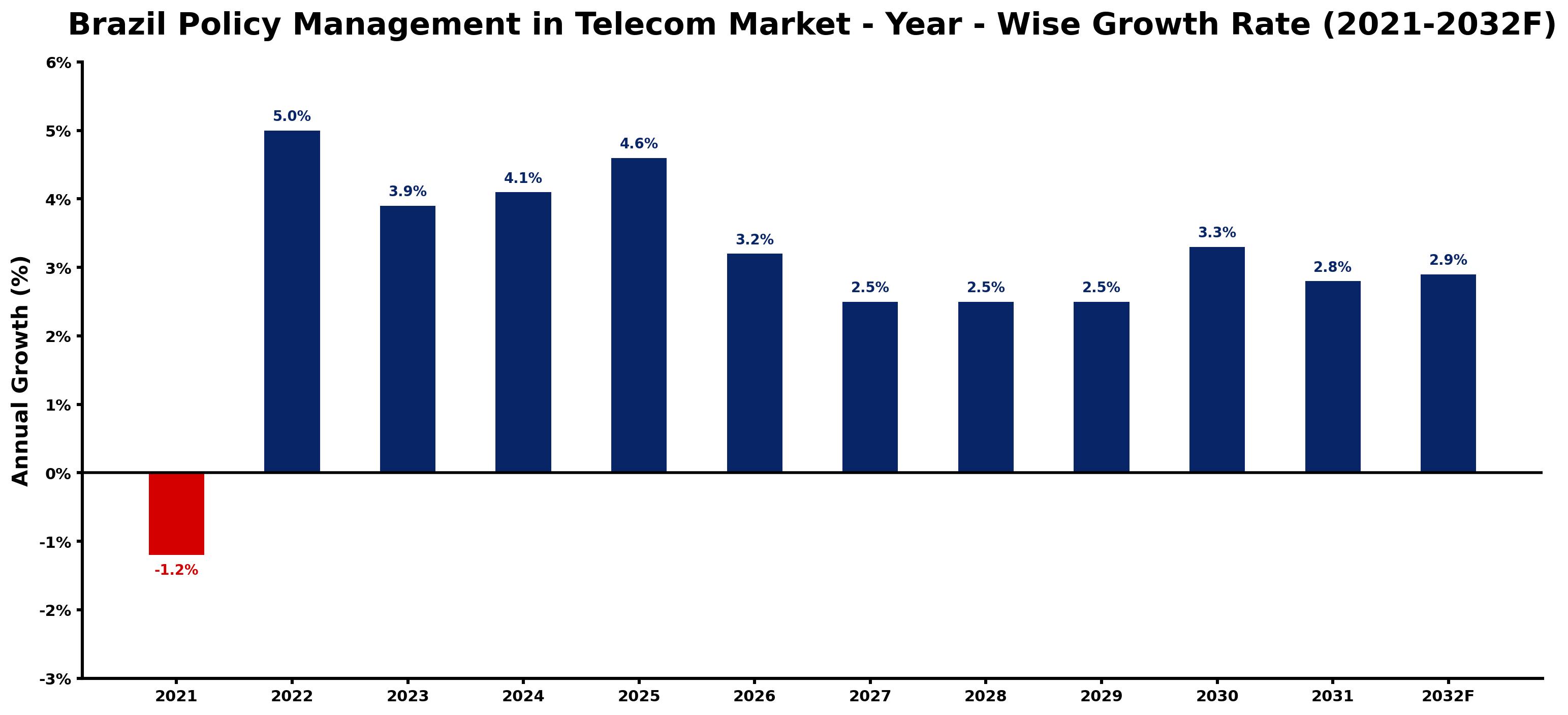
The table below presents the year‑wise growth rates along with the key drivers influencing the market
| Year | Growth Rate | Major Drivers |
| 2021 | -1.2% | Anatel's new regulations slowed investment in telecom infrastructure. |
| 2022 | 5.0% | Implementation of Anatel's regulatory framework for telecom pricing. |
| 2023 | 3.9% | Government subsidies promoting rural telecom service expansion. |
| 2024 | 4.1% | Increased investment in 5G network rollout initiatives. |
| 2025 | 4.6% | Adoption of new telecom policies for consumer protection. |
| 2026 | 3.2% | Growth in IoT services driving telecom policy adaptations. |
| 2027 | 2.5% | Rise in digital content consumption influencing policy reforms. |
| 2028 | 2.5% | Enhanced spectrum allocation by Anatel boosting competition. |
| 2029 | 2.5% | Government initiatives to improve mobile coverage accessibility. |
| 2030 | 3.3% | Focus on cybersecurity regulations enhancing telecom customer trust. |
| 2031 | 2.8% | Regulatory support for innovation in telecom service offerings. |
| 2032 | 2.9% | Increased demand for transparent telecom service agreements. |
Note: Market size estimations and growth projections presented in this report are based on 6Wresearch's proprietary forecasting methodology, utilizing the latest available industry data, government publications, and primary research inputs.
Brazil Policy Management in Telecom Market Key Takeaways
Below are some of the specific key takeaways from the market, including:
- The market is set for gradual growth, driven by the need for effective network policy management.
- Regulatory compliance continues to challenge telecom operators, necessitating innovative policy solutions.
- Advanced technologies such as 5G are influencing the demand for real-time policy adjustments.
- Customer experience enhancements are a primary motivator for investment in policy management systems.
- Cybersecurity concerns remain a significant factor affecting policy management approaches.
Evaluation of Restraints in Brazil Policy Management in Telecom Market
The Brazil Policy Management in Telecom market faces notable restraints that could impede its growth trajectory. Primary among these is the complexity of regulatory compliance; operators must continually adapt to evolving laws, which can be a resource-intensive process. Furthermore, concerns surrounding data security add another layer of complexity, as telecom companies work to protect sensitive customer information while implementing new policies. The rapid pace of technological advancement can also be daunting, with operators needing to balance ongoing investments in new systems against the potential obsolescence of current solutions.
Brazil Policy Management in Telecom Market Trends
Several trends are currently shaping the Brazil Policy Management in Telecom market. An increasing focus on customer-centric services is compelling operators to adopt solutions that offer granular control over network policies. The push for 5G technology not only emphasizes speed and capacity but also the management of diverse services over a unified network architecture. Additionally, the integration of AI and machine learning into policy management solutions is gaining traction, enhancing the ability to automate policy enforcement and response.
Brazil Policy Management in Telecom Market Opportunities
Genuine growth opportunities within the Brazil Policy Management in Telecom market are emerging. The ongoing rollout of 5G presents an avenue for telecom operators to refine their policy management strategies, optimizing bandwidth allocation and ensuring quality of service for diverse applications. Additionally, as businesses increasingly rely on telecom services for digital transformation, there is a growing demand for tailored policy management solutions that can address specific enterprise needs, opening a new revenue stream for providers.
Government Initiatives in the Brazil Policy Management in Telecom Market
Government policies are fundamentally reshaping the Brazil Policy Management in Telecom market by addressing critical issues like data privacy and net neutrality. Regulatory bodies are intensifying their focus on establishing frameworks that promote transparency and competition, which in turn influences the operational strategies of telecom providers. Operators must stay aligned with these initiatives to remain compliant while fostering innovation.
- A regulatory framework introduced in 2025 mandates increased billing transparency across telecom operators.
- Current efforts include a nationwide digital infrastructure upgrade program, enhancing connectivity in underserved regions.
- Planned initiatives aim to streamline spectrum allocation processes, expected to be finalized by 2028.
- Government programs promoting public-private partnerships in telecom infrastructure are gaining traction, with several projects in the planning stage.
- Recently completed initiatives have focused on enhancing consumer protection laws related to telecom services, encouraging compliance.
Future Insights of the Brazil Policy Management in Telecom Market
Looking towards 2026-2032, the Brazil Policy Management in Telecom market is likely to evolve significantly. As the demand for real-time data processing grows, operators will need to invest in more sophisticated policy management solutions that can handle the intricacies of modern networks. Innovations driven by AI and machine learning will redefine operational efficiency, allowing for quicker policy adjustments in response to network demands. The interplay between government regulations and market requirements will also shape future investments, ensuring that policy management remains a central focus for telecom operators.
Brazil Policy Management in Telecom Market Latest Developments
In the past year, the Brazil Policy Management in Telecom market has witnessed several noteworthy developments that signal a strategic shift within the industry. Operators are increasingly recognizing the need for enhanced policy management systems to cope with growing regulatory pressures and customer expectations. These developments are indicative of a market that is maturing and adapting to new technological realities.
- A major technology vendor announced an ongoing collaboration with regional operators to develop AI-driven policy management tools, with the pilot project expected to complete by late 2026.
- In early 2025, a leading regional operator launched an upgraded policy management system designed to improve customer service response times and regulatory compliance.
- Plans for a public-private initiative aimed at expanding telecom infrastructure to rural areas were unveiled, with implementation set to begin in mid-2026.
- An initiative focusing on integrating real-time data analytics into policy management systems is currently underway, anticipated to enhance operational efficiency.
- In Q3 2025, a new framework for automated policy enforcement was rolled out, enhancing compliance across the industry.
Brazil Policy Management in Telecom Market - Key Attractiveness of the Report
- 10 Years of Market Numbers
- Historical Data Starting from 2022 to 2025
- Base Year: 2025
- Forecast Data until 2032
- Key Performance Indicators Impacting the Market
- Major Upcoming Developments and Projects
Key Highlights of the Report:
- Brazil Policy Management in Telecom Market Outlook
- Market Size of Brazil Policy Management in Telecom Market, 2025
- Forecast of Brazil Policy Management in Telecom Market, 2032
- Historical Data and Forecast of Brazil Policy Management in Telecom Revenues & Volume for the Period 2022-2032F
- Brazil Policy Management in Telecom Market Trend Evolution
- Brazil Policy Management in Telecom Market Drivers and Challenges
- Brazil Policy Management in Telecom Price Trends
- Brazil Policy Management in Telecom Porter's Five Forces
- Brazil Policy Management in Telecom Industry Life Cycle
- Historical Data and Forecast of Brazil Policy Management in Telecom Market Revenues & Volume By Network for the Period 2022-2032F
- Historical Data and Forecast of Brazil Policy Management in Telecom Market Revenues & Volume By Fixed for the Period 2022-2032F
- Historical Data and Forecast of Brazil Policy Management in Telecom Market Revenues & Volume By Wireless for the Period 2022-2032F
- Historical Data and Forecast of Brazil Policy Management in Telecom Market Revenues & Volume By Component for the Period 2022-2032F
- Historical Data and Forecast of Brazil Policy Management in Telecom Market Revenues & Volume By Solutions for the Period 2022-2032F
- Historical Data and Forecast of Brazil Policy Management in Telecom Market Revenues & Volume By Services for the Period 2022-2032F
- Historical Data and Forecast of Brazil Policy Management in Telecom Market Revenues & Volume By Deployment for the Period 2022-2032F
- Historical Data and Forecast of Brazil Policy Management in Telecom Market Revenues & Volume By Cloud for the Period 2022-2032F
- Historical Data and Forecast of Brazil Policy Management in Telecom Market Revenues & Volume By On-Premises for the Period 2022-2032F
- Brazil Policy Management in Telecom Import Export Trade Statistics
- Market Opportunity Assessment By Network
- Market Opportunity Assessment By Component
- Market Opportunity Assessment By Deployment
- Brazil Policy Management in Telecom Top Companies Market Share
- Brazil Policy Management in Telecom Competitive Benchmarking By Technical and Operational Parameters
- Brazil Policy Management in Telecom Company Profiles
- Brazil Policy Management in Telecom Key Strategic Recommendations






































