Venezuela Policy Management in Telecom Market Size & Growth Rate (2026-2032)
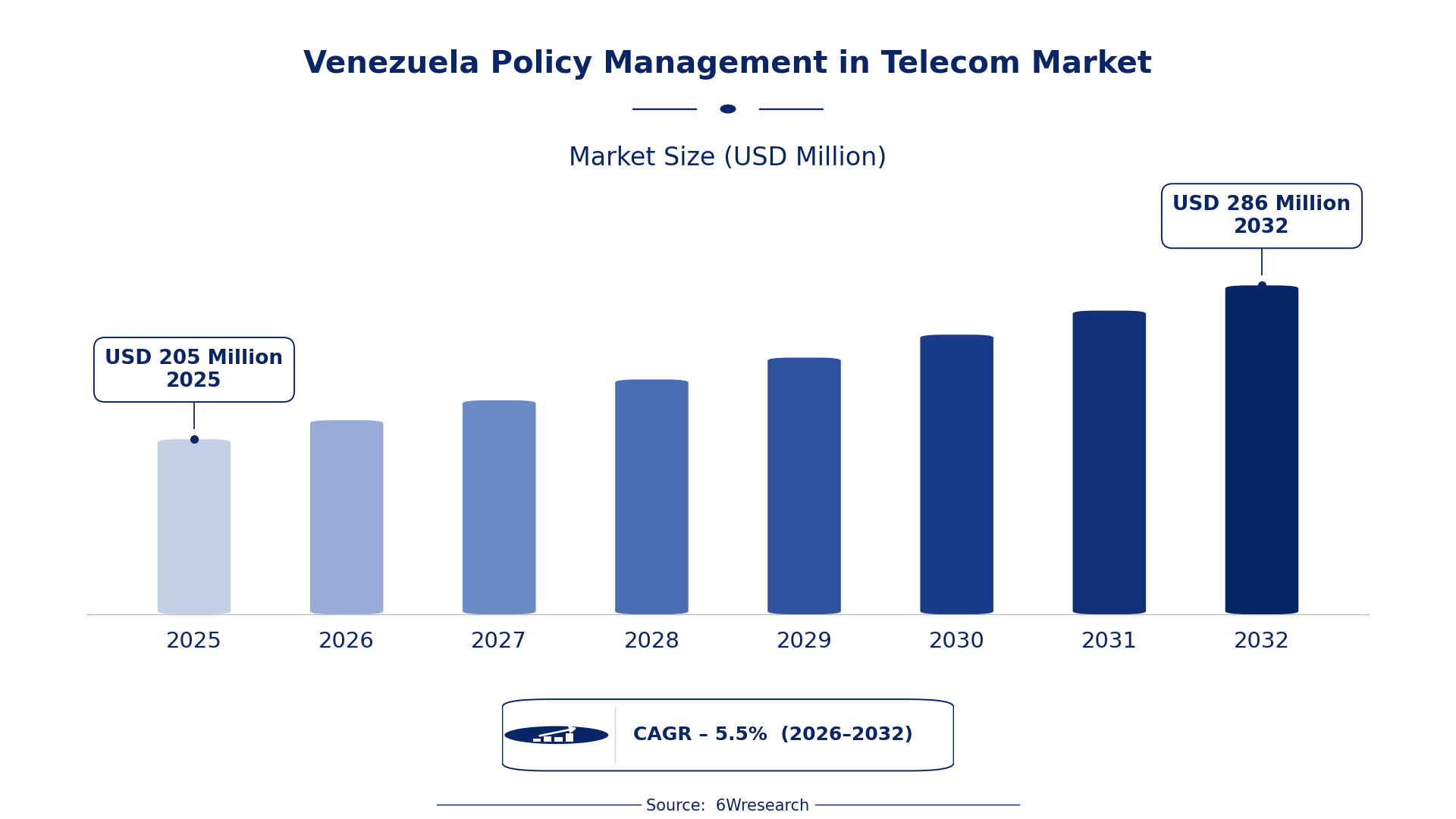
The Venezuela Policy Management in Telecom Market was estimated at USD 205 Million in 2025 and is projected to reach USD 286 Million by 2032, growing at a CAGR of 5.5% from 2026 to 2032.
Venezuela Policy Management in Telecom Market Synopsis
The demand for improved telecommunications in Venezuela is urgent, fueled by a populace eager for enhanced digital connectivity. Yet, the path to modernization is obstructed by an ever-changing regulatory landscape that requires both agility and foresight from companies operating within the sector.
Economic instability further complicates policy management, making it critical for telecom firms to stay informed and adaptive. As government intervention remains prevalent, companies must negotiate a myriad of regulations to remain compliant while striving to meet growing consumer expectations.
Venezuela Policy Management in Telecom Market Year-wise Growth Rate and Key Drivers
This graph illustrates the annual growth rates of the Venezuela Policy Management in Telecom Market from 2021 to 2032, highlighting a steady upward trajectory and projected expansion over the forecast period.
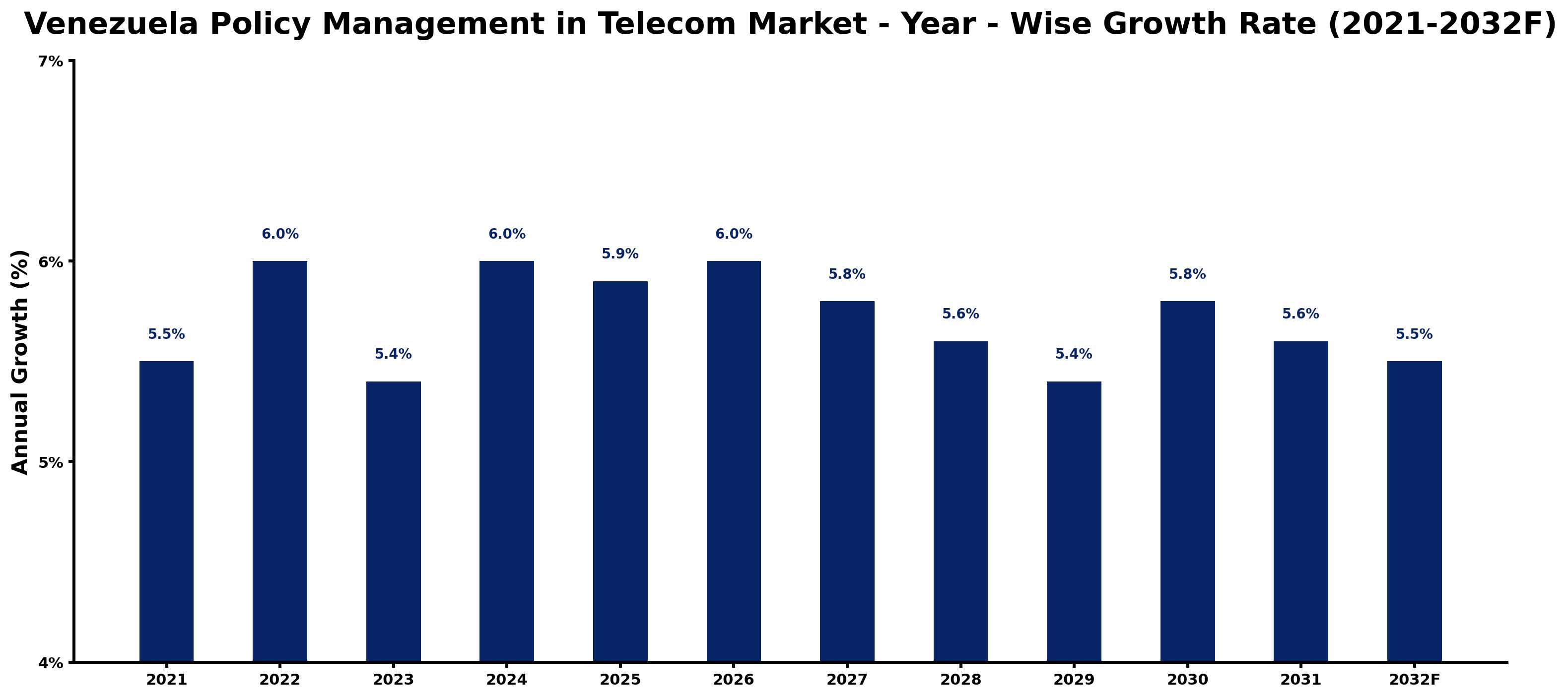
The table below presents the year‑wise growth rates along with the key drivers influencing the market
| Year | Growth Rate | Major Drivers |
| 2021 | 5.5% | Implementation of government telecom regulatory framework reforms. |
| 2022 | 6.0% | Increased mobile network expansions by state-owned CANTV. |
| 2023 | 5.4% | Rising smartphone adoption rates among Venezuelan consumers. |
| 2024 | 6.0% | Government initiatives to enhance rural telecommunications access. |
| 2025 | 5.9% | Improved cybersecurity regulations boosting consumer confidence. |
| 2026 | 6.0% | Collaborations with international firms for telecom infrastructure upgrades. |
| 2027 | 5.8% | Launch of new telecom policy promoting competition among providers. |
| 2028 | 5.6% | Increased foreign investment in Venezuelan telecom projects. |
| 2029 | 5.4% | Growing digital service demands shifting consumer preferences. |
| 2030 | 5.8% | Focus on expanding broadband internet access nationwide. |
| 2031 | 5.6% | Regulatory incentives encouraging telecom innovation and startups. |
| 2032 | 5.5% | Government support for 5G deployment across major cities. |
Note: Market size estimations and growth projections presented in this report are based on 6Wresearch's proprietary forecasting methodology, utilizing the latest available industry data, government publications, and primary research inputs.
Venezuela Policy Management in Telecom Market Key Takeaways
Below are some of the specific key takeaways from the market, including:
- Government policies significantly shape the competitive landscape, with frequent adjustments creating uncertainty.
- Investment in regulatory compliance technologies is gaining traction among telecom companies.
- Trends indicate a shift towards prioritizing data privacy and security in response to consumer demands.
- Long-term growth is hampered by inadequate infrastructure and foreign investment restrictions.
- Opportunities exist for companies that can innovate within the constraints of current policies.
Evaluation of Restraints in Venezuela Policy Management in Telecom Market
Several factors limit the growth of the Venezuela Policy Management in Telecom Market. Key among them is the government's heavy-handed intervention, which includes stringent price controls and stringent licensing requirements. This creates an unpredictable environment that discourages foreign investment. Additionally, a lack of a consistent regulatory framework means companies often face an uphill battle in compliance. Outdated infrastructure further exacerbates these challenges, making it difficult for telecom operators to deliver quality services.
Venezuela Policy Management in Telecom Market Trends
Current trends show that telecom policy management in Venezuela is increasingly focused on transparency and accountability. Companies are prioritizing compliance to new regulations concerning data privacy, reflecting a growing concern over consumer protection. As the demand for digital services rises, policymakers are under pressure to create frameworks that not only enable competition but also foster innovation. This environment is conducive to companies that can integrate advanced technology while adhering to evolving regulations.
Venezuela Policy Management in Telecom Market Opportunities
Despite the challenges, opportunities abound for companies willing to invest in tailored solutions that meet the unique needs of the Venezuelan market. Developing advanced policy management systems that streamline compliance processes will offer a competitive edge. Collaborations with local telecom operators can facilitate shared resources and knowledge, optimizing infrastructure deployment. There's also a burgeoning market for technologies focused on data security and regulatory compliance, which can yield significant returns in the long term.
Government Initiatives in the Venezuela Policy Management in Telecom Market
The Venezuelan government has a considerable influence over the telecom sector, implementing policies aimed at expanding access and improving service quality. Recent shifts in public policy are focused on infrastructure enhancement and consumer protection, essential for fostering a healthier market environment. Companies must understand these dynamics to position themselves advantageously within this framework.
- A national digital infrastructure upgrade programme recently completed in 2025 aimed to enhance connectivity across urban and rural areas.
- Current efforts are underway to establish a regulatory framework mandating greater transparency in service billing practices.
- Upcoming initiatives include a planned public-private partnership expected to bolster telecom services and improve competition by 2027.
- Recently launched data privacy regulations require telecom operators to adopt stricter data management practices to safeguard consumer information.
- Ongoing reviews of spectrum allocation policies aim to optimize frequency use and stimulate market entry for new players.
Future Insights of the Venezuela Policy Management in Telecom Market
Looking ahead to 2026-2032, the Venezuela Policy Management in Telecom Market will likely navigate turbulent waters. Economic uncertainties will continue to challenge investment levels, particularly in infrastructure. However, increased demand for digital services presents a silver lining. Firms adept at adjusting to regulatory changes will find pathways to growth. Innovation, especially in compliance technology, will be critical for sustainable success in this volatile environment.
Venezuela Policy Management in Telecom Market Latest Developments
In the past year, the Venezuela Policy Management in Telecom Market has seen a flurry of activity aimed at addressing regulatory and infrastructural challenges. Companies are actively exploring new technologies and strategies to enhance service delivery amidst a complex policy landscape.
- An initiative launched in early 2025 focused on integrating artificial intelligence into regulatory compliance systems, streamlining operations for telecom providers.
- In mid-2025, a major technology vendor initiated an infrastructure upgrade to improve network reliability, with plans to complete the rollout by late 2026.
- A public campaign to educate consumers on their rights under new data privacy laws is currently underway, aimed at increasing consumer trust.
- Upcoming in Q4 2026, a major regulatory review is expected to address licensing and investment restrictions that have hindered sector growth.
- A partnership between local telecom operators initiated in early 2025 aims to enhance collaboration on infrastructure projects and share best practices.
Venezuela Policy Management in Telecom Market - Key Attractiveness of the Report
- 10 Years of Market Numbers
- Historical Data Starting from 2022 to 2025
- Base Year: 2025
- Forecast Data until 2032
- Key Performance Indicators Impacting the Market
- Major Upcoming Developments and Projects
Where are the opportunities for investment in Venezuela’s telecom market?
Key Highlights of the Report:
- Venezuela Policy Management in Telecom Market Outlook
- Market Size of Venezuela Policy Management in Telecom Market, 2025
- Forecast of Venezuela Policy Management in Telecom Market, 2032
- Historical Data and Forecast of Venezuela Policy Management in Telecom Revenues & Volume for the Period 2022-2032F
- Venezuela Policy Management in Telecom Market Trend Evolution
- Venezuela Policy Management in Telecom Market Drivers and Challenges
- Venezuela Policy Management in Telecom Price Trends
- Venezuela Policy Management in Telecom Porter's Five Forces
- Venezuela Policy Management in Telecom Industry Life Cycle
- Historical Data and Forecast of Venezuela Policy Management in Telecom Market Revenues & Volume By Network for the Period 2022-2032F
- Historical Data and Forecast of Venezuela Policy Management in Telecom Market Revenues & Volume By Fixed for the Period 2022-2032F
- Historical Data and Forecast of Venezuela Policy Management in Telecom Market Revenues & Volume By Wireless for the Period 2022-2032F
- Historical Data and Forecast of Venezuela Policy Management in Telecom Market Revenues & Volume By Component for the Period 2022-2032F
- Historical Data and Forecast of Venezuela Policy Management in Telecom Market Revenues & Volume By Solutions for the Period 2022-2032F
- Historical Data and Forecast of Venezuela Policy Management in Telecom Market Revenues & Volume By Services for the Period 2022-2032F
- Historical Data and Forecast of Venezuela Policy Management in Telecom Market Revenues & Volume By Deployment for the Period 2022-2032F
- Historical Data and Forecast of Venezuela Policy Management in Telecom Market Revenues & Volume By Cloud for the Period 2022-2032F
- Historical Data and Forecast of Venezuela Policy Management in Telecom Market Revenues & Volume By On-Premises for the Period 2022-2032F
- Venezuela Policy Management in Telecom Import Export Trade Statistics
- Market Opportunity Assessment By Network
- Market Opportunity Assessment By Component
- Market Opportunity Assessment By Deployment
- Venezuela Policy Management in Telecom Top Companies Market Share
- Venezuela Policy Management in Telecom Competitive Benchmarking By Technical and Operational Parameters
- Venezuela Policy Management in Telecom Company Profiles
- Venezuela Policy Management in Telecom Key Strategic Recommendations






































