Russia Simulation Software Market Size & Growth Rate (2026-2032)
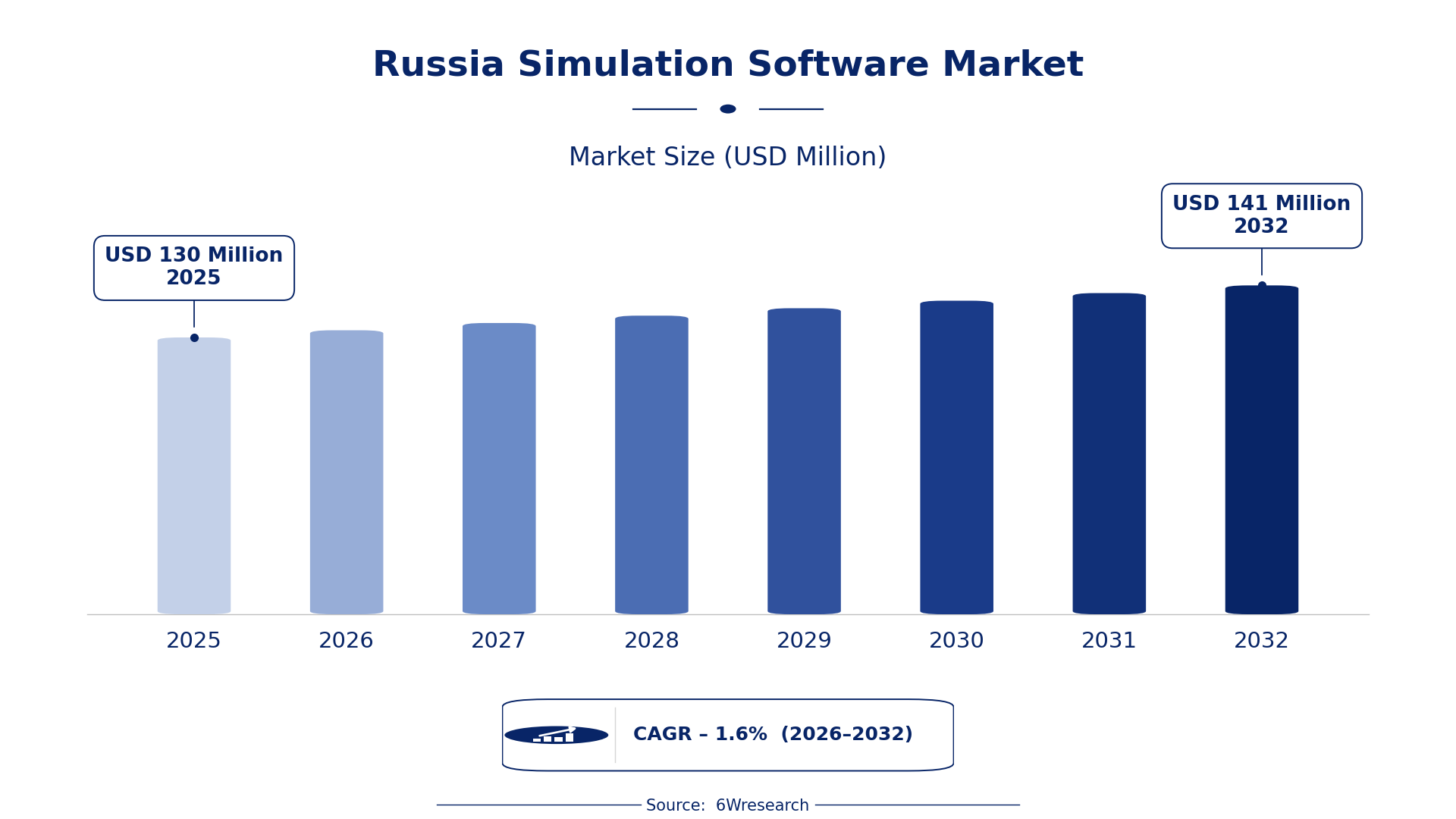
The Russia Simulation Software Market was estimated at USD 130 Million in 2025 and is projected to reach USD 141 Million by 2032, growing at a CAGR of 1.6% from 2026 to 2032.
Russia Simulation Software Market Synopsis
The Russia Simulation Software Market is witnessing steady growth, fueled by escalating demand across various sectors including defense, aerospace, automotive, and healthcare. Companies are increasingly recognizing the necessity for advanced simulation tools to enhance product development and training processes, leading to a surge in market activity.
With a diverse range of offerings such as finite element analysis and computational fluid dynamics, the market is being reshaped by innovations like digital twin technology and the integration of artificial intelligence. These trends not only improve operational efficiency but also drive down costs, positioning simulation software as a critical asset for many organizations.
Russia Simulation Software Market Year-wise Growth Rate and Key Drivers
This graph illustrates the annual growth rates of the Russia Simulation Software Market from 2021 to 2032, highlighting a steady upward trajectory and projected expansion over the forecast period.
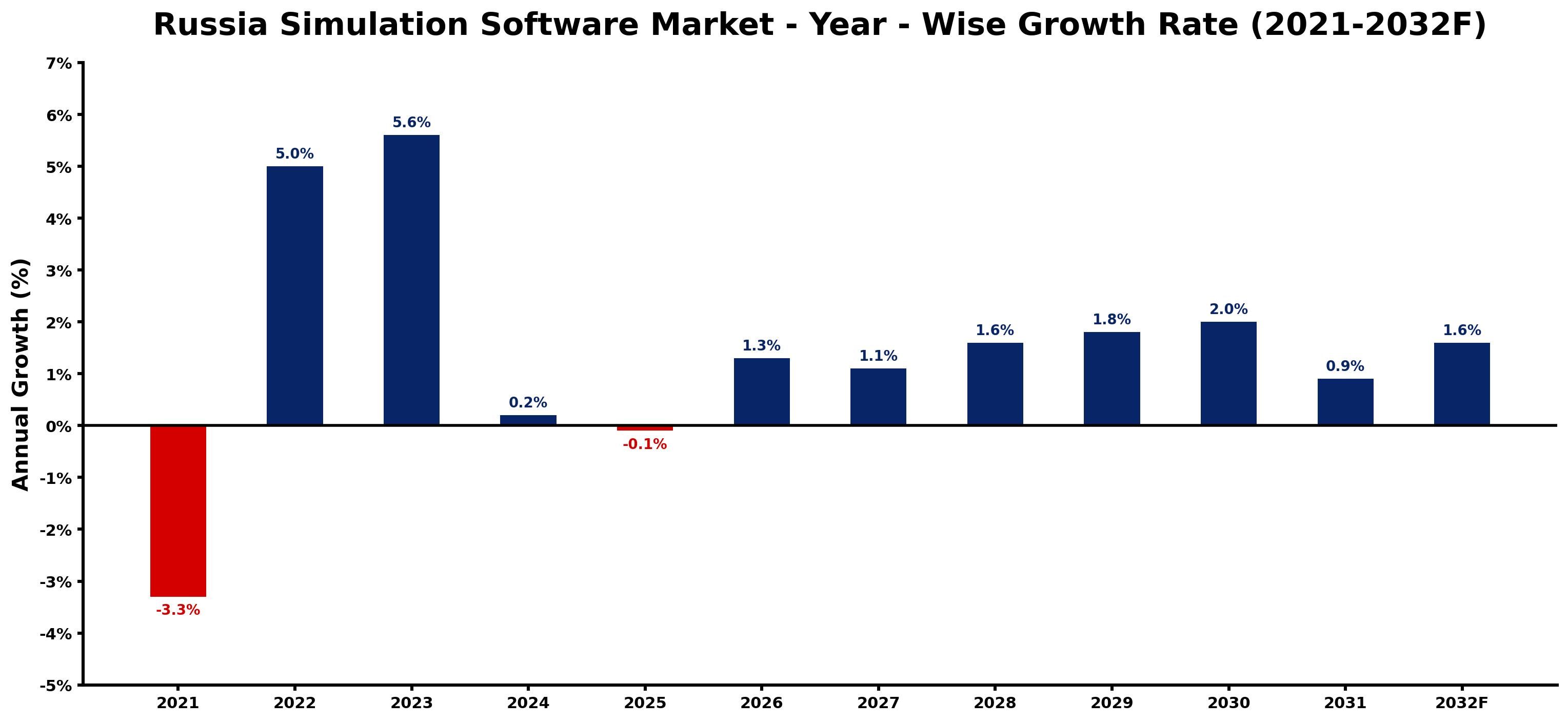
The table below presents the year‑wise growth rates along with the key drivers influencing the market
| Year | Growth Rate | Major Drivers |
| 2021 | -3.3% | Sanctions hinder access to essential software technology. |
| 2022 | 5.0% | Increased military spending drives defense simulation software demand. |
| 2023 | 5.6% | Growing interest in virtual training programs for workforce development. |
| 2024 | 0.2% | Government support for innovation boosts technological simulation advancements. |
| 2025 | -0.1% | Declining investment from Russian defense contractors affects growth. |
| 2026 | 1.3% | Emergence of localized software solutions for diverse industries. |
| 2027 | 1.1% | Increased integration of AI in simulation processes. |
| 2028 | 1.6% | Rise in academic partnerships promoting simulation research initiatives. |
| 2029 | 1.8% | Demand for realistic modeling in aerospace sector grows. |
| 2030 | 2.0% | Expanding applications of simulations in healthcare training. |
| 2031 | 0.9% | Increased focus on cyber-physical systems in engineering. |
| 2032 | 1.6% | Regulatory changes incentivizing digital simulations in various sectors. |
Note: Market size estimations and growth projections presented in this report are based on 6Wresearch's proprietary forecasting methodology, utilizing the latest available industry data, government publications, and primary research inputs.
Russia Simulation Software Market Key Takeaways
Below are some of the specific key takeaways from the market, including:
- Growth is fueled by increased adoption of digital technologies across key industries.
- Government initiatives are actively promoting digital transformation and innovation in simulation software.
- Advanced technologies like AI and machine learning are becoming integral to simulation solutions.
- Cloud-based solutions are gaining traction for their flexibility and scalability.
- Challenges such as regulatory hurdles and market entry barriers are impacting foreign companies.
Evaluation of Restraints in Russia Simulation Software Market
Despite its potential, the Russia Simulation Software Market faces several restraints that hinder its growth. Strict government regulations regarding data security and privacy create significant compliance challenges. on top of that, limited access to advanced technology due to sanctions and trade restrictions complicates the landscape for international players. A general lack of awareness and acceptance of simulation software among traditional industries further constrains adoption. Companies must work diligently to establish local partnerships and tailor their offerings to align with domestic practices.
Russia Simulation Software Market Trends
The market is currently shaped by several key trends. The adoption of advanced simulation tools continues to rise, particularly in sectors like aerospace and defense, where precision and reliability are paramount. There's also a noticeable shift toward virtual reality and augmented reality applications, enhancing user engagement and training effectiveness. on top of that, the incorporation of AI and machine learning into simulation software is becoming a game-changer, providing deeper insights and facilitating predictive analytics.
Russia Simulation Software Market Opportunities
Investment opportunities abound in the Russia Simulation Software Market, especially as industries prioritize operational efficiency and cost reduction. Key growth sectors include manufacturing, healthcare, and automotive, all of which are increasingly reliant on simulation software for enhanced decision-making. Investors should focus on companies that offer tailored solutions and consulting services to cater to the unique needs of Russian businesses, especially those aligned with government modernization initiatives.
Government Initiatives in the Russia Simulation Software Market
The Russian government is taking proactive steps to foster growth in the simulation software sector. Public policy is increasingly focused on promoting innovation and facilitating partnerships between academia and industry. This regulatory support is crucial as it not only stimulates market development but also ensures that local companies remain competitive on a global scale.
- A recently completed initiative involved the allocation of grants for R&D projects aimed at enhancing simulation capabilities in critical sectors.
- Ongoing efforts include a national digital transformation program that encourages the integration of simulation software in healthcare and defense.
- Planned initiatives are expected to introduce new regulations that promote fair competition and protect intellectual property rights in the software industry.
- The government is also facilitating public-private partnerships to drive innovation in simulation technologies.
Future Insights of the Russia Simulation Software Market
Looking ahead to 2026-2032, the Russia Simulation Software Market is expected to witness substantial growth. The integration of advanced technologies such as AI and virtual reality will continue to enhance the capabilities of simulation tools, making them indispensable for various industries. As businesses strive for operational excellence, the demand for simulation software will rise, driven by the need for cost-effective and efficient solutions. Investments in R&D will likely lead to innovative product offerings, further fueling market expansion.
Russia Simulation Software Market Latest Developments
Recent activity in the Russia Simulation Software Market reflects a dynamic environment, with companies actively adapting to evolving needs. Over the past 12-14 months, there has been a notable increase in partnerships aimed at enhancing simulation capabilities, particularly in sectors like aerospace and healthcare.
- A major technology vendor launched an advanced simulation platform designed for the automotive sector in Q2 2025, enhancing design efficiency.
- In mid-2025, a leading regional operator began an initiative to integrate AI tools into existing simulation software, aiming to improve predictive analytics.
- A partnership established in early 2025 between a local university and an industry player focuses on developing new simulation training programs for healthcare professionals.
- An upcoming regulatory framework expected by late 2026 aims to standardize simulation software usage in government projects.
Russia Simulation Software Market - Key Attractiveness of the Report
- 10 Years of Market Numbers
- Historical Data Starting from 2022 to 2025
- Base Year: 2025
- Forecast Data until 2032
- Key Performance Indicators Impacting the Market
- Major Upcoming Developments and Projects
The Russian government is actively promoting digital transformation through various initiatives, including grants for R&D, encouraging public-private partnerships, and implementing regulations to protect intellectual property and ensure fair competition.
Key Highlights of the Report:
- Russia Simulation Software Market Outlook
- Market Size of Russia Simulation Software Market, 2025
- Forecast of Russia Simulation Software Market, 2032
- Historical Data and Forecast of Russia Simulation Software Revenues & Volume for the Period 2022-2032F
- Russia Simulation Software Market Trend Evolution
- Russia Simulation Software Market Drivers and Challenges
- Russia Simulation Software Price Trends
- Russia Simulation Software Porter's Five Forces
- Russia Simulation Software Industry Life Cycle
- Historical Data and Forecast of Russia Simulation Software Market Revenues & Volume By Component for the Period 2022-2032F
- Historical Data and Forecast of Russia Simulation Software Market Revenues & Volume By Software for the Period 2022-2032F
- Historical Data and Forecast of Russia Simulation Software Market Revenues & Volume By Professional Services for the Period 2022-2032F
- Historical Data and Forecast of Russia Simulation Software Market Revenues & Volume By Deployment for the Period 2022-2032F
- Historical Data and Forecast of Russia Simulation Software Market Revenues & Volume By Cloud for the Period 2022-2032F
- Historical Data and Forecast of Russia Simulation Software Market Revenues & Volume By On-premises for the Period 2022-2032F
- Historical Data and Forecast of Russia Simulation Software Market Revenues & Volume By Application for the Period 2022-2032F
- Historical Data and Forecast of Russia Simulation Software Market Revenues & Volume By Product Engineering for the Period 2022-2032F
- Historical Data and Forecast of Russia Simulation Software Market Revenues & Volume By Research and Development for the Period 2022-2032F
- Historical Data and Forecast of Russia Simulation Software Market Revenues & Volume By Gamification for the Period 2022-2032F
- Historical Data and Forecast of Russia Simulation Software Market Revenues & Volume By Vertical Automobile for the Period 2022-2032F
- Historical Data and Forecast of Russia Simulation Software Market Revenues & Volume By Automobile for the Period 2022-2032F
- Historical Data and Forecast of Russia Simulation Software Market Revenues & Volume By Aerospace and Defense for the Period 2022-2032F
- Historical Data and Forecast of Russia Simulation Software Market Revenues & Volume By Electrical and Electronics for the Period 2022-2032F
- Historical Data and Forecast of Russia Simulation Software Market Revenues & Volume By Healthcare and Pharmaceuticals for the Period 2022-2032F
- Historical Data and Forecast of Russia Simulation Software Market Revenues & Volume By Oil and Gas and Mining for the Period 2022-2032F
- Historical Data and Forecast of Russia Simulation Software Market Revenues & Volume By Construction for the Period 2022-2032F
- Historical Data and Forecast of Russia Simulation Software Market Revenues & Volume By Ship Buildings and Marine for the Period 2022-2032F
- Historical Data and Forecast of Russia Simulation Software Market Revenues & Volume By Chemicals for the Period 2022-2032F
- Russia Simulation Software Import Export Trade Statistics
- Market Opportunity Assessment By Component
- Market Opportunity Assessment By Deployment
- Market Opportunity Assessment By Application
- Market Opportunity Assessment By Vertical Automobile
- Russia Simulation Software Top Companies Market Share
- Russia Simulation Software Competitive Benchmarking By Technical and Operational Parameters
- Russia Simulation Software Company Profiles
- Russia Simulation Software Key Strategic Recommendations






































