Saudi Arabia Anti Reflective Glass Market Size, Share & Growth Rate
The Saudi Arabia Anti Reflective Glass Market was estimated at USD 374 Million in 2025 and is projected to reach USD 479 Million by 2032, growing at a CAGR of 3.6% from 2026 to 2032. This growth trajectory is fueled by increasing applications in the architectural sector, where enhanced visibility and aesthetics are paramount. Additionally, the automotive and electronics industries are adopting anti-reflective glass to improve product performance, further accelerating market expansion.
Saudi Arabia Anti Reflective Glass Market Year-wise Growth Rate and Key Drivers
This graph highlights how the Saudi Arabia Anti Reflective Glass Market has steadily grown over the years, supported by major growth factors.
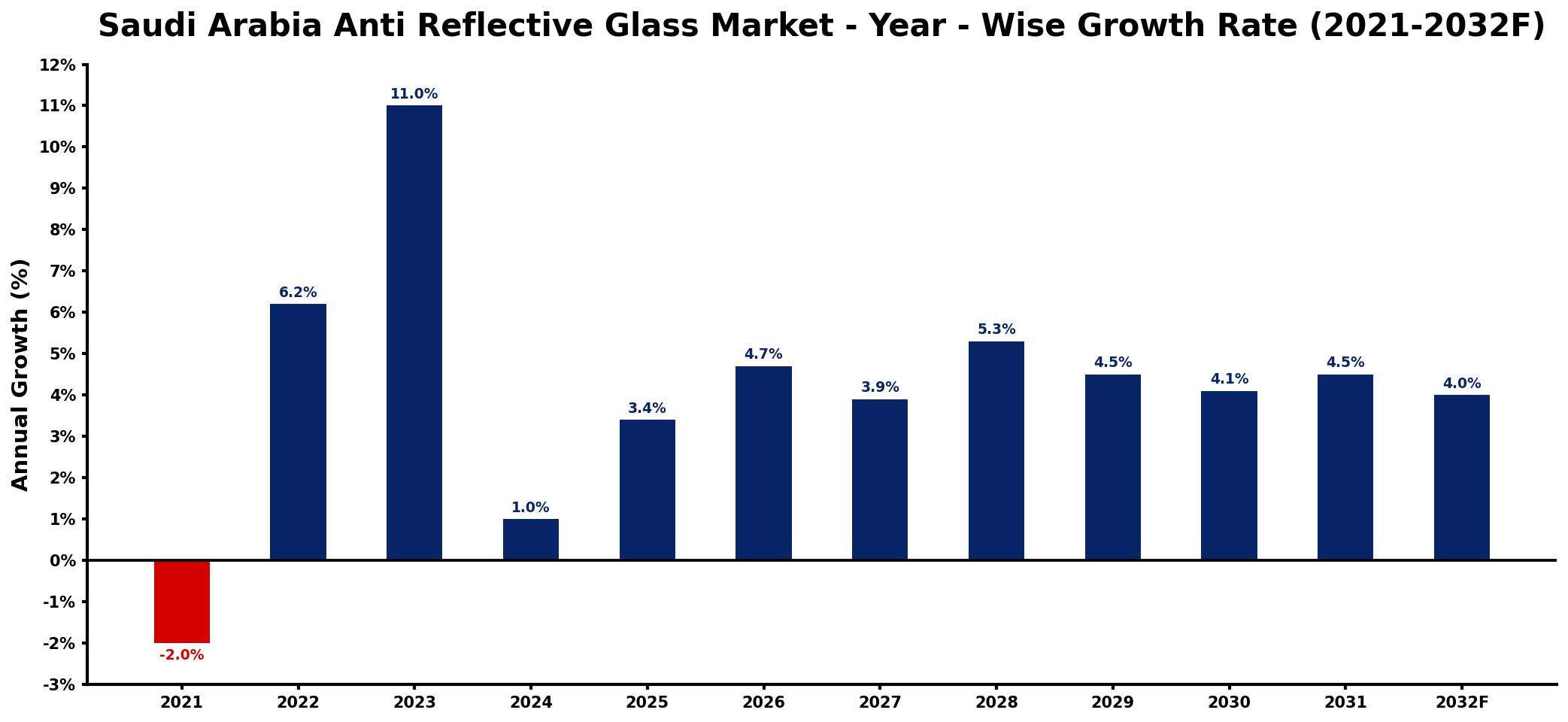
The table below presents the year‑wise growth rates along with the key drivers influencing the market
| Year | Growth Rate | Major Drivers |
| 2021 | -2.0% | Decreased consumer spending on renovations |
| 2022 | 6.2% | Rise in construction sector investments |
| 2023 | 11.0% | Surge in architectural design trends |
| 2024 | 1.0% | Growth in energy efficiency regulations |
| 2025 | 3.4% | Increase in residential building projects |
| 2026 | 4.7% | Expansion of commercial real estate |
| 2027 | 3.9% | Higher demand for sustainable solutions |
| 2028 | 5.3% | Boost in automotive manufacturing needs |
| 2029 | 4.5% | Development of smart building technologies |
| 2030 | 4.1% | Increased focus on environmental standards |
| 2031 | 4.5% | Rising popularity of interior design |
| 2032 | 4.0% | Growing need for enhanced aesthetics |
Note: Market size estimations and growth projections presented in this report are based on 6Wresearch's proprietary forecasting methodology, utilizing the latest available industry data, government publications, and primary research inputs.
Saudi Arabia Anti Reflective Glass Market Synopsis
The anti-reflective glass market in Saudi Arabia is witnessing a surge, driven by the necessity for improved clarity and visual comfort across various sectors. From skyscrapers to sleek automobiles, industries are integrating this innovative glass to combat glare and enhance the viewing experience.
With the rise of modern architectural designs and advancements in display technologies, the demand for anti-reflective glass is on the rise. The ability of this glass to minimize reflection while maximizing light transmission makes it a preferred choice in both functional and aesthetic applications.
Saudi Arabia Anti Reflective Glass Market Key Takeaways
- The market is experiencing steady growth due to increased adoption in architecture and automotive sectors.
- Enhanced clarity and reduced glare are significant factors driving demand.
- Key players in the market are focusing on technological advancements to improve coating durability.
- The market is rebounding post-COVID-19, with a renewed focus on construction and optics.
- Educating consumers on the benefits of anti-reflective glass remains crucial for market expansion.
Evaluation of Restraints in Saudi Arabia Anti Reflective Glass Market
Despite its growth potential, the Saudi Arabia anti-reflective glass market faces specific challenges that can hinder its full development. One of the primary restraints is the durability of the coatings applied to the glass, which can degrade over time, affecting performance. Furthermore, the need for cost-effective production methods poses a barrier for manufacturers looking to expand their market presence. Consumer awareness remains limited, and enhancing education around the advantages of anti-reflective glass is critical for fostering wider acceptance.
Saudi Arabia Anti Reflective Glass Market Trends
Emerging trends in the Saudi Arabia anti-reflective glass market are predominantly driven by technological innovations and sustainability considerations. The industry is witnessing advancements in coating techniques that improve the lifespan and effectiveness of anti-reflective properties. Additionally, a growing focus on energy-efficient buildings is steering interest towards glass solutions that not only enhance visibility but also contribute to overall energy savings. Consumer demand for aesthetically pleasing and functional designs is further propelling the adoption of anti-reflective glass in diverse applications.
Saudi Arabia Anti Reflective Glass Market Opportunities
There are significant growth opportunities in the Saudi Arabia anti-reflective glass market, particularly in sectors such as construction and electronics. As urban development accelerates, the demand for high-performance architectural glass is set to rise. Furthermore, the burgeoning electronics market, characterized by a growing need for superior display technologies, presents new avenues for anti-reflective glass applications. Investing in research and development for more efficient production techniques could also enhance profit margins and market competitiveness.
Government Initiatives in the Saudi Arabia Anti Reflective Glass Market
The Saudi government has initiated several programs aimed at bolstering the construction and manufacturing sectors, which directly impacts the anti-reflective glass market. Policies promoting sustainable building practices and energy efficiency are particularly relevant, as they encourage the use of advanced glass technologies. Increased public spending on infrastructure projects provides a favorable environment for anti-reflective glass solutions, aligning with the Kingdoms broader economic diversification strategies.
Future Insights of the Saudi Arabia Anti Reflective Glass Market
Looking ahead to 2026-2032, the Saudi Arabia anti-reflective glass market is poised for progressive growth. Key factors contributing to this upward trend include the continual expansion of urban areas and the rising demand for high-quality architectural glass in both residential and commercial buildings. The automotive sector's ongoing shift towards innovative designs that incorporate advanced glazing technologies will also support market growth. Furthermore, as consumers become increasingly aware of the benefits of anti-reflective glass, the market is likely to experience enhanced penetration across multiple industries.
Saudi Arabia Anti Reflective Glass Market Latest Developments (2025 - 2026)
Recent developments in the Saudi Arabia anti-reflective glass market indicate a shift toward more sustainable manufacturing practices. Industry players are investing in eco-friendly materials and processes to meet growing regulatory and consumer demand for sustainability. Additionally, collaborations between manufacturers and technology firms are emerging to innovate new coatings that enhance glass performance while reducing production costs. As market dynamics evolve, these strategic movements reflect the industry's commitment to adapting to modern consumer needs.
Saudi Arabia Anti Reflective Glass Market - Key Attractiveness of the Report
- 10 Years of Market Numbers
- Historical Data Starting from 2022 to 2025
- Base Year: 2025
- Forecast Data until 2032
- Key Performance Indicators Impacting the Market
- Major Upcoming Developments and Projects
Key Highlights of the Report:
- Saudi Arabia Anti Reflective Glass Market Outlook
- Market Size of Saudi Arabia Anti Reflective Glass Market, 2025
- Forecast of Saudi Arabia Anti Reflective Glass Market, 2032
- Historical Data and Forecast of Saudi Arabia Anti Reflective Glass Revenues & Volume for the Period 2022-2032F
- Saudi Arabia Anti Reflective Glass Market Trend Evolution
- Saudi Arabia Anti Reflective Glass Market Drivers and Challenges
- Saudi Arabia Anti Reflective Glass Price Trends
- Saudi Arabia Anti Reflective Glass Porter's Five Forces
- Saudi Arabia Anti Reflective Glass Industry Life Cycle
- Historical Data and Forecast of Saudi Arabia Anti Reflective Glass Market Revenues & Volume By Type for the Period 2022-2032F
- Historical Data and Forecast of Saudi Arabia Anti Reflective Glass Market Revenues & Volume By Double Layers for the Period 2022-2032F
- Historical Data and Forecast of Saudi Arabia Anti Reflective Glass Market Revenues & Volume By Four Layers for the Period 2022-2032F
- Historical Data and Forecast of Saudi Arabia Anti Reflective Glass Market Revenues & Volume By Others for the Period 2022-2032F
- Historical Data and Forecast of Saudi Arabia Anti Reflective Glass Market Revenues & Volume By Application for the Period 2022-2032F
- Historical Data and Forecast of Saudi Arabia Anti Reflective Glass Market Revenues & Volume By Architectural Windows for the Period 2022-2032F
- Historical Data and Forecast of Saudi Arabia Anti Reflective Glass Market Revenues & Volume By Instrumentation Windows for the Period 2022-2032F
- Historical Data and Forecast of Saudi Arabia Anti Reflective Glass Market Revenues & Volume By Electronic Displays for the Period 2022-2032F
- Historical Data and Forecast of Saudi Arabia Anti Reflective Glass Market Revenues & Volume By Picture Framing Glass for the Period 2022-2032F
- Historical Data and Forecast of Saudi Arabia Anti Reflective Glass Market Revenues & Volume By Showcase Glass for the Period 2022-2032F
- Historical Data and Forecast of Saudi Arabia Anti Reflective Glass Market Revenues & Volume By Cold Storage Displays for the Period 2022-2032F
- Historical Data and Forecast of Saudi Arabia Anti Reflective Glass Market Revenues & Volume By Lamps Glass for the Period 2022-2032F
- Historical Data and Forecast of Saudi Arabia Anti Reflective Glass Market Revenues & Volume By Others for the Period 2022-2032F
- Saudi Arabia Anti Reflective Glass Import Export Trade Statistics
- Market Opportunity Assessment By Type
- Market Opportunity Assessment By Application
- Saudi Arabia Anti Reflective Glass Top Companies Market Share
- Saudi Arabia Anti Reflective Glass Competitive Benchmarking By Technical and Operational Parameters
- Saudi Arabia Anti Reflective Glass Company Profiles
- Saudi Arabia Anti Reflective Glass Key Strategic Recommendations






































