Saudi Arabia Asphalt Market Summary
The saudi arabia asphalt market was estimated at USD 229 Million in 2025 and is projected to reach USD 294 Million by 2032, growing at a CAGR of 5.1% from 2026 to 2032.
Saudi Arabia Asphalt Market Year-wise Growth Rate and Key Drivers
This graph highlights how the Saudi Arabia Asphalt Market has steadily grown over the past five years, supported by major growth factors.
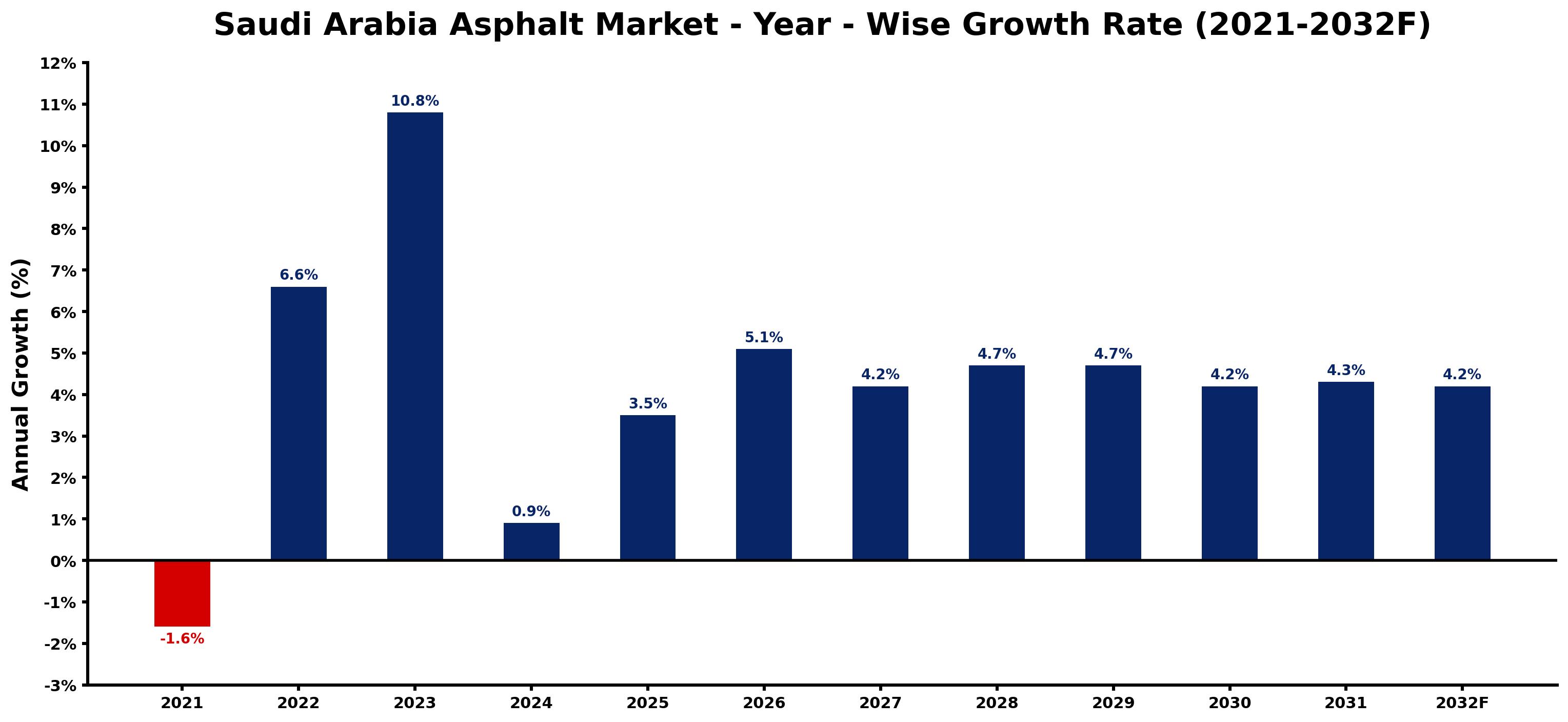
The table below presents the year wise growth rates along with the key drivers influencing the market
| Year | Growth Rate | Major Drivers |
| 2021 | -1.6% | Diminished construction activities due to economic uncertainties hindered asphalt demand in key infrastructure projects. |
| 2022 | 6.6% | Increasing urbanization rates prompted greater demand for durable road construction materials. |
| 2023 | 10.8% | Major construction initiatives, such as Neom, led to heightened asphalt consumption expectations. |
| 2024 | 0.9% | Localized production facilities started emerging to meet rising domestic asphalt requirements. |
| 2025 | 3.5% | Legacy infrastructure renovations created significant opportunities for asphalt suppliers and contractors. |
| 2026 | 5.1% | Emerging green technologies began influencing asphalt production methods and sustainability efforts. |
| 2027 | 4.2% | Growth in residential developments necessitated substantial volumes of asphalt for roadways. |
| 2028 | 4.7% | Regional cooperation initiatives strengthened supply chains across the GCC asphalt market. |
| 2029 | 4.7% | Innovative asphalt formulations attracted attention for their performance in extreme temperatures. |
| 2030 | 4.2% | Corporate budgets shifted towards eco-friendly materials, enhancing sustainable asphalt options. |
| 2031 | 4.3% | Public-private partnerships emerged, facilitating large-scale infrastructure projects across the kingdom. |
| 2032 | 4.2% | Technological advancements in recycling asphalt drew interest from environmental consciousness. |
Note - Market size estimations and growth projections presented in this report are based on 6Wresearch's advanced forecasting approach, validated with industry datasets as of June 2026.
Saudi Arabia Asphalt Market Synopsis
The Saudi Arabia Asphalt Market is projected to reach 5.1% and witness significant growth during the forecast period (2026-2032). Asphalt, commonly referred to as bitumen, is a viscous hydrocarbon that plays a crucial role as a binder in construction materials. Its durability, cost-effectiveness, and ability to enhance structural integrity make it a preferred choice for a variety of construction applications, including roads, bridges, and airport runways.
Saudi Arabia Asphalt Market Growth Drivers
The growth of the Saudi Arabia asphalt market is primarily driven by multiple factors:
- Increasing government spending on infrastructure projects is anticipated to significantly bolster asphalt demand. Major initiatives, such as Vision 2031, aim to modernize the country's infrastructure, thus driving the need for high-quality asphalt.
- The development of transportation networks, including highways and airports, is critical for national growth and economic diversification. This increased emphasis on infrastructure lays the groundwork for sustained asphalt consumption.
- Strategic investments in construction and development projects, as outlined in the National Transformation Program 2025 (NTP 2025), will further stimulate the asphalt market as construction activities escalate.
- Growing urbanization and population expansion necessitate the construction of new roads and public spaces, which will inherently increase the demand for asphalt as a key building material.
- Technological advancements in asphalt production and application are making it easier for companies to adopt innovative solutions that enhance performance and reduce costs, thus driving demand.
Saudi Arabia Asphalt Market Challenges and Restraints
Despite the promising growth prospects, the Saudi Arabia asphalt market faces several challenges:
- Intense competition from alternative materials, such as concrete and polymer-based solutions, poses a significant threat to the asphalt market, as these materials are often perceived as more sustainable.
- The volatility in crude oil prices, a primary raw material for asphalt production, can lead to fluctuations in production costs, directly affecting market stability.
- Logistical and distribution challenges may arise due to the extensive geographic coverage required for asphalt application in large infrastructure projects.
- Environmental concerns regarding the impact of asphalt production on air quality and ecosystems may deter investment and development in certain areas.
- The ongoing influence of the COVID-19 pandemic may continue to affect labor availability and supply chains, thereby hindering the pace of recovery and growth within the market.
Saudi Arabia Asphalt Market Government Investment and Initiatives
The Saudi government is actively investing in various initiatives to bolster the asphalt market. These investments are strategically aligned with national goals aimed at economic diversification and infrastructure enhancement. The Vision 2031 initiative focuses on transforming infrastructure across the Kingdom, leading to increased allocations for highway and airport projects. Furthermore, the NTP 2025 emphasizes major infrastructural developments, ensuring a steady stream of governmental funding to support these projects. Public-private partnerships are also encouraged, allowing for collaborative investment in asphalt production and distribution, thereby enhancing procurement efficiency and reducing costs.
Saudi Arabia Asphalt Market Latest Developments (May 2025 - June 2026)
During the period from May 2025 to June 2026, the Saudi Arabia asphalt market has experienced a phase of adjustment and realignment following the impacts of the COVID-19 pandemic. Market participants began to implement innovative practices to improve labor efficiency and adapt to new health regulations. The reopening of various sectors has initiated a gradual recovery in construction activities, with increased government projects aimed at enhancing infrastructure to meet growing demands. Companies have also focused on sustainable production methods, reflecting a broader global trend toward environmentally-friendly practices within the asphalt industry. The pent-up demand for road and airport construction projects is anticipated to further cement the asphalt market's growth trajectory throughout 2026.
Saudi Arabia Asphalt Market - Key Attractiveness of the Report
- 10 Years of Market Numbers
- Historical Data Starting from 2022 to 2025
- Base Year: 2025
- Forecast Data until 2032
- Key Performance Indicators Impacting the Market
- Major Upcoming Developments and Projects
Key Highlights of the Report:
- Saudi Arabia Asphalt Market Outlook
- Market Size of Saudi Arabia Asphalt Market, 2025
- Forecast of Saudi Arabia Asphalt Market, 2032
- Historical Data and Forecast of Saudi Arabia Asphalt Revenues & Volume for the Period 2022-2032F
- Saudi Arabia Asphalt Market Trend Evolution
- Saudi Arabia Asphalt Market Drivers and Challenges
- Saudi Arabia Asphalt Price Trends
- Saudi Arabia Asphalt Porter's Five Forces
- Saudi Arabia Asphalt Industry Life Cycle
- Historical Data and Forecast of Saudi Arabia Asphalt Market Revenues & Volume By Type for the Period 2022-2032F
- Historical Data and Forecast of Saudi Arabia Asphalt Market Revenues & Volume By Paving Petroleum Asphalt for the Period 2022-2032F
- Historical Data and Forecast of Saudi Arabia Asphalt Market Revenues & Volume By Industrial Petroleum Asphalt for the Period 2022-2032F
- Historical Data and Forecast of Saudi Arabia Asphalt Market Revenues & Volume By Others for the Period 2022-2032F
- Historical Data and Forecast of Saudi Arabia Asphalt Market Revenues & Volume By Application for the Period 2022-2032F
- Historical Data and Forecast of Saudi Arabia Asphalt Market Revenues & Volume By Paving for the Period 2022-2032F
- Historical Data and Forecast of Saudi Arabia Asphalt Market Revenues & Volume By Roofing for the Period 2022-2032F
- Historical Data and Forecast of Saudi Arabia Asphalt Market Revenues & Volume By Others for the Period 2022-2032F
- Saudi Arabia Asphalt Import Export Trade Statistics
- Market Opportunity Assessment By Type
- Market Opportunity Assessment By Application
- Saudi Arabia Asphalt Top Companies Market Share
- Saudi Arabia Asphalt Competitive Benchmarking By Technical and Operational Parameters
- Saudi Arabia Asphalt Company Profiles
- Saudi Arabia Asphalt Key Strategic Recommendations






































