Saudi Arabia Bricks and Blocks Market Summary
The saudi arabia bricks and blocks market was estimated at USD 461 Million in 2025 and is projected to reach USD 587 Million by 2032, growing at a CAGR of 5.2% from 2026 to 2032.
Saudi Arabia Bricks and Blocks Market Year-wise Growth Rate and Key Drivers
This graph highlights how the Saudi Arabia Bricks and Blocks Market has steadily grown over the past five years, supported by major growth factors.
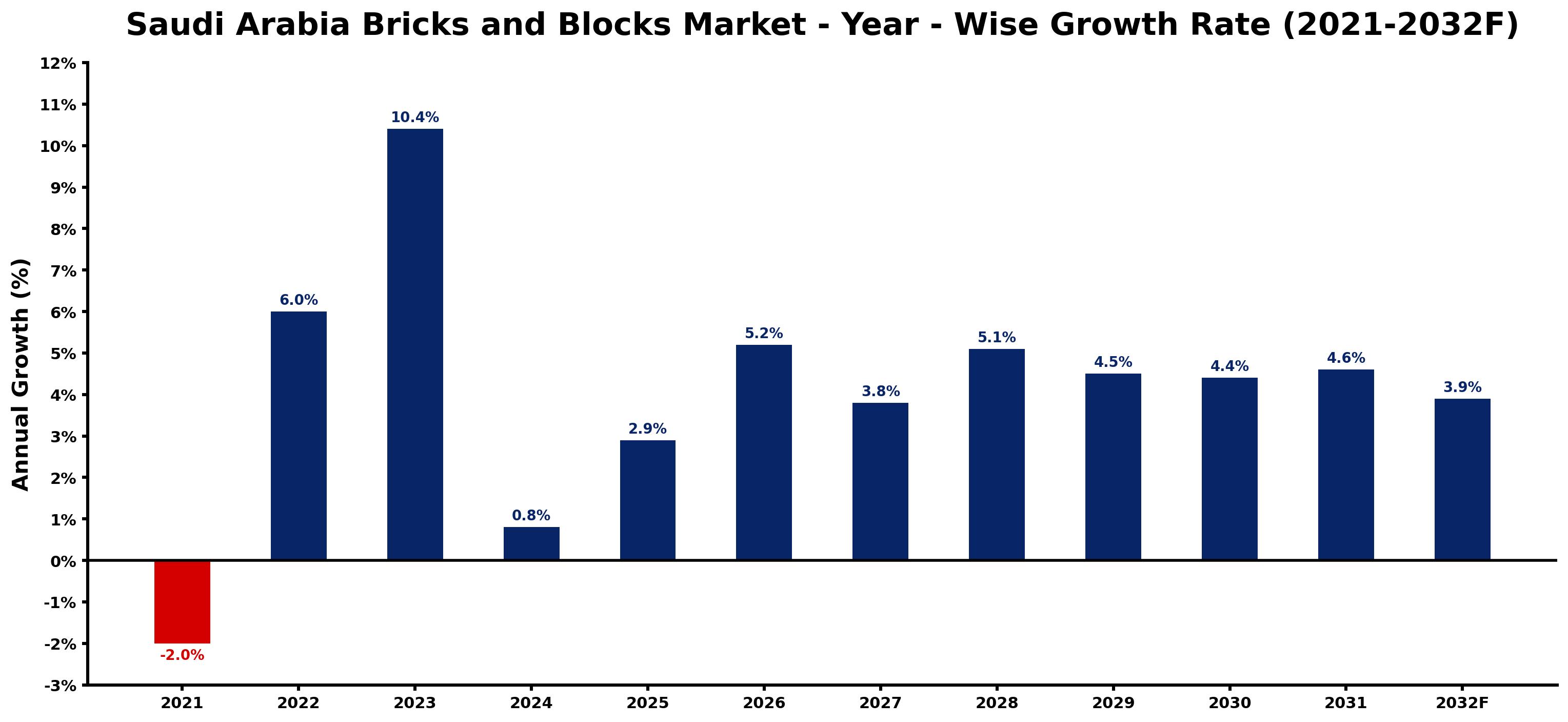
The table below presents the year wise growth rates along with the key drivers influencing the market
| Year | Growth Rate | Major Drivers |
| 2021 | -2.0% | Geopolitical tensions prompted construction project delays, significantly dampening demand for bricks and blocks. |
| 2022 | 6.0% | Major projects within NEOM have accelerated investment in local building materials production. |
| 2023 | 10.4% | High temperatures necessitate innovative thermal insulation in block manufacturing processes. |
| 2024 | 0.8% | Traditional building practices are increasingly challenged by modern construction techniques and materials. |
| 2025 | 2.9% | Shifts toward residential projects indicate a steady increase in brick consumption patterns. |
| 2026 | 5.2% | The adoption of sustainable materials has begun reshaping industry standards and expectations. |
| 2027 | 3.8% | Infrastructure expansions are generating consistent demand for durable and high-quality blocks. |
| 2028 | 5.1% | Collaborations between local firms and international players enhance competitive market dynamics. |
| 2029 | 4.5% | Technological advancements in manufacturing are improving efficiency and reducing production costs. |
| 2030 | 4.4% | Diversification into eco-friendly options is becoming essential for long-term market viability. |
| 2031 | 4.6% | Market entries by startups focusing on innovation are stimulating product development trends. |
| 2032 | 3.9% | Consumer preferences are shifting towards aesthetic and functional benefits in building materials. |
Note - Market size estimations and growth projections presented in this report are based on 6Wresearch's advanced forecasting approach, validated with industry datasets as of June 2026.
Saudi Arabia Bricks and Blocks Market Synopsis
The Saudi Arabia Bricks and Blocks Market is projected to reach 5.2% and witness significant growth during the forecast period (2026-2032). This expansion is underpinned by robust government investments in infrastructure and a burgeoning demand for residential and commercial properties. The rise in urbanization, coupled with a growing population, further intensifies the need for construction materials like bricks and blocks, thus supporting the market's growth trajectory.
Saudi Arabia Bricks and Blocks Market Growth Drivers
Several factors are driving the growth of the Saudi Arabia Bricks and Blocks Market, primarily linked to the construction sector's dynamism. The following are key growth drivers:
- Government Infrastructure Spending: Significant public investments in hospitals, universities, and transport facilities are elevating the demand for bricks and blocks used in construction projects.
- Urbanization Trends: Increased urban migration has led to a higher demand for housing units, stimulating the need for building materials that can cater to the growing population.
- Industrial Expansion: Investments in various industrial sectors have prompted companies to establish new production facilities, thereby boosting the demand for construction materials.
- Job Creation Initiatives: Government initiatives aimed at creating job opportunities are expected to increase consumer spending and housing demand, positively impacting the bricks and blocks market.
- Resilient Economic Recovery: Post-pandemic recovery initiatives are expected to accelerate construction activity, further driving the market for bricks and blocks.
Saudi Arabia Bricks and Blocks Market Challenges and Restraints
While the Saudi Arabia Bricks and Blocks Market presents numerous opportunities, it also faces several challenges that could impede growth:
- Volatility in Oil Prices: As the economy heavily relies on oil revenues, fluctuations in oil prices can significantly impact funding for construction projects, thereby constraining demand for bricks and blocks.
- Economic Dependency: The reliance on a single commodity sector exposes the economy to risks that can lead to project delays or cancellations in construction.
- Supply Chain Disruptions: Issues such as transportation bottlenecks and raw material shortages can affect the timely availability of bricks and blocks, thus hindering market growth.
- Regulatory Compliance: Stricter environmental regulations may impose additional operational costs on manufacturers, impacting the overall market performance.
- Covid-19 Aftereffects: The lingering effects of the pandemic may continue to influence consumer behavior and construction timelines, creating uncertainty in demand projections for bricks and blocks.
Saudi Arabia Bricks and Blocks Market Government Investment and Initiatives
The Saudi government has been instrumental in shaping the Bricks and Blocks Market through various investment initiatives. Key government strategies include:
- Infrastructure Vision 2030: The government's long-term development plan emphasizes diversification away from oil dependency, promoting large-scale infrastructure projects that require substantial amounts of bricks and blocks.
- Public-Private Partnerships: Encouraging collaborations between public entities and private firms enables resource pooling for construction projects, enhancing the overall market potential.
- Subsidies and Incentives: Financial incentives for local manufacturers and builders have been introduced to stimulate production and construction activity, boosting demand for bricks and blocks.
- Urban Development Programs: Initiatives aimed at urban transformation and renovation are actively promoting the construction of new residential and commercial buildings.
- Job Creation Policies: As part of its economic diversification efforts, the government is fostering job creation to stimulate consumer confidence and increase demand for housing.
Saudi Arabia Bricks and Blocks Market Latest Developments (May 2025 - June 2026)
Recent developments in the Saudi Arabia Bricks and Blocks Market reflect ongoing trends and adjustments in response to economic conditions. Critical insights during the May 2025 to June 2026 period include:
- Project Resumption: Following the easing of pandemic restrictions, construction projects have resumed at an accelerated pace, creating an upsurge in demand for bricks and blocks.
- Increased Production Capacity: Key manufacturers within the market are expanding their production facilities to meet the rising demand driven by infrastructure projects and housing needs.
- Innovation in Materials: The introduction of eco-friendly and sustainable building materials has gained traction, reflecting a shift towards more environmentally conscious construction practices.
- Collaboration with International Firms: Strategic partnerships with global firms are being formed to enhance technology transfer and optimize production processes within the local market.
- Focus on Quality Standards: The market is witnessing a growing emphasis on quality assurance, with manufacturers investing in better technologies to produce high-standard bricks and blocks.
Saudi Arabia Bricks and Blocks Market - Key Attractiveness of the Report
- 10 Years of Market Numbers
- Historical Data Starting from 2022 to 2025
- Base Year: 2025
- Forecast Data until 2032
- Key Performance Indicators Impacting the Market
- Major Upcoming Developments and Projects
Key Highlights of the Report:
- Saudi Arabia Bricks and Blocks Market Outlook
- Market Size of Saudi Arabia Bricks and Blocks Market, 2025
- Forecast of Saudi Arabia Bricks and Blocks Market, 2032
- Historical Data and Forecast of Saudi Arabia Bricks and Blocks Revenues & Volume for the Period 2022-2032F
- Saudi Arabia Bricks and Blocks Market Trend Evolution
- Saudi Arabia Bricks and Blocks Market Drivers and Challenges
- Saudi Arabia Bricks and Blocks Price Trends
- Saudi Arabia Bricks and Blocks Porter's Five Forces
- Saudi Arabia Bricks and Blocks Industry Life Cycle
- Historical Data and Forecast of Saudi Arabia Bricks and Blocks Market Revenues & Volume By Type for the Period 2022-2032F
- Historical Data and Forecast of Saudi Arabia Bricks and Blocks Market Revenues & Volume By Clay Bricks for the Period 2022-2032F
- Historical Data and Forecast of Saudi Arabia Bricks and Blocks Market Revenues & Volume By Concrete Bricks and Blocks for the Period 2022-2032F
- Historical Data and Forecast of Saudi Arabia Bricks and Blocks Market Revenues & Volume By Calcium Silicate Bricks for the Period 2022-2032F
- Historical Data and Forecast of Saudi Arabia Bricks and Blocks Market Revenues & Volume By Autoclaved Aerated Concrete for the Period 2022-2032F
- Historical Data and Forecast of Saudi Arabia Bricks and Blocks Market Revenues & Volume By Others for the Period 2022-2032F
- Historical Data and Forecast of Saudi Arabia Bricks and Blocks Market Revenues & Volume By Applications for the Period 2022-2032F
- Historical Data and Forecast of Saudi Arabia Bricks and Blocks Market Revenues & Volume By Building for the Period 2022-2032F
- Historical Data and Forecast of Saudi Arabia Bricks and Blocks Market Revenues & Volume By Path for the Period 2022-2032F
- Historical Data and Forecast of Saudi Arabia Bricks and Blocks Market Revenues & Volume By Parterre for the Period 2022-2032F
- Historical Data and Forecast of Saudi Arabia Bricks and Blocks Market Revenues & Volume By Other for the Period 2022-2032F
- Saudi Arabia Bricks and Blocks Import Export Trade Statistics
- Market Opportunity Assessment By Type
- Market Opportunity Assessment By Applications
- Saudi Arabia Bricks and Blocks Top Companies Market Share
- Saudi Arabia Bricks and Blocks Competitive Benchmarking By Technical and Operational Parameters
- Saudi Arabia Bricks and Blocks Company Profiles
- Saudi Arabia Bricks and Blocks Key Strategic Recommendations






































