Saudi Arabia Cultivator and Tiller Machinery Market Size, Share & Growth Rate
The Saudi Arabia Cultivator and Tiller Machinery Market was estimated at USD 359 Million in 2025 and is projected to reach USD 458 Million by 2032, growing at a CAGR of 3.5% from 2026 to 2032. This growth trajectory is primarily fueled by the governments commitment to enhancing domestic food production and food security, alongside a rising trend toward modern agricultural practices. Increased mechanization and technological adoption in farming are expected to play critical roles in elevating the market's potential.
Saudi Arabia Cultivator and Tiller Machinery Market Year-wise Growth Rate and Key Drivers
This graph highlights how the Saudi Arabia Cultivator and Tiller Machinery Market has steadily grown over the years, supported by major growth factors.
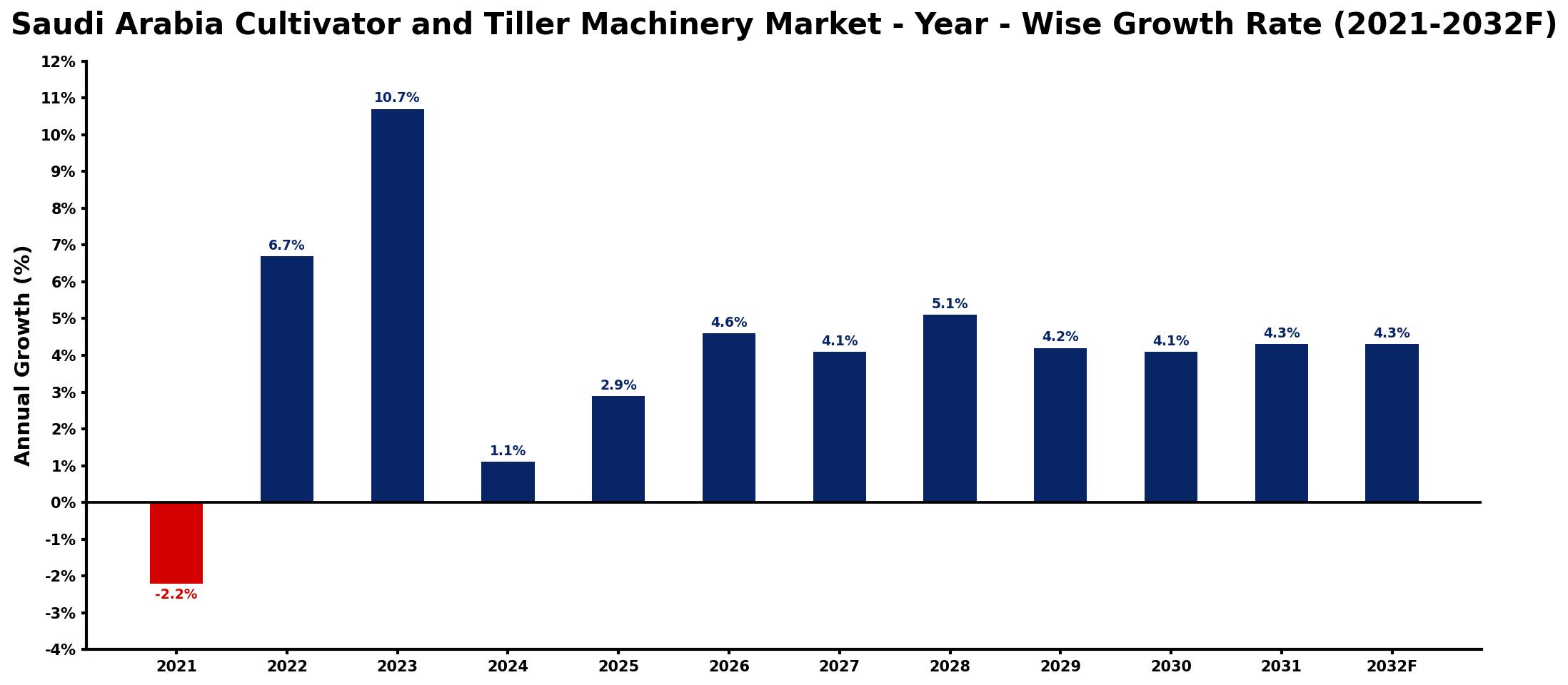
The table below presents the year‑wise growth rates along with the key drivers influencing the market
| Year | Growth Rate | Major Drivers |
| 2021 | -2.2% | decreased agricultural investment activities |
| 2022 | 6.7% | increased demand for automation solutions |
| 2023 | 10.7% | expansion of sustainable farming practices |
| 2024 | 1.1% | growing interest in precision agriculture |
| 2025 | 2.9% | rising farmer income levels |
| 2026 | 4.6% | enhanced government support initiatives |
| 2027 | 4.1% | increased focus on food security |
| 2028 | 5.1% | development of advanced farming technologies |
| 2029 | 4.2% | growing urban agriculture initiatives |
| 2030 | 4.1% | rising adoption of eco-friendly practices |
| 2031 | 4.3% | rising infrastructure development spending |
| 2032 | 4.3% | increased agricultural research funding |
Note: Market size estimations and growth projections presented in this report are based on 6Wresearch's proprietary forecasting methodology, utilizing the latest available industry data, government publications, and primary research inputs.
Saudi Arabia Cultivator and Tiller Machinery Market Synopsis
A significant driver currently shaping the Saudi Arabia cultivator and tiller machinery market is the government's robust initiatives aimed at boosting agricultural productivity. These initiatives focus on expanding the adoption of advanced farming technologies to combat challenges posed by the regions arid climate.
Moreover, the transition towards sustainable and efficient farming practices has increased the demand for versatile machinery that can adapt to various agricultural needs. As more farmers recognize the benefits of mechanization, the market is positioned for a steady upward trajectory.
Saudi Arabia Cultivator and Tiller Machinery Market Key Takeaways
- The market is experiencing a growing adoption of modern farming techniques, driven by government policies.
- Customization and fuel efficiency are becoming vital selling points for new machinery.
- The evolution of precision agriculture technologies is shaping product development in the market.
- Awareness of sustainable practices is prompting shifts in consumer preferences towards efficient machinery.
- Investment opportunities are emerging as small-scale farmers seek government support to upgrade equipment.
Evaluation of Restraints in Saudi Arabia Cultivator and Tiller Machinery Market
Despite its growth potential, the Saudi Arabia cultivator and tiller machinery market faces challenges tied to the region's limited arable land and water scarcity. These factors contribute to a reliance on efficient irrigation systems, making it critical for machinery to be compatible with such technologies. Additionally, historical dependence on oil revenue has hindered substantial investment in agriculture, which may impact the modernization of farming equipment. The initial cost of advanced cultivators and tillers can also pose barriers for many small-scale farmers, indicating a need for supportive government interventions to stimulate market growth.
Saudi Arabia Cultivator and Tiller Machinery Market Trends
Current trends in the Saudi Arabia cultivator and tiller machinery market include a noticeable shift toward the integration of precision farming technologies. These advancements allow farmers to utilize data-driven insights for better yield management and resource allocation. Additionally, there's a growing interest in machines that offer sustainability features, such as reduced fuel consumption and lower carbon footprints. The ongoing push towards smart agriculture is fostering innovation, compelling manufacturers to develop equipment that not only meets the demands of modern farming but also addresses environmental considerations.
Saudi Arabia Cultivator and Tiller Machinery Market Opportunities
There exists a significant opportunity for growth in the Saudi Arabia cultivator and tiller machinery market, particularly through government-supported initiatives aimed at agricultural innovation. Potential investments in research and development for sustainable technologies could lead to breakthroughs in machinery efficiency and performance. Additionally, as the emphasis on food security continues to grow, the demand for machinery that enhances productivity presents a ripe avenue for new entrants and existing manufacturers to capture greater market share.
Government Initiatives in the Saudi Arabia Cultivator and Tiller Machinery Market
The Saudi government has rolled out various policies aimed at enhancing agricultural development and food security. These initiatives include financial incentives for farmers adopting modern machinery, funding for research into sustainable farming practices, and programs focused on increasing arable land through improved irrigation technologies. Such measures are integral to bolstering local food production and facilitating the growth of the cultivator and tiller machinery market.
Future Insights of the Saudi Arabia Cultivator and Tiller Machinery Market
Looking forward, from 2026 to 2032, the Saudi Arabia cultivator and tiller machinery market is poised for continued expansion. Enhanced mechanization and the integration of innovative technologies will be at the forefront of this growth. As agricultural policies adapt to meet the dual goals of increased efficiency and sustainability, market participants will need to innovate and collaborate effectively to stay ahead. Ultimately, the focus on food security will ensure a thriving market environment where demand for advanced agricultural equipment continues to rise.
Saudi Arabia Cultivator and Tiller Machinery Market Latest Developments (2025 - 2026)
Recent trends within the Saudi Arabia cultivator and tiller machinery market indicate a strong pivot towards automation and smart farming solutions. Industry stakeholders are increasingly exploring partnerships that focus on developing cutting-edge technologies to enhance the capabilities of existing machinery. Furthermore, there are signs of rising investment towards creating more efficient supply chains, which aim to improve the availability of machinery and parts, making them more accessible to farmers across the region.
Saudi Arabia Cultivator and Tiller Machinery Market - Key Attractiveness of the Report
- 10 Years of Market Numbers
- Historical Data Starting from 2022 to 2025
- Base Year: 2025
- Forecast Data until 2032
- Key Performance Indicators Impacting the Market
- Major Upcoming Developments and Projects
Key Highlights of the Report:
- Saudi Arabia Cultivator and Tiller Machinery Market Outlook
- Market Size of Saudi Arabia Cultivator and Tiller Machinery Market, 2025
- Forecast of Saudi Arabia Cultivator and Tiller Machinery Market, 2032
- Historical Data and Forecast of Saudi Arabia Cultivator and Tiller Machinery Revenues & Volume for the Period 2022-2032F
- Saudi Arabia Cultivator and Tiller Machinery Market Trend Evolution
- Saudi Arabia Cultivator and Tiller Machinery Market Drivers and Challenges
- Saudi Arabia Cultivator and Tiller Machinery Price Trends
- Saudi Arabia Cultivator and Tiller Machinery Porter's Five Forces
- Saudi Arabia Cultivator and Tiller Machinery Industry Life Cycle
- Historical Data and Forecast of Saudi Arabia Cultivator and Tiller Machinery Market Revenues & Volume By Product Type for the Period 2022-2032F
- Historical Data and Forecast of Saudi Arabia Cultivator and Tiller Machinery Market Revenues & Volume By Cultivators for the Period 2022-2032F
- Historical Data and Forecast of Saudi Arabia Cultivator and Tiller Machinery Market Revenues & Volume By Tillers for the Period 2022-2032F
- Historical Data and Forecast of Saudi Arabia Cultivator and Tiller Machinery Market Revenues & Volume By for the Period 2022-2032F
- Historical Data and Forecast of Saudi Arabia Cultivator and Tiller Machinery Market Revenues & Volume By Application for the Period 2022-2032F
- Historical Data and Forecast of Saudi Arabia Cultivator and Tiller Machinery Market Revenues & Volume By Agriculture for the Period 2022-2032F
- Historical Data and Forecast of Saudi Arabia Cultivator and Tiller Machinery Market Revenues & Volume By Garden for the Period 2022-2032F
- Saudi Arabia Cultivator and Tiller Machinery Import Export Trade Statistics
- Market Opportunity Assessment By Product Type
- Market Opportunity Assessment By Application
- Saudi Arabia Cultivator and Tiller Machinery Top Companies Market Share
- Saudi Arabia Cultivator and Tiller Machinery Competitive Benchmarking By Technical and Operational Parameters
- Saudi Arabia Cultivator and Tiller Machinery Company Profiles
- Saudi Arabia Cultivator and Tiller Machinery Key Strategic Recommendations






































