Saudi Arabia Glass Tiles Market Size, Share & Growth Rate
The Saudi Arabia Glass Tiles Market was estimated at USD 193 Million in 2025 and is projected to reach USD 246 Million by 2032, growing at a CAGR of 3.5% from 2026 to 2032. This growth trajectory is primarily driven by the robust expansion of the construction sector and the increasing preference for modern, luxurious aesthetics in both residential and commercial spaces. Additionally, advancements in manufacturing technology are enhancing the design possibilities and applications of glass tiles, further propelling market demand.
Saudi Arabia Glass Tiles Market Year-wise Growth Rate and Key Drivers
This graph highlights how the Saudi Arabia Glass Tiles Market has steadily grown over the years, supported by major growth factors.
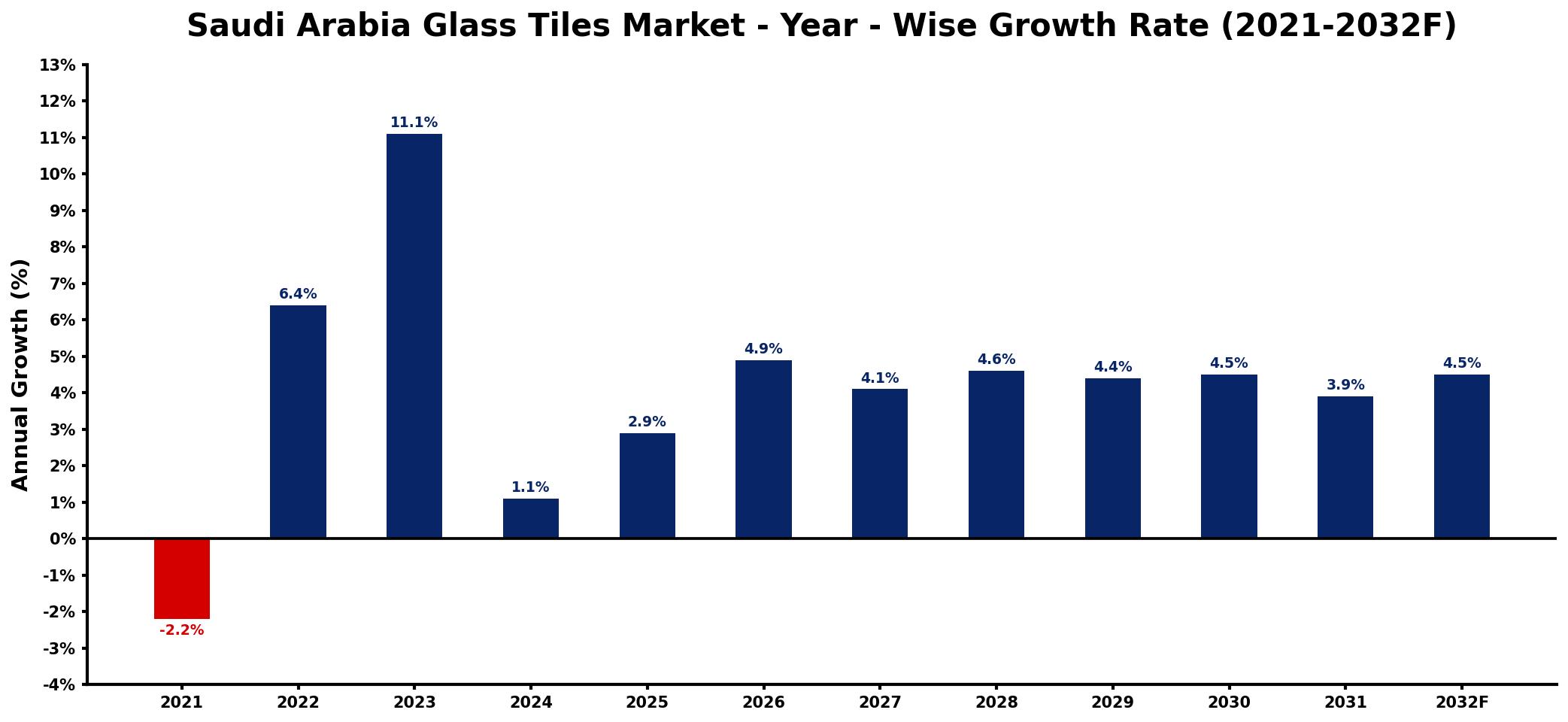
The table below presents the year‑wise growth rates along with the key drivers influencing the market
| Year | Growth Rate | Major Drivers |
| 2021 | -2.2% | construction projects faced delays |
| 2022 | 6.4% | increased residential construction activities |
| 2023 | 11.1% | rising demand for interior design |
| 2024 | 1.1% | growing popularity of sustainable materials |
| 2025 | 2.9% | expansion of luxury housing market |
| 2026 | 4.9% | increased investments in infrastructure |
| 2027 | 4.1% | surge in renovation projects |
| 2028 | 4.6% | growing interest in modern aesthetics |
| 2029 | 4.4% | higher demand for custom designs |
| 2030 | 4.5% | increased production capacity utilization |
| 2031 | 3.9% | rising focus on eco-friendly options |
| 2032 | 4.5% | growth in commercial building sector |
Note: Market size estimations and growth projections presented in this report are based on 6Wresearch's proprietary forecasting methodology, utilizing the latest available industry data, government publications, and primary research inputs.
Saudi Arabia Glass Tiles Market Synopsis
Aesthetic appeal stands as the strongest force shaping the Saudi Arabia Glass Tiles Market today. Homeowners and designers alike are gravitating towards these tiles for their ability to create striking visual statements while also offering durability and ease of maintenance. This trend is particularly prevalent in urban centers, where space optimization and modern design solutions are in high demand.
Furthermore, the hospitality and commercial sectors are increasingly utilizing glass tiles for their reflective qualities, which enhance the perception of space, making them ideal for smaller areas. As the country continues to invest heavily in infrastructure and real estate development, the opportunities for glass tiles to be incorporated into a variety of applications remain abundant.
Saudi Arabia Glass Tiles Market Key Takeaways
- Rapid growth driven by a thriving construction sector focused on modern aesthetics.
- Glass tiles provide a versatile solution for residential, commercial, and hospitality applications.
- Technological advancements are expanding the design and functional capabilities of glass tiles.
- Demand for innovative, sustainable, and energy-efficient tile solutions is on the rise.
- Market players face challenges related to installation complexities and initial costs.
Evaluation of Restraints in Saudi Arabia Glass Tiles Market
Despite the positive outlook, several restraints hinder the broader adoption of glass tiles within the Saudi Arabian market. The initial investment required for glass tiles is typically higher than that for traditional ceramic options, which may deter price-sensitive customers. Moreover, the complexity of installation necessitates skilled labor, and not all contractors possess the expertise needed for such specialized tasks. There are also concerns regarding the long-term durability of glass tiles, as issues like cracking and discoloration can affect consumer confidence. A consistent supply chain for high-quality raw materials, combined with the pressure to innovate and keep pace with changing consumer preferences, poses additional challenges that must be navigated effectively.
Saudi Arabia Glass Tiles Market Trends
Current trends in the Saudi Arabia Glass Tiles Market reflect a growing demand for customized and innovative design solutions. The integration of technology into glass tiles, such as smart features that allow for adjustable transparency, is creating exciting opportunities for architects and designers. Additionally, there is an increasing inclination towards eco-friendly and energy-efficient tile options, driven by heightened environmental awareness among consumers. These trends not only enhance the functionality of glass tiles but also align with the broader sustainability goals being embraced across various industries.
Saudi Arabia Glass Tiles Market Opportunities
The Saudi Arabia Glass Tiles Market presents promising growth opportunities, particularly as urbanization accelerates and infrastructure development intensifies. As demand rises for unique architectural solutions that emphasize light and texture, glass tiles are poised to meet this need effectively. There is also potential for partnerships with interior design firms and construction companies to promote the use of glass tiles in high-profile projects. Furthermore, developing a range of sustainable options, such as tiles made from recycled materials, could resonate strongly with an environmentally conscious consumer base.
Government Initiatives in the Saudi Arabia Glass Tiles Market
The Saudi government is actively promoting initiatives aimed at enhancing the construction and real estate sectors, which subsequently impact the glass tiles market. Public spending on infrastructure projects and new housing developments is on the rise, reflecting the nation's Vision 2030 goals. Additionally, there is support for sustainable building practices, encouraging the adoption of environmentally friendly materials in construction. These initiatives create a favorable environment for the growth and expansion of the glass tiles market, as stakeholders align with government objectives.
Future Insights of the Saudi Arabia Glass Tiles Market
Looking ahead to the period of 2026-2032, the Saudi Arabia Glass Tiles Market is expected to continue its upward trajectory, driven by ongoing innovations and increasing consumer demand for aesthetically pleasing and functional design solutions. As urbanization continues to rise, coupled with an expanding middle class that favors luxury and modern living spaces, the market is well-positioned for growth. The integration of smart technologies and sustainable materials will likely play a crucial role in shaping future developments, providing opportunities for manufacturers and designers to cater to evolving preferences.
Saudi Arabia Glass Tiles Market Latest Developments (2025 - 2026)
In the recent months leading into mid-2026, the Saudi Arabia Glass Tiles Market has seen a surge in innovative product launches focused on sustainability and technological integration. Companies are investing in research and development to introduce smart glass tiles with features that appeal to both aesthetic and functional needs. Additionally, there is a notable shift towards collaborative projects with architects and designers to ensure that the offerings align with modern design trends, thereby enhancing market competitiveness.
Saudi Arabia Glass Tiles Market - Key Attractiveness of the Report
- 10 Years of Market Numbers
- Historical Data Starting from 2022 to 2025
- Base Year: 2025
- Forecast Data until 2032
- Key Performance Indicators Impacting the Market
- Major Upcoming Developments and Projects
Key Highlights of the Report:
- Saudi Arabia Glass Tiles Market Outlook
- Market Size of Saudi Arabia Glass Tiles Market, 2025
- Forecast of Saudi Arabia Glass Tiles Market, 2032
- Historical Data and Forecast of Saudi Arabia Glass Tiles Revenues & Volume for the Period 2022-2032F
- Saudi Arabia Glass Tiles Market Trend Evolution
- Saudi Arabia Glass Tiles Market Drivers and Challenges
- Saudi Arabia Glass Tiles Price Trends
- Saudi Arabia Glass Tiles Porter's Five Forces
- Saudi Arabia Glass Tiles Industry Life Cycle
- Historical Data and Forecast of Saudi Arabia Glass Tiles Market Revenues & Volume By Manufacturing Process for the Period 2022-2032F
- Historical Data and Forecast of Saudi Arabia Glass Tiles Market Revenues & Volume By Smalti Tiles for the Period 2022-2032F
- Historical Data and Forecast of Saudi Arabia Glass Tiles Market Revenues & Volume By Fused Tiles for the Period 2022-2032F
- Historical Data and Forecast of Saudi Arabia Glass Tiles Market Revenues & Volume By Sintered Tiles for the Period 2022-2032F
- Historical Data and Forecast of Saudi Arabia Glass Tiles Market Revenues & Volume By Cast Tiles for the Period 2022-2032F
- Historical Data and Forecast of Saudi Arabia Glass Tiles Market Revenues & Volume By Other for the Period 2022-2032F
- Historical Data and Forecast of Saudi Arabia Glass Tiles Market Revenues & Volume By Product Type for the Period 2022-2032F
- Historical Data and Forecast of Saudi Arabia Glass Tiles Market Revenues & Volume By Matte-finished Glass Tile for the Period 2022-2032F
- Historical Data and Forecast of Saudi Arabia Glass Tiles Market Revenues & Volume By Smooth Glass Tile for the Period 2022-2032F
- Historical Data and Forecast of Saudi Arabia Glass Tiles Market Revenues & Volume By End-User Industry for the Period 2022-2032F
- Historical Data and Forecast of Saudi Arabia Glass Tiles Market Revenues & Volume By Residential for the Period 2022-2032F
- Historical Data and Forecast of Saudi Arabia Glass Tiles Market Revenues & Volume By Commercial for the Period 2022-2032F
- Historical Data and Forecast of Saudi Arabia Glass Tiles Market Revenues & Volume By Infrastructure for the Period 2022-2032F
- Saudi Arabia Glass Tiles Import Export Trade Statistics
- Market Opportunity Assessment By Manufacturing Process
- Market Opportunity Assessment By Product Type
- Market Opportunity Assessment By End-User Industry
- Saudi Arabia Glass Tiles Top Companies Market Share
- Saudi Arabia Glass Tiles Competitive Benchmarking By Technical and Operational Parameters
- Saudi Arabia Glass Tiles Company Profiles
- Saudi Arabia Glass Tiles Key Strategic Recommendations






































