Saudi Arabia IoT(Internet of Things) in Oil and Gas Market Size, Share & Growth Rate
The Saudi Arabia IoT(Internet of Things) in Oil and Gas Market was estimated at USD 234 Million in 2025 and is projected to reach USD 299 Million by 2032, growing at a CAGR of 3.6% from 2026 to 2032. This growth trajectory is propelled by the urgent need for enhanced operational efficiency and safety within the oil and gas sector. As companies adopt IoT technologies to facilitate predictive maintenance, real-time monitoring, and improved asset management, we see a significant shift towards digital transformation aligned with Industry 4.0 principles.
Saudi Arabia IoT(Internet of Things) in Oil and Gas Market Year-wise Growth Rate and Key Drivers
This graph highlights how the Saudi Arabia IoT(Internet of Things) in Oil and Gas Market has steadily grown over the years, supported by major growth factors.
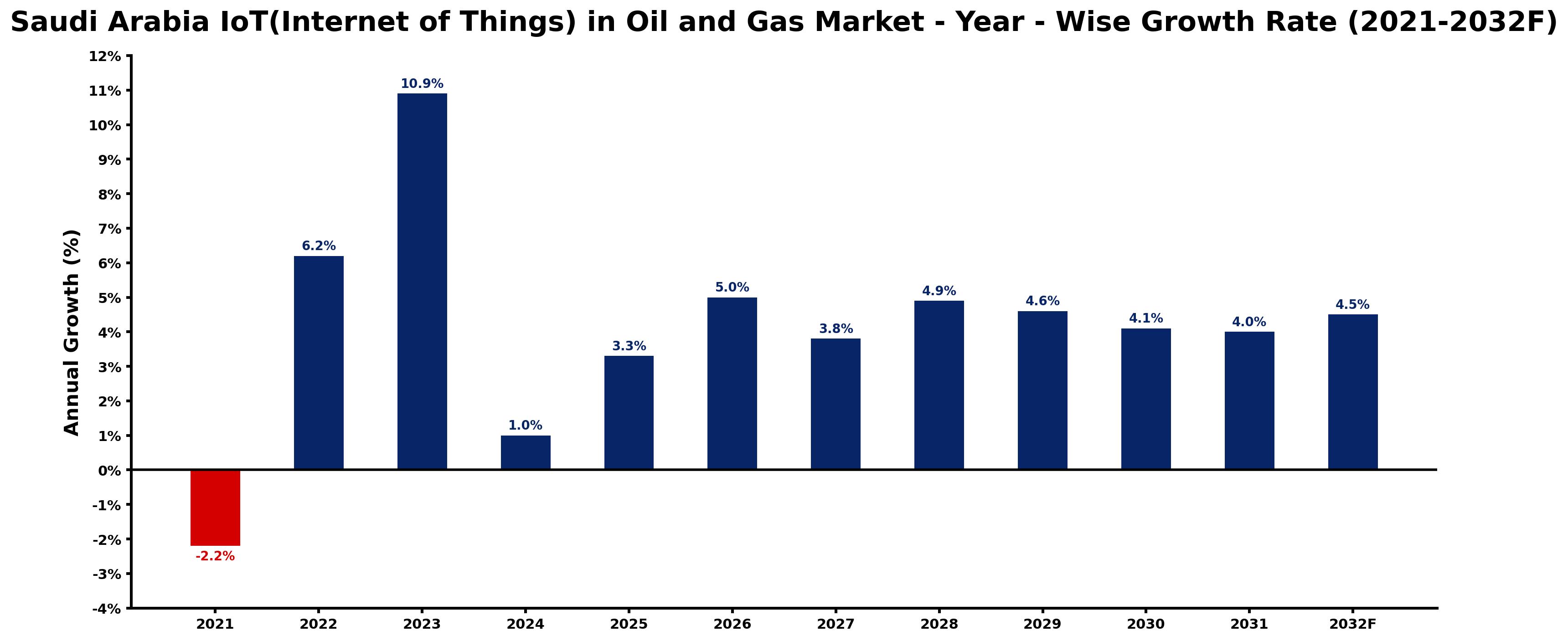
The table below presents the year‑wise growth rates along with the key drivers influencing the market
| Year | Growth Rate | Major Drivers |
| 2021 | -2.2% | Expansion of manufacturing activities |
| 2022 | 6.2% | Increasing industrial infrastructure investments |
| 2023 | 10.9% | Expansion of transportation and logistics networks |
| 2024 | 1.0% | Increasing industrial automation investments |
| 2025 | 3.3% | Government infrastructure modernization initiatives |
| 2026 | 5.0% | Rapid growth in telecom and data center sectors |
| 2027 | 3.8% | Growing renewable energy integration projects |
| 2028 | 4.9% | Rapid growth in telecom and data center sectors |
| 2029 | 4.6% | Increasing adoption of advanced technologies |
| 2030 | 4.1% | Increasing adoption of advanced technologies |
| 2031 | 4.0% | Rising electricity demand across industries |
| 2032 | 4.5% | Expansion of commercial construction activities |
Note - Market size estimations and growth projections presented in this report are based on 6Wresearch's advanced forecasting approach, validated with industry datasets as of June 2026.
Saudi Arabia IoT(Internet of Things) in Oil and Gas Market Synopsis
The demand for IoT solutions in Saudi Arabia's oil and gas industry is soaring, driven by the vast geographical spread of operations. This necessitates sophisticated remote monitoring and control capabilities, allowing companies to manage assets efficiently across diverse locations. As a result, the industry is increasingly adopting advanced IoT solutions for real-time data analytics and decision-making.
Furthermore, regulatory pressures related to environmental compliance and safety are fostering investment in IoT technologies. Companies recognize that these digital tools not only enhance operational performance but also help in adhering to stringent environmental regulations, thereby reducing the overall impact on the environment.
Saudi Arabia IoT(Internet of Things) in Oil and Gas Market Key Takeaways
- The market is projected to grow significantly, emphasizing the transformative role of IoT in operational efficiency.
- Real-time monitoring and predictive maintenance capabilities are crucial for reducing downtime and optimizing resource allocation.
- Increased safety through early detection of potential issues showcases the integral role of IoT solutions.
- Regulatory compliance and environmental considerations are driving further adoption of IoT technologies.
- Challenges such as cybersecurity risks and integration with legacy systems remain key considerations for stakeholders.
Evaluation of Restraints in Saudi Arabia IoT(Internet of Things) in Oil and Gas Market
Despite its promising growth, the Saudi Arabia IoT in Oil and Gas Market faces several restraints. Chief among these are cybersecurity threats, which have become increasingly pronounced with the rise of interconnected devices and data-sharing practices. Protecting sensitive operational data is paramount as the industry becomes more reliant on digital infrastructure. Moreover, the integration of IoT technologies with existing legacy systems can be a daunting task, requiring significant investment in both time and resources. This complexity often delays the transition to modernized operational frameworks, hindering the full realization of IoT benefits.
Saudi Arabia IoT(Internet of Things) in Oil and Gas Market Trends
Several key trends are shaping the Saudi Arabia IoT in Oil and Gas Market. The ongoing digital transformation in the industry highlights a growing reliance on automation and data analytics. There is also an increasing focus on using IoT for sustainability, driven by the need for reduced environmental impacts and adherence to regulations. Moreover, the COVID-19 pandemic has accelerated the adoption of remote monitoring solutions, emphasizing the importance of operational resilience through digital tools.
Saudi Arabia IoT(Internet of Things) in Oil and Gas Market Opportunities
Investment opportunities abound in the Saudi Arabia IoT in Oil and Gas Market, particularly for solutions that enhance automation and predictive analytics. The push towards Industry 4.0 presents avenues for companies to innovate in areas like asset tracking and maintenance optimization. Furthermore, partnerships between technology providers and oil and gas firms can yield collaborative solutions that address specific operational challenges, leading to more customized implementations of IoT technologies.
Government Initiatives in the Saudi Arabia IoT(Internet of Things) in Oil and Gas Market
The Saudi government is actively promoting the adoption of IoT technologies within the oil and gas sector. Various initiatives are focused on fostering innovation, supporting digital transformation, and enhancing operational efficiency. Policies aimed at encouraging public-private partnerships are paving the way for investments in IoT infrastructure. Additionally, strategic programs are being developed to enhance skills and knowledge related to IoT technologies among industry professionals.
Future Insights of the Saudi Arabia IoT(Internet of Things) in Oil and Gas Market
Looking ahead to 2026-2032, the Saudi Arabia IoT in Oil and Gas Market is poised for significant evolution. As technological advancements continue to emerge, companies will increasingly adopt IoT solutions for enhanced operational efficiency and predictive capabilities. The focus on sustainability and regulatory compliance will drive further investments in these technologies, making IoT an indispensable component of the industry's future landscape. As market players navigate challenges related to cybersecurity and integration, those who successfully innovate will capitalize on the growth potential of this dynamic market.
Saudi Arabia IoT(Internet of Things) in Oil and Gas Market Latest Developments (May 2025 - June 2026)
Recent developments within the Saudi Arabia IoT in Oil and Gas Market reflect a strong trend towards enhanced technological integration. Companies are exploring collaborative efforts to improve data analytics capabilities and enhance cybersecurity measures. Additionally, there has been a noticeable uptick in pilot projects focusing on advanced monitoring solutions, aimed at driving operational efficiencies and cost reductions across various segments of the oil and gas value chain.
Saudi Arabia IoT(Internet of Things) in Oil and Gas Market - Key Attractiveness of the Report
- 10 Years of Market Numbers
- Historical Data Starting from 2022 to 2025
- Base Year: 2025
- Forecast Data until 2032
- Key Performance Indicators Impacting the Market
- Major Upcoming Developments and Projects
Key Highlights of the Report:
- Saudi Arabia IoT(Internet of Things) in Oil and Gas Market Outlook
- Market Size of Saudi Arabia IoT(Internet of Things) in Oil and Gas Market, 2025
- Forecast of Saudi Arabia IoT(Internet of Things) in Oil and Gas Market, 2032
- Historical Data and Forecast of Saudi Arabia IoT(Internet of Things) in Oil and Gas Revenues & Volume for the Period 2022-2032F
- Saudi Arabia IoT(Internet of Things) in Oil and Gas Market Trend Evolution
- Saudi Arabia IoT(Internet of Things) in Oil and Gas Market Drivers and Challenges
- Saudi Arabia IoT(Internet of Things) in Oil and Gas Price Trends
- Saudi Arabia IoT(Internet of Things) in Oil and Gas Porter's Five Forces
- Saudi Arabia IoT(Internet of Things) in Oil and Gas Industry Life Cycle
- Historical Data and Forecast of Saudi Arabia IoT(Internet of Things) in Oil and Gas Market Revenues & Volume By Solution for the Period 2022-2032F
- Historical Data and Forecast of Saudi Arabia IoT(Internet of Things) in Oil and Gas Market Revenues & Volume By Sensing for the Period 2022-2032F
- Historical Data and Forecast of Saudi Arabia IoT(Internet of Things) in Oil and Gas Market Revenues & Volume By Communication for the Period 2022-2032F
- Historical Data and Forecast of Saudi Arabia IoT(Internet of Things) in Oil and Gas Market Revenues & Volume By Cloud and Edge Computing for the Period 2022-2032F
- Historical Data and Forecast of Saudi Arabia IoT(Internet of Things) in Oil and Gas Market Revenues & Volume By Data Management for the Period 2022-2032F
- Historical Data and Forecast of Saudi Arabia IoT(Internet of Things) in Oil and Gas Market Revenues & Volume By Application for the Period 2022-2032F
- Historical Data and Forecast of Saudi Arabia IoT(Internet of Things) in Oil and Gas Market Revenues & Volume By Fleet and Asset Management for the Period 2022-2032F
- Historical Data and Forecast of Saudi Arabia IoT(Internet of Things) in Oil and Gas Market Revenues & Volume By Preventive Maintenance for the Period 2022-2032F
- Historical Data and Forecast of Saudi Arabia IoT(Internet of Things) in Oil and Gas Market Revenues & Volume By Security Management for the Period 2022-2032F
- Historical Data and Forecast of Saudi Arabia IoT(Internet of Things) in Oil and Gas Market Revenues & Volume By Pipeline Monitoring for the Period 2022-2032F
- Historical Data and Forecast of Saudi Arabia IoT(Internet of Things) in Oil and Gas Market Revenues & Volume By Others for the Period 2022-2032F
- Historical Data and Forecast of Saudi Arabia IoT(Internet of Things) in Oil and Gas Market Revenues & Volume By Industry Stream for the Period 2022-2032F
- Historical Data and Forecast of Saudi Arabia IoT(Internet of Things) in Oil and Gas Market Revenues & Volume By Upstream for the Period 2022-2032F
- Historical Data and Forecast of Saudi Arabia IoT(Internet of Things) in Oil and Gas Market Revenues & Volume By Midstream for the Period 2022-2032F
- Historical Data and Forecast of Saudi Arabia IoT(Internet of Things) in Oil and Gas Market Revenues & Volume By Downstream for the Period 2022-2032F
- Saudi Arabia IoT(Internet of Things) in Oil and Gas Import Export Trade Statistics
- Market Opportunity Assessment By Solution
- Market Opportunity Assessment By Application
- Market Opportunity Assessment By Industry Stream
- Saudi Arabia IoT(Internet of Things) in Oil and Gas Top Companies Market Share
- Saudi Arabia IoT(Internet of Things) in Oil and Gas Competitive Benchmarking By Technical and Operational Parameters
- Saudi Arabia IoT(Internet of Things) in Oil and Gas Company Profiles
- Saudi Arabia IoT(Internet of Things) in Oil and Gas Key Strategic Recommendations






































